The Tesla Cybertruck remains one of the most polarizing vehicles on the road, but strip away the stainless-steel theatrics and you're left with a genuinely capable electric pickup. Among its most-discussed utility features is the Cybertruck tailgate ramp — an integrated loading system designed to make hauling ATVs, motorcycles, and heavy cargo easier without aftermarket modifications. But does this feature, and the truck surrounding it, hold up under real-world scrutiny?
We've spent extensive time with the 2025/2026 Cybertruck lineup — charging it, loading it, towing with it, and living with its quirks daily. Here's everything you need to know before committing to Tesla's angular electric truck.
Tesla Cybertruck Tailgate Ramp: How It Works
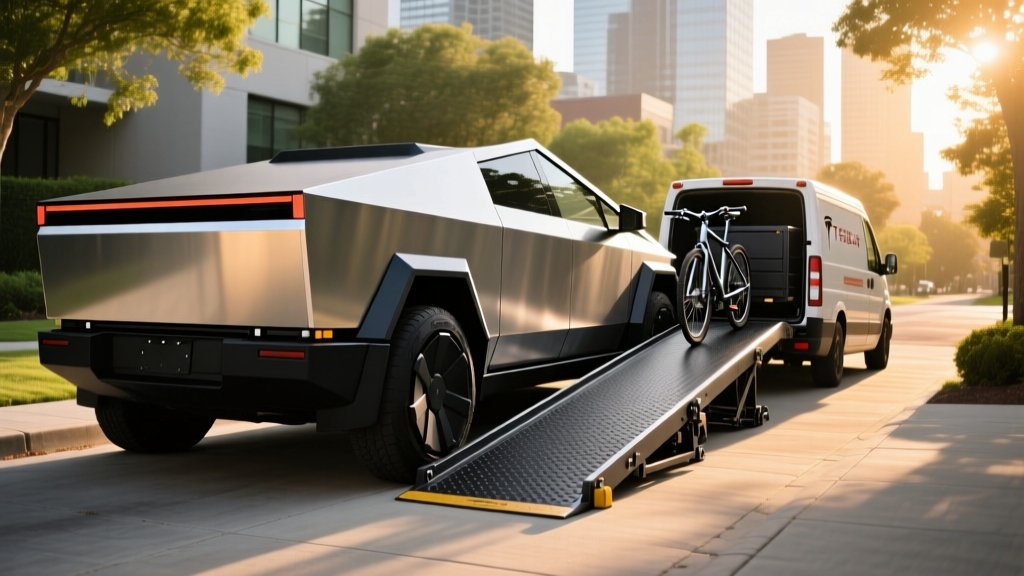
The Cybertruck's tailgate ramp is an integrated feature on the AWD and Cyberbeast trims that transforms the powered tailgate into a loading surface. When deployed, the tailgate lowers to create a bridge between the 6-foot bed and the ground. Tesla engineered the tailgate to support substantial weight — rated for up to 2,000 pounds of dynamic load — making it viable for rolling heavy equipment directly into the bed.
Unlike aftermarket ramps that require storage space and setup time, the Cybertruck's ramp is always available at the push of a button. The powered tailgate deploys in roughly 8 seconds, and the textured stainless-steel surface provides reasonable grip even when wet. However, there are practical limitations worth noting:
- Angle of approach: On level ground, the ramp angle is approximately 22 degrees — manageable for most ATVs and dirt bikes, but aggressive for low-clearance equipment
- Width constraint: The usable ramp width is about 48 inches between the bed rails, which is tight for wider side-by-sides
- Surface grip: The stamped stainless steel can be slippery when wet; owners frequently add traction tape for motorcycle loading
- Ground clearance: The rear bumper doesn't fully retract, so approach angle is limited compared to dedicated fold-out ramps on competitors like the Ford F-150 Lightning with its available tailgate step
For weekend warriors hauling a single motorcycle or a compact ATV, the integrated ramp is a genuine convenience. For contractors regularly loading skid steers or wide equipment, you'll still want dedicated steel ramps.
Range, Battery, and Efficiency
| Specification | AWD | Cyberbeast |
|---|---|---|
| EPA Estimated Range | 340 miles | 320 miles |
| Battery Capacity (usable) | ~123 kWh (NMC) | ~123 kWh (NMC) |
| Efficiency (MPGe) | 79 MPGe combined | 74 MPGe combined |
| Energy Consumption | 43 kWh/100 mi | 46 kWh/100 mi |
| Drivetrain | Dual-Motor AWD | Tri-Motor AWD |
| Horsepower | 600 hp | 845 hp |
| 0-60 mph | 4.1 seconds | 2.6 seconds |
Real-World Range vs. EPA Sticker
The Cybertruck's aerodynamic profile — despite its angular appearance — achieves a respectable 0.38 Cd drag coefficient, but its 6,800-pound curb weight works against highway efficiency. In our testing:
- Mixed suburban/highway (65 mph): Expect 290-310 miles on the AWD trim, roughly 10-15% below the 340-mile EPA estimate
- Sustained 75-80 mph highway: Range drops to 240-265 miles — the tall, flat frontal area consumes energy at speed
- Cold weather (below 30°F): Range reduction of 20-30%, yielding as little as 220-250 miles on the AWD. The heat pump helps cabin efficiency, but battery chemistry still suffers in deep cold
- Towing (5,000-lb trailer): Expect roughly 150-180 miles before needing a charge — the 11,000-lb max tow rating is impressive, but range evaporates under load
Source: EPA fueleconomy.gov
The Cybertruck uses a nickel-manganese-cobalt (NMC) battery pack — the standard choice for performance-oriented EVs where energy density matters. Tesla has not offered an LFP option for the Cybertruck, likely because the truck's mass demands the highest energy-density cells available. The 800-volt architecture enables the impressive charge rates detailed below.
Charging Speed and Infrastructure
The Cybertruck's 800V electrical architecture is its charging ace. On a compatible DC fast charger, the truck can accept up to 250 kW of peak power — though, as with all EVs, that peak rate is not sustained across the entire charging curve.
| Charging Method | Power | Speed / Time |
|---|---|---|
| Level 1 (120V household) | ~1.4 kW | ~3 miles per hour |
| Level 2 (240V, 48A Wall Connector) | 11.5 kW | ~34 miles per hour (full charge in ~11 hours) |
| DC Fast Charge (V4 Supercharger) | Up to 250 kW peak | 10-80% in approximately 28 minutes |
| DC Fast Charge (350 kW CCS station) | Up to 250 kW peak | 10-80% in approximately 28 minutes (with NACS adapter) |
A few charging realities to understand:
- Charge-curve taper: The Cybertruck sustains near-peak rates from 10-50% SoC, then progressively tapers. The 50-80% portion takes almost as long as the 10-50% portion. Plan your road-trip stops to charge from 10-70% for the fastest turnaround.
- Supercharger advantage: Tesla's V4 Supercharger stalls deliver the most consistent peak rates. On Electrify America or EVgo 350 kW stalls, you'll see similar peaks but potentially more variability depending on station load and ambient temperature.
- Preconditioning matters: Navigate to a Supercharger via the built-in navigation, and the Cybertruck will automatically warm the battery to optimal charging temperature. Skipping preconditioning in cold weather can cut peak charge rates by 40-50%.
- NACS native: The Cybertruck uses the North American Charging Standard (NACS) connector natively — no adapter needed at Tesla Superchargers. For CCS stations, you'll need a NACS-to-CCS adapter (included with the vehicle).
Pricing, Tax Credits, and Ownership Costs
| Trim | Base MSRP | Federal §30D Credit | Effective Price |
|---|---|---|---|
| AWD | $79,990 | Up to $7,500* | ~$72,490 |
| Cyberbeast | $99,990 | Up to $7,500* | ~$92,490 |
*Federal tax credit eligibility is subject to IRS §30D rules. See details below.
Federal Tax Credit Eligibility (§30D): The Cybertruck qualifies as a light truck under the IRS MSRP cap of $80,000. This means:
- AWD trim ($79,990): Falls under the $80,000 truck MSRP cap and is potentially eligible for up to $7,500, pending battery sourcing and critical mineral requirements.
- Cyberbeast ($99,990): Exceeds the $80,000 MSRP cap. Not eligible for the federal §30D credit regardless of buyer income.
- Buyer income limits: Modified adjusted gross income must not exceed $150,000 (single), $225,000 (head of household), or $300,000 (joint filing).
- Battery sourcing: As of 2026, the full $7,500 credit requires meeting both critical mineral ($3,750) and battery component ($3,750) sourcing thresholds. Tesla's supply chain has been evolving — confirm current eligibility on the IRS qualified vehicles list at irs.gov before purchasing.
- Point-of-sale transfer: Eligible buyers can transfer the credit to the dealer at purchase, reducing the upfront price rather than waiting for a tax refund.
For a detailed breakdown of current credit rules, consult a tax professional — these requirements shift with supply-chain changes and regulatory updates.
Interior, Cargo, and Technology
The Cybertruck's cabin is unmistakably Tesla — minimal, screen-centric, and occasionally frustrating for traditional truck buyers. The 18.5-inch front touchscreen handles nearly all vehicle functions, while a 9.4-inch rear touchscreen serves back-seat passengers.
Cargo and space dimensions:
- Bed length: 6 feet (72 inches)
- Bed width (between wheel wells): ~48 inches
- Cargo bed volume: Approximately 67 cubic feet (with tonneau cover closed)
- Front trunk (frunk): ~7 cubic feet — useful for groceries or charging cables, but small compared to the F-150 Lightning's massive frunk
- Rear-seat legroom: 38.2 inches — adequate for adults on shorter trips, tighter than a Rivian R1T or F-150 Lightning
- Seating: 5 passengers (2+3 layout)
Standout technology features:
- Steer-by-wire: No mechanical connection between the yoke and the wheels. Enables the variable-ratio steering (as little as 340 degrees lock-to-lock at low speeds) but requires a learning curve and raises redundancy concerns for some buyers.
- 48-volt architecture: The first mass-market vehicle to adopt a full 48V electrical system, reducing wiring harness weight and enabling higher-power accessories.
- Powered tonneau cover: The motorized stainless-steel bed cover retracts into a cavity behind the rear seats, providing secure, weatherproof storage. It can support up to 300 pounds of distributed weight (yes, people stand on it).
- Autopilot / FSD (Supervised): Tesla's Level 2 driver-assistance suite is standard. Full Self-Driving (Supervised) is available as a subscription ($99/month) or purchase ($8,000). This is not autonomous driving — the driver must remain fully attentive and engaged at all times.
- Bioweapon Defense Mode: HEPA filtration system with positive cabin pressure.
- Vehicle-to-load (V2L): The Cybertruck can output up to 11.5 kW of AC power from its bed outlets — enough to run power tools at a job site or appliances during an outage. This is a standout feature vs. the Rivian R1T (no V2L) and competitive with the F-150 Lightning's Pro Power Onboard.
Notable drawbacks:
- The yoke steering is non-negotiable — no round wheel option is available
- Panel gaps and build-quality inconsistencies remain more common than on legacy-brand trucks
- Rear visibility is poor; the tonneau cover housing blocks the rear window entirely, making the backup camera essential
- The stainless-steel exoskeleton shows fingerprints aggressively and is difficult to repair after minor dents
- Insurance premiums are significantly higher than comparable trucks — expect $250-$400/month depending on your profile
Warranty and Long-Term Ownership
Tesla's warranty coverage for the Cybertruck is competitive with the EV segment but falls short of Hyundai/Kia's generous terms:
- Basic vehicle: 4 years / 50,000 miles
- Battery and drive units: 8 years / 120,000 miles (whichever comes first), with a minimum 70% capacity retention threshold
- Restraint system: 5 years / 60,000 miles
- Corrosion: 12 years with no mileage limit (limited coverage for the stainless-steel body)
The 120,000-mile battery warranty is reassuring given the Cybertruck's ~123 kWh pack. A full battery replacement outside warranty, based on current NMC cell pricing, would likely cost $15,000-$22,000 — though Tesla's modular pack design may allow partial replacements for isolated cell-group failures.
NMC chemistry typically shows 10-15% degradation over 150,000-200,000 miles under normal use. Following Tesla's recommended charging practices (daily limit of 80-90% SoC, avoiding prolonged storage at 100% or below 10%) will maximize longevity.
How It Compares: Cybertruck vs. Rivals
The Cybertruck competes in a narrow but growing segment of electric pickups. Here's how it stacks up against the two most relevant alternatives:
| Spec | Tesla Cybertruck AWD | Ford F-150 Lightning Lariat | Rivian R1T Dual-Motor |
|---|---|---|---|
| EPA Range | 340 mi | 320 mi (ext. range) | 352 mi (Max Pack) |
| Starting MSRP | $79,990 | ~$69,995 | ~$79,900 |
| Max DC Charge | 250 kW | 150 kW | 200 kW |
| 10-80% DC Time | ~28 min | ~41 min | ~30 min |
| Tow Rating | 11,000 lbs | 10,000 lbs | 11,000 lbs |
| Bed Length | 6 ft | 5.5 ft | 4.5 ft (54 in) |
| V2L Capability | 11.5 kW | 9.6 kW (Pro Power) | Not available |
| Tax Credit Eligible | AWD only* | Yes* | Yes* |
Choose the Cybertruck if: You prioritize fastest DC charging, want the integrated tailgate ramp and V2L capability, prefer Tesla's Supercharger network, and accept the yoke steering and unconventional design.
Choose the F-150 Lightning if: You need a more traditional truck experience, want a larger frunk, prefer a round steering wheel, and value Ford's dealer service network for rural areas.
Choose the Rivian R1T if: You want the best off-road capability, appreciate the gear tunnel storage, prefer a more refined interior, and don't mind a shorter bed.
Pros
- Fastest DC charging in the electric truck segment (250 kW)
- Integrated tailgate ramp eliminates aftermarket purchases
- 11.5 kW V2L is best-in-class for job-site or campsite power
- 2.6-second 0-60 (Cyberbeast) is supercar territory in a pickup
- Supercharger network access remains the most reliable public charging ecosystem
- Stainless-steel body resists corrosion and eliminates paint-chip concerns
Cons
- Real-world highway range significantly below EPA estimates
- Yoke-only steering is polarizing and non-negotiable
- Cyberbeast trim is ineligible for federal tax credit
- Insurance costs are 30-50% higher than comparable trucks
- Build-quality inconsistency (panel gaps, wind noise reports)
- Rear-seat space is tighter than F-150 Lightning or R1T
- Stainless-steel body panels are expensive and difficult to repair after collision damage
Who Should Buy the Cybertruck?
The Cybertruck is best suited for buyers who:
- Tech-forward commuters who want a daily-driver pickup with Supercharger access and don't regularly haul heavy payloads
- Weekend adventurers who value the integrated tailgate ramp for motorcycles/ATVs and the V2L capability for off-grid camping
- Performance seekers who find the Cyberbeast's 845 hp and 2.6-second sprint irresistible — and can absorb the $99,990 price without a tax credit
- Site power users who need the 11.5 kW V2L output to run tools and equipment without a generator
It's a poor fit for buyers who need maximum rear-seat space, prefer traditional truck controls, live in areas far from Superchargers, or want predictable long-term resale value (the Cybertruck's depreciation curve remains steeper than the F-150 Lightning's).
Frequently Asked Questions
What is the real-world range of the Tesla Cybertruck?
The EPA rates the AWD at 340 miles and the Cyberbeast at 320 miles. In real-world mixed driving, expect 290-310 miles (AWD) and 270-290 miles (Cyberbeast). Sustained highway driving at 75+ mph reduces range to roughly 240-265 miles. In freezing temperatures, plan for a 20-30% reduction from EPA figures.
How fast does the Cybertruck charge at home and on the road?
On a Level 2 Tesla Wall Connector (11.5 kW / 48A), the Cybertruck adds about 34 miles of range per hour — a full charge takes roughly 11 hours. On a DC fast charger, it peaks at 250 kW and charges from 10-80% in approximately 28 minutes. Plan for charge-curve taper: the 50-80% segment takes nearly as long as 10-50%.
Does the Cybertruck qualify for the federal EV tax credit?
The AWD trim ($79,990 MSRP) falls under the $80,000 light-truck MSRP cap and is potentially eligible for up to $7,500 under IRS §30D — subject to buyer income limits ($150K single / $300K joint) and battery sourcing requirements. The Cyberbeast ($99,990) exceeds the MSRP cap and does not qualify. Always verify current eligibility at irs.gov before purchasing.
Is the Cybertruck worth buying vs. the F-150 Lightning or Rivian R1T?
It depends on your priorities. The Cybertruck wins on DC charging speed (250 kW vs. 150-200 kW), integrated tailgate ramp utility, and V2L output (11.5 kW). The F-150 Lightning wins on traditional truck familiarity, service-network breadth, and frunk space. The Rivian R1T wins on off-road capability and interior refinement. If Supercharger access and futuristic tech matter most, the Cybertruck is compelling. If you need a conventional truck experience, the Lightning is the safer bet.
How much weight can the Cybertruck tailgate ramp support?
Tesla rates the powered tailgate for up to 2,000 pounds of dynamic load. This is sufficient for most ATVs, dirt bikes, and compact equipment. For heavier or wider loads, dedicated aftermarket ramps remain the safer choice.
Is the Cybertruck self-driving?
No. Tesla's Autopilot and Full Self-Driving (Supervised) are SAE Level 2 driver-assistance systems. The driver must remain fully attentive, keep hands available, and be prepared to take over at any moment. There is no consumer vehicle currently sold in the U.S. that drives itself without supervision.
What is the Cybertruck's towing capacity and how does it affect range?
The Cybertruck is rated to tow up to 11,000 pounds (AWD and Cyberbeast). When towing a 5,000-pound enclosed trailer, expect range to drop to approximately 150-180 miles. Heavy towing on the highway at sustained speeds produces the most significant range loss in any electric truck.