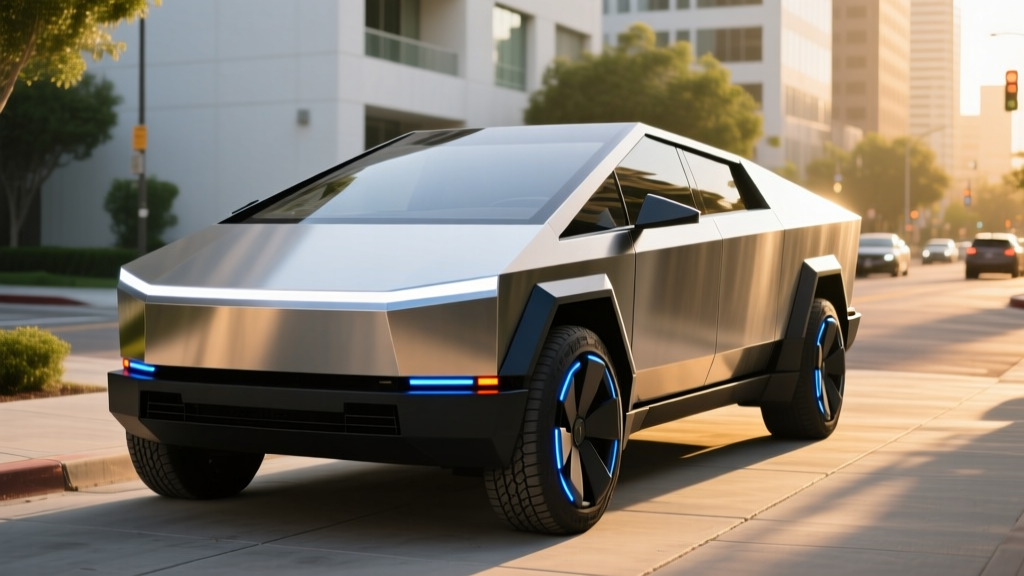
The search for a "Cybertruck SUV" usually stems from one of two intentions: buyers who love the angular, stainless-steel aesthetic of the Tesla Cybertruck but need a fully enclosed, family-friendly cabin, or shoppers who've heard rumors of a second-row-focused Cybertruck variant. As of 2026, Tesla does not manufacture a Cybertruck SUV. The Cybertruck remains a battery-electric pickup — available in Rear-Wheel Drive, Dual Motor All-Wheel Drive, and tri-motor Cyberbeast trims — with a six-passenger, two-row cabin that blurs the line between truck and utility vehicle.
This profile covers the current Cybertruck lineup in depth — real-world range, charging curves, tax credit status, and practicality — while directly addressing the SUV question and pointing buyers toward Tesla's actual enclosed-cabin alternatives.
Cybertruck Lineup at a Glance: 2026 Specs
| Spec | RWD | Dual Motor AWD | Cyberbeast (Tri-Motor) |
|---|---|---|---|
| EPA Range | ~250 mi | 340 mi | 320 mi |
| Battery (usable, est.) | ~100 kWh | ~123 kWh | ~123 kWh |
| Chemistry | NMC (estimated) | NMC | NMC |
| 0–60 mph | ~6.5 sec | 4.1 sec | 2.6 sec |
| Horsepower | ~315 hp | 600 hp | 845 hp |
| Drivetrain | RWD | AWD | AWD |
| Max DC Fast Charge | ~250 kW | ~350 kW | ~350 kW |
| 10–80% DC Time | ~28 min | ~15 min | ~15 min |
| Level 2 Rate | 11.5 kW (~37 mi/hr) | 11.5 kW (~37 mi/hr) | 11.5 kW (~37 mi/hr) |
| Towing Capacity | 7,500 lb | 11,000 lb | 11,000 lb |
| Base MSRP | ~$60,990 | $79,990 | $99,990 |
| Federal Tax Credit (§30D) | Eligible (see rules) | Not eligible (MSRP cap) | Not eligible (MSRP cap) |
| Battery/Drive Warranty | 8 yr / 120,000 mi | 8 yr / 120,000 mi | 8 yr / 120,000 mi |
Sources: Tesla Cybertruck specs, fueleconomy.gov. RWD trim specs estimated from preliminary announcements; Dual Motor and Cyberbeast figures reflect delivered production models.
Is There a Cybertruck SUV? Addressing the Rumor
Tesla has never officially announced a "Cybertruck SUV." What buyers encounter online are speculative renders, patent filings, and Elon Musk's historical pattern of teasing future vehicles years before production. The Cybertruck itself is a crew-cab pickup with a six-seat interior, a 6-foot composite bed, and a motorized retractable tonneau cover — not a traditional enclosed SUV.
If your core need is a Tesla with an enclosed cargo area, three-row seating, or a hatchback liftgate, you're actually shopping for a Tesla Model X (falcon-wing doors, up to 348 miles EPA range, ~$79,990 base) or the Tesla Model Y (compact SUV, up to 320 miles EPA range, ~$44,990 base, and currently eligible for the full $7,500 federal tax credit). The Model X, in particular, occupies the premium large-SUV space that a hypothetical "Cybertruck SUV" would target.
For this review, we'll focus on the Cybertruck as it exists — because many buyers cross-shop it with large SUVs given its interior volume, tech suite, and passenger capacity.
Real-World Range: What the EPA Sticker Doesn't Tell You
EPA Estimate: 340 miles
Real-World Highway (70 mph, mild weather): ~270–290 miles
Real-World Highway (cold weather, 30°F): ~220–250 miles
Mixed City/Suburban: ~300–320 miles
While Towing (5,000+ lb trailer): ~150–180 miles
The Cybertruck's stainless-steel exoskeleton and flat-panel geometry create more aerodynamic drag than a curved, purpose-built SUV like the Rivian R1S or Model X. At highway speeds, that drag compounds, and the truck's ~6,800-lb curb weight demands substantial energy to maintain momentum. Expect to lose roughly 15–20% off the EPA figure on sustained highway drives in good conditions, and up to 30–35% in sub-freezing temperatures where battery chemistry slows and cabin heating draws additional power.
Regenerative braking in stop-and-go city traffic partially recovers energy, which is why mixed-use driving gets closer to the EPA sticker. If your primary use case is a 40-mile daily commute with home charging, range is rarely a concern. If you're planning 400-mile road trips with a trailer in tow, route planning around Supercharger stops every 150 miles is essential.
Charging Speed: DC Fast, Home Level 2, and the Charge Curve
| Charging Method | Power (kW) | Miles Added per Hour | Notes |
|---|---|---|---|
| Level 1 (120V household) | ~1.2 kW | ~3–4 mi/hr | Emergency/trickle only |
| Level 2 (240V home wall connector) | 11.5 kW | ~37 mi/hr | Full overnight charge in ~10–12 hr |
| DC Fast (Tesla V4 Supercharger) | Up to 350 kW (peak) | ~200+ mi in 15 min | Peak rate only at low SoC |
| DC Fast (non-Tesla CCS via adapter) | Up to 150–250 kW | Varies | Requires NACS-to-CCS adapter |
The Cybertruck uses Tesla's NACS (North American Charging Standard) connector natively, granting full access to the Supercharger network — the most reliable public DC fast-charging infrastructure in the U.S. as measured by uptime and plug-and-charge simplicity.
Understanding the charge curve: The advertised "350 kW peak" applies only at low state of charge (roughly 5–15% SoC). As the battery fills, the charge rate tapers to protect cell longevity. A typical 10–80% session on a V4 Supercharger takes approximately 15 minutes for the Dual Motor and Cyberbeast trims, but pushing from 80–100% can add another 20+ minutes. For daily driving, charging to 80% at home overnight on Level 2 is the recommended practice for NMC chemistry to minimize long-term degradation.
Home Level 2 installation typically requires a 60-amp dedicated circuit (NEMA 14-50 or hardwired Tesla Wall Connector). Budget $800–$2,500 for installation depending on panel proximity and whether your home's electrical panel requires an upgrade to support a 200-amp service. A licensed electrician should always perform this work.
Performance, Interior, and Tech: What It Actually Drives Like
The Cyberbeast's 2.6-second 0–60 mph time makes it one of the quickest production vehicles on Earth, truck or otherwise. The Dual Motor AWD's 4.1-second sprint is more than adequate for highway merging and passing. The RWD base model, at an estimated 6.5 seconds, is still brisk by full-size truck standards.
Inside, the Cybertruck seats six across two rows with a front bench seat — a configuration more reminiscent of 1990s trucks than modern luxury EVs. Rear legroom is approximately 38 inches, adequate for adults on long trips. Cargo volume behind the second row is effectively the 6-foot bed (roughly 6.5 feet long with the tailgate up, expandable with the tailgate down), plus a front trunk (frunk) offering roughly 7 cubic feet of lockable, weather-sealed storage.
The 18.5-inch center touchscreen runs Tesla's latest software suite, including navigation with real-time Supercharger routing, over-the-air updates, and entertainment streaming while parked. The yoke-style steering wheel is standard — love it or hate it, there's no round-wheel option. Build quality on 2024–2025 delivery models drew criticism for panel-gap inconsistencies; Tesla has iterated on production processes, but buyers should inspect delivery vehicles carefully.
Driver Assistance — SAE Level 2: The Cybertruck comes with Tesla's Basic Autopilot (adaptive cruise + lane centering). Full Self-Driving (Supervised) is an optional upgrade (~$8,000 or $99/month subscription). Despite the "Full Self-Driving" branding, this remains an SAE Level 2 system — the driver must remain fully attentive, hands on the yoke, and eyes on the road at all times. It is not autonomous driving. Only Level 4 robotaxi services like Waymo operate without a human driver in geofenced areas.
Tesla's FSD does not make the Cybertruck self-driving. The system can navigate highways, handle some city streets, and park autonomously, but it requires continuous driver supervision. NHTSA has investigated multiple incidents involving Tesla's driver-assist systems. Always remain prepared to take immediate control.
Pricing, Trims, and Federal Tax Credit Eligibility
| Trim | Base MSRP | Est. As-Tested (with options) | §30D Tax Credit Eligible? |
|---|---|---|---|
| RWD (est.) | ~$60,990 | ~$63,000–$67,000 | Potentially — under $80K truck MSRP cap* |
| Dual Motor AWD | $79,990 | ~$82,000–$90,000 | No — exceeds $80,000 truck MSRP cap |
| Cyberbeast | $99,990 | ~$102,000–$110,000 | No — exceeds $80,000 truck MSRP cap |
Under IRS §30D rules, the federal clean vehicle credit offers up to $7,500 for qualifying new EVs. For trucks, vans, and SUVs, the MSRP cap is $80,000 — but this cap applies to the base MSRP before destination fees and options. The Dual Motor AWD at $79,990 sits right at the threshold; however, adding any factory options (FSD, premium paint, accessories) pushes the total above the cap, disqualifying it. The Cyberbeast is well above the limit.
The RWD base model, once it reaches volume production, would likely qualify — provided the buyer also meets income caps ($150K single / $300K joint AGI) and the vehicle satisfies critical-mineral and battery-component sourcing requirements. These sourcing rules tighten annually, so always verify current eligibility on the IRS website or through a tax professional before counting on the credit. As of 2026, the credit can be transferred to the dealer at point of sale, reducing your out-of-pocket cost directly rather than waiting for a tax refund.
Pros and Cons: The Honest Assessment
- Best-in-class Supercharger network access (NACS native)
- Extreme performance — Cyberbeast 0–60 in 2.6 sec
- 11,000-lb towing capacity (AWD trims)
- Stainless-steel exoskeleton — dent and corrosion resistant
- Frunk + 6-ft bed with powered tonneau cover
- OTA software updates continuously add features
- Unique design — nothing else looks like it
- No enclosed SUV cargo area — it's a truck, not an SUV
- Highway range falls well short of EPA due to aero drag
- Dual Motor and Cyberbeast do not qualify for §30D tax credit
- Yoke steering is polarizing and not optional
- Build quality inconsistencies reported on early deliveries
- Large footprint — tight garages and parking are challenging
- No third-row seating; only six passengers max
- Insurance premiums run higher than average for the segment
Who Should Buy the Cybertruck (and Who Should Look Elsewhere)?
- You need a pickup truck with daily-driver comfort and EV running costs
- You tow boats, trailers, or equipment regularly (up to 11,000 lb)
- You have home Level 2 charging and a garage that fits a ~19-foot vehicle
- You want Supercharger access for road trips across the U.S.
- Performance matters — you want supercar acceleration in a utility vehicle
Look elsewhere if:
- You need an enclosed, weather-sealed cargo area for gear, groceries, or pets → Consider Model X, Rivian R1S, or Kia EV9
- You need three-row seating for seven passengers → Consider Model X, Rivian R1S, or Kia EV9
- You want a full $7,500 tax credit on a premium EV → Consider Model Y, Ford F-150 Lightning XLT, or Chevrolet Silverado EV WT
- You primarily drive in dense urban areas with tight parking → Consider Model Y or Hyundai Ioniq 5
Frequently Asked Questions
What is the real-world range of the Cybertruck?
The Dual Motor AWD carries a 340-mile EPA estimate, but real-world highway driving in mild conditions yields roughly 270–290 miles. In cold weather (below freezing), expect 220–250 miles. The Cyberbeast, with its tri-motor power draw, achieves approximately 320 miles EPA and roughly 250–275 miles in real-world mixed driving.
How fast does the Cybertruck charge at home and on the road?
On a home Level 2 charger (11.5 kW), the Cybertruck adds approximately 37 miles of range per hour, requiring 10–12 hours for a full charge from near-empty. On a Tesla V4 Supercharger, the Dual Motor and Cyberbeast can add roughly 200 miles in 15 minutes under optimal conditions (low SoC, preconditioned battery), with a 10–80% session taking about 15 minutes.
Does the Cybertruck qualify for the $7,500 federal EV tax credit?
Only the base RWD trim (estimated ~$60,990 MSRP) would potentially qualify under §30D, as the Dual Motor AWD ($79,990) and Cyberbeast ($99,990) exceed or sit at the $80,000 MSRP cap for trucks. Even the RWD must meet buyer income limits ($150K single / $300K joint) and battery-sourcing requirements. Verify current eligibility at irs.gov before purchase.
Is the Cybertruck worth buying vs. the Rivian R1T or Ford F-150 Lightning?
It depends on your priorities. The Cybertruck wins on raw performance (2.6-sec Cyberbeast), Supercharger network access, and design distinctiveness. The Rivian R1T offers a more refined interior, a traditional round steering wheel, and better off-road capability with its quad-motor setup. The Ford F-150 Lightning provides a more conventional truck experience, a larger frunk (14 cu ft), and broader tax credit eligibility on lower trims. For pure towing and acceleration, the Cybertruck leads. For traditional truck utility and comfort, the F-150 Lightning and R1T are strong alternatives.
Will Tesla ever release a Cybertruck SUV variant?
Tesla has not announced any plans for a Cybertruck SUV as of 2026. The company's SUV lineup currently consists of the Model Y (compact) and Model X (large). If Tesla develops a future vehicle with Cybertruck styling cues in an SUV body, it would likely be announced through an official Tesla event — not through third-party speculation. For now, buyers seeking an enclosed Tesla SUV should evaluate the Model X or Model Y.
What is the Cybertruck's efficiency in MPGe?
The Dual Motor AWD Cybertruck achieves an EPA-estimated 50 MPGe combined (roughly 67 kWh per 100 miles), reflecting the energy cost of its heavy weight and flat aerodynamic profile. This is lower efficiency than most passenger EVs — the Model X achieves ~100 MPGe — but is competitive within the electric truck segment.