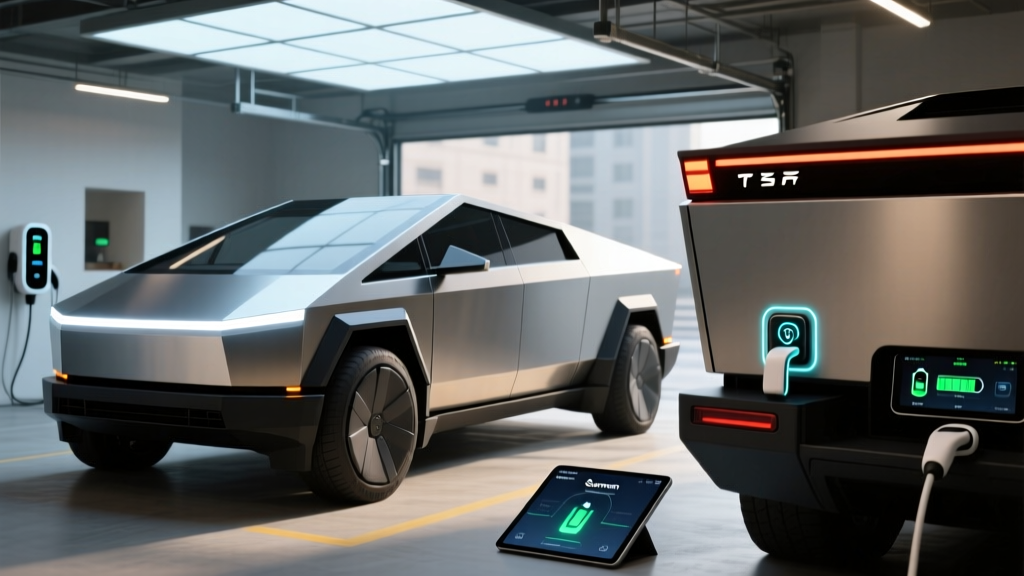
The Tesla Cybertruck is equal parts polarizing design statement and engineering showcase. But for owners navigating tight parking garages or rain-soaked driveways, one feature consistently dominates search queries and forum debates: Cybertruck Summon. Tesla's Smart Summon and related remote-driving features promise to bring the truck to you in a parking lot — but how well do they work on a 6,600-pound stainless-steel triangle, and how does the rest of the package hold up as a daily-driver EV?
This 2026 review covers the Cybertruck's Smart Summon capabilities alongside the hard numbers every buyer needs: real-world range, charging speeds, pricing after federal tax credits, and how it stacks up against the Ford F-150 Lightning and Rivian R1T.
Cybertruck Summon and Smart Features Explained
Tesla's Summon ecosystem includes several related features accessible through the Tesla mobile app:
- Basic Summon: Moves the Cybertruck forward or backward in a straight line — useful for squeezing into tight garage spaces where opening doors is impossible.
- Smart Summon: The truck navigates a parking lot autonomously to your location or a chosen pin, avoiding obstacles and pedestrians. You monitor via the app's camera feed.
- Autopark: The Cybertruck identifies a parking spot and parks itself (parallel or perpendicular) while you remain in the driver's seat, ready to intervene.
All Cybertruck Summon and Autopilot features are SAE Level 2 driver-assistance systems. The driver must remain attentive, maintain situational awareness, and be prepared to take control instantly. Smart Summon requires you to monitor the vehicle via the Tesla app at all times. This is not autonomous driving — only Level 4 services like Waymo operate without a human supervisor.
How Smart Summon Works on Cybertruck
The Cybertruck uses Tesla's Hardware 4 (HW4) suite: high-resolution cameras providing 360-degree visibility, processed by Tesla's neural-network-based vision system (Tesla Vision — no ultrasonic sensors). Smart Summon relies on this camera array to map the parking environment, detect curbs, shopping carts, pedestrians, and other vehicles.
In practice, Smart Summon on the Cybertruck works well in open, well-lit lots with clear lane markings. Performance degrades in crowded, poorly marked, or dimly lit environments. The truck's angular geometry and 82-inch width (excluding mirrors) also mean it takes wider paths around obstacles than a sedan would. Expect occasional pauses where the system hesitates at complex intersections in a lot — this is conservative programming, not a malfunction.
- Requires clear GPS signal and cellular connectivity
- Does not operate on public roads or above ~6 mph in Smart Summon mode
- Struggles with steep ramps, speed bumps, and unpaved surfaces
- Rain, snow, or dirty cameras can disable the feature entirely
- Not a substitute for attentive driving — you are legally responsible for the vehicle
Range, Battery, and Efficiency
| Spec | AWD | Cyberbeast |
|---|---|---|
| EPA Range | 340 miles | 320 miles |
| Battery (usable) | ~123 kWh (estimated, NMC) | ~123 kWh (estimated, NMC) |
| MPGe (combined) | ~67 MPGe | ~65 MPGe |
| Efficiency | ~50 kWh/100 mi | ~52 kWh/100 mi |
| Drivetrain | Dual-Motor AWD | Tri-Motor AWD |
| 0-60 mph | 3.9 seconds | 2.6 seconds |
| Horsepower | 600 hp | 845 hp |
The AWD's 340-mile EPA estimate assumes mixed driving. On a sustained 75-mph highway run in 70°F weather, expect ~270-290 miles before needing a charger. In cold weather (below 32°F), range drops an additional 15-25%, putting real-world winter highway range closer to 220-250 miles. The Cybertruck's brick-like aerodynamics (despite the angular shaping) hit efficiency hard at highway speeds — city driving with regenerative braking yields better results. The available Range Extender battery pack (bed-mounted) is expected to add ~130+ miles when it becomes available, but as of early 2026, it remains limited in availability.
Tesla has not officially published the Cybertruck's exact battery capacity. Teardown analysis and real-world charging data suggest a usable capacity near 123 kWh using 4680-format NMC (nickel manganese cobalt) cells manufactured at Giga Texas. The 800V-class architecture enables the strong charging speeds detailed below.
Charging Speed and Infrastructure
| Charging Level | Power / Rate | Speed |
|---|---|---|
| Level 1 (120V) | ~1.4 kW | ~3-4 miles/hour |
| Level 2 (240V, 48A) | 11.5 kW | ~29 miles/hour |
| Level 2 (240V, 80A) | 19.2 kW | ~48 miles/hour |
| DC Fast (NACS Supercharger) | Peak 250 kW | 10-80% in ~30 min |
| DC Fast (V4 Supercharger) | Up to 350 kW (future) | Faster as V4 rolls out |
The Cybertruck charges natively via the NACS (North American Charging Standard) connector — the same Tesla plug now adopted industry-wide. On a V3 Supercharger (250 kW peak), the charge curve is strong through 50% State of Charge, then tapers progressively. The 10-80% time of roughly 30 minutes is competitive but not class-leading; the F-150 Lightning on a 350 kW-capable charger can match or slightly beat this.
At home on a Tesla Wall Connector (48A / 11.5 kW), a full charge from 10% takes roughly 10-11 hours — feasible for overnight top-ups if you drive under 200 miles daily. Owners with 80A circuits (requiring a 100A breaker and 2-gauge wire) can cut that to about 6.5 hours. Expect home installation costs of $800-$2,500 depending on panel capacity and run length; a 200A panel upgrade adds $1,500-$3,000 if your home needs one.
Pricing, Trims, and Federal Tax Credit
| Trim | MSRP | After §30D Credit* |
|---|---|---|
| RWD (announced, 2026+) | ~$60,990 | ~$53,490 |
| AWD | $79,990 | $72,490 |
| Cyberbeast | $99,990 | $92,490 |
*Federal tax credit eligibility is subject to IRS §30D rules. As of 2026, the Cybertruck AWD and Cyberbeast are below the $80,000 and $100,000 MSRP caps for trucks, respectively. Buyer income must not exceed $150,000 (single) / $300,000 (joint). Battery components and critical minerals must meet escalating domestic-sourcing thresholds. The credit can be applied at point of sale as a price reduction. Always verify current eligibility at IRS.gov and consult a tax professional.
The base RWD model was announced at ~$60,990 but has faced repeated delays. As of early 2026, most buyers are taking delivery of AWD and Cyberbeast trims. The Cybertruck does not qualify for the full $7,500 credit in all configurations and all buyer circumstances — battery sourcing requirements tighten annually, and some build months may fall short. Check Tesla's website or the fueleconomy.gov credit lookup for the specific VIN/build-date eligibility.
Cargo, Towing, and Practicality
The Cybertruck's 6-foot vault (bed) offers 67 cubic feet of lockable, weather-sealed cargo space with a powered tonneau cover rated to support 300 pounds. The rear glass opens upward electrically, and the bed features built-in 120V and 240V outlets — enabling job-site tool use or campsite power without a generator.
Interior passenger space is generous in front (41.1 inches of legroom) but the rear seat, while adequate for adults, has a relatively upright seatback and 34.7 inches of legroom — less than an F-150 Lightning's rear quarters. The front trunk (frunk) provides an additional ~7 cubic feet of lockable storage.
Towing capacity is rated at 11,000 pounds for both AWD and Cyberbeast trims. However, towing at or near max capacity slashes range by roughly 40-50%, dropping effective range to ~150-180 miles. This is common across electric trucks but worth planning for on long hauls.
Warranty and Long-Term Ownership
Tesla covers the Cybertruck with:
- Basic Vehicle: 4 years / 50,000 miles
- Battery & Drive Unit: 8 years / 120,000 miles (whichever comes first), with a minimum 70% capacity retention guarantee
- Restraint System: 5 years / 60,000 miles
The 8-year/120,000-mile battery warranty is competitive with the F-150 Lightning (8yr/100,000mi) and Rivian R1T (8yr/175,000mi). Tesla's 4680 cells have shown promising early degradation data, but the Cybertruck is still young in the field — long-term 150,000+ mile data does not yet exist. Replacement cost for the structural battery pack, should it fail out of warranty, is estimated at $20,000-$30,000+ based on current Tesla pack pricing.
Who Should Buy the Cybertruck?
- You want a distinctive design with strong performance (2.6s 0-60 on Cyberbeast)
- You need a lockable, weatherproof bed with built-in power outlets
- You're already in the Tesla/Supercharger ecosystem and value seamless charging
- Smart Summon and Tesla's software-driven features are priorities
- Rear-seat comfort for adults on long trips is a priority (check the F-150 Lightning or R1T)
- You need proven long-term reliability data — the platform is new
- You frequently tow heavy loads over long distances (range loss is significant)
- You want a conventional truck experience with physical controls and familiar ergonomics
- Tri-motor Cyberbeast is absurdly quick (2.6s to 60)
- Lockable vault bed with integrated power
- Supercharger network access (most reliable DC network)
- 800V-class architecture for strong charging
- Over-the-air updates continually add features
- Smart Summon useful in tight spaces
- Highway range loss significant due to aerodynamics
- Rear seat less comfortable than competitors
- Stainless-steel body panels show fingerprints and are costly to repair
- Steer-by-wire takes adjustment (yoke or wheel)
- Smart Summon inconsistent in complex environments
- No Apple CarPlay or Android Auto
Frequently Asked Questions
What is the real-world range of the Cybertruck?
The AWD's 340-mile EPA figure translates to roughly 270-290 miles at highway speeds in mild weather, and 220-250 miles in freezing temperatures. City driving with regen braking gets closer to the EPA number. The Cyberbeast, with its tri-motor power draw, averages about 10-15 fewer miles in equivalent conditions.
How fast does the Cybertruck charge at home and on the road?
On a 250 kW Supercharger, expect 10-80% in about 30 minutes. At home on a 48A Level 2 Wall Connector (11.5 kW), you'll add roughly 29 miles per hour — a full overnight charge from 20% takes about 9-10 hours. The 80A option (19.2 kW) cuts that significantly but requires heavier electrical infrastructure.
How much does the Cybertruck cost after the federal tax credit?
The AWD at $79,990 drops to approximately $72,490 if you qualify for the full $7,500 §30D credit. Eligibility depends on your adjusted gross income (≤$150K single / ≤$300K joint), the truck's MSRP (under the $80K truck cap for AWD), and battery sourcing compliance. The Cyberbeast at $99,990 falls under the $100K truck cap but buyer income limits still apply. Verify at IRS.gov.
Is the Cybertruck worth buying vs. the F-150 Lightning or Rivian R1T?
The F-150 Lightning offers a more traditional truck experience, better rear-seat comfort, and competitive pricing (starting ~$55K), though with slightly lower range (230-320 mi EPA depending on battery). The Rivian R1T is more refined off-road and offers a quad-motor option, but starts above $70K and uses a smaller charging network. The Cybertruck wins on performance, Supercharger access, and tech features — but loses on rear-seat comfort and proven reliability track record.
Does Smart Summon work reliably on the Cybertruck?
Smart Summon works well in open, well-marked parking lots with good lighting and cell signal. It struggles in crowded garages, poorly marked areas, and adverse weather. It's a useful convenience feature — not a replacement for driving the truck yourself. Expect it to get you out of tight spots, but don't rely on it to navigate a busy grocery-store lot autonomously every time.
Does the Cybertruck qualify for the federal EV tax credit?
As of 2026, both the AWD and Cyberbeast can qualify for up to $7,500 under §30D, provided the buyer meets income caps and the specific vehicle's battery sourcing meets current-year thresholds. The credit can be transferred at point of sale, reducing your purchase price directly. Because sourcing rules tighten each year, confirm eligibility for your specific delivery window with Tesla and your tax advisor.