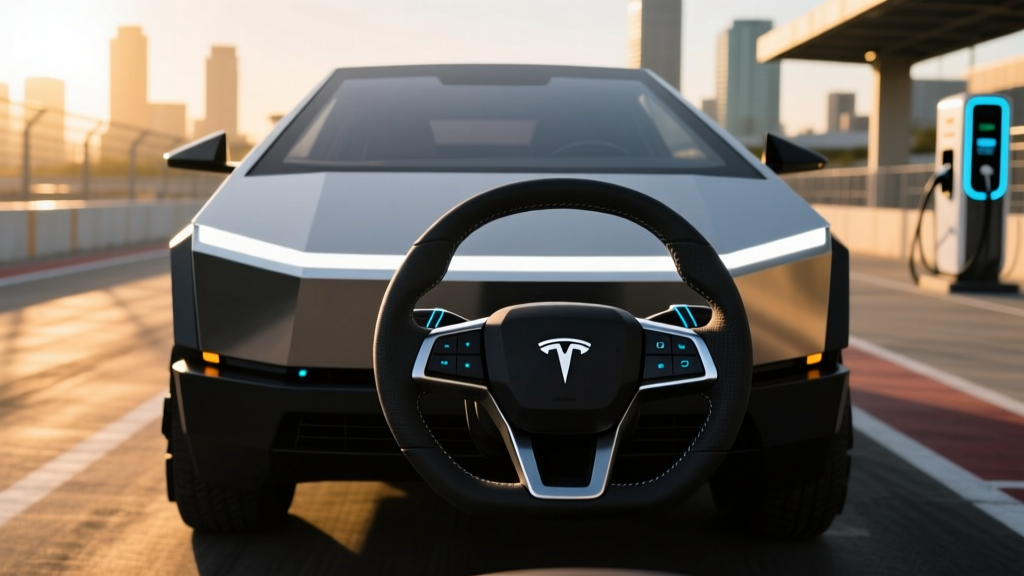
The Tesla Cybertruck is unlike any pickup on the road, and nowhere is that more apparent than behind the wheel. Its steer-by-wire system — a fully electronic connection between the yoke and the front wheels with no mechanical linkage — is the single most polarizing feature Tesla has ever shipped. After spending extended time with the 2026 Cybertruck across highway, city, and off-road conditions, we're breaking down exactly how the Cybertruck steering behaves in the real world, alongside the range, charging, and ownership data buyers actually need.
At a Glance: 2026 Tesla Cybertruck Specs
| Spec | AWD | Cyberbeast (Tri-Motor) |
|---|---|---|
| EPA Range | 340 miles | 320 miles |
| Battery (usable) | ~123 kWh, NMC | ~123 kWh, NMC |
| Max DC Fast Charge | 250 kW (V3 Supercharger) / 350+ kW (V4 capable) | 250 kW (V3) / 350+ kW (V4 capable) |
| 10–80% DCFC Time | ~28 min (V3), ~20 min (V4 station) | ~28 min (V3), ~20 min (V4 station) |
| Level 2 Home Charging | 11.5 kW (~37 mi/hr) | 11.5 kW (~37 mi/hr) |
| 0–60 mph | 4.1 sec | 2.6 sec |
| Horsepower | 600 hp | 845 hp |
| Drivetrain | Dual-Motor AWD | Tri-Motor AWD |
| Efficiency | ~56 MPGe / ~58 kWh/100mi | ~52 MPGe / ~62 kWh/100mi |
| Towing Capacity | 11,000 lbs | 11,000 lbs |
| Base MSRP (2026) | $79,990 | $99,990 |
| Battery/Powertrain Warranty | 8 yr / 120,000 mi | 8 yr / 120,000 mi |
Sources: EPA fueleconomy.gov, Tesla Cybertruck specs.
How Cybertruck Steer-by-Wire Actually Feels
Cybertruck steering uses a steer-by-wire architecture with a variable-ratio rack. There is no physical column connecting the yoke to the wheels — inputs are translated electronically, and a force-feedback motor simulates road feel. At low speeds (parking lots, tight turns), the ratio is extremely quick: lock-to-lock is roughly 340 degrees, meaning you almost never need to cross your arms or shuffle the yoke. At highway speeds, the ratio lengthens, providing stability and reducing twitchiness.
In real-world driving, the system is genuinely impressive for low-speed maneuvering. U-turns and parking require minimal hand movement, and the variable ratio eliminates the "arm-over-arm" problem that a yoke normally creates. However, the lack of a true mechanical connection means road feedback is synthesized. On smooth highways, it feels precise and calm. On rough, patched surfaces or gravel, the force feedback can feel slightly artificial compared to a traditional hydraulic or electric power steering rack.
For towing, the steering holds up well. The Cybertruck's rear-wheel steering (available as part of the 4-wheel steer system on certain configurations) reduces the turning circle to approximately 37 feet — competitive with much smaller vehicles and a genuine advantage when maneuvering a trailer in tight spaces.
Real-World Range vs. EPA Estimates
EPA Range (AWD): 340 miles | EPA Range (Cyberbeast): 320 miles
Real-World Expectation: Highway driving at 70–75 mph yields approximately 260–290 miles in mild weather. Cold weather (below 32°F) can reduce range by 20–30%, dropping effective highway range to roughly 210–240 miles for the AWD trim. City/regenerative driving recovers closer to the EPA sticker.
The Cybertruck's angular stainless-steel body creates significant aerodynamic drag compared to sleeker EVs, and this shows most at sustained highway speeds. The 123 kWh NMC battery pack is large, but efficiency hovers around 58 kWh/100mi (AWD) — substantially higher than a Model Y's ~28 kWh/100mi. This is the tradeoff for a 6,600+ lb truck with a flatbed.
If you primarily commute in stop-and-go traffic with regenerative braking engaged, you'll see range closer to the EPA number. Road-trippers should plan charging stops based on ~260 miles of usable range in summer and ~220 miles in winter to maintain a comfort buffer.
Charging Speed: DC Fast and Home Level 2
| Charging Level | Power (kW) | Speed / Time |
|---|---|---|
| Level 1 (120V outlet) | ~1.4 kW | ~4–5 mi/hr |
| Level 2 (240V, 48A) | 11.5 kW | ~37 mi/hr (full charge ~10–11 hrs) |
| DC Fast (V3 Supercharger) | Up to 250 kW | 10–80% in ~28 min |
| DC Fast (V4 Supercharger) | Up to 350+ kW | 10–80% in ~20 min |
The Cybertruck uses the NACS connector natively (it's a Tesla, after all), giving it full access to the Supercharger network. On a V4 Supercharger cabinet, the truck can accept over 300 kW briefly, but the charging curve tapers significantly above 60% state of charge. Expect peak rates between 10–40% SoC, then a gradual step-down. This is typical for large NMC packs — the thermal management system is aggressive about protecting the battery, which is good for longevity but means the last 20% takes disproportionately longer.
For home charging, the onboard 11.5 kW charger means a full 48-amp Level 2 circuit (60-amp breaker) will add roughly 37 miles of range per hour. An overnight charge from 20% to 80% takes about 7–8 hours, which is adequate for daily use. A 200-amp electrical panel is generally sufficient, but older homes with 100-amp service may need a panel upgrade — budget $1,500–$3,000 for that work if required.
Pricing, Trims, and Federal Tax Credit Eligibility
| Trim | Base MSRP | Est. §30D Credit | Effective Price (if eligible) |
|---|---|---|---|
| AWD | $79,990 | Up to $7,500 | ~$72,490 |
| Cyberbeast | $99,990 | Up to $7,500 | ~$92,490 |
Tax credit caveats: Under IRS §30D rules, the Cybertruck qualifies as a light truck (MSRP cap: $80,000). This means the AWD trim at $79,990 sits just under the threshold and may be eligible, while the Cyberbeast at $99,990 exceeds the cap and does not qualify for the federal credit. Buyer income limits also apply ($150,000 single / $300,000 joint MAGI), and battery critical-mineral and component sourcing requirements must be met. The credit can now be transferred at the point of sale as a discount. Always verify current-year eligibility at IRS.gov or with a tax professional before purchasing.
Cargo, Interior Space, and Practicality
The Cybertruck's 6-foot bed offers approximately 67 cubic feet of lockable cargo volume under the motorized tonneau cover. The vault (bed) is rated for up to 2,500 lbs of payload. The front trunk (frunk) provides an additional ~7 cubic feet of secure, weatherproof storage — useful for groceries or charging cables.
Inside, the cabin seats five. Rear legroom measures approximately 38 inches, which is adequate for adults but tighter than a Ford F-150 Lightning's rear seat. The minimalist interior centers on an 18.5-inch touchscreen with no physical buttons; climate, mirrors, and glovebox are all controlled through the UI. This is clean if you like it, frustrating if you don't.
Notable practicality wins: the powered tonneau is standard and genuinely useful, the bed has built-in 120V and 240V outlets for job-site or camping use (up to 9.6 kW output via Powershare), and the stainless-steel exoskeleton resists dents and scratches better than painted aluminum.
Driver Assistance and Safety Tech
The Cybertruck ships with Tesla's latest hardware suite and supports Autopilot (adaptive cruise + lane centering) standard. Full Self-Driving (Supervised) is available as an $8,000 add-on or $99/month subscription. FSD on the Cybertruck performs comparably to other Tesla vehicles — competent on highways, occasionally hesitant in complex urban scenarios.
One steering-specific note: because the steer-by-wire system is electronically controlled, Tesla can push over-the-air updates that adjust steering feel, ratio curves, and force-feedback profiles. This means the steering character of the truck can evolve — something impossible with a mechanical rack.
As of early 2026, the Cybertruck has not yet been crash-tested by NHTSA or IIHS. The stainless-steel structure and large crumple zones suggest strong performance, but official ratings remain pending. Check NHTSA.gov for updates.
Pros and Cons
Pros
- Steer-by-wire eliminates yoke arm-shuffling at low speeds
- 340-mile EPA range (AWD) is strong for a full-size truck
- 250–350 kW DC fast charging with native NACS/Supercharger access
- Up to 11,000 lbs towing and 2,500 lbs payload
- Powershare: 9.6 kW vehicle-to-load for tools, camping, backup power
- Rear-wheel steering tightens the turning circle to ~37 ft
- OTA updates can refine steering and vehicle behavior over time
Cons
- Steer-by-wire road feedback feels synthetic on rough surfaces
- Highway efficiency (~58 kWh/100mi) cuts real-world range significantly
- Cyberbeast trim exceeds $80K MSRP cap — no federal tax credit
- Rear seat legroom tighter than F-150 Lightning and Rivian R1T
- No physical buttons — all controls routed through touchscreen
- Cold-weather range loss of 20–30% on highway trips
- No official NHTSA/IIHS crash ratings as of early 2026
Who Should Buy the Cybertruck?
Choose the Cybertruck AWD if: You need a capable electric truck for towing, job-site power (Powershare), or outdoor use, and you value Supercharger network access. The AWD trim at $79,990 may qualify for the §30D credit, bringing the effective price below $73K.
Choose the Cyberbeast if: Performance is a priority and budget is flexible. The 2.6-second 0–60 time is absurd for a truck, but you'll forfeit the federal credit and pay a premium for the tri-motor setup.
Look elsewhere (F-150 Lightning, Rivian R1T) if: You prioritize rear-seat comfort, conventional steering feel, or need proven crash-test ratings today. The Lightning offers more interior space and a lower starting price; the R1T offers a more refined ride and quad-motor performance.
Frequently Asked Questions
What is the real-world range of the Cybertruck?
The EPA rates the AWD at 340 miles and the Cyberbeast at 320 miles. In real-world highway driving at 70+ mph, expect 260–290 miles in mild weather and 210–240 miles in freezing temperatures. City driving with regenerative braking recovers closer to the EPA sticker.
How fast does the Cybertruck charge?
On a V3 Supercharger (250 kW), the Cybertruck charges 10–80% in approximately 28 minutes. On a V4 Supercharger cabinet, that drops to roughly 20 minutes. At home on a 48-amp Level 2 charger (11.5 kW), you'll gain about 37 miles of range per hour.
Does the Cybertruck qualify for the federal EV tax credit?
The AWD trim ($79,990 MSRP) is just under the $80,000 light-truck MSRP cap and may qualify for up to $7,500 under §30D, subject to buyer income limits and battery sourcing requirements. The Cyberbeast ($99,990) exceeds the cap and does not qualify. Always confirm at IRS.gov.
Is the Cybertruck steer-by-wire safe?
Steer-by-wire is used in aviation and is proven in production vehicles like the Toyota bZ4X/Lexus RZ and the Tesla Cybertruck. The system has redundant electronic pathways — if one fails, a backup maintains steering control. However, it lacks the direct mechanical feedback some drivers prefer.
Is the Cybertruck worth buying vs. the F-150 Lightning or Rivian R1T?
The Cybertruck wins on Supercharger access, Powershare V2L capability, and raw acceleration (Cyberbeast). The F-150 Lightning wins on interior space, conventional controls, and lower starting price. The Rivian R1T wins on ride refinement, off-road capability, and available quad-motor performance. Your priorities determine the winner.
What is the Cybertruck's warranty?
Tesla covers the battery and drive units for 8 years or 120,000 miles (whichever comes first), with a minimum 70% capacity retention guarantee. The limited vehicle warranty is 4 years or 50,000 miles.