Why the Cybertruck's Stainless Steel Exoskeleton Actually Matters
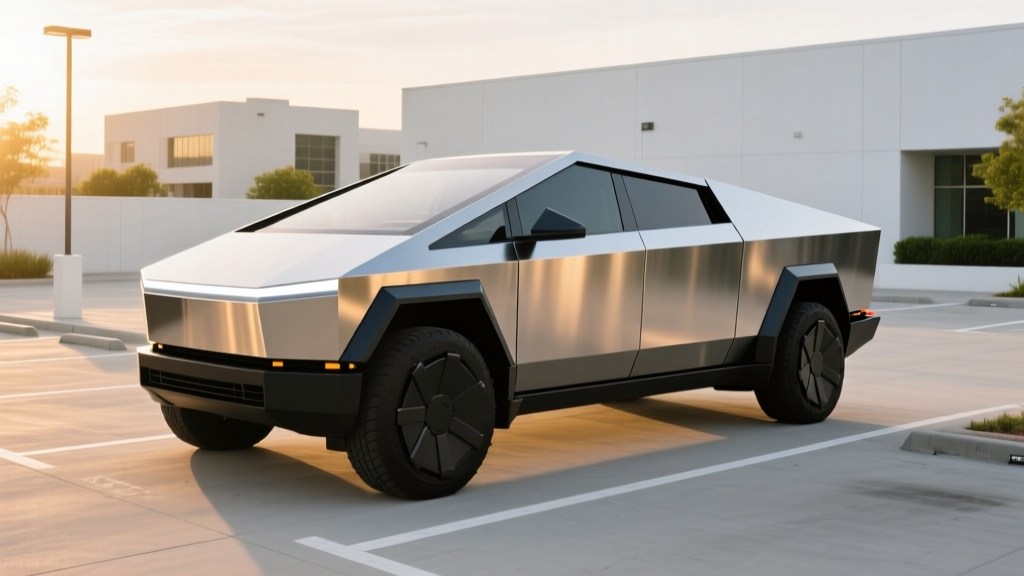
Most electric trucks hide behind aluminum bodies or stamped-steel unibodies wrapped in paint. The Tesla Cybertruck takes a radically different approach: an ultra-hard 30X cold-rolled stainless steel exoskeleton that serves as both the structural frame and the exterior skin. For 2026, the Cybertruck lineup continues to polarize, but the engineering rationale behind its stainless steel body is worth a serious, data-driven look — especially if you're weighing it against the Ford F-150 Lightning, Rivian R1T, or Chevrolet Silverado EV.
This review examines the Cybertruck's stainless steel benefits in the context of a full vehicle profile: real-world range, charging performance, ownership costs, and whether the exoskeleton philosophy translates into tangible advantages for actual owners.
| Spec | Value |
|---|---|
| EPA Range | 340 miles (AWD) / 320 miles (Cyberbeast) |
| Battery Capacity | ~123 kWh usable (NMC chemistry) |
| Max DC Fast Charge | 250 kW peak (V3 Supercharger) |
| 10–80% DC Charge Time | ~30 minutes (with preconditioning) |
| Level 2 Home Charge Rate | 11.5 kW (~37 miles/hr) |
| 0–60 mph | 3.9 sec (AWD) / 2.6 sec (Cyberbeast) |
| Horsepower | 600 hp (AWD) / 845 hp (Cyberbeast) |
| Drivetrain | Dual-motor AWD / Tri-motor AWD (Cyberbeast) |
| Towing Capacity | 11,000 lbs |
| MPGe (Combined) | 76 MPGe (AWD) |
| Efficiency | ~48 kWh/100 mi |
| Base MSRP | $79,990 (AWD) / $99,990 (Cyberbeast) |
| Battery Warranty | 8 years / 120,000 miles |
Range and Efficiency: What the Stainless Steel Body Costs You
The Cybertruck's angular, flat-panel stainless steel design is visually striking, but it comes with an aerodynamic penalty compared to more sculpted EV trucks. Tesla quotes an EPA-estimated 340 miles for the dual-motor AWD trim and 320 miles for the tri-motor Cyberbeast. Those numbers are competitive with the segment, but real-world experience tells a more nuanced story.
EPA Estimate: 340 miles (AWD) / 320 miles (Cyberbeast)
Highway (70–75 mph): Expect ~270–295 miles. The flat-panel exoskeleton creates more turbulent airflow than curved bodywork, reducing efficiency at sustained speed.
Cold Weather (below 32°F): Range drops to roughly 230–260 miles. The stainless steel body conducts heat differently than aluminum or composite panels, and the large cabin volume demands significant energy for HVAC.
City/Mixed Driving: Closer to EPA, around 310–330 miles, where regenerative braking recovers energy effectively.
Efficiency lands at approximately 48 kWh per 100 miles on the AWD trim — roughly 76 MPGe combined per fueleconomy.gov. For comparison, the Rivian R1T Dual-Motor achieves around 73 MPGe combined, while the Ford F-150 Lightning Extended Range sits at 70 MPGe. The Cybertruck's heavy stainless steel body (curb weight exceeds 6,600 lbs for the Cyberbeast) works against efficiency, but the large battery pack compensates.
The ~123 kWh usable battery uses NMC (nickel-manganese-cobalt) chemistry, chosen for its high energy density. This is critical given the Cybertruck's weight — an LFP pack of equivalent capacity would be heavier and physically larger, further compromising the design. NMC chemistry does mean you'll want to follow Tesla's daily charge limit recommendation (typically 80–90% for daily use, 100% only for long trips) to maximize long-term battery health.
Charging Performance: DC Fast and Home Level 2
The Cybertruck supports Tesla's V3 Supercharger architecture at up to 250 kW peak. That's not the fastest in the EV truck segment — the Hyundai Ioniq 5 and some 800V-architecture vehicles hit 350 kW — but Tesla's Supercharger network reliability largely compensates for the lower peak rate.
| Charge Level | Power / Rate | Miles Added per Hour | Notes |
|---|---|---|---|
| Level 1 (120V) | ~1.4 kW | ~3–4 mi/hr | Emergency/trickle only |
| Level 2 (240V, 48A) | 11.5 kW | ~37 mi/hr | Full overnight charge in ~11 hrs |
| DC Fast (V3 Supercharger) | 250 kW peak | ~180 mi in 15 min | 10–80% in ~30 min with preconditioning |
Charging curve reality: The Cybertruck peaks near 250 kW only between roughly 10–30% state of charge (SoC). Above 50%, the rate tapers to ~120–150 kW, and above 80% it drops further to protect the NMC cells. A 10–80% session takes approximately 30 minutes with proper battery preconditioning (navigating to a Supercharger in the Tesla app triggers this automatically). Without preconditioning — for example, at a non-Tesla DC fast charger using an adapter — expect 35–40 minutes for the same session.
For home charging, the Cybertruck's onboard charger accepts up to 11.5 kW on a 240V/48A circuit. That translates to roughly 37 miles of range per hour of charging. A full 0–100% charge at home takes about 11 hours. Most owners who plug in nightly after a typical 40–60 mile commute will wake up fully replenished. Installation of a Tesla Wall Connector on a dedicated 60A circuit typically costs $500–$1,500 for the electrician work, depending on panel proximity and local permit requirements.
Stainless Steel Benefits: Durability, Dent Resistance, and Zero Paint
This is where the Cybertruck diverges from every other truck on the market. The 30X cold-rolled stainless steel exoskeleton isn't an aesthetic gimmick — it offers measurable functional advantages that directly address common truck-owner pain points.
Dent and scratch resistance. The 30X alloy is significantly harder than conventional automotive steel or aluminum. Tesla demonstrated this at launch with sledgehammer impacts and 9mm handgun fire (the panels stopped both). In real-world ownership, this translates to a truck that shrugs off shopping cart dings, trail-side brush scratches, and the gravel pitting that destroys painted hoods on conventional pickups within a few years. The stainless steel doesn't have a clear coat or paint layer to chip — the metal itself is the finish.
No paint to maintain or repair. Conventional truck paint jobs cost $3,000–$8,000 to repair after body damage, and factory paint quality varies widely across the industry. The Cybertruck eliminates this entirely. There is no paint to fade, oxidize, or clear-coat peel. Tesla does offer a color-wrap option (Stealth Matte, Satin Black, etc.) through its accessories store, but the bare stainless steel requires zero paint maintenance — just occasional cleaning with a recommended stainless steel cleaner to prevent water-spot staining.
Structural rigidity. The exoskeleton design means the body panels are load-bearing, contributing to the vehicle's torsional rigidity. This benefits handling precision (notably for a 6,600+ lb vehicle) and provides a strong occupant safety cell. The stainless steel's high tensile strength also contributes to the Cybertruck's 11,000-lb towing capacity and its ability to handle heavy payloads without body flex.
Corrosion resistance. 30X cold-rolled stainless steel is inherently resistant to rust and corrosion in a way that painted mild steel or even aluminum is not. For owners in salt-belt states who deal with road salt every winter, the Cybertruck's body will not develop the bubbling rocker-panel rust that plagues conventional trucks after 8–12 years. This is a significant long-term ownership advantage that doesn't show up on a spec sheet.
The trade-offs are real, however. The stainless steel body is heavy — the Cybertruck's curb weight is substantially higher than an aluminum-body F-150 Lightning. Panel repair after severe collision damage requires specialized Tesla-approved body shops with stainless steel welding capability, and replacement panels can be costly. The flat, angular design also limits crumple-zone geometry in ways that traditional curved body structures don't, though Tesla's engineering team has addressed this with internal structural reinforcements. The Cybertruck earned a 5-star overall NHTSA safety rating, validating the structural approach.
Performance, Cargo, and Interior
The Cybertruck's powertrain options deliver sports-car acceleration in a truck body. The dual-motor AWD trim hits 0–60 mph in 3.9 seconds with 600 horsepower, while the tri-motor Cyberbeast drops that to 2.6 seconds with 845 hp. Both trims feature adaptive air suspension with up to 17 inches of ground clearance in Off-Road mode — useful for trail use, though the stainless steel underbody armor (an optional accessory) adds further protection.
Cargo and bed specs:
- Bed length: 6 feet (with the motorized tonneau cover closed)
- Bed width: ~47 inches between wheel wells
- Built-in 120V and 240V bed outlets (up to 9.6 kW output for powering tools or a campsite)
- Front trunk (frunk): Lockable storage with ~7 cu ft of space
- Gear Locker: Optional lockable, removable bed storage system
Interior dimensions:
- Seating: 6-passenger (front bench seat on AWD trim)
- Front legroom: ~41.5 inches
- Rear legroom: ~38.5 inches (adequate for adults, tighter than an F-150 SuperCrew)
- Rear headroom: Compromised by the sloping roofline — taller passengers will notice
- Infotainment: 18.5-inch front touchscreen, 9.4-inch rear touchscreen
The interior is minimalist in true Tesla fashion — no physical buttons, no instrument cluster, everything runs through the central screen. The yoke-style steering wheel (standard) takes adjustment, especially during low-speed parking maneuvers. Build quality on 2025–2026 models has improved significantly over early production units, with tighter panel alignment and fewer reported rattles.
Driver assistance: The Cybertruck comes with Tesla's Autopilot (SAE Level 2) standard, including adaptive cruise control and lane-keeping. Full Self-Driving (Supervised) is available as a $8,000 add-on or $99/month subscription. FSD remains a Level 2 system — the driver must remain attentive and keep hands on the wheel at all times. It handles highway interchanges and city streets impressively in many scenarios, but it is not autonomous driving and requires constant supervision.
2026 Pricing, Trims, and Federal Tax Credit Eligibility
The Cybertruck lineup for 2026 includes three trims. Here's how pricing breaks down and how the federal tax credit applies:
| Trim | Base MSRP | Federal Tax Credit (§30D) | Effective Price (if eligible) |
|---|---|---|---|
| Long Range AWD | $79,990 | Up to $7,500 (subject to eligibility) | ~$72,490 |
| AWD (Dual Motor) | $79,990 | Up to $7,500 (subject to eligibility) | ~$72,490 |
| Cyberbeast (Tri Motor) | $99,990 | Up to $7,500 (subject to eligibility) | ~$92,490 |
Federal tax credit rules (§30D) — critical caveats: The Cybertruck qualifies as a pickup truck under the IRS MSRP cap of $80,000. This means the AWD trim at $79,990 clears the cap, but the Cyberbeast at $99,990 exceeds it and is not eligible for the federal credit. Buyer income caps also apply: $300,000 for joint filers, $225,000 for heads of household, and $150,000 for single filers (modified adjusted gross income). Additionally, the battery must meet critical-mineral and battery-component sourcing requirements under current IRS rules — Tesla's supply chain has largely met these thresholds, but always verify current-year eligibility at irs.gov before purchasing. The credit can now be transferred to the dealer at point of sale as a price reduction, rather than waiting for a tax refund.
Warranty coverage: Tesla provides a 4-year/50,000-mile basic vehicle warranty and an 8-year/120,000-mile battery and drive unit warranty. The battery warranty guarantees at least 70% capacity retention over that period. Given the Cybertruck's ~123 kWh pack, 70% retention still leaves ~86 kWh usable — enough for roughly 240 miles of real-world range at end of warranty. Battery replacement costs outside warranty are estimated at $15,000–$25,000 based on current Tesla service pricing for large packs, though costs are expected to decline over the warranty period.
Cybertruck vs. the Competition: Is It Worth Buying?
The electric truck segment in 2026 offers legitimate alternatives, each with different strengths:
- Ford F-150 Lightning (Extended Range): EPA 320 miles, starting ~$69,990. More conventional truck feel, better rear-seat space, Pro Power Onboard. Aluminum body requires paint maintenance. Best for: traditional truck buyers who want EV efficiency without radical design.
- Rivian R1T (Dual-Motor Max Pack): EPA ~352 miles, starting ~$83,000. Superior off-road capability, gear tunnel storage, excellent build quality. Best for: adventure-oriented buyers who prioritize trail performance and premium interiors.
- Chevrolet Silverado EV (4WT/Extended Range): EPA ~380–400 miles (fleet-oriented 4WT), starting ~$55,000–$75,000 depending on trim. Best range in segment, but availability and trim configurations vary. Best for: commercial/fleet buyers and range-priority shoppers.
The Cybertruck's stainless steel exoskeleton gives it a unique value proposition: near-zero exterior maintenance, exceptional dent/scratch resistance, and a corrosion-proof body that should outlast conventional truck materials by decades. If you use your truck as a tool — job sites, trails, hauling materials — the stainless steel body's resistance to abuse is a genuine functional advantage, not just a design statement.
However, the Cybertruck's polarizing design, limited rear-seat headroom, higher curb weight (and resulting efficiency penalty), and the Cyberbeast's tax-credit ineligibility are real drawbacks. It's also the most expensive truck in its class when comparing equivalently equipped trims.
- Stainless steel body: no paint maintenance, dent-resistant, corrosion-proof
- 11,000-lb towing with integrated 240V bed power (9.6 kW)
- Sports-car acceleration (2.6 sec 0–60 Cyberbeast)
- Tesla Supercharger network access (most reliable DC network)
- 5-star NHTSA safety rating
- Adaptive air suspension with 17" ground clearance
- Cyberbeast exceeds $80K MSRP cap — no federal tax credit
- Rear-seat headroom limited by roofline slope
- Heavy curb weight reduces efficiency vs. aluminum-body competitors
- Yoke steering wheel requires significant adaptation
- Stainless steel panel repair requires specialized body shops
- High base price compared to F-150 Lightning and Silverado EV
Who Should Buy the Cybertruck?
Best for: Truck owners who use their vehicle as a daily workhorse and want a body that won't show wear after years of job-site use, trail running, or rural driving. The stainless steel exoskeleton's durability advantages compound over time — this is a truck that will look largely the same at year 10 as it did at delivery, something no painted truck can claim. It's also compelling for Tesla ecosystem loyalists who want Supercharger access and over-the-air updates.
Not ideal for: Families needing maximum rear-seat comfort (the Rivian R1T or F-150 Lightning offer better rear headroom and legroom). Budget-conscious buyers who need the federal tax credit and want the lowest possible entry price (the F-150 Lightning or Silverado EV base trims undercut the Cybertruck significantly). And anyone who prefers a traditional truck aesthetic and driving experience — the Cybertruck is deliberately unconventional in every way.
Frequently Asked Questions
What is the real-world range of the Tesla Cybertruck?
The EPA estimates 340 miles for the AWD trim and 320 miles for the Cyberbeast. In real-world highway driving at 70–75 mph, expect 270–295 miles. In cold weather below freezing, range drops to approximately 230–260 miles. City and mixed driving with regenerative braking recovers more energy, yielding results closer to the EPA sticker.
How fast does the Cybertruck charge at home and on the road?
On a V3 Supercharger, the Cybertruck peaks at 250 kW and charges from 10–80% in approximately 30 minutes with battery preconditioning. At home on a 240V/48A Level 2 charger, it accepts 11.5 kW, adding about 37 miles of range per hour. A full home charge takes roughly 11 hours.
Does the Cybertruck qualify for the $7,500 federal EV tax credit?
The AWD trim at $79,990 MSRP falls under the IRS $80,000 pickup truck cap and is eligible for up to $7,500, provided the buyer meets income limits ($300K joint / $150K single) and the battery meets critical-mineral sourcing requirements. The Cyberbeast at $99,990 exceeds the MSRP cap and does not qualify. Always verify current rules at irs.gov before purchasing.
Is the stainless steel body really maintenance-free?
It's very low maintenance, not zero maintenance. The stainless steel won't rust, chip, or fade like painted surfaces, but it can show fingerprints, water spots, and fine surface scuffs. Tesla recommends periodic cleaning with a stainless steel-specific cleaner. Severe collision damage requires specialized repair. But compared to conventional truck paint — which requires waxing, touch-up, and eventual repaint — the stainless steel is dramatically lower maintenance over the vehicle's life.
Is the Cybertruck worth buying over the F-150 Lightning or Rivian R1T?
It depends on your priorities. Choose the Cybertruck if you value exterior durability, Tesla's Supercharger network, and distinctive design. Choose the F-150 Lightning for a more conventional truck experience with better rear-seat space and a lower entry price. Choose the Rivian R1T for best-in-class off-road capability and a premium interior. The Cybertruck's stainless steel benefits are most valuable for owners who subject their truck to harsh conditions regularly.
What is the Cybertruck's battery warranty and replacement cost?
Tesla covers the battery and drive unit for 8 years or 120,000 miles, whichever comes first, with a guaranteed minimum of 70% capacity retention. Out-of-warranty battery replacement is estimated at $15,000–$25,000 based on current Tesla service pricing, though battery costs continue to decline industry-wide.