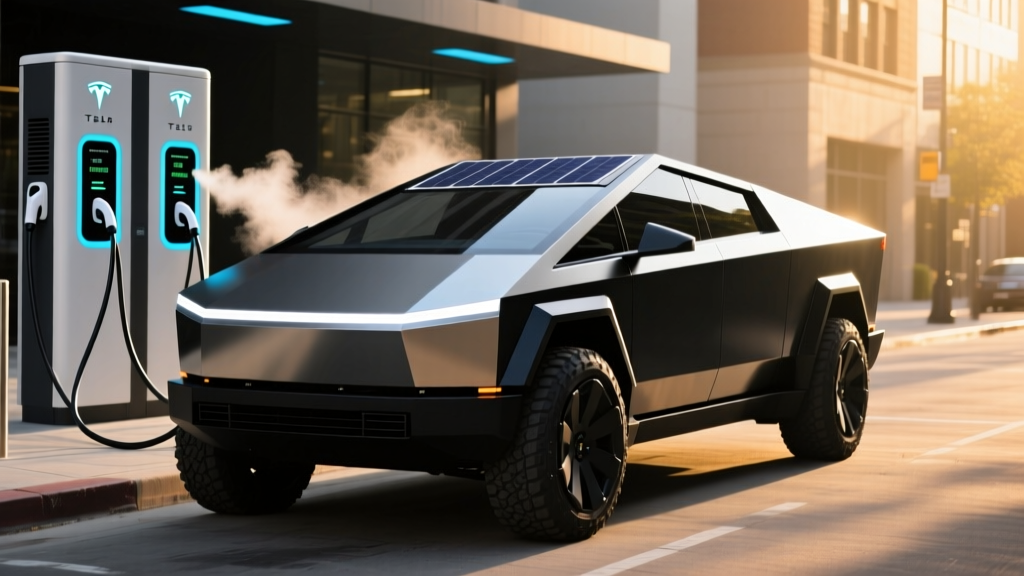
The Tesla Cybertruck entered production in late 2023 and has since become one of the most polarizing — and closely scrutinized — electric vehicles on the road. For 2026, Tesla continues to offer the Cybertruck in three main configurations: the single-motor Rear-Wheel Drive, the dual-motor All-Wheel Drive, and the tri-motor Cyberbeast. Buyers searching for Cybertruck speed figures will find them impressive on paper, but the full ownership story involves range trade-offs, charging logistics, and a price tag that has climbed since the original 2019 unveiling.
This review breaks down every critical spec — from acceleration and real-world range to DC fast-charging curves and federal tax credit eligibility — so you can decide whether the Cybertruck earns a spot in your garage or whether a Rivian R1T, Ford F-150 Lightning, or Chevrolet Silverado EV makes more sense.
Cybertruck Speed and Performance by Trim
Tesla offers the 2026 Cybertruck in three powertrain configurations, each with distinct performance characteristics. The headline number for most enthusiasts is the Cyberbeast's 2.6-second 0–60 mph time, which places it among the quickest production vehicles ever sold, regardless of powertrain type.
| Specification | RWD (Single Motor) | AWD (Dual Motor) | Cyberbeast (Tri-Motor) |
|---|---|---|---|
| 0–60 mph | ~6.5 seconds | 4.1 seconds | 2.6 seconds |
| Horsepower | ~285 hp | ~600 hp | 845 hp |
| Torque (lb-ft) | ~310 | ~590 | ~740+ |
| Drivetrain | Rear-Wheel Drive | All-Wheel Drive | All-Wheel Drive |
| Top Speed | 112 mph | 130 mph | 130 mph |
| Towing Capacity | 7,500 lbs | 11,000 lbs | 11,000 lbs |
The Cyberbeast achieves its 2.6-second sprint using torque vectoring across three motors and a 48-volt electrical architecture that enables faster power delivery than conventional 12-volt systems. In real-world testing, the AWD dual-motor variant consistently delivers 4.0–4.3 second runs depending on surface temperature and tire condition — close to Tesla's claim. The RWD model, while slower, still outperforms most midsize gasoline trucks in acceleration.
One important note: sustained high-speed performance generates significant battery heat. After multiple consecutive hard launches, the Cybertruck's thermal management system will limit power output to protect the battery pack — a common behavior across all high-performance EVs.
Range and Efficiency: EPA vs Real World
Range is where the Cybertruck's angular, stainless-steel design creates its biggest trade-off. The truck's flat panels and sharp edges produce a drag coefficient significantly higher than more aerodynamic EVs, which directly impacts highway efficiency and real-world range.
- AWD (Dual Motor): EPA-estimated 340 miles — expect ~270–300 miles in mixed highway driving; ~230–260 miles in cold weather (below 32°F) or at sustained 75+ mph speeds.
- Cyberbeast (Tri-Motor): EPA-estimated 320 miles — expect ~255–285 miles mixed highway; ~215–245 miles in cold weather or high-speed cruising.
- RWD (Single Motor): EPA-estimated 250+ miles (when available) — expect ~200–225 miles real-world highway.
Sources: fueleconomy.gov, Tesla specification sheets. Real-world estimates based on independent testing data accounting for highway speed, temperature, and terrain.
The Cybertruck AWD achieves approximately 2.0–2.2 kWh per mile (roughly 48–50 kWh/100mi), which translates to an EPA-estimated ~74 MPGe combined. For context, the Rivian R1T Dual-Motor achieves approximately 73 MPGe combined, while the Ford F-150 Lightning Extended Range sits around 70 MPGe. The Cybertruck's efficiency is competitive within the electric truck segment, but its large frontal area means highway efficiency drops more sharply than in sleeker EVs when speeds exceed 70 mph.
If you regularly tow, plan for a 40–50% range reduction depending on trailer weight and aerodynamics. Tesla's integrated trailer brake controller and tow mode help manage energy consumption, but physics is physics — pulling 8,000+ pounds will compress your range to roughly 150–190 miles per charge on the AWD model.
Battery, Charging Speed, and Infrastructure
The 2026 Cybertruck uses a structural battery pack with an estimated ~123 kWh of usable capacity (AWD/Cyberbeast) built on Tesla's 4680 cell format. Tesla has not publicly disclosed whether these cells use NMC (nickel manganese cobalt) or a hybrid chemistry, but teardown analyses and supply-chain reporting indicate a high-nickel NMC variant optimized for energy density and power output.
| Charging Method | Max Rate | Speed / Time |
|---|---|---|
| DC Fast Charging (Supercharger V4) | ~250 kW peak | 10–80% in ~30 minutes |
| DC Fast Charging (3rd-party CCS via adapter) | ~150–200 kW (varies) | 10–80% in ~35–45 minutes |
| Level 2 Home Charging (240V, 48A) | 11.5 kW | ~30–34 miles of range per hour |
| Level 2 Home Charging (240V, 80A w/ Wall Connector) | ~17 kW (truck-limited to ~11.5 kW) | ~30–34 miles of range per hour |
| Level 1 (120V standard outlet) | ~1.4 kW | ~3–4 miles of range per hour |
Charging curve reality: The Cybertruck peaks near 250 kW only between approximately 10–30% state of charge. Above 50%, the charge rate tapers significantly, dropping to roughly 100–120 kW, and below 50 kW past 80%. This is normal lithium-ion behavior but worth understanding — the "30-minute 10–80%" figure assumes a V3 or V4 Supercharger with no stalls sharing power and a preconditioned battery.
The Cybertruck uses the NACS (North American Charging Standard) connector natively, which is now the Tesla Supercharger standard and has been adopted by Ford, GM, Rivian, and most major automakers for 2025+ models. This gives Cybertruck owners seamless access to Tesla's Supercharger network — currently the largest and most reliable DC fast-charging network in North America with over 6,000 stations.
For home charging, a 48-amp Level 2 circuit (requiring a 60-amp breaker) delivers the Cybertruck's maximum onboard charge rate of 11.5 kW. A full 0–100% home charge takes approximately 10–12 hours. Most owners who charge overnight from a 20–30% residual will wake up fully charged every morning. Installation costs for a dedicated 240V/60A circuit typically range from $800 to $2,500 depending on panel proximity and local permitting — consult a licensed electrician for your specific setup.
Pricing, Trims, and Federal Tax Credit Eligibility
The Cybertruck's pricing has moved considerably since Tesla's original 2019 projections. For 2026, here is the current MSRP structure before any incentives:
| Trim | Base MSRP | As-Tested (Typical Options) | §30D Federal Credit Eligible? |
|---|---|---|---|
| RWD (Single Motor) | ~$60,990 | $62,000–$65,000 | Potentially — see rules below |
| AWD (Dual Motor) | ~$79,990 | $85,000–$95,000 | No — exceeds MSRP cap |
| Cyberbeast (Tri-Motor) | ~$99,990 | $105,000–$115,000 | No — exceeds MSRP cap |
Federal tax credit rules (§30D) for 2026: The IRS caps the new clean vehicle credit at $7,500, but eligibility requires meeting all of the following criteria simultaneously:
- MSRP cap: Pickup trucks must have an MSRP at or below $80,000 — this eliminates the AWD and Cyberbeast trims entirely.
- Buyer income cap: Modified adjusted gross income must not exceed $150,000 (single), $225,000 (head of household), or $300,000 (joint filers).
- Battery sourcing: Increasing percentages of critical minerals and battery components must be sourced from the U.S. or free-trade-agreement countries. Tesla's 4680 cell supply chain has been progressively domestic, but verify current-year compliance on irs.gov.
- Point-of-sale transfer: Eligible buyers can transfer the credit to the dealer at purchase, reducing the upfront price rather than waiting for a tax refund.
In practice, only the RWD single-motor Cybertruck, if and when it becomes widely available, has a realistic path to the $7,500 credit — and even then, battery-sourcing compliance must be confirmed for the specific build month. The AWD and Cyberbeast trims exceed the $80,000 truck MSRP cap and receive no federal credit regardless of buyer income. Consult a tax professional before making purchase decisions based on incentive assumptions.
Interior, Cargo, and Practicality
The Cybertruck's cabin reflects Tesla's minimalist design philosophy, centered around an 18.5-inch touchscreen that controls virtually all vehicle functions. There is no traditional instrument cluster — speed, range, and navigation all live on the central display. A rear 9.4-inch touchscreen serves second-row passengers.
Dimensionally, the Cybertruck sits between midsize and full-size pickups:
- Bed length: 6 feet (72 inches)
- Bed width (between wheel wells): ~49 inches
- Cargo bed volume: ~67 cu ft
- Front trunk (frunk): ~7 cu ft (lockable, drainable)
- Seating: 5 passengers across two rows
- Rear legroom: ~38 inches (adequate for adults but less generous than an F-150 Lightning)
- Ground clearance: Up to 17.4 inches (with adaptive air suspension in Extract mode)
- Approach/departure angles: 35°/30° (competitive off-road geometry)
The motorized tonneau cover is standard and integrates with the truck's powered tailgate, which can deploy as a ramp. The stainless-steel exoskeleton requires no paint and resists dents, but it shows fingerprints prominently and is not easily repaired after collision damage — a consideration for insurance costs.
Driver Assistance and Technology
The Cybertruck ships with Tesla's Autopilot suite as standard, which includes adaptive cruise control, lane-keeping assist, and automatic emergency braking. Tesla's Full Self-Driving (Supervised) package is available as a $8,000 add-on (or $99/month subscription) and adds features like automatic lane changes, traffic-light recognition, and city-street navigation.
Both Autopilot and FSD (Supervised) are SAE Level 2 driver-assistance systems. The driver must remain fully attentive, keep hands on the steering yoke, and be prepared to take over at any moment. These systems are not self-driving. Tesla's naming convention ("Full Self-Driving") is widely considered misleading by safety advocates. Only Level 4 services like Waymo operate without a human driver in defined geographic zones.
Other notable technology includes:
- Steer-by-wire: No mechanical connection between the yoke and wheels — enables the Cybertruck's variable-ratio steering and extremely tight turning radius (~35 feet) despite its size.
- 48-volt architecture: Reduces wiring harness weight and enables higher-power accessories.
- Armor glass: Tesla's proprietary laminated glass, though early-production reports noted susceptibility to rock chips.
- Bioweapon Defense Mode: HEPA filtration system for cabin air quality.
- Powershare (V2L/V2H): Vehicle-to-load capability allows the Cybertruck to power tools, appliances, or serve as a backup home power source during outages (up to 11.5 kW output with appropriate equipment).
Warranty, Ownership Costs, and Competitor Comparison
Tesla provides the following warranty coverage for the 2026 Cybertruck:
- Basic vehicle warranty: 4 years / 50,000 miles
- Battery & drive unit warranty: 8 years / 120,000 miles (with minimum 70% capacity retention)
- Rust-through (perforation): Not explicitly covered in the same manner as traditional automakers, given the stainless-steel body
Insurance premiums for the Cybertruck tend to run 20–40% higher than comparable electric trucks due to the vehicle's repair complexity, high MSRP, and performance profile. Obtain quotes before purchasing.
| Spec | Cybertruck AWD | Rivian R1T Dual-Motor | Ford F-150 Lightning Ext. Range |
|---|---|---|---|
| EPA Range | 340 mi | ~352 mi | ~320 mi |
| 0–60 mph | 4.1 sec | ~4.5 sec | ~4.0 sec |
| Towing | 11,000 lbs | 11,000 lbs | 10,000 lbs |
| Base MSRP | ~$79,990 | ~$69,900 | ~$62,000 |
| §30D Credit Eligible | No (over cap) | Yes (select configs) | Yes (select configs) |
| Charging Network | NACS (Supercharger native) | NACS (adapter/Supercharger) | NACS (adapter/Supercharger) |
Pros and Cons
- Class-leading acceleration (Cyberbeast 2.6s 0–60)
- Native NACS / Supercharger network access
- 11,000-lb towing capacity with integrated brake controller
- Adaptive air suspension with up to 17.4" ground clearance
- V2L/V2H Powershare capability
- Stainless-steel body resists dents, requires no paint
- Steer-by-wire enables tight turning radius
- AWD/Cyberbeast exceed $80K MSRP cap — no federal tax credit
- Real-world highway range significantly below EPA estimate
- High drag coefficient hurts efficiency above 70 mph
- Insurance premiums 20–40% above segment average
- Rear-seat legroom tighter than F-150 Lightning or Silverado EV
- Armor glass susceptible to rock chips (early reports)
- Stainless-steel body complicates collision repair
- FSD naming misleading — still requires full driver attention
Who Should Buy the Cybertruck?
The Cybertruck makes the most sense for buyers who:
- Prioritize performance and want sports-car acceleration in a truck form factor
- Already use the Supercharger network and value seamless DC fast-charging access for road trips
- Need serious towing (11,000 lbs) combined with a frunk and V2L capability for job sites or camping
- Want a distinctive vehicle and accept the attention — positive and negative — that the Cybertruck's design attracts
It is less ideal for buyers who need maximum rear-seat space (look at the F-150 Lightning), want a sub-$70,000 truck eligible for the full federal credit (consider the R1T or Lightning), or prioritize highway range efficiency over raw acceleration.
Frequently Asked Questions
What is the real-world range of the Cybertruck?
The AWD model's EPA-estimated range is 340 miles, but expect approximately 270–300 miles in mixed highway driving at moderate speeds. Cold weather (below freezing) can reduce this to 230–260 miles. The Cyberbeast delivers roughly 255–285 miles in similar conditions due to its higher power draw from three motors.
How fast does the Cybertruck charge?
On a Tesla V3 or V4 Supercharger, the Cybertruck peaks at approximately 250 kW and charges from 10–80% in about 30 minutes with a preconditioned battery. At home on a 240V/48A Level 2 charger, it adds roughly 30–34 miles of range per hour, requiring 10–12 hours for a full charge from empty.
Does the Cybertruck qualify for the federal EV tax credit?
Only the RWD single-motor variant, priced under the $80,000 MSRP cap for trucks, has a path to the $7,500 §30D credit — and only if the buyer meets income limits and the battery meets critical-mineral sourcing requirements. The AWD (~$79,990 base) and Cyberbeast (~$99,990 base) trims do not qualify due to the MSRP cap. Verify current eligibility at irs.gov and consult a tax professional.
Is the Cybertruck worth buying over the Rivian R1T or F-150 Lightning?
If top priority is acceleration and native Supercharger access, the Cybertruck is compelling. If you want a lower entry price, federal credit eligibility, more rear-seat space, or a more conventional truck experience, the F-150 Lightning or Rivian R1T may be better fits. The R1T also offers the Gear Tunnel for enclosed storage, which the Cybertruck lacks.
How much does it cost to charge a Cybertruck at home?
With a ~123 kWh battery and the U.S. average electricity rate of approximately $0.16/kWh, a full home charge costs roughly $18–$20. At 2.1 kWh per mile, that translates to about $0.34 per mile — significantly less than a gasoline truck achieving 18 mpg at $3.50/gallon ($0.19/mile for fuel alone, though gas trucks have higher maintenance costs). Your actual rate depends on local utility pricing and whether you have access to time-of-use or solar-offset electricity.
What is the Cybertruck's towing range impact?
Expect a 40–50% range reduction when towing near the 11,000-lb maximum. An AWD Cybertruck rated at 340 miles EPA will realistically deliver 150–190 miles when towing a heavy trailer at highway speeds. Plan charging stops accordingly on towing trips.
Sources: fueleconomy.gov (EPA range and efficiency data), tesla.com/cybertruck (manufacturer specifications), irs.gov (§30D federal tax credit rules). All pricing and specifications reflect 2026 model year data as available and are subject to change.