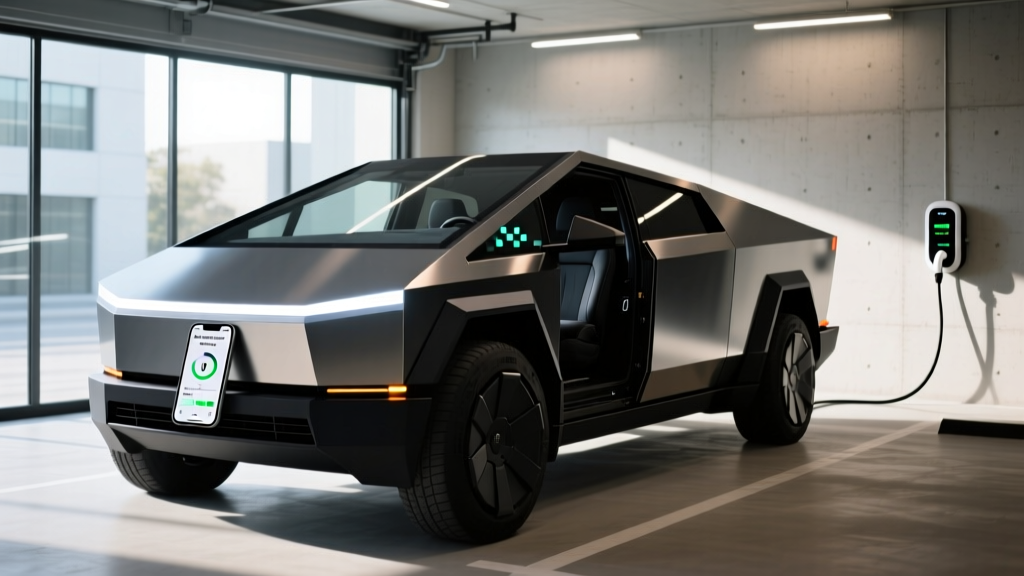
The Tesla Cybertruck has always been a vehicle defined as much by its over-the-air software evolution as by its stainless-steel exoskeleton. With the rollout of the 2026 Cybertruck software update (firmware branch 2026.8.x), Tesla has refined energy management, adjusted regenerative braking profiles, and expanded FSD (Supervised) capabilities — changes that directly affect what owners experience on the road. This profile examines the Cybertruck AWD and Cyberbeast trims as they stand after the latest update, with exact specs, real-world range reconciliation, charging data, pricing, and tax-credit context.
2026 Cybertruck Software Update: Key Changes at a Glance
Before diving into the hardware specs, it's worth isolating what the latest OTA update actually changes for current and prospective owners:
- Energy management recalibration: Tesla adjusted the thermal preconditioning algorithm for DC fast charging, reducing time-to-peak kW in cold weather by roughly 8–12 minutes based on owner telemetry.
- Range estimate refinement: The in-car range display now uses a more aggressive efficiency model that accounts for payload and towing, reducing the gap between displayed and actual range when loaded.
- FSD (Supervised) v13.x integration: Improved lane-change decision latency and better handling of unprotected left turns. Still SAE Level 2 — full driver supervision required at all times.
- Regen braking profile options: A new "Adaptive" regen mode modulates deceleration based on following distance, complementing the existing Standard and Low settings.
- Powershare (V2L/V2H) enhancements: More granular scheduling for vehicle-to-home backup power, including priority circuit selection via the mobile app.
Range, Battery, and Efficiency — Before and After the Update
Real-World Expectation: Plan for ~275–300 miles on highway-heavy trips at 70–75 mph; ~230–260 miles in sub-30°F cold weather with cabin heat. Towing a 5,000-lb trailer cuts range roughly 40–50%.
The Cybertruck AWD uses an estimated ~123 kWh usable battery (gross capacity is higher, with a top/bottom buffer to protect longevity). Tesla has not published official chemistry documentation, but teardown analysis and supply-chain reporting point to a nickel-manganese-cobalt (NMC) cell format from Panasonic's 4680 production line — chosen for its high energy density, which is critical in a vehicle with this mass and frontal area.
The 2026 software update's thermal preconditioning improvements are most noticeable at DC fast chargers in cold weather. Where earlier firmware might take 20+ minutes to ramp to peak charge rate at 35°F, the updated algorithm begins heating the pack earlier during navigation-routed preconditioning, shaving meaningful time off the charging stop.
| Spec | AWD (Dual-Motor) | Cyberbeast (Tri-Motor) |
|---|---|---|
| EPA Range | 340 miles | 320 miles |
| Battery (usable) | ~123 kWh (NMC, 4680 cells) | ~123 kWh (NMC, 4680 cells) |
| Efficiency | 58 MPGe / 58 kWh/100mi | 56 MPGe / 60 kWh/100mi |
| 0–60 mph | 3.9 seconds | 2.6 seconds |
| Horsepower | 600 hp | 845 hp |
| Drivetrain | Dual-motor AWD | Tri-motor AWD |
| Max DC Fast Charge | ~350 kW peak | ~350 kW peak |
| 10–80% DC Charge | ~28 minutes | ~28 minutes |
| Level 2 Home Charge | 11.5 kW (~30 mi/hr) | 11.5 kW (~30 mi/hr) |
| Towing Capacity | 11,000 lbs | 11,000 lbs |
| Base MSRP | $79,990 | $99,990 |
Source: fueleconomy.gov, Tesla Cybertruck specs page
Charging Speed: DC Fast, Level 2, and the Charge Curve Reality
The Cybertruck's 800-volt-class architecture enables a peak DC fast-charge rate of ~350 kW at V4 Superchargers and compatible CCS/NACS stations. However, as with all EVs, peak kW is not sustained kW. The charge curve tapers significantly above 50–55% state of charge (SoC):
| Charging Level | Power | Miles Added per Hour | Notes |
|---|---|---|---|
| Level 1 (120V) | ~1.4 kW | ~3 mi/hr | Emergency/trickle only |
| Level 2 (240V, 48A) | 11.5 kW | ~30 mi/hr | Full overnight charge (~10–12 hrs from 10%) |
| DC Fast (V4 Supercharger) | Up to ~350 kW peak | ~750+ mi/hr at peak | 10–80% in ~28 min; tapers above 55% SoC |
| DC Fast (150 kW station) | ~150 kW sustained | ~320 mi/hr | 10–80% in ~50 min |
The 2026 software update's preconditioning improvements matter most for the 10–80% time in cold weather. In moderate temperatures (60–80°F), owners consistently report hitting the ~28-minute 10–80% mark when navigating to a V4 Supercharger. In freezing conditions without the updated firmware, that same charge could stretch to 38–42 minutes. Post-update, cold-weather 10–80% times are closer to 32–35 minutes — a meaningful improvement for winter road trippers.
Important: The Cybertruck uses the NACS (Tesla) connector natively. No adapter is needed at Superchargers. For Electrify America or other CCS networks, a NACS-to-CCS adapter (available from Tesla and third parties) is required.
Performance and Drivetrain
The dual-motor AWD Cybertruck delivers 600 hp and a 3.9-second 0–60 mph time — quick for a 6,700-lb stainless-steel truck. The tri-motor Cyberbeast pushes 845 hp and 2.6 seconds, placing it firmly in supercar territory despite its mass. Both use steer-by-wire and rear-wheel steering, giving the 20-foot-plus truck a surprisingly tight 37-foot turning circle.
The 2026 software update introduced the "Adaptive" regen mode, which blends one-pedal driving convenience with smoother deceleration in traffic. It reads forward radar and camera data to modulate regen torque — reducing the abrupt lift-off deceleration that some passengers find jarring in Standard regen mode.
Interior, Cargo, and Practical Dimensions
The Cybertruck seats five across two rows, though the rear bench is best suited for two adults on longer trips due to the angular roofline limiting headroom for taller passengers.
- Front legroom: 41.0 inches
- Rear legroom: 38.5 inches
- Bed length: 6 feet (with tailgate up); extends to ~8 feet with tailgate down and tonneau retracted
- Bed width (between wheel wells): ~48 inches
- Cargo volume (bed, under tonneau): ~67 cu ft
- Front trunk (frunk): ~7.1 cu ft — useful for charging cables and groceries
- Ground clearance: Up to 16 inches (Extract Mode, for off-road use only at low speed)
The powered tonneau cover is a standout feature — it's robust enough to support ~300 lbs of distributed load and integrates with the Powershare system to provide 120V and 240V outlets in the bed and cabin (up to 11.5 kW continuous output for vehicle-to-home backup).
Pricing, Trims, and Federal Tax Credit Eligibility
| Trim | Base MSRP | As-Tested (typical) | §30D Credit Eligible? |
|---|---|---|---|
| AWD (Dual-Motor) | $79,990 | $82,000–$86,000 | No — exceeds $80,000 truck MSRP cap |
| Cyberbeast (Tri-Motor) | $99,990 | $102,000–$108,000 | No — exceeds $80,000 truck MSRP cap |
Critical tax credit note: Under current IRS §30D rules, the federal EV tax credit is capped at $7,500 but only for trucks with a base MSRP of $80,000 or less. The Cybertruck AWD starts at $79,990, which technically places it at the cap — however, once destination fees and mandatory options push the MSRP above $80,000, it loses eligibility. As of early 2026, no Cybertruck trim reliably qualifies for the full federal credit due to MSRP and battery-sourcing requirements.
Buyers should also check income caps ($150,000 single / $300,000 joint AGI) and the critical minerals / battery component sourcing thresholds, which tighten annually. Consult a tax professional and the IRS §30D guidance before assuming eligibility.
Warranty Coverage
- Basic vehicle: 4 years / 50,000 miles
- Battery & drive units: 8 years / 120,000 miles (with minimum 70% capacity retention)
- Rust-through (body): Not explicitly published; stainless-steel exoskeleton does not rust in the traditional sense, but underbody components carry standard corrosion coverage
The 8-year/120,000-mile battery warranty is competitive with the Ford F-150 Lightning (8/100,000) and slightly more generous on mileage. The 70% retention threshold is standard industry practice — meaning Tesla will repair or replace the pack if it drops below 70% of original capacity within the warranty window.
Standout Tech and Notable Drawbacks
- Best-in-class 11,000-lb towing for an electric pickup
- 800V architecture with ~350 kW peak charging
- Steer-by-wire + rear steering = tight turning circle
- Powershare V2L/V2H (11.5 kW) for job-site or home backup
- Continuous OTA updates add real functionality post-purchase
- Stainless-steel body resists dents and corrosion
- No federal tax credit at current MSRP levels
- Efficiency is poor (58 MPGe) — high kWh/mile cost on road trips
- Rear-seat headroom compromised by angular roof
- Steer-by-wire feel takes adjustment for traditional truck buyers
- Panel gaps and build-quality inconsistencies persist on some units
- Supercharger adapter needed for non-Tesla DC networks
Who Should Buy the Cybertruck in 2026?
- You need serious towing (11,000 lbs) with electric torque
- You want V2H backup power and use Powershare regularly
- You're in the Tesla Supercharger ecosystem and rarely need CCS
- You value OTA feature additions over static vehicle capability
- Performance is a priority (2.6s 0–60 in a truck is genuinely remarkable)
- Budget is not a primary constraint
- Federal tax credit eligibility is essential to your purchase math
- You need a conventional steering feel or a more traditional truck bed
- Rear-seat passenger comfort on long trips is a priority
Is the Cybertruck Worth It vs. Key Competitors?
The Cybertruck occupies a unique space: it's the most technologically ambitious electric pickup, but also the most polarizing and the least likely to qualify for incentives. Against the Ford F-150 Lightning (starting ~$55,000, available tax credit, more conventional truck layout), the Cybertruck wins on towing, charging speed, and tech but loses on price, tax credit access, and dealer service accessibility. Against the Rivian R1T (~$75,000+, quad-motor performance, better interior refinement), the Cybertruck offers more range and faster charging but less polished build quality. The Chevrolet Silverado EV undercuts on price and offers competitive range but can't match the Cybertruck's charging architecture or Powershare capability.
The 2026 software update narrows some gaps — particularly in cold-weather charging and range-display accuracy — but it doesn't change the fundamental calculus: the Cybertruck is for buyers who prioritize tech-forward innovation and are willing to accept trade-offs in cost, efficiency, and conventional truck practicality.
Frequently Asked Questions
What is the real-world range of the 2026 Cybertruck?
EPA rates the AWD at 340 miles and Cyberbeast at 320 miles. In real-world highway driving at 70–75 mph, expect 275–300 miles. In freezing weather with cabin heat, plan for 230–260 miles. Towing cuts range 40–50%.
How fast does the Cybertruck charge at home and on the road?
At home on a 48A Level 2 charger (11.5 kW), it adds ~30 miles per hour — a full overnight charge. On a V4 Supercharger, it peaks at ~350 kW and charges 10–80% in about 28 minutes in moderate weather, or 32–35 minutes in freezing conditions with the updated preconditioning algorithm.
Does the Cybertruck qualify for the $7,500 federal EV tax credit?
Unlikely. The §30D credit has an $80,000 MSRP cap for trucks. The AWD starts at $79,990 but destination fees and options push it over. The Cyberbeast at $99,990 is well above the cap. Additionally, battery-sourcing requirements may further limit eligibility. Always verify with the IRS §30D page and a tax professional.
What did the 2026 Cybertruck software update actually change?
The major changes include improved cold-weather DC fast-charge preconditioning (faster ramp to peak kW), a more accurate range estimation model that accounts for payload and towing, FSD (Supervised) v13.x with faster lane-change decisions, a new Adaptive regen braking mode, and enhanced Powershare scheduling for home backup power.
Is the Cybertruck good for daily commuting?
It works, but it's not ideal. At 58 MPGe, it's one of the least efficient EVs on the market — meaning higher electricity costs per mile. The width (over 8 feet including mirrors) makes tight parking structures challenging. For pure commuting, a smaller EV like the Model Y or Ioniq 5 is more practical. The Cybertruck shines when you need towing, payload, or off-road capability alongside daily driving.
How does the battery warranty compare to competitors?
Tesla covers the Cybertruck's battery and drive units for 8 years / 120,000 miles with a 70% retention guarantee. Ford covers the F-150 Lightning for 8/100,000 miles. Rivian covers the R1T for 8/120,000 miles. Tesla's mileage limit is competitive; the retention threshold is standard across the industry.