The Tesla Cybertruck is an angular statement piece that polarizes on sight, but beneath the stainless-steel exoskeleton sits a serious electric pickup with legitimate capability — and some real compromises. For buyers researching Cybertruck seating, cargo utility, and whether this truck can actually replace a daily driver, the answers depend heavily on which trim you pick and what you expect from a six-figure EV. This review breaks down the 2026 Cybertruck's seating configuration, EPA range, charging speeds, tax-credit picture, and ownership economics with the exact numbers you need before signing a purchase agreement.
Quick Verdict: Who Should Buy the Cybertruck?
The Cybertruck fits a narrow but enthusiastic buyer profile: tech-forward truck owners who prioritize acceleration, software integration, and head-turning design over traditional pickup refinement. If you need a five-passenger crew cab with a 6-foot bed, tow up to 11,000 lbs, and want a 48-volt electrical architecture that outpaces legacy trucks, the Cybertruck delivers. If you need a quiet highway cruiser, back-seat comfort for tall adults on long trips, or proven long-term reliability data, look at the Rivian R1T or Ford F-150 Lightning instead.
Cybertruck Seating: Cabin Layout and Dimensions
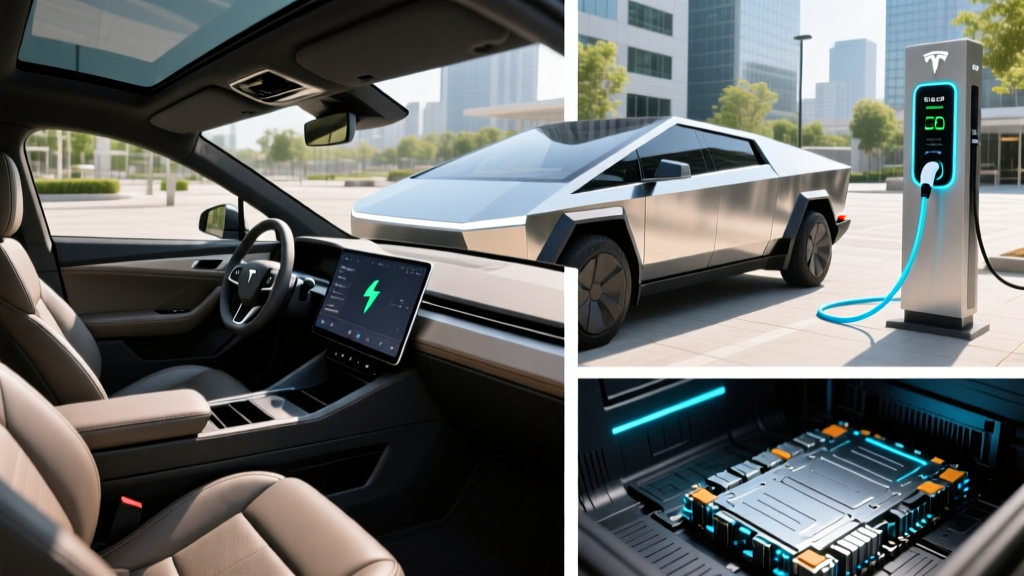
The Cybertruck seats five passengers across two rows — a 3-across front bench and a 3-across rear bench. This is a single cab configuration; there is no extended-cab or crew-cab variant. The front bench uses a 40/20/40 split with a fold-down center armrest, while the rear is a 60/40 split that folds nearly flat to extend cargo capacity into the cabin.
| Measurement | Front Row | Rear Row |
|---|---|---|
| Headroom | 41.2 in | 38.1 in |
| Legroom | 41.8 in | 36.4 in |
| Shoulder Room | 62.0 in | 58.3 in |
| Hip Room | 58.5 in | 54.1 in |
The rear seat is the Cybertruck's most debated interior feature. At 36.4 inches of legroom, it falls short of the Ford F-150 Lightning's ~43 inches and the Rivian R1T's ~41 inches. Adults over six feet will find their knees close to the front seatbacks on longer drives. The rear cushion sits relatively upright, and the sloping roofline cuts into headroom for taller passengers. That said, the seat itself is well-padded, and three-across seating is physically possible thanks to the flat floor (no transmission tunnel) and wide shoulder room.
The front bench is a standout. The center seating position is genuinely usable — unlike many trucks that offer a token middle perch — and the wide cabin provides ample elbow room. The yoke-style steering wheel (standard on Cyberbeast, optional elsewhere) takes adaptation but opens up sightlines to the 18.5-inch center touchscreen that handles virtually all vehicle controls, including glovebox release and mirror adjustment.
Range, Efficiency, and Real-World Expectations
Dual Motor AWD: EPA 340 miles | Expect ~280–310 miles highway; ~240–260 miles in freezing temps.
Cyberbeast (Tri-Motor): EPA 320 miles | Expect ~260–290 miles highway; ~220–250 miles in freezing temps.
The Cybertruck's sharp-edged, flat-panel design produces a higher drag coefficient than a rounded pickup, which hits efficiency hard above 70 mph. Cold weather further reduces range by 15–25% due to battery heating demands and cabin climate load. The available Range Extender battery pack (bed-mounted, adds ~130+ miles) partially offsets this but occupies roughly one-third of the bed.
Tesla's 4680-format battery cells use a nickel-manganese-cobalt (NMC) chemistry optimized for energy density. The usable pack capacity sits at approximately 123 kWh for the Dual Motor AWD and Cyberbeast trims. Efficiency on the EPA combined cycle rates at roughly 56 MPGe for the AWD and 51 MPGe for the Cyberbeast — translating to about 60 kWh and 66 kWh per 100 miles, respectively. That's thirstier than a Ford F-150 Lightning Extended Range (~49 kWh/100 mi) owing to the Cybertruck's weight (nearly 7,000 lbs curb) and aerodynamic profile.
| Spec | AWD | Cyberbeast |
|---|---|---|
| EPA Range | 340 mi | 320 mi |
| Battery (usable) | ~123 kWh, NMC | ~123 kWh, NMC |
| Drivetrain | Dual-Motor AWD | Tri-Motor AWD |
| Horsepower | 600 hp | 845 hp |
| 0–60 mph | 4.1 sec | 2.6 sec |
| Max Towing | 11,000 lbs | 11,000 lbs |
| Payload | 2,500 lbs | 2,500 lbs |
| Bed Length | 6 ft (72 in) | 6 ft (72 in) |
| MPGe (combined) | 56 MPGe | 51 MPGe |
Charging Speed: DC Fast Charging and Home Level 2
Charging is where the Cybertruck's 800-volt-class architecture pays dividends. The truck supports up to 250 kW peak DC fast charging at Tesla Superchargers (V3 and V4 stalls). In practice, the charge curve peaks near 250 kW between roughly 10–30% state of charge, then tapers progressively. A 10–80% session takes approximately 28–32 minutes at a capable Supercharger. Above 80%, charging slows dramatically — plan to unplug at 80% on road trips rather than wait for a full top-off.
At home, the Cybertruck accepts up to 11.5 kW on Level 2 (48A on a 60A circuit using the Tesla Wall Connector). That delivers roughly 35–40 miles of range per hour of charging. A full 0–100% home charge takes about 11–12 hours, making overnight replenishment straightforward for most daily driving needs.
| Charging Level | Power | Speed / Time |
|---|---|---|
| Level 1 (120V outlet) | ~1.4 kW | ~4–5 mi/hr |
| Level 2 (240V, 48A) | 11.5 kW | ~35–40 mi/hr; 0–100% in ~11–12 hr |
| DC Fast Charge (peak) | 250 kW | 10–80% in ~28–32 min |
One practical note: the Cybertruck ships with a NACS (North American Charging Standard) port natively. This grants access to the full Tesla Supercharger network — currently the most reliable DC fast-charging ecosystem in North America — without adapters. For non-Tesla CCS chargers (Electrify America, EVgo), you'll need a NACS-to-CCS adapter, which Tesla sells separately.
Pricing, Trims, and Federal Tax Credit Eligibility
The 2026 Cybertruck lineup carries premium pricing that places it firmly in the luxury-truck segment. Here's where each trim lands before and after potential incentives:
| Trim | Base MSRP | §30D Credit Eligible? | Effective Price (if eligible) |
|---|---|---|---|
| Rear-Wheel Drive (Long Range) | ~$60,990 | Yes (subject to income/sourcing) | ~$53,490 |
| AWD (Dual Motor) | ~$79,990 | Yes (subject to income/sourcing) | ~$72,490 |
| Cyberbeast (Tri-Motor) | ~$99,990 | Yes (subject to income/sourcing) | ~$92,490 |
Critical §30D eligibility notes (2026 tax year): Under IRS rules, the Cybertruck qualifies as a light truck, so the MSRP cap is $80,000. This means the Cyberbeast at ~$99,990 exceeds the MSRP cap and does not qualify for the $7,500 federal credit. The AWD trim at ~$79,990 sits right at the threshold — confirm the exact as-built MSRP with your dealer, as options can push it over. The Rear-Wheel Drive Long Range trim qualifies on price. All trims are subject to:
- Buyer income caps: $150,000 single / $225,000 head of household / $300,000 joint (modified AGI)
- Battery component and critical mineral sourcing requirements that phase in progressively — Tesla's supply chain has generally met these thresholds, but verify at point of sale
- Point-of-sale transfer option: You can transfer the credit to the dealer at purchase to reduce your out-of-pocket cost, rather than waiting to claim it on your tax return
Always confirm eligibility with a tax professional and check the latest IRS guidance on clean vehicle credits before purchasing, as sourcing rules and eligible vehicle lists update periodically.
Performance, Towing, and Daily Driving
The Cyberbeast's 2.6-second 0–60 mph time makes it the quickest production pickup ever sold, a figure that feels surreal in a vehicle weighing nearly three and a half tons. The dual-motor AWD trim is hardly slow at 4.1 seconds. Both trims use steer-by-wire technology — there is no mechanical connection between the yoke/wheel and the front axle. This enables variable steering ratios (fewer turns lock-to-lock at low speeds) but takes acclimation, especially at highway speeds where the lack of traditional feedback feels detached initially.
Towing capacity peaks at 11,000 lbs across all trims, matching or exceeding many half-ton gas trucks. However, towing any significant load cuts range by 30–50% depending on trailer weight and profile. A 7,000-lb enclosed trailer on the highway can reduce the AWD's effective range to under 180 miles — plan charging stops accordingly. The Cybertruck includes an integrated trailer brake controller and a tow/haul mode that adjusts regen and throttle mapping.
Ride quality has improved since early-production models thanks to firmware updates to the adaptive air suspension, but the truck still transmits more road imperfections into the cabin than an F-150 Lightning or Rivian R1T. The stainless-steel body panels are dent-resistant but show fingerprints and water spots aggressively — expect to wipe the truck down frequently if appearance matters to you.
Tech, Driver Assistance, and Standout Features
The Cybertruck runs Tesla's latest vehicle software on the 18.5-inch center display, which also serves as the instrument cluster (visible over the yoke). A 9.4-inch rear touchscreen controls rear climate and entertainment. Key tech includes:
- Autopilot (standard): Adaptive cruise, lane centering, automatic emergency braking — SAE Level 2 driver assistance, requiring continuous driver supervision
- Full Self-Driving (Supervised) ($8,000 option or subscription): Adds automated lane changes, Navigate on Autopilot, traffic light/stop sign recognition, and city-street autosteer. Still SAE Level 2 — you must monitor the road at all times
- Powered tonneau bed cover with integrated bed lighting and 120V/240V outlets (up to 11.5 kW vehicle-to-load power output)
- Bioweapon Defense Mode HEPA air filtration
- Frunk (front trunk) with ~7 cu ft of lockable storage
| Area | Volume / Dimension |
|---|---|
| Bed (with cover closed) | ~67 cu ft |
| Frunk | ~7 cu ft |
| Under-bed rear storage | Limited (no traditional under-bed access) |
| Bed length | 72 in (6 ft) |
| Bed width (between wheel wells) | ~50 in |
Warranty and Long-Term Ownership
Tesla covers the Cybertruck with a 4-year / 50,000-mile basic vehicle warranty and an 8-year / 120,000-mile battery and drive unit warranty. The battery warranty guarantees a minimum 70% capacity retention over the warranty period. Given the Cybertruck's relatively low production volume and novel construction (stainless-steel exoskeleton, steer-by-wire, 48V architecture), long-term reliability data is still accumulating. Early-production vehicles experienced recalls for accelerator pedal trim detachment, windshield wiper motor failures, and inverter issues — all addressed via recall campaigns.
Insurance costs run significantly higher than average for the segment. Expect annual premiums 25–40% above a comparably priced F-150 Lightning, driven by the Cybertruck's repair complexity (stainless-steel panel replacement requires specialized body shops), high replacement parts costs, and performance classification. Get insurance quotes before ordering — this is a meaningful ownership cost that catches many buyers off guard.
Cybertruck vs. Key Competitors
| Spec | Cybertruck AWD | Ford F-150 Lightning (Ext. Range) | Rivian R1T (Dual-Motor Max) |
|---|---|---|---|
| EPA Range | 340 mi | 320 mi | 352 mi |
| Base MSRP | ~$79,990 | ~$69,995 | ~$89,900 |
| 0–60 mph | 4.1 sec | ~4.5 sec | ~3.5 sec |
| Max Towing | 11,000 lbs | 10,000 lbs | 11,000 lbs |
| Rear Legroom | 36.4 in | ~43.6 in | ~41.3 in |
| Bed Length | 72 in | 67 in (5.5 ft) | 54 in (4.5 ft) + Gear Tunnel |
| §30D Credit | Eligible (if under cap) | Eligible | Eligible |
The F-150 Lightning wins on rear-seat comfort, dealer service network breadth, and lower entry price. The Rivian R1T offers superior build quality, a more refined ride, and a creative Gear Tunnel for enclosed storage, though at a higher price and shorter bed. The Cybertruck counters with the longest standard bed, the most distinctive design, V2L capability rivaling a portable generator, and the Tesla Supercharger network advantage.
Pros and Cons
- Class-leading acceleration (Cyberbeast: 2.6 sec 0–60)
- 11,000-lb towing capacity with integrated brake controller
- NACS native — full Supercharger network access
- 11.5 kW V2L power output for job-site or camping use
- Stainless-steel body resists dents and corrosion
- Longest standard bed in the EV pickup segment (6 ft)
- Rear seat legroom is tight for adults (36.4 in)
- Highway efficiency suffers from boxy aerodynamics (~56 MPGe)
- Steer-by-wire requires adaptation; lacks traditional road feedback
- Insurance premiums significantly above segment average
- Stainless-steel panels show smudges and require frequent cleaning
- Cyberbeast exceeds $80K MSRP cap — no §30D credit
- Limited service center network vs. legacy truck brands
Frequently Asked Questions
What is the real-world range of the Cybertruck?
The EPA rates the AWD at 340 miles and the Cyberbeast at 320 miles. In real-world highway driving at 70–75 mph, expect roughly 280–310 miles from the AWD and 260–290 from the Cyberbeast. In freezing temperatures, subtract another 15–25%. The optional Range Extender pack adds approximately 130+ miles but consumes bed space.
How fast does the Cybertruck charge?
At a 250 kW Tesla Supercharger, the Cybertruck charges from 10–80% in approximately 28–32 minutes. On a home Level 2 charger (11.5 kW / 48A), expect 35–40 miles of range per hour, with a full charge taking about 11–12 hours.
How much does the Cybertruck cost after tax credits?
The RWD Long Range starts around $60,990, dropping to ~$53,490 with the full $7,500 §30D credit if you meet income and sourcing requirements. The AWD at ~$79,990 may qualify but sits right at the MSRP cap. The Cyberbeast at ~$99,990 does not qualify due to the $80,000 truck MSRP cap.
Does the Cybertruck qualify for the federal EV tax credit?
It depends on the trim and your tax situation. The RWD and potentially the AWD qualify under the $80,000 truck MSRP cap. The Cyberbeast does not. All trims require the buyer to meet IRS income limits and the vehicle must meet battery-sourcing requirements. Consult a tax professional and verify at point of sale.
Is the Cybertruck worth buying over the F-150 Lightning or Rivian R1T?
Choose the Cybertruck if you prioritize acceleration, Tesla's Supercharger network, V2L capability, a full 6-foot bed, and distinctive design. Choose the F-150 Lightning for rear-seat comfort, lower pricing, and a vast dealer service network. Choose the Rivian R1T for build quality, ride refinement, and adventure-oriented storage solutions.
How comfortable is the Cybertruck rear seat for adults?
Adequate for short trips but tight for long highway drives. The 36.4 inches of rear legroom trails both the Lightning and R1T by several inches, and the rear cushion sits upright. Three adults can fit across the bench, but shoulder room is snug. If rear-seat passengers are a daily priority, test-ride before ordering.
Sources: EPA Fuel Economy, Tesla Cybertruck Specifications, IRS Clean Vehicle Credits.