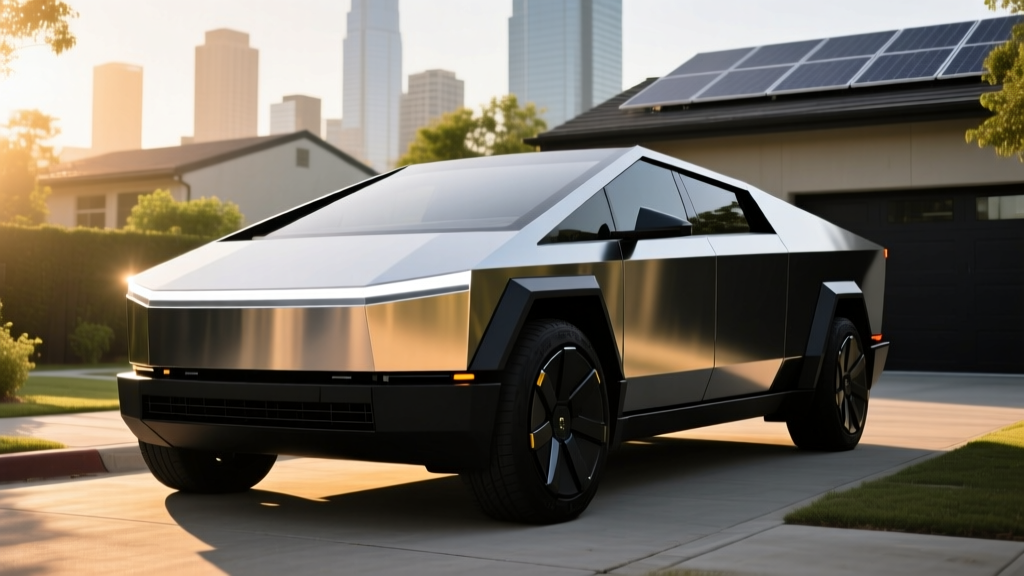
After a turbulent launch year, the Tesla Cybertruck enters 2026 with a clearer market position and a full calendar of sales data behind it. Cybertruck sales in 2025 revealed a polarized reception: strong demand from Tesla loyalists and fleet buyers, tempered by production constraints, price adjustments, and real-world range scrutiny that every large electric pickup faces. For buyers evaluating the Cybertruck today, understanding what those 2025 numbers mean—and how the truck actually performs in daily use—matters more than headline volume figures.
This review breaks down the Cybertruck lineup as it stands for the 2026 model year, using 2025 sales context to frame which trims move, what ownership actually costs, and whether the Cybertruck's specs hold up outside the showroom.
Cybertruck Sales 2025: The Numbers and What They Signal
Industry estimates placed full-year 2025 Cybertruck deliveries in the range of 40,000 to 55,000 units across all trims—a figure that reflects both Tesla's production ramp and the natural demand ceiling for a six-figure electric pickup. The rear-wheel-drive (RWD) base model, announced for 2025 availability, shifted the entry price downward and accounted for a meaningful share of orders in the second half of the year. The dual-motor all-wheel-drive (AWD) and Cyberbeast trims dominated early deliveries to reservation holders willing to pay premium pricing.
For 2026 buyers, the sales data reveals a practical takeaway: the AWD trim is the volume sweet spot, balancing range, performance, and price. The Cyberbeast remains a low-volume halo, and the RWD model—while the most affordable—carries the shortest range and longest wait times as Tesla prioritizes higher-margin configurations.
Range, Battery, and Real-World Efficiency
Dual Motor AWD: EPA-estimated 340 miles. Real-world highway driving at 70+ mph yields approximately 270–300 miles. In cold weather (below 32°F), expect 220–260 miles without preconditioning.
Cyberbeast (Tri-Motor AWD): EPA-estimated 320 miles. Real-world highway: ~255–285 miles. Cold weather: ~200–240 miles.
Rear-Wheel Drive: EPA-estimated 250 miles (preliminary). Real-world highway: ~200–225 miles.
The Cybertruck's angular stainless-steel exoskeleton creates a drag coefficient higher than sleeker EVs, and that aerodynamic penalty shows up most at highway speeds. The truck's roughly 123 cubic-foot equivalent bed and 6,600+ lb curb weight also work against efficiency. On the EPA cycle, the Dual Motor AWD achieves approximately 2.0 kWh/mile (about 50 kWh/100 mi), translating to roughly 60 MPGe combined. These are not class-leading numbers—the Rivian R1T and Ford F-150 Lightning post similar or slightly better efficiency—but they are typical for a full-size electric pickup.
The battery pack uses an NMC (nickel manganese cobalt) chemistry in a structural 4680-cell configuration. Usable capacity sits at approximately 123 kWh for the AWD and Cyberbeast trims. Tesla's thermal management system, including a heat pump, helps mitigate cold-weather losses, but any large-battery EV will shed 20–30% of range in sustained sub-freezing temperatures without garage preconditioning.
| Spec | RWD | AWD (Dual Motor) | Cyberbeast (Tri-Motor) |
|---|---|---|---|
| EPA Range | ~250 mi | 340 mi | 320 mi |
| Battery (usable) | ~100 kWh (est.) | ~123 kWh | ~123 kWh |
| Chemistry | NMC (4680) | NMC (4680) | NMC (4680) |
| 0–60 mph | ~6.5 sec | 4.1 sec | 2.6 sec |
| Horsepower | ~350 hp | 600 hp | 845 hp |
| Drivetrain | RWD | AWD | AWD |
| Max Towing | 7,500 lb | 11,000 lb | 11,000 lb |
| MPGe (combined) | ~58 MPGe | ~60 MPGe | ~56 MPGe |
| Base MSRP | $60,990 | $79,990 | $99,990 |
Charging Speed: DC Fast, Level 2, and the 4680 Curve
Charging speed is where the Cybertruck's 4680 cells face real-world scrutiny. Tesla rates the AWD and Cyberbeast for a peak DC fast-charge rate of approximately 350 kW at a V4 Supercharger under ideal conditions. However, sustained charge rates tell a different story.
| Charging Level | Power (kW) | Speed / Notes |
|---|---|---|
| DC Fast Charge (Peak) | ~350 kW | 10–80% in ~20 min (optimal conditions, preconditioned) |
| DC Fast Charge (Sustained avg.) | ~175–225 kW | Charge curve tapers significantly above 60% SoC |
| Level 2 Home (48A / 11.5 kW) | 11.5 kW | ~28–30 miles of range per hour; 0–100% in ~11–12 hours |
| Level 2 Home (32A / 7.7 kW) | 7.7 kW | ~19 miles per hour; 0–100% in ~16 hours |
| Level 1 (120V / 12A) | ~1.4 kW | ~3–4 miles per hour; emergency/trickle only |
The 10–80% time of roughly 20 minutes assumes the battery is preconditioned via the navigation-routed Supercharger approach and ambient temperatures are moderate. In cold weather or without preconditioning, expect 10–80% times closer to 30–35 minutes at most public DC chargers. The charge curve tapers hard past 60% state of charge (SoC)—a characteristic of the 4680 NMC cells—so charging from 80–100% on DC fast charging is painfully slow and best left to overnight Level 2 sessions.
At home, a 48-amp Level 2 charger on a 60-amp circuit (the most common residential upgrade) delivers about 11.5 kW, adding roughly 29 miles of range per hour of charging. For a driver covering 40–50 miles daily, an overnight charge from 30% to 80% takes about 5–6 hours—well within a normal sleep window. Installation costs for a Level 2 home setup typically range from $800 to $2,500 depending on panel capacity and conduit run, according to the U.S. Department of Energy.
Performance and Driving Dynamics
The Cyberbeast's 2.6-second 0–60 mph time is supercar territory in a truck that weighs nearly three and a half tons. The dual-motor AWD's 4.1-second run is more relevant for most buyers—it's quicker than any internal-combustion pickup in its class and delivers confident highway merging and passing. The tri-motor Cyberbeast adds torque vectoring to the rear axle, which improves cornering composure but adds weight and cost.
Ride quality uses an adaptive air suspension with up to 16 inches of ground clearance in Extract Mode (useful for off-road obstacles but rarely needed on pavement). The steer-by-wire system, which replaces the mechanical steering column with electronic actuators, takes adjustment. At low speeds, the yoke-style steering wheel requires fewer turns lock-to-lock than a conventional setup; at highway speeds, it feels precise but disconnected from road texture. Drivers accustomed to traditional steering may need a week or two to build muscle memory.
The 11,000-pound max towing capacity (AWD and Cyberbeast) is competitive with the F-150 Lightning's 10,000-pound rating but trails heavy-duty ICE trucks. Towing at max capacity cuts range roughly in half—expect 150–170 miles from the AWD when pulling a loaded trailer at highway speeds. This is a physics reality for every electric pickup, not a Cybertruck-specific limitation.
Pricing, Trims, and Federal Tax Credit Eligibility
The Cybertruck lineup for 2026 carries significant pricing, and the federal tax credit picture is nuanced.
| Trim | Base MSRP | §30D Credit Eligible? | Effective Price (if eligible) |
|---|---|---|---|
| RWD | $60,990 | Yes (under $80K truck cap) | ~$53,490 |
| Dual Motor AWD | $79,990 | Yes (under $80K truck cap) | ~$72,490 |
| Cyberbeast | $99,990 | No (exceeds $80K truck MSRP cap) | $99,990 |
Under IRS §30D rules, new clean vehicle credits are capped at $7,500 and subject to several requirements:
- MSRP cap: Vans, SUVs, and pickup trucks must have an MSRP at or below $80,000. The RWD and AWD trims qualify; the Cyberbeast at $99,990 does not.
- Buyer income limits: Modified adjusted gross income (MAGI) must not exceed $300,000 (joint filers), $225,000 (head of household), or $150,000 (single filers).
- Battery sourcing: A percentage of critical minerals and battery components must be sourced from the U.S. or free-trade-agreement partners. Tesla's domestic 4680 cell production positions the Cybertruck favorably, but exact eligibility can shift with supply-chain changes. Confirm current-year compliance at fueleconomy.gov.
- Point-of-sale transfer: Eligible buyers can apply the credit as a down-payment reduction at the dealer rather than waiting for a tax refund.
The Cyberbeast's exclusion from the credit is a dealbreaker for some performance-oriented buyers, but at nearly $100,000, most Cyberbeast purchasers are less credit-sensitive. The AWD at an effective ~$72,490 after the credit becomes a more compelling value proposition against the Rivian R1T and F-150 Lightning.
Cargo, Interior Space, and Daily Practicality
The Cybertruck's 6-foot composite bed (officially called the "Vault") offers 67 cubic feet of enclosed cargo space with the tonneau cover closed. The bed is 43.5 inches wide between the wheel wells—narrow enough for a standard sheet of plywood laid flat only if angled slightly, which is a practical frustration for contractors. The motorized tonneau cover supports up to 300 pounds of distributed load and integrates with the truck's 120V and 240V bed outlets for powering tools or appliances (a feature Tesla calls Powershare).
Inside, the cabin seats five (six with the optional front bench). Rear legroom measures approximately 38.5 inches—adequate for adults but tighter than the F-150 Lightning's more traditional crew-cab dimensions. The minimalist interior centers on an 18.5-inch front touchscreen and a 9.4-inch rear screen, with no physical buttons for climate or audio. The yoke steering wheel is standard; a conventional round wheel is available as a no-cost option for 2026.
Storage includes a front trunk (frunk) with approximately 7 cubic feet of space—large enough for a charging cable bag and a few grocery bags but smaller than the Lightning's massive frunk. The stainless-steel exterior is dent-resistant but shows fingerprints aggressively; Tesla recommends a specific cleaning regimen that some owners find tedious.
Technology, Driver Assistance, and Safety
The Cybertruck ships with Tesla's latest Hardware 4.0 computer and a camera-only vision system (no radar or ultrasonic sensors). Autopilot—Tesla's standard Level 2 driver-assistance suite—includes adaptive cruise control, lane centering, and automatic emergency braking. Full Self-Driving (Supervised), a $8,000 add-on or $99/month subscription, adds automated lane changes, navigation-based on-ramp-to-off-ramp assistance, and traffic-light recognition.
Both Autopilot and FSD (Supervised) are SAE Level 2 driver-assistance systems. The driver must remain fully engaged, hands on the yoke/wheel, and eyes on the road at all times. The Cybertruck is not a self-driving vehicle. Tesla's camera-only approach has drawn scrutiny from NHTSA investigations regarding driver-monitoring adequacy.
The infotainment system supports streaming, gaming (via a built-in GPU capable of running titles like Cyberpunk 2077 while parked), and over-the-air software updates that periodically add features. There is no Apple CarPlay or Android Auto—a deliberate Tesla choice that frustrates some buyers who prefer phone-mirroring ecosystems.
As of early 2026, the Cybertruck has not been crash-tested by the IIHS or rated by NHTSA's 5-star program. The stainless-steel exoskeleton and large crumple zones suggest strong crashworthiness, but the absence of independent test data is a gap buyers should note.
Warranty, Ownership Costs, and Longevity
Tesla covers the Cybertruck with a 4-year/50,000-mile basic limited warranty and an 8-year/120,000-mile battery and drive-unit warranty. The battery warranty guarantees retention of at least 70% of original capacity over that period—a threshold consistent with industry norms. Based on Tesla's 4680 cell degradation data from Model Y deployments, owners can reasonably expect approximately 10–12% total capacity loss over 150,000 miles under normal charging habits (avoiding frequent 100% charges and DC fast charging when possible).
Insurance premiums for the Cybertruck run significantly higher than average—often $3,000–$5,000 annually depending on state, driving record, and trim. The stainless-steel body panels and specialized repair requirements contribute to higher collision-repair costs, which insurers price into premiums. Get quotes before purchasing; the difference between the RWD and Cyberbeast insurance costs can be substantial.
Five-year total cost of ownership for the AWD trim, assuming 12,000 miles/year, $0.14/kWh home electricity, and no major repairs, lands in the neighborhood of $55,000–$62,000 (including depreciation, insurance, energy, and maintenance). This is competitive with a loaded F-150 Lightning but higher than a Rivian R1T when factoring in the R1T's stronger residual values.
Pros
- Class-leading acceleration (Cyberbeast: 2.6 sec 0–60)
- Stainless-steel exoskeleton resists dents and corrosion
- 350 kW peak DC fast-charge capability
- Onboard 120V/240V power outlets for tools and appliances
- Strong Supercharger network access for road trips
- Air suspension with adjustable ride height
Cons
- Real-world highway range falls well short of EPA estimates
- No Apple CarPlay or Android Auto
- Bed width between wheel wells won't fit flat plywood
- High insurance premiums due to repair costs
- No independent crash-test ratings yet
- Steer-by-wire and yoke require significant adaptation
- Cyberbeast trim ineligible for federal tax credit
Who Should Buy the Cybertruck in 2026?
The Cybertruck AWD makes the most sense for buyers who want a daily-drivable electric pickup with genuine towing capability, access to Tesla's Supercharger network, and enough range for 200-mile road-trip legs between charging stops. It suits tech-forward owners who value over-the-air updates and integrated power delivery over traditional truck ergonomics.
It is less ideal for commercial fleets that need wide-bed cargo loading, buyers who prioritize proven crash-test data, or anyone who depends on Apple CarPlay for daily navigation. If you tow frequently over long distances, the Lightning's larger battery option or the Rivian R1T's Max Pack may offer more practical range under load.
- You want a $72K–$80K electric pickup with Supercharger access and 340 miles of EPA range
- You value onboard power outlets for job-site or camping use
- You're comfortable with a camera-only driver-assist system and minimalist interior
- You need flat-loadable bed width for plywood or pallets (check the F-150 Lightning)
- You want independent crash-test ratings before buying (wait for IIHS/NHTSA data)
- You tow heavy loads over 200+ miles regularly without time for mid-route charging
Frequently Asked Questions
What is the real-world range of the Cybertruck?
The Dual Motor AWD is EPA-rated at 340 miles, but real-world highway driving at 70+ mph typically yields 270–300 miles. In cold weather below freezing, expect 220–260 miles unless you precondition the battery while plugged in. The Cyberbeast loses about 20 miles of EPA range due to its tri-motor weight and performance tuning.
How fast does the Cybertruck charge at home and on the road?
On a 48-amp Level 2 home charger, the Cybertruck adds roughly 29 miles of range per hour, reaching a full charge overnight in about 11–12 hours. At a V4 Supercharger, it peaks at 350 kW and can charge from 10–80% in approximately 20 minutes when preconditioned—though sustained average rates are closer to 175–225 kW due to the charge curve taper above 60% SoC.
Does the Cybertruck qualify for the $7,500 federal EV tax credit?
The RWD ($60,990) and AWD ($79,990) trims fall under the $80,000 MSRP cap for trucks and are eligible for the full $7,500 §30D credit if the buyer meets income limits ($300K joint / $150K single) and the vehicle's battery sourcing meets current-year critical-mineral requirements. The Cyberbeast at $99,990 exceeds the MSRP cap and does not qualify. Always verify current eligibility at fueleconomy.gov and consult a tax professional.
Is the Cybertruck worth buying versus the Rivian R1T or F-150 Lightning?
The Cybertruck wins on acceleration, Supercharger network access, and stainless-steel durability. The F-150 Lightning offers a more traditional truck layout with a wider bed and larger frunk. The Rivian R1T provides a more refined interior, better off-road capability with quad-motor torque vectoring, and stronger early residual values. If Supercharger access and Tesla's software ecosystem matter to you, the Cybertruck AWD is compelling. If bed practicality or crash-test data are priorities, the Lightning or R1T may be better fits.
What are the biggest Cybertruck drawbacks owners report?
The most common owner complaints center on real-world range falling short of EPA estimates (especially at highway speeds), the fingerprint-prone stainless-steel exterior requiring frequent cleaning, the learning curve of steer-by-wire with the yoke, and the absence of Apple CarPlay. Insurance costs also surprise many first-time owners.
How long will the Cybertruck battery last?
Tesla warranties the battery for 8 years or 120,000 miles, whichever comes first, with at least 70% capacity retention. Based on 4680 NMC cell data, expect roughly 10–12% degradation over 150,000 miles under moderate use. Avoiding routine 100% charges and minimizing DC fast charging to road trips will extend long-term battery health.