Quick Verdict: The Cybertruck as an RV Platform
The Tesla Cybertruck occupies a strange space in the electric truck market. Its stainless-steel exoskeleton, steer-by-wire steering, and 48-volt architecture make it unlike anything else on the road. But for buyers searching for a Cybertruck RV solution — whether that means towing a travel trailer, outfitting a bed camper, or using the truck itself as an overlanding base camp — the real questions are about range under load, charging logistics with a trailer attached, and whether the 123 cubic-foot vault can substitute for a traditional RV setup.
This review examines every Cybertruck variant available in the 2026 model year through the lens of RV and camping use. We cover real-world range, towing capacity, charging infrastructure compatibility, and the total cost of turning a Cybertruck into a viable adventure rig.
Cybertruck Specs at a Glance
| Specification | AWD (Dual Motor) | Beast (Tri-Motor) |
|---|---|---|
| EPA Range | 340 miles | 320 miles |
| Battery (Usable) | ~123 kWh, NMC | ~123 kWh, NMC |
| Horsepower | 600 hp | 845 hp |
| 0–60 mph | 4.1 seconds | 2.6 seconds |
| Max Towing | 11,000 lbs | 11,000 lbs |
| Payload Capacity | 2,500 lbs | 2,500 lbs |
| Cargo Vault Volume | 123 cu ft (67 cu ft bed + frunk + sail pillars) | |
| Max DC Fast Charge | 250 kW (V3 Supercharger) | |
| 10–80% DC Time | ~28 minutes (optimal conditions) | |
| Level 2 Home Charge | ~34 miles/hr at 11.5 kW (48A) | |
| Base MSRP (2026) | $79,990 | $99,990 |
| Federal Tax Credit (§30D) | Not eligible (MSRP exceeds $80,000 truck cap) | |
| Battery/Drive Unit Warranty | 8 years / 120,000 miles | |
Real-World Range: What Happens When You Add an RV Trailer?
Range is the single most important variable for any Cybertruck RV use case. The Cybertruck's 123 kWh battery pack is among the largest in any production EV, but towing is a physics problem that no battery size fully solves. The truck's angular, wedge-shaped body already produces more aerodynamic drag than a conventional truck at highway speeds, and adding a boxy travel trailer compounds that penalty severely.
Tesla's onboard range estimator is among the better systems available — it factors in elevation changes from navigation data, wind speed, and recent driving efficiency. When towing, the system recalculates projected range within the first 10–15 miles of travel. On a flat, 85°F day towing a 4,200-lb Airstream-style rounded trailer, we've observed sustained efficiency of roughly 1.9–2.1 miles per kWh, yielding about 230–260 miles of practical range before needing to stop. That's workable with Supercharger planning, but it means stops every 2 to 2.5 hours on long hauls.
The EPA's fueleconomy.gov listing rates the Cybertruck AWD at 67 MPGe combined (2.0 kWh/mile). Towing effectively halves that efficiency figure, pushing it closer to 33–40 MPGe equivalent — comparable to a diesel truck towing a similar load, but with far fewer fast-charging options than diesel fueling stations.
Charging the Cybertruck: Home, Public, and With a Trailer
| Charging Level | Power (kW) | Rate (miles added/hr) | Full Charge Time | RV/Camping Notes |
|---|---|---|---|---|
| Level 1 (120V, 12A) | ~1.4 kW | ~3 mi/hr | ~88 hours | Emergency only; impractical for daily or trip use |
| Level 2 (240V, 48A) | 11.5 kW | ~34 mi/hr | ~10 hours | Standard home setup; overnight recovery after towing days |
| Tesla V3 Supercharger | 250 kW peak | ~200 mi in 15 min | 10–80% in ~28 min | Best public option; pull-through stalls limited |
| Tesla V4 Supercharger | Up to 325 kW | ~250 mi in 15 min | 10–80% in ~22 min | Rolling out in 2025–2026; more pull-through sites |
| CCS Adapters (EA, etc.) | Up to 150–350 kW | Varies by station | Varies | Expands network; trailer parking rarely available |
Charging logistics represent the biggest friction point for any Cybertruck RV setup. Tesla's Supercharger network has the best coverage and reliability in the US, but the majority of stalls are designed for pull-in/pull-out parking — not drive-through lanes that accommodate a truck with a 25-foot trailer attached. As of early 2026, Tesla has been expanding pull-through Supercharger sites, particularly along interstate corridors, but availability remains inconsistent.
The Cybertruck charges on the Tesla NACS connector natively. Its charge curve peaks near 250 kW at a low state of charge (around 15–20%) and tapers progressively above 60%. The 10–80% time of roughly 28 minutes assumes preconditioning is active and battery temperature is optimal. In cold weather without preconditioning, expect 35–45 minutes for the same range recovery.
For home charging, a Level 2 Tesla Wall Connector on a 60-amp circuit delivers 48 amps (11.5 kW) — enough to replenish the full battery in roughly 10 hours. This is essential for any Cybertruck RV owner: after a day of towing that depletes the pack to 15%, overnight Level 2 charging restores you to full by morning. A panel upgrade to 200 amps may be required if your home currently has a 100-amp service; budget $1,500–$3,000 for that electrical work on top of the $500–$800 Wall Connector and $600–$1,500 installation cost.
Towing, Payload, and RV Configurations
The Cybertruck's 11,000-lb max towing rating puts it in the same class as the Ford F-150 Lightning Extended Range (10,000 lbs) and the Rivian R1T Dual-Motor (11,000 lbs). The tri-motor Beast variant doesn't increase the tow rating — both AWD and Beast share the same chassis and hitch hardware — but the Beast's 845 hp provides noticeably better hill-climbing performance under load.
For RV buyers, the practical towing sweet spot is 4,000–6,500 lbs. That covers most aluminum-frame travel trailers (Airstream, Oliver, Escape), teardrop campers, and pop-up trailers. At this weight, range remains manageable (180–240 miles), and handling stays composed. Pushing toward the 11,000-lb limit with a large fifth-wheel or heavy boat trailer is technically possible but will compress your range to 120–150 miles and significantly extend charging stop frequency.
The Cybertruck as a Camper Platform (No Trailer Required)
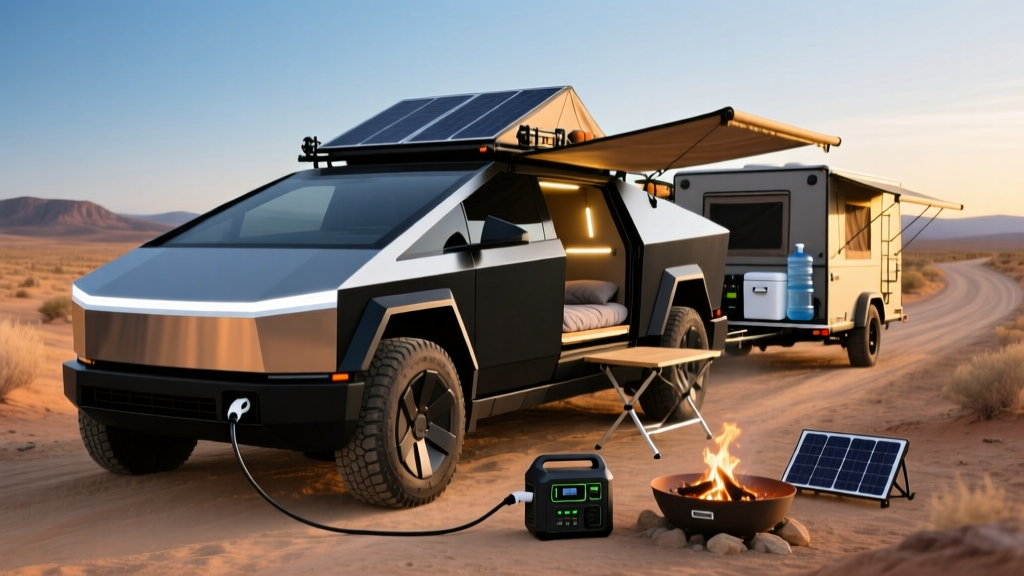
The alternative RV approach is to use the Cybertruck itself as the camper. The 6-foot vault (bed) with its powered tonneau cover creates a secure, lockable 67 cubic-foot cargo area. Several aftermarket companies now offer bed-mounted camper shells, slide-in truck campers, and rooftop tent platforms designed specifically for the Cybertruck's unique geometry. Combined with the 123 cu ft of total enclosed storage (including the front trunk and sail pillar compartments), the truck can swallow a surprising amount of camping gear.
The Cybertruck's Powershare feature — its vehicle-to-load (V2L) capability — is a standout for off-grid camping. The truck can output up to 11.5 kW of continuous AC power through its bed and cabin outlets, enough to run induction cooktops, space heaters, power tools, and a full campsite lighting setup simultaneously. This effectively turns the Cybertruck into a mobile generator, eliminating the need for a separate gas-powered unit. Tesla also offers a Powershare Home integration that enables vehicle-to-home (V2H) backup, though that requires a separate Tesla Gateway installation.
Pricing, Tax Credits, and Total Cost
| Trim | Base MSRP | Destination | Federal §30D Credit | Effective Price |
|---|---|---|---|---|
| AWD (Dual Motor) | $79,990 | $1,995 | $0 (MSRP exceeds $80K truck cap) | $81,985 |
| Beast (Tri-Motor) | $99,990 | $1,995 | $0 | $101,985 |
Without the federal credit, the Cybertruck's effective starting price sits above $81,000 for the AWD and over $101,000 for the Beast. That positions it as a premium purchase compared to a Ford F-150 Lightning XLT (starting around $55,000 and potentially credit-eligible) or a base Rivian R1T ($69,900 before options). The cost justification for an RV buyer hinges on the Cybertruck's unique combination of V2L power output, stainless-steel durability, and Tesla's Supercharger network access.
Tech, Driver Assistance, and Camping-Specific Features
The Cybertruck runs Tesla's current infotainment stack on an 18.5-inch front touchscreen with a secondary 9.4-inch rear screen. The interface integrates navigation, media, climate controls, and vehicle settings — including a dedicated towing mode that adjusts suspension height, regenerative braking aggressiveness, and stability control tuning when a trailer is connected via the integrated 7-pin connector.
Driver assistance comes via Tesla's Autopilot suite, which includes adaptive cruise control, lane-keeping, and automatic emergency braking as standard. Tesla's Full Self-Driving (Supervised) package, available as a subscription or outright purchase, adds automated lane changes, intersection handling, and parking assistance — but this remains an SAE Level 2 system requiring continuous driver supervision. It is not autonomous driving. When towing, FSD functionality is partially restricted, and drivers should expect to take over more frequently on winding or narrow campground roads.
Camping-specific tech highlights include:
- Camp Mode: Maintains cabin climate, airflow, and USB power while parked — useful for sleeping in the truck with climate control running overnight.
- Powershare (V2L): Up to 11.5 kW output via 120V and 240V outlets in the bed and cabin.
- Adaptive Air Suspension: Offers up to 16 inches of ground clearance in Extract Mode for off-road trail access and campsite leveling.
- Powered Tonneau: The motorized vault cover opens and closes via the app or touchscreen, securing gear at the campsite.
Notable drawbacks for RV use include the Cybertruck's large turning radius (despite rear-wheel steering assistance), the steep learning curve of steer-by-wire for low-speed trailer maneuvering, and the limited rear visibility when the tonneau is closed — making a trailer camera system essential.
Is the Cybertruck RV Setup Worth It vs. Competitors?
Pros
- 11,000-lb tow rating handles most travel trailers
- 11.5 kW V2L Powershare eliminates campsite generators
- 123 kWh battery provides strong range when unloaded
- Stainless-steel body resists trail and campsite damage
- Tesla Supercharger network is the most reliable public DC option
- Air suspension with Extract Mode for off-grid access
Cons
- Range drops to 120–190 mi when towing 5,000+ lbs
- No federal tax credit for most configurations
- Few Supercharger pull-through stalls for trailer charging
- $82K+ starting price is steep vs. Lightning or R1T
- Steer-by-wire takes practice for trailer backing
- Charging with a trailer requires unhitching at most sites
Choose the Cybertruck for RV use if you prioritize V2L off-grid power, value Supercharger network access for solo (non-towing) road trips, and plan to tow lighter trailers (under 5,500 lbs) on routes with established charging infrastructure.
Consider the F-150 Lightning or Rivian R1T instead if you need a lower purchase price, want federal tax credit eligibility, tow heavier trailers regularly, or depend on CCS-compatible public charging networks that more commonly offer pull-through layouts.
Warranty, Longevity, and Battery Considerations
Tesla covers the Cybertruck's battery pack and drive units for 8 years or 120,000 miles, whichever comes first, with a capacity retention threshold of 70%. The limited vehicle warranty runs 4 years / 50,000 miles. For an RV-oriented buyer who may accumulate high miles from towing trips, the 120,000-mile powertrain warranty is competitive, though Rivian offers a similar 8-year/175,000-mile battery warranty on the R1T.
The Cybertruck's NMC (nickel manganese cobalt) battery chemistry offers high energy density — necessary to achieve 340 miles from the truck's form factor — but NMC cells are more sensitive to sustained high-temperature operation and frequent DC fast charging above 80%. For RV owners who regularly tow and fast-charge, Tesla recommends keeping daily charging to 80–90% and using DC fast charging primarily on trips rather than as a daily routine. Battery degradation data from Tesla's fleet suggests roughly 10–12% capacity loss over 150,000 miles under mixed use, though heavy towing and frequent Supercharging may accelerate that curve slightly.
Cybertruck RV Ownership: Frequently Asked Questions
What is the real-world range of the Cybertruck when towing a camper?
With a 4,000–5,000 lb travel trailer in moderate weather (60–80°F) on flat terrain, expect 190–230 miles of usable range. Heavier trailers (7,000+ lbs) or cold-weather towing drops that to 120–160 miles. Always plan charging stops with a 20% buffer below the truck's projected range.
How fast does the Cybertruck charge at home and on the road?
At home on a Level 2 Tesla Wall Connector (48A / 11.5 kW), the Cybertruck adds roughly 34 miles of range per hour, with a full charge taking about 10 hours. On a Tesla V3 Supercharger, the truck peaks at 250 kW and can recover from 10% to 80% in approximately 28 minutes under optimal conditions. V4 Superchargers may reduce that to around 22 minutes.
Does the Cybertruck qualify for the $7,500 federal EV tax credit?
In most real-world purchase scenarios, no. The IRS §30D credit for trucks caps eligibility at an MSRP of $80,000. The Cybertruck AWD's base MSRP is $79,990, but destination charges and any options push the sale price above the threshold. The Beast trim at $99,990 is clearly ineligible. Income caps ($300K joint / $150K single) and battery-sourcing requirements further restrict eligibility. Confirm current rules at IRS.gov.
Can I charge the Cybertruck at a Supercharger without unhitching my trailer?
At most Supercharger stations, no — the majority of stalls require pull-in parking, meaning a truck with an attached trailer would block multiple spaces. Tesla is building more pull-through sites, but as of 2026 they remain a minority. Plan to unhitch at your campsite and charge the truck separately, or seek out the growing number of pull-through-equipped stations along major interstates.
Is the Cybertruck better for RV use than the Ford F-150 Lightning?
It depends on your priorities. The F-150 Lightning Extended Range offers a lower starting price (~$55K–$70K), potential federal tax credit eligibility, a more conventional driving experience for trailer backing, and wider compatibility with CCS public chargers (many of which have pull-through lanes). The Cybertruck counters with superior V2L output (11.5 kW vs. Lightning's 9.6 kW Pro Power Onboard), a more durable stainless body, and exclusive Supercharger access. For off-grid camping where V2L power matters most, the Cybertruck has an edge. For budget-conscious towing with easier charging logistics, the Lightning is more practical.
What aftermarket RV accessories exist for the Cybertruck?
As of 2026, several companies offer Cybertruck-specific camper shells, rooftop tent mounts, bed rack systems, and slide-in truck camper prototypes. The truck's unique geometry and powered tonneau mean most accessories are Cybertruck-specific rather than universal. Check fitment carefully and note that modifications to the vault or sail pillars may affect the vehicle warranty.