The Cybertruck Rust Wrap Phenomenon: What's Really Happening to Tesla's Stainless Steel
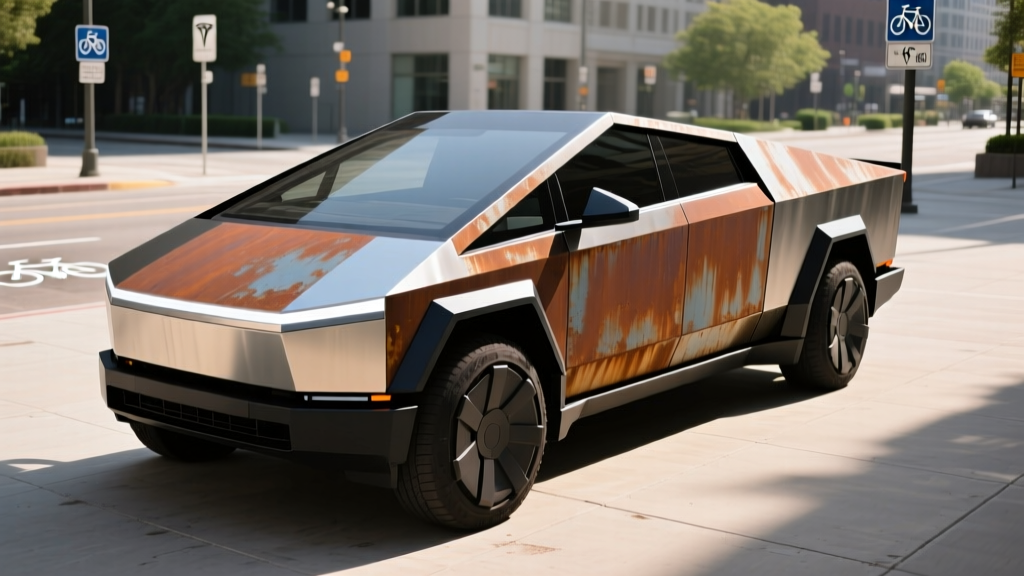
When Tesla unveiled the Cybertruck, the unpainted 30X cold-rolled stainless steel exoskeleton was its defining feature — a brutalist, mirror-finish statement that required no paint shop and promised dent resistance. But by 2025, a growing chorus of owners reported something unexpected: surface rust spots, oxidation staining, and "rail dust" contamination appearing on the stainless panels, particularly in coastal, humid, or road-salt-heavy environments. The result? A surge in owners applying vinyl wraps and paint protection film (PPF) not just for aesthetics, but to protect the bare metal — a trend the EV community has dubbed the Cybertruck rust wrap.
This isn't your grandfather's body-panel rot. The Cybertruck's stainless steel doesn't structurally corrode the way mild steel does. What owners are seeing is surface-level iron contamination — tiny ferrous particles from brake dust, rail transport, or industrial fallout embedding in the steel's grain and oxidizing. The fix ranges from a $150 chemical decontamination (iron remover + clay bar) to a full PPF or vinyl wrap costing $3,000–$7,000. We'll break down the science, the costs, and whether wrapping is worth it — then move into a full 2026 Cybertruck review covering range, charging, pricing, and how it stacks up against the Rivian R1T and Ford F-150 Lightning.
Why Stainless Steel Rusts (Yes, Really) and How Wraps Help
The Cybertruck uses a custom alloy Tesla calls 30X stainless steel — a variant in the 300-series austenitic family, similar to 304 but work-hardened for higher yield strength. Stainless steel earns its name from a passive chromium oxide layer (Cr₂O₃) that forms when chromium content exceeds ~10.5%. This layer self-heals in the presence of oxygen and prevents bulk corrosion.
But "stainless" doesn't mean "stain-proof." Three mechanisms cause the surface spots Cybertruck owners report:
- Iron particle contamination (rail dust): Microscopic ferrous particles from manufacturing, rail transport, or nearby brake dust land on the surface, embed in the grain, and rust independently of the stainless substrate. This is the #1 cause of "rust spots" on new Cybertrucks.
- Chloride-induced pitting: Road salt (NaCl, MgCl₂) and coastal sea spray introduce chloride ions that can locally break down the passive layer, causing small pits. More common in the Northeast and coastal regions.
- Galvanic contact: Dissimilar metals (carbon steel tools, mounting hardware) touching the stainless in the presence of an electrolyte (rain, condensation) can drive localized corrosion.
A quality vinyl wrap (3M 2080, Avery Supreme) or PPF (XPEL Ultimate Plus, SunTek Reaction) creates a physical barrier that blocks all three mechanisms. PPF is the enthusiast preference — self-healing top coat, 10-year warranty, optically clear or color-shift. Vinyl wraps offer full color changes at lower cost but less impact resistance.
Cybertruck Wrap Cost Breakdown (2026 Market Rates)
| Protection Type | Material Cost | Install Labor | Total | Lifespan |
|---|---|---|---|---|
| Chemical decon + ceramic coat | $200–$400 | $600–$1,200 | $800–$1,600 | 2–3 years |
| Full-body vinyl wrap (color change) | $1,500–$2,500 | $2,500–$4,500 | $4,000–$7,000 | 5–7 years |
| Full-body PPF (clear or matte) | $3,000–$5,000 | $3,500–$5,500 | $6,500–$10,500 | 7–10 years |
| Partial PPF (front clip + hood + mirrors) | $1,200–$2,000 | $1,000–$1,800 | $2,200–$3,800 | 7–10 years |
Owner tip: Cybertruck panels have sharp creases and compound curves that make wrapping more labor-intensive than a typical sedan. Expect quotes 20–30% higher than a Model Y wrap. Shops experienced with Cybertruck specifically (look for XPEL or 3M certified installers with Cybertruck portfolio shots) are worth the premium — poor seam placement on the angular body is visible and traps moisture.
2026 Cybertruck Range, Efficiency, and Real-World Numbers
Setting the wrap debate aside, the Cybertruck remains one of the most capable — and most polarizing — electric trucks on the market. Let's dig into the numbers that matter for ownership.
AWD: EPA-estimated 340 miles | Rear-Wheel Drive: EPA-estimated 350 miles
Real-world expectation: 270–300 mi highway (70–80 mph), 220–260 mi in cold weather (below 32°F), up to 320 mi mixed city driving with regen. Towing a 5,000-lb trailer cuts range roughly in half.
The Cybertruck's angular profile creates a drag coefficient around 0.34–0.38 Cd — worse than the Model Y (~0.23) and noticeably worse than the Rivian R1T (~0.30). At highway speeds, that aerodynamic penalty compounds, and you'll watch the Wh/mi climb past 500 on uphill Interstate segments. City driving with aggressive regen recovers energy effectively, which is why urban owners often report exceeding EPA estimates while road-trippers come in 15–20% below.
Cold weather hits all EVs, but the Cybertruck's large 123 kWh battery pack means more absolute energy is consumed warming the cells. Tesla's heat pump (standard) helps cabin efficiency, but expect a 25–35% range reduction in sustained sub-freezing conditions without preconditioning.
Efficiency Snapshot
| Trim | EPA MPGe (Combined) | kWh/100 mi | EPA Range |
|---|---|---|---|
| Rear-Wheel Drive | 70 MPGe | 48 | 350 mi |
| AWD (Dual Motor) | 68 MPGe | 50 | 340 mi |
| Cyberbeast (Tri-Motor) | 65 MPGe | 52 | 320 mi |
Source: fueleconomy.gov
Charging Speed: DC Fast, Level 2, and the 800V Advantage
The Cybertruck uses an 800-volt electrical architecture (shared with the refreshed Model S/X and next-gen platform), which enables higher charge power at lower current — reducing heat and cable weight. This translates into some of the fastest DC charging in Tesla's lineup.
| Charging Level | Power / Rate | Speed | Notes |
|---|---|---|---|
| Level 1 (120V household) | 1.4 kW | ~4 mi/hr | Emergency only; ~90 hrs for full charge |
| Level 2 (240V / 48A Wall Connector) | 11.5 kW | ~34 mi/hr | Full charge in ~11 hrs; recommended daily |
| DC Fast Charge (V4 Supercharger) | Peak 350 kW | 10–80% in ~18 min | Sustains ~250 kW to 50%, tapers hard above 80% |
| DC Fast Charge (CCS via adapter) | Peak 250 kW | 10–80% in ~25 min | Electrify America, EVgo; adapter included 2024+, sold separately otherwise |
Charging curve reality check: The "350 kW peak" headline number is only sustained for roughly the first 10–15% of the charge session when the battery is warm and SoC is low. The curve tapers progressively: ~300 kW at 20% SoC, ~250 kW at 40%, ~150 kW at 60%, and below 50 kW past 85%. This is normal lithium-ion behavior to protect cell longevity, but it means your actual average charge rate on a 10–80% session is closer to 200–220 kW, not 350.
Preconditioning matters enormously. Navigate to a Supercharger using the Tesla nav (or manually activate preconditioning 15–20 minutes before arrival) and the battery thermal management system will warm or cool the pack to optimal charge temperature. Skip this step on a cold morning and your peak rate may be capped at 100–120 kW until the pack warms up — adding 10+ minutes to your stop.
Performance, Drivetrain, and the Cyberbeast Factor
The Cybertruck's tri-motor Cyberbeast variant produces 845 horsepower and delivers a manufacturer-claimed 0–60 mph time of 2.6 seconds — putting it in supercar territory despite a curb weight exceeding 6,600 lbs. The dual-motor AWD model makes 600 hp and hits 60 mph in 3.9 seconds, while the single-motor RWD (introduced for 2025) delivers 315 hp and a 6.5-second run.
| Spec | RWD | AWD | Cyberbeast |
|---|---|---|---|
| Horsepower | 315 hp | 600 hp | 845 hp |
| 0–60 mph | 6.5 sec | 3.9 sec | 2.6 sec |
| Drivetrain | Rear motor | Dual-motor AWD | Tri-motor AWD (torque vectoring) |
| Towing Capacity | 7,500 lbs | 11,000 lbs | 11,000 lbs |
| Payload | 2,500 lbs | 2,500 lbs | 2,500 lbs |
For context, the Rivian R1T Dual-Motor delivers 533 hp and a 4.5-second 0–60, while the Ford F-150 Lightning Extended Range makes 580 hp and runs to 60 in 3.8 seconds. The Cyberbeast's acceleration advantage is real but largely a party trick — the more relevant metric for truck buyers is towing, where the Cybertruck's 11,000-lb rating leads the Lightning (10,000 lbs) but trails heavy-duty ICE trucks by a wide margin.
Interior, Tech, and the Screen-First Cabin
The Cybertruck interior follows Tesla's minimalist ethos to an extreme: a single 18.5-inch center touchscreen handles nearly every vehicle function, from climate to glovebox release to mirror adjustment (the Cybertruck uses camera-based digital side mirrors in most markets, though US-spec models retain physical mirrors with camera overlays).
Key tech features include:
- Autopilot (standard): SAE Level 2 adaptive cruise + lane centering. Driver must maintain hands-on-wheel engagement.
- Full Self-Driving (Supervised): $8,000 add-on or $99/month subscription. Still SAE Level 2 — not autonomous. Handles highway interchanges, traffic lights, and some surface streets with active supervision.
- Steer-by-wire: No mechanical connection between yoke and wheels. Enables variable ratio steering (less than one full turn lock-to-lock) and 4-wheel steering with a rear-axle pivot up to 10 degrees.
- Powershare: 11.5 kW of onboard bidirectional power — 240V outlets in the bed and cabin can run power tools, camp appliances, or provide limited home backup during outages.
- Armor glass: Laminated "ultra-hard" glass. Stronger than standard automotive glass but not unbreakable, as early delivery-event demonstrations showed.
Space and Practicality
| Dimension | Cybertruck | Rivian R1T | F-150 Lightning |
|---|---|---|---|
| Bed length | 72 in (6 ft) | 54 in (4.5 ft) + Gear Tunnel | 66 in (5.5 ft) |
| Bed width (between wheelwells) | 48 in | 50 in | 50.6 in |
| Front legroom | 41.5 in | 41.3 in | 43.9 in |
| Rear legroom | 35.0 in | 36.8 in | 40.4 in |
| Front trunk (frunk) | 7.1 cu ft | 11.0 cu ft | 14.1 cu ft |
| Max cargo (bed + vault) | ~67 cu ft (bed) | ~54 cu ft (bed) + Gear Tunnel | ~53 cu ft (bed) |
The Cybertruck's 6-foot bed is the longest in the electric-truck segment, but its 48-inch width between wheelwells means standard 4×8 sheets of plywood do NOT lay flat — a frequent complaint from working-truck buyers. The rear seat is tighter than the Lightning's, making the Ford a better family hauler for adults in the back row.
Pricing, Trim Levels, and Federal Tax Credit Eligibility
Tesla's pricing has fluctuated significantly since the Cybertruck's late-2023 launch. As of early 2026, here's where the lineup stands:
| Trim | Base MSRP | As-Tested (typical options) | Federal §30D Credit Eligibility |
|---|---|---|---|
| Rear-Wheel Drive | $60,990 | $62,500–$65,000 | Up to $7,500 (subject to income/sourcing rules) |
| AWD (Dual Motor) | $79,990 | $82,000–$88,000 | Up to $7,500 (subject to income/sourcing rules) |
| Cyberbeast (Tri-Motor) | $99,990 | $102,000–$110,000 | Up to $7,500 (subject to income/sourcing rules) |
- MSRP cap for trucks: Vehicle MSRP must not exceed $80,000. This means the RWD and AWD trims qualify; the Cyberbeast ($99,990 base) does NOT.
- Buyer income caps: Modified AGI ≤ $150,000 (single), $225,000 (head of household), $300,000 (married filing jointly).
- Battery sourcing: Increasing percentages of critical minerals and battery components must be sourced from the US or FTA partners. Vehicles with "foreign entities of concern" (FEOC) battery components are disqualified — verify current-year status on IRS.gov.
- Point-of-sale transfer: Eligible buyers can transfer the credit to the dealer at purchase, reducing the purchase price directly rather than waiting for a tax refund.
- Consult a tax professional. Eligibility depends on individual circumstances and rules subject to change.
Effective price after credit: An AWD Cybertruck at $79,990 MSRP, with a qualifying buyer receiving the full $7,500 point-of-sale credit, nets to approximately $72,490 before destination and options. Add a $5,000 wrap or PPF job and you're approaching $78,000 out the door — which is precisely why many buyers weigh the Cybertruck against the fully-loaded Rivian R1T and F-150 Lightning Platinum.
Warranty, Battery Longevity, and Ownership Costs
| Warranty | Coverage |
|---|---|
| Basic Vehicle | 4 years / 50,000 miles |
| Battery & Drive Unit | 8 years / 120,000 miles (min 70% capacity retention) |
| Stainless Steel Body | 4 years / 50,000 miles (corrosion perforation) |
| Roadside Assistance | 4 years / 50,000 miles |
The Cybertruck uses a structural battery pack with Tesla's 4680 cells — larger format, tabless design with NMC (nickel manganese cobalt) chemistry. NMC offers higher energy density than LFP (lithium iron phosphate), enabling the Cybertruck's 320–350-mile range from a ~123 kWh usable pack, but LFP cells typically demonstrate longer cycle life and less degradation over time.
Based on Tesla's historical fleet data and 4680 cell testing, expect roughly 8–12% degradation over the first 100,000 miles, with the curve flattening significantly thereafter. The 8-year/120,000-mile warranty guarantees at least 70% capacity retention — a floor, not an expectation. Most owners will retain 85–90% capacity at 100K miles based on current Model Y/X fleet telemetry.
Insurance note: Cybertruck insurance premiums run 30–60% higher than comparable F-150 Lightning policies, driven by the stainless body's repair complexity, high parts cost, and Tesla's limited third-party body shop network. Get quotes before purchasing — we've seen annual premiums of $3,200–$5,500 depending on state and driving record.
Is the Cybertruck Worth It vs. Rivian R1T and F-150 Lightning?
- You want the longest bed (6 ft) and highest towing rating (11,000 lbs) in the EV truck segment
- Acceleration performance (2.6s Cyberbeast) is a priority
- You value Powershare V2L for job-site or camping power
- You're a Tesla ecosystem user (Supercharger network, app, FSD subscription)
- You prioritize off-road capability (4-motor torque vectoring, adjustable air suspension with 14.9" ground clearance)
- You want the Gear Tunnel for secure, weatherproof cross-bed storage
- You prefer a more conventional, serviceable interior layout
- Back-seat passenger space is a priority (40.4" rear legroom vs. Cybertruck's 35")
- You want the largest frunk (14.1 cu ft Mega Power Frunk)
- You prefer Ford dealer service network accessibility
- Pro Power Onboard (9.6 kW) meets your V2L needs at lower cost
- Fastest DC charging in segment (350 kW peak, 10–80% in ~18 min)
- 6-ft bed length beats R1T and Lightning
- 11,000-lb towing leads EV truck class
- Steer-by-wire + 4-wheel steering = remarkably tight turning circle
- Powershare 11.5 kW bidirectional power
- Stainless body is dent-resistant (no paint chips)
- Surface rust/oxidation requires wrap or PPF in many climates
- 48" bed width won't fit flat plywood sheets
- Tight rear seat vs. Lightning
- High insurance premiums ($3,200–$5,500/yr)
- Stainless body repairs require specialized Tesla body shops
- Cyberbeast trim exceeds $80K MSRP cap — no federal tax credit
- Polarizing styling limits resale pool
Frequently Asked Questions
Does the Cybertruck actually rust through, or is it just surface staining?
It's surface-level contamination, not structural rust-through. The 30X stainless steel substrate does not corrode the way painted mild steel does. The orange/brown spots are iron particles (rail dust, brake dust, industrial fallout) that have landed on the surface and oxidized independently. A proper iron-remover chemical treatment (e.g., CarPro IronX, Sonax Fallout Cleaner) dissolves these particles. Left untreated in a salt-air environment for years, they could theoretically initiate pitting — hence the case for a wrap or PPF as preventative protection.
Will wrapping the Cybertruck void the body warranty?
Tesla has not issued a blanket policy voiding warranty for wraps. However, any damage caused by improper wrap installation (adhesive residue, paint/stainless damage during removal, moisture trapping at seams) would not be covered. Use a reputable installer and keep documentation. PPF is generally considered lower-risk than vinyl for stainless because it's designed for long-term adhesion and clean removal.
What is the real-world range of the Cybertruck on a road trip?
On a 75-mph highway drive in 70°F weather, expect 270–300 miles from the AWD model (EPA 340). In winter (25°F), that drops to 220–260 miles without preconditioning. Towing a 5,000-lb trailer at highway speeds can reduce range to 160–180 miles. Plan charging stops accordingly — the Supercharger network makes this manageable, but you'll stop more often than in a Model Y or Model S.
How fast does the Cybertruck charge at home?
On a Tesla Wall Connector at 48 amps / 240V, the Cybertruck adds roughly 34 miles of range per hour, or about 11.5 kW. A full charge from empty takes approximately 11 hours. Most owners charge overnight from 20–80% SoC, which takes about 7 hours — perfectly manageable with a standard overnight schedule. A 200-amp home electrical panel is usually sufficient; older 100-amp panels may require an upgrade ($1,500–$3,000).
How much does the Cybertruck cost after the federal tax credit?
The AWD Cybertruck at $79,990 MSRP qualifies for up to $7,500 under §30D (assuming the buyer meets income caps and the battery sourcing requirements are met for the model year), bringing the effective price to ~$72,490. The RWD model at $60,990 drops to ~$53,490 with the credit. The Cyberbeast at $99,990 exceeds the $80,000 truck MSRP cap and does not qualify. Always verify current eligibility on IRS.gov and consult a tax professional.
Is PPF or a vinyl wrap better for preventing Cybertruck rust spots?
For pure protection, PPF (paint protection film) is superior — it's thicker (8–10 mil vs. 2–3 mil vinyl), self-healing on minor scratches, and typically carries a 7–10 year warranty against yellowing and delamination. For a color change or matte finish, vinyl is the only option. Many owners do PPF on high-impact zones (front clip, bed edges, lower rockers) and leave the rest bare with periodic iron-remover treatments — a middle-ground approach costing $2,500–$4,000.
Is the Cybertruck worth buying vs. the Rivian R1T or F-150 Lightning?
It depends on your use case. If you need maximum bed length, the fastest DC charging, and V2L capability, the Cybertruck wins. If off-road capability and creative storage (Gear Tunnel) matter more, the R1T is the better tool. If back-seat space, dealer service access, and a proven full-size truck platform are priorities, the F-150 Lightning remains the pragmatic choice. All three are excellent electric trucks — none is universally "best."