The Cybertruck's Rear View Mirror Debate: Camera vs. Glass
If you've searched for "Cybertruck rear view mirror" you've likely noticed something unusual: Tesla's angular electric pickup doesn't use a traditional interior rear-view mirror in the way most drivers expect. Instead, the Cybertruck relies on a high-resolution digital rear camera display mounted where a conventional mirror would sit, supplemented by physical side mirrors and a full camera array. The result is a driving experience that feels futuristic but demands an adjustment period — and raises real questions about usability, legality, and long-term reliability.
This review covers the 2026 Tesla Cybertruck lineup — the Long Range AWD, Cyberbeast, and the newly available Rear-Wheel Drive — with a focus on how the rear-vision system works in practice, alongside the full spec sheet buyers need: real-world range, 800V charging curves, battery chemistry, tax-credit eligibility, and ownership economics.
2026 Cybertruck Spec Table: Range, Battery, Charging & Performance
| Spec | Long Range AWD | Cyberbeast (Tri-Motor) | RWD (Base) |
|---|---|---|---|
| EPA Range | 320 mi | 300 mi | ~250 mi (est.) |
| Battery (Usable) | ~123 kWh, NMC (4680 cells) | ~123 kWh, NMC (4680 cells) | ~100 kWh, LFP (est.) |
| Peak DC Fast Charge | 250 kW (V3 Supercharger) | 250 kW | 250 kW |
| 10–80% DC Time | ~28 min | ~28 min | ~30 min |
| Level 2 Home Rate | 11.5 kW / ~37 mi/hr | 11.5 kW / ~37 mi/hr | 11.5 kW / ~37 mi/hr |
| 0–60 mph | 3.9 sec | 2.6 sec | ~6.5 sec (est.) |
| Horsepower | 600 hp | 845 hp | ~315 hp (est.) |
| Drivetrain | Dual-Motor AWD | Tri-Motor AWD | Single-Motor RWD |
| MPGe (Combined) | ~68 MPGe | ~62 MPGe | ~72 MPGe (est.) |
| Efficiency | ~50 kWh/100mi | ~55 kWh/100mi | ~46 kWh/100mi (est.) |
| Towing Capacity | 11,000 lbs | 11,000 lbs | 7,500 lbs (est.) |
| Base MSRP (2026) | $79,990 | $99,990 | $60,990 |
Sources: EPA fueleconomy.gov, Tesla Cybertruck specs. RWD trim specs estimated based on Tesla announcements; final EPA certification pending.
How the Cybertruck Rear View Mirror (Camera) System Works
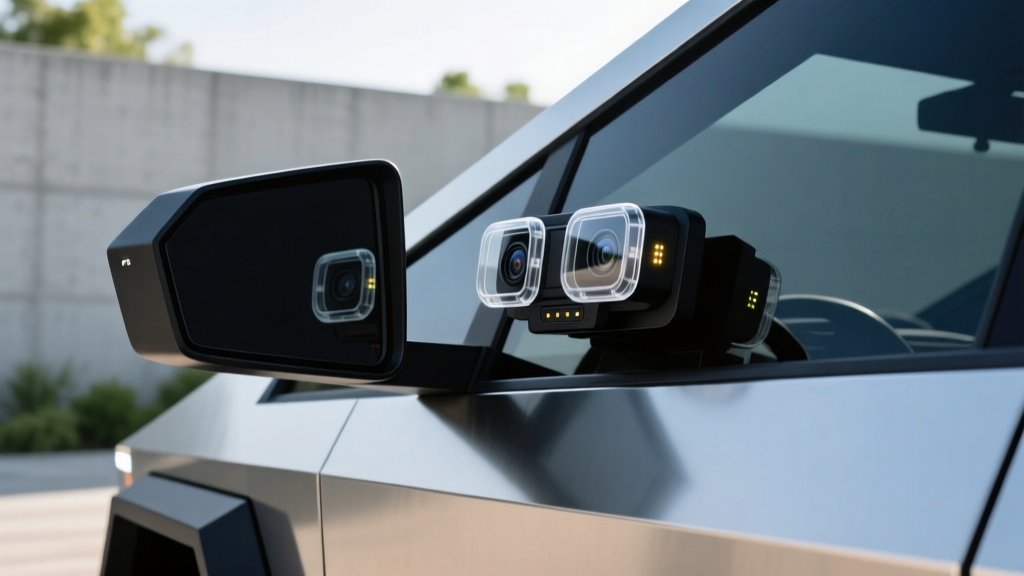
The Cybertruck's stainless-steel exoskeleton and sharply sloped bed cap create a rear window that is small, heavily tinted, and angled in a way that makes a traditional reflective rear-view mirror nearly useless. Tesla's solution is a digital rear-view camera display — a high-definition LCD screen positioned at the top of the windshield where a conventional mirror would normally mount.
The system uses a wide-angle camera embedded in the rear of the vehicle (near the top of the bed cap) to feed a live video stream to the interior display. Here's what this means in practice:
- Unobstructed view: Unlike a traditional mirror, the camera view isn't blocked by rear-seat headrests, cargo stacked in the bed, or the tonneau cover when closed.
- Night performance: The camera sensor performs significantly better than a glass mirror at night, with software-based brightness enhancement that makes headlights behind you visible without the blinding glare effect.
- Wide field of view: The digital display shows a wider angle than a flat mirror, reducing blind spots directly behind the truck.
- Adjustment period: Drivers accustomed to a glass mirror report 1–3 weeks of adaptation. Depth perception through a screen differs from optical reflection — objects can appear slightly farther away than they are.
- Weather vulnerability: Rain, mud, and road grime can coat the rear camera lens. Tesla includes a camera-cleaning washer nozzle, but in heavy winter slush, the feed can degrade until cleaned.
Physical side mirrors remain standard and are required by NHTSA FMVSS 111 regulations. The Cybertruck's side mirrors are power-folding, heated, and include integrated turn signals and blind-spot indicator lights. They are also among the widest side mirrors on any production pickup, which helps compensate for the truck's 81.9-inch width (excluding mirrors).
Camera System Drawbacks
The digital rear-view display is not without compromise. In direct sunlight, the screen can suffer from glare or washout. If the camera system fails electronically, you lose rear visibility entirely — there is no optical backup. Some owners report mild eye strain on long drives from focusing on a near-field screen rather than a distant optical reflection. And for trailer hookups, while the camera provides a good center-line view, the wide-angle distortion can make precise alignment slightly trickier than with a standard mirror at close range.
Charging: 800V Architecture and Real-World Speeds
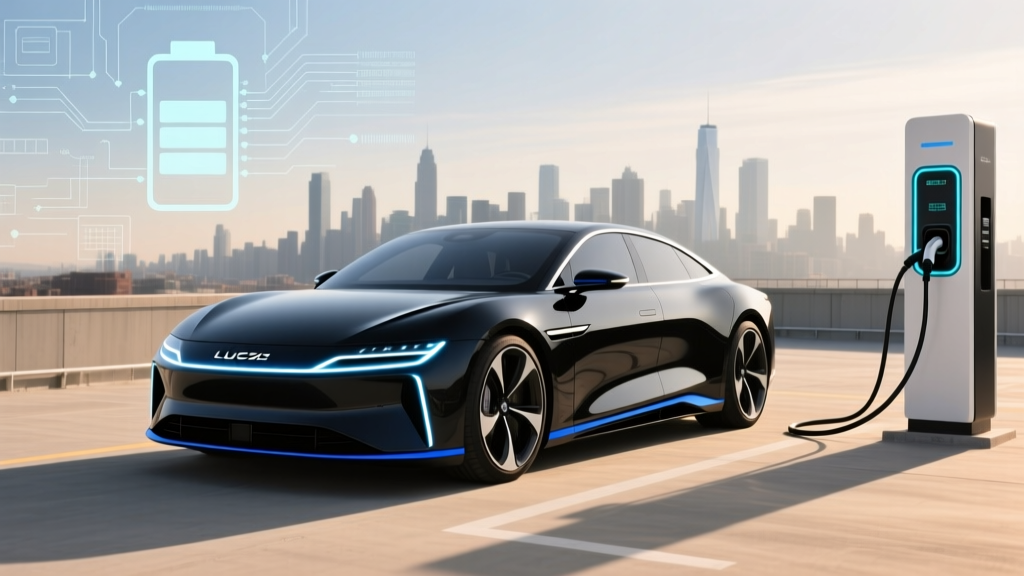
The Cybertruck uses an 800-volt electrical architecture, which enables faster charging with lower current — reducing heat and cable weight. However, Tesla's V3 Supercharger network tops out at 250 kW per stall. This means the Cybertruck's battery can accept more power than most V3 stalls can deliver.
| Charging Level | Power (kW) | Miles Added per Hour | Notes |
|---|---|---|---|
| Level 1 (120V outlet) | ~1.4 kW | ~4 mi/hr | Emergency/trickle only |
| Level 2 (240V, 48A) | 11.5 kW | ~37 mi/hr | Full overnight charge in ~9 hrs |
| DC Fast (V3 Supercharger) | 250 kW peak | ~140 mi in 15 min | 10–80% in ~28 min |
| DC Fast (V4 Supercharger) | Up to 350 kW | ~175 mi in 15 min | Limited V4 availability in 2026 |
Charging curve reality: The 250 kW peak is achieved only between approximately 10–35% state of charge. Above 50%, the rate tapers to roughly 150 kW, and above 80%, it drops to under 50 kW to protect the battery. This means the last 20% of a charge takes nearly as long as the first 50%. On road trips, plan to charge to 80% and move on — don't wait for a full charge.
At home, a Tesla Wall Connector on a 60-amp circuit delivers the full 11.5 kW (48 amps continuous). Expect installation costs of $500–$2,500 depending on panel proximity and whether your home needs a 200-amp service upgrade. Always have a licensed electrician assess your panel before installation.
Battery Chemistry, Degradation & Warranty
The dual-motor and Cyberbeast Cybertruck trims use Tesla's 4680-format cells with NMC (nickel manganese cobalt) chemistry, manufactured at Giga Texas. NMC offers higher energy density — critical for a 6,800-pound truck — but is more sensitive to sustained high state-of-charge and extreme heat.
The upcoming RWD base model is expected to use LFP (lithium iron phosphate) chemistry, which trades some energy density for longer cycle life, lower cost, and the ability to charge to 100% regularly without accelerated degradation.
| Chemistry | Energy Density | Cycle Life | 100% Charging OK? | Cold Performance |
|---|---|---|---|---|
| NMC (AWD/Cyberbeast) | High | ~1,000–1,500 cycles | No — keep at 80% daily | Moderate |
| LFP (RWD est.) | Medium | ~3,000+ cycles | Yes — charge to 100% weekly | Reduced |
Warranty coverage: Tesla covers the Cybertruck battery and drive units for 8 years or 120,000 miles (Long Range AWD) and 8 years or 120,000 miles (Cyberbeast), whichever comes first, with a minimum 70% capacity retention threshold. The basic vehicle warranty is 4 years / 50,000 miles. This is competitive with the Ford F-150 Lightning (8yr/100,000mi battery) and slightly better on mileage.
Based on Tesla's fleet data, 4680 NMC packs have shown approximately 5–8% degradation at 50,000 miles, with the curve flattening significantly after the initial break-in period. A full battery replacement outside warranty currently costs an estimated $15,000–$22,000 — a figure to factor into long-term ownership planning.
Pricing, Tax Credits & Total Cost of Ownership
| Trim | MSRP (2026) | §30D Federal Credit | Effective Price |
|---|---|---|---|
| RWD (Base) | $60,990 | Up to $7,500* | ~$53,490* |
| Long Range AWD | $79,990 | $0 (over MSRP cap) | $79,990 |
| Cyberbeast | $99,990 | $0 (over MSRP cap) | $99,990 |
*§30D credit eligibility requires: buyer AGI under $150K (single) / $300K (joint), vehicle MSRP under $80,000 for trucks, and battery components + critical minerals meeting IRS sourcing requirements. Credit can be transferred to the dealer as a point-of-sale discount. Rules subject to change — verify with a tax professional.
The critical insight: only the base RWD Cybertruck qualifies for the federal tax credit, and only if your income falls under the cap and the battery sourcing requirements are met for the specific build week. The Long Range AWD at $79,990 sits just under the $80,000 truck MSRP cap and may qualify — but Tesla's pricing has fluctuated, and any destination fee or mandatory option push could exceed the threshold. The Cyberbeast at $99,990 is definitively ineligible.
5-Year Ownership Cost Estimate (Long Range AWD)
- Purchase price: $79,990
- Insurance (avg): $2,800/yr × 5 = $14,000 (Cybertruck insurance runs 30–50% higher than F-150 Lightning due to stainless-steel repair costs)
- Electricity (15,000 mi/yr, $0.14/kWh avg): ~$1,050/yr × 5 = $5,250
- Maintenance: ~$400/yr × 5 = $2,000 (tire rotation, cabin filter, wiper fluid — no oil changes)
- Estimated depreciation: ~45% over 5 years = $36,000
- Total 5-year cost of ownership: ~$57,250 (net of depreciation)
Cargo, Interior Space & Practicality
The Cybertruck's 6.5-foot bed (74.3 inches long, 49.5 inches wide between wheel wells) offers 67 cubic feet of cargo volume with the tonneau cover closed. The powered retractable tonneau is standard and can support up to 300 pounds of distributed weight — useful for gear or a rooftop tent platform.
Interior dimensions:
- Front legroom: 41.3 inches
- Rear legroom: 38.1 inches (tight for a full-size truck — the F-150 Lightning offers 43.4 inches rear)
- Front headroom: 40.8 inches
- Seating: 6 passengers (3-across front bench + 3-across rear bench)
- Under-bed storage (frunk-equivalent): The Cybertruck has a rear "gear locker" sub-trunk with ~10 cu ft of lockable storage beneath the bed floor
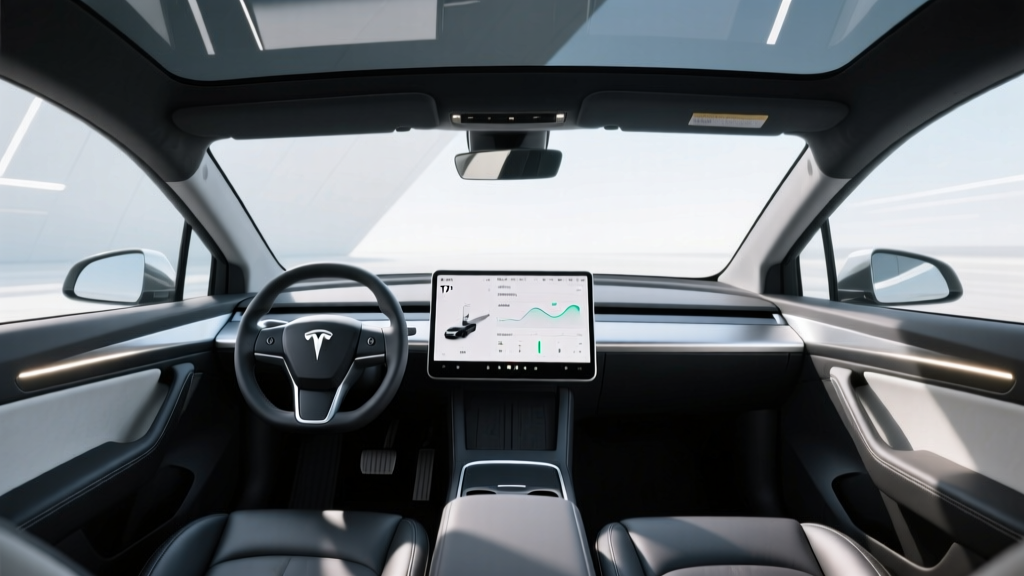
The 18.5-inch front touchscreen handles nearly all vehicle controls — there are no physical buttons for climate, mirrors, or glovebox. Mirror adjustment, including the digital rear-view camera brightness and angle, is controlled through the vehicle settings menu on this screen. The rear passengers get their own 9.4-inch touchscreen for climate and entertainment.
Driver Assistance: Autopilot and FSD (Supervised)
Tesla Autopilot and Full Self-Driving (Supervised) are Level 2 driver-assistance systems. The driver must remain fully attentive, with hands on or near the steering wheel, at all times. These systems do NOT make the Cybertruck self-driving. Only Level 4 services like Waymo operate without a human driver — and those are geofenced robotaxis, not consumer vehicles.
The Cybertruck ships with Tesla's latest HW4 (Hardware 4) computer and a suite of cameras (no ultrasonic sensors — Tesla uses vision-only "Tesla Vision"). Autopilot includes adaptive cruise control and lane centering at no extra cost. FSD (Supervised) adds automatic lane changes, traffic-light recognition, and city-street navigation for $8,000 one-time or $99/month.
In practice, FSD (Supervised) handles highway driving competently but requires regular intervention in construction zones, on poorly marked roads, and during heavy rain when camera visibility degrades. The Cybertruck's wide body (over 96 inches with mirrors) makes lane positioning critical — FSD occasionally centers the truck slightly off in narrow lanes.
Pros, Cons & Who Should Buy the Cybertruck
Pros
- Tri-motor Cyberbeast delivers supercar-level acceleration (2.6s 0–60) in a pickup
- 800V architecture enables fast charging on V4 Superchargers
- Digital rear camera eliminates bed-cargo blind spots
- Stainless-steel exoskeleton is dent-resistant and requires no paint
- 11,000-lb towing capacity with integrated trailer brake controller
- Access to Tesla's Supercharger network (20,000+ stalls in North America)
- Standard air suspension with 16 inches of ground clearance adjustability
Cons
- Rear camera mirror requires adaptation; no optical backup if system fails
- Rear legroom is tight (38.1") for a full-size crew cab
- Insurance premiums 30–50% above comparable F-150 Lightning
- Only base RWD may qualify for §30D federal tax credit
- Stainless-steel body panels are expensive to repair if damaged
- Efficiency is poor for an EV (~50 kWh/100mi) — high charging costs on road trips
- Visibility compromised by thick A-pillars and small rear window
- No Apple CarPlay or Android Auto — Tesla-only ecosystem
Who This EV Suits Best
- Choose the Cybertruck if: You want a statement vehicle with class-leading performance, tow toys on weekends, have home Level 2 charging, and value the Supercharger network for road trips.
- Choose the F-150 Lightning instead if: You need maximum rear-seat space, prefer physical controls, want broader §30D credit eligibility, and value conventional body repairability.
- Choose the Rivian R1T instead if: You prioritize off-road capability, need a gear tunnel for adventure equipment, and prefer a more refined interior with better rear-seat comfort.
Frequently Asked Questions
Does the Cybertruck have a traditional rear view mirror?
No. The 2026 Cybertruck uses a digital rear-view camera display instead of a reflective glass mirror. A camera mounted at the rear of the vehicle feeds a live video stream to an LCD screen positioned at the top of the windshield. Physical side mirrors are still present and legally required.
What is the real-world range of the Cybertruck?
The Long Range AWD is EPA-rated at 320 miles, but expect 260–285 miles in real-world highway driving and as low as 210–240 miles in freezing temperatures. The Cyberbeast drops to approximately 240–265 miles on the highway. Towing can cut range by 40–50%.
How fast does the Cybertruck charge?
On a Tesla V3 Supercharger, the Cybertruck peaks at 250 kW and charges from 10–80% in approximately 28 minutes. On V4 Superchargers (limited availability), it can accept higher rates. At home on Level 2 (11.5 kW), a full charge takes about 9 hours.
Does the Cybertruck qualify for the $7,500 federal tax credit?
Only the base RWD model ($60,990) clearly qualifies, and only if the buyer's adjusted gross income is under $150,000 (single) or $300,000 (joint), and the battery meets IRS critical-mineral and component sourcing requirements. The Long Range AWD at $79,990 is at the MSRP cap edge. The Cyberbeast at $99,990 does not qualify.
Is the Cybertruck worth buying vs. the F-150 Lightning or Rivian R1T?
The Cybertruck wins on raw acceleration, stainless-steel durability, and Supercharger access. It loses on rear-seat space, insurance cost, tax-credit eligibility (for most trims), and repair complexity. If you prioritize practicality and credit eligibility, the F-150 Lightning is the stronger value. If off-road adventure is your priority, the Rivian R1T is more capable. The Cybertruck is best for buyers who want performance, exclusivity, and the Tesla ecosystem.
Can I adjust the rear camera mirror brightness or turn it off?
Yes. Through the Cybertruck's 18.5-inch touchscreen, you can adjust the digital rear-view display's brightness and, on some software versions, toggle between camera view and a dimmed/off state. However, there is no optical mirror to fall back on — if the camera system malfunctions, rear visibility is lost until repaired.