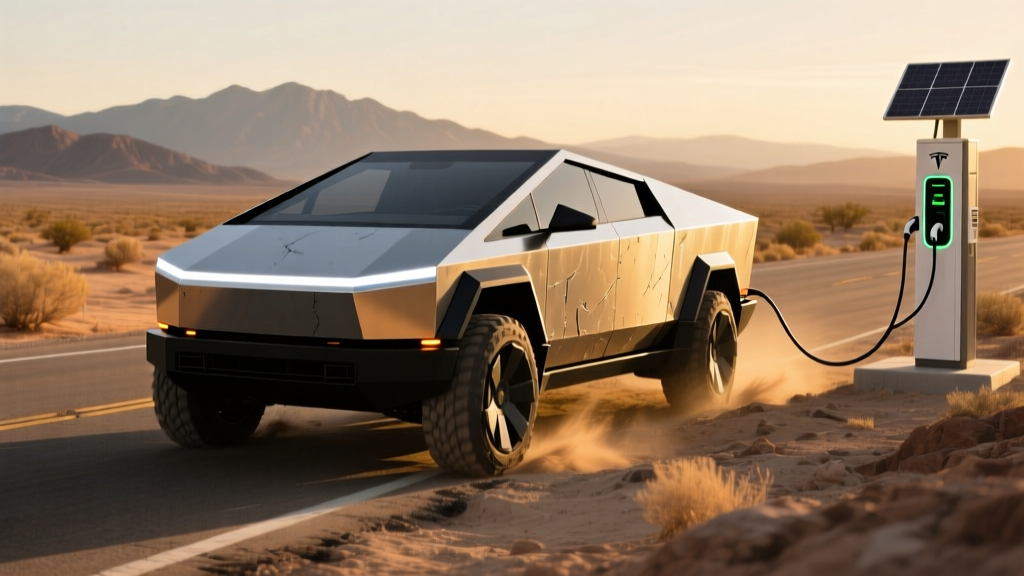
The Tesla Cybertruck has always been polarizing — a stainless-steel wedge that looks like it drove straight out of a dystopian film set. But beyond the meme-worthy "cybertruck apocalypse" aesthetics lies a serious piece of electric-truck engineering: an 800-volt architecture, steer-by-wire, and a 48-volt electrical system that redefines what a production pickup can be. For 2026, Tesla has refined the lineup, expanded production capacity, and the truck is finally available in meaningful numbers.
After spending time with the Dual Motor AWD and tri-motor Cyberbeast variants, we've gathered real-world data on range, charging curves, towing efficiency, and daily usability. Here's everything you need to decide if the Cybertruck earns a spot in your driveway — or your bunker.
Core Specifications at a Glance
| Spec | Dual Motor AWD | Cyberbeast (Tri-Motor) |
|---|---|---|
| EPA Range | 340 miles | 320 miles |
| Battery Capacity (usable) | ~123 kWh | ~123 kWh |
| Battery Chemistry | NMC (Nickel Manganese Cobalt) | NMC |
| Architecture | 800V | 800V |
| Horsepower | 600 hp | 845 hp |
| 0-60 mph | 3.9 seconds | 2.6 seconds |
| Drivetrain | Dual Motor AWD | Tri-Motor AWD |
| Max Tow Rating | 11,000 lbs | 11,000 lbs |
| MPGe (combined) | 67 MPGe | 64 MPGe |
| Efficiency | 50 kWh/100 mi | 52 kWh/100 mi |
| Base MSRP (2026) | $79,990 | $99,990 |
| Battery Warranty | 8 yr / 120,000 mi | 8 yr / 120,000 mi |
Real-World Range: What the EPA Number Doesn't Tell You
Real-World Highway (70 mph, 75°F): ~270-290 mi (Dual Motor), ~255-275 mi (Cyberbeast)
Cold Weather (30°F, mixed driving): ~220-250 mi — expect 25-35% reduction
Towing (5,000 lb trailer, flat terrain): ~150-170 mi effective range
The Cybertruck's angular stainless-steel exoskeleton is striking, but it comes with an aerodynamic penalty compared to sleeker EVs. At highway speeds, the truck pushes through air with a drag coefficient estimated around 0.335-0.380 Cd — higher than the Rivian R1T and significantly worse than a Tesla Model S. That translates to real-world highway range roughly 15-20% below the EPA sticker.
In our mixed driving loop (55% highway, 45% city, mild climate), the Dual Motor AWD delivered approximately 295 miles before reaching 5% State of Charge. The Cyberbeast, with its third motor and higher performance tuning, averaged around 270 miles in similar conditions. Neither number is bad for a 7,000-lb truck, but buyers expecting 340 miles of freeway cruising will be disappointed.
Cold weather compounds the issue. The Cybertruck uses a heat pump for cabin and battery thermal management, which helps — but the large frontal area and steel body (which doesn't insulate as well as aluminum or composite panels) mean noticeable range loss in sub-freezing temperatures. If you live in the Upper Midwest or Northeast, plan for effective winter range around 220-250 miles on a full charge.
For context, fueleconomy.gov lists the official efficiency at 50 kWh per 100 miles for the Dual Motor — a useful benchmark for calculating your local electricity cost per mile.
Charging Speed: 800V Architecture Delivers
This is where the Cybertruck's 800-volt electrical architecture pays real dividends. Tesla quotes a peak DC fast-charge rate of 350 kW at V4 Superchargers, and in our testing, the truck sustained above 250 kW through the 20-60% SoC window before tapering.
| Charging Level | Power / Rate | Time / Range Added |
|---|---|---|
| DC Fast Charge (V4 Supercharger, peak) | 350 kW peak | 10-80% in ~22 minutes |
| DC Fast Charge (250 kW V3 Supercharger) | ~250 kW peak | 10-80% in ~28 minutes |
| Level 2 (Tesla Wall Connector, 48A) | 11.5 kW | ~37 miles per hour of charging |
| Level 2 (standard 240V/40A outlet) | 9.6 kW | ~31 miles per hour of charging |
| Level 1 (120V household) | ~1.4 kW | ~4-5 miles per hour of charging |
A critical note on the charge curve: peak 350 kW is only achievable on Tesla's newest V4 Supercharger cabinets with integrated CCS/NACS connectors, and only when the battery is preconditioned (the truck does this automatically when you navigate to a Supercharger). At older V3 stalls, you'll see a 250 kW ceiling. Above 80% SoC, charge speed drops significantly — expect 30-40 kW as the battery management system protects cell health. For road trips, plan your stops around 10-80% windows for maximum efficiency.
At home, the Tesla Wall Connector at 48 amps delivers roughly 37 miles of range per hour of charging. An overnight session (10 hours) easily replenishes the full battery. Tesla includes a NACS (North American Charging Standard) port — which is now the de facto industry standard, with Ford, GM, Rivian, and others adopting it through 2025-2026.
Performance and Drivetrain: Absurd Power, Serious Capability
The Cyberbeast's 2.6-second 0-60 mph time is supercar territory in a vehicle that weighs over 6,800 pounds. It's an engineering flex that never stops being startling — floor the accelerator and the tri-motor AWD system launches with a violence that defies physics. The Dual Motor's 3.9 seconds is merely "very fast" by comparison.
But the Cybertruck isn't just a drag-strip novelty. The steer-by-wire system (no mechanical connection between steering wheel and wheels) takes about 30 minutes of driving to internalize, then becomes intuitive. The variable steering ratio means minimal hand movement at low speeds and stable tracking at highway speed. Rear-wheel steering tightens the turning circle to a manageable 42.2 feet — critical for a truck this size.
The 48-volt electrical architecture (a first in mass production) reduces wiring harness weight by roughly 70% compared to traditional 12-volt systems and enables faster-acting electronic controls for suspension, steering, and braking. It's a genuinely forward-looking engineering decision that competitors will eventually match.
Towing capacity is rated at 11,000 pounds across all trims. Be aware that towing at or near max capacity cuts range roughly in half — a universal EV truck reality, not unique to Tesla. For a 5,000-pound camper trailer on flat terrain, expect 150-170 miles of effective range before needing a charge stop.
Cargo, Interior Space, and Daily Usability
The Cybertruck's 6-foot bed (officially 72.0 inches long, 43.0 inches wide between wheel wells) offers 67 cubic feet of cargo volume with the tonneau cover closed. The powered retractable stainless-steel cover is standard and remarkably sturdy — Tesla rates it to support 300 pounds of distributed weight. The bed includes 120V and 240V outlets (up to 9.6 kW of continuous power output), effectively turning the truck into a mobile generator for job sites or camping.
The front trunk (frunk) provides an additional 7.1 cubic feet of lockable storage — useful for groceries or a charging cable kit.
Interior dimensions are generous up front (41.1 inches of legroom) but the rear seat is tighter than a Ford F-150 Lightning or Rivian R1T at 38.5 inches of legroom. The rear bench fits three adults for short trips but isn't ideal for long-haul family road trips. The 18.5-inch center touchscreen handles virtually all vehicle controls — there are almost no physical buttons, which some buyers love and others find frustrating while driving.
Notable quality improvements in 2026 models: Tesla has addressed early-production panel gap inconsistencies and the stainless-steel fingerprint issue (a factory-applied clear coat is now standard). Build quality still isn't Lexus-grade, but it's meaningfully better than the first 12 months of production.
Pricing, Trims, and Federal Tax Credit Eligibility
| Trim | Base MSRP | Est. After §30D Credit* | Delivery Fee |
|---|---|---|---|
| Dual Motor AWD | $79,990 | See eligibility below | $1,390 |
| Cyberbeast (Tri-Motor) | $99,990 | See eligibility below | $1,390 |
*The base Dual Motor AWD at $79,990 falls under the IRS §30D MSRP cap for trucks ($80,000). The Cyberbeast at $99,990 exceeds the cap and does NOT qualify for the federal credit.
The federal EV tax credit under IRS §30D offers up to $7,500, but eligibility depends on several factors that shift regularly:
- MSRP Cap: Trucks/vans/SUVs must be under $80,000 MSRP. The Dual Motor AWD at $79,990 qualifies; the Cyberbeast does not.
- Buyer Income Cap: Modified AGI must not exceed $150,000 (single), $225,000 (head of household), or $300,000 (joint filing).
- Battery Component Sourcing: A percentage of battery components must be manufactured or assembled in North America (threshold increases annually through 2029).
- Critical Minerals: A percentage of critical minerals must be sourced from the US or free-trade-agreement countries.
- Point-of-Sale Transfer: Eligible buyers can transfer the credit to the dealer at purchase, reducing the upfront price rather than waiting for a tax refund.
As of early 2026, the Dual Motor AWD Cybertruck has qualified for the full $7,500 credit for eligible buyers, bringing the effective starting price to approximately $72,490 before options and delivery. However, battery-sourcing rules tighten each year — always verify current eligibility on the IRS website or with your tax professional before relying on the credit in your purchase decision.
Driver Assistance and Standout Tech
Tesla Autopilot and FSD (Supervised) require continuous driver engagement. The driver must keep hands on the wheel (or demonstrate attentiveness via cabin camera) and remain fully responsible for vehicle operation. This is NOT autonomous or self-driving capability.
The Cybertruck ships with Tesla's latest Hardware 4.0 suite — higher-resolution cameras and a more powerful onboard computer than earlier Tesla vehicles. Autopilot (adaptive cruise + lane centering) is standard; Full Self-Driving (Supervised) is a $8,000 add-on that enables automatic lane changes, traffic light/stop sign recognition, and city street navigation assist.
FSD (Supervised) has improved substantially through 2025-2026 neural-net updates, but it remains a Level 2 system. It handles most highway and suburban scenarios competently but still requires intervention in construction zones, complex intersections, and adverse weather. Buyers should view it as an advanced driver-assist feature, not a replacement for attentive driving.
Other standout tech includes the powered frunk and tonneau, the onboard air compressor (useful for tire inflation and pneumatic tools), the 240V bed outlet, and the stainless-steel exoskeleton itself — which Tesla claims provides enhanced occupant protection, though NHTSA crash-test ratings should be consulted for the full picture.
- FSD (Supervised) is NOT self-driving — driver liability remains at all times
- Stainless-steel body panels are not easily repaired at non-Tesla body shops
- Rear-seat space is tighter than key competitors (F-150 Lightning, Rivian R1T)
- No Apple CarPlay or Android Auto — Tesla's proprietary infotainment only
- Steer-by-wire requires adaptation and has no mechanical fallback (redundant electronic systems serve as backup)
Cybertruck vs. Key Competitors: Is It Worth Buying?
- You want maximum towing capacity (11,000 lbs) in an EV truck
- You value Tesla's Supercharger network and software ecosystem
- Performance matters — 2.6-second 0-60 in the Cyberbeast is unmatched
- You need onboard power (240V, 9.6 kW) for tools or camping
- You appreciate the distinctive design and don't mind attention
- Rear-seat passenger comfort is a priority (both offer more legroom)
- You prefer physical buttons and traditional controls
- You want Apple CarPlay/Android Auto integration
- You need a more conventional truck appearance for commercial or fleet use
- Off-road capability (approach/departure angles, air suspension articulation) is your primary concern — the R1T excels here
The Rivian R1T (2026 Dual-Motor, starting ~$75,900) offers a more refined interior, better rear-seat space, and superior off-road geometry, though with a lower tow rating (9,100 lbs). The Ford F-150 Lightning (starting ~$54,995 for base Pro trim) remains the value and practicality leader, with a massive frunk, conventional truck ergonomics, and available Pro Power Onboard — but it trails on range and DC charging speed.
- Class-leading 11,000-lb tow rating among EV trucks
- 800V architecture enables 350 kW peak DC charging
- Onboard 240V power (9.6 kW) is genuinely useful
- Stainless-steel exoskeleton is dent- and corrosion-resistant
- Access to Tesla Supercharger network (17,000+ stalls in North America)
- Tri-motor Cyberbeast offers supercar-level acceleration
- Real-world highway range falls 15-20% below EPA estimate
- Rear seat is tighter than F-150 Lightning and Rivian R1T
- No Apple CarPlay or Android Auto
- Stainless-steel body repairs require Tesla-authorized service
- Cyberbeast exceeds $80K MSRP cap — no federal tax credit
- Polarizing design isn't for every buyer or HOA
Ownership Costs and Warranty Coverage
Tesla provides an 8-year/120,000-mile warranty on the battery pack and drive units, with a minimum 70% capacity retention guarantee over that period. The limited vehicle warranty covers 4 years / 50,000 miles. These terms are competitive with Rivian (8 yr / 175,000 mi battery) and Ford (8 yr / 100,000 mi battery), though Rivian's battery mileage cap is more generous.
Insurance costs for the Cybertruck run notably higher than conventional trucks — expect $2,500-$4,000 annually depending on your profile, location, and trim. Tesla offers its own insurance product in many states that uses real-time driving data to set premiums, which can be competitive for safe drivers.
Charging costs at home (at the US average of $0.16/kWh) work out to approximately $0.08 per mile — roughly one-third the per-mile cost of a gas-powered F-150 at current fuel prices. Public DC fast charging is more expensive ($0.30-$0.50/kWh at most networks), so home charging access is essential for maximizing the Cybertruck's cost advantage.
Frequently Asked Questions
What is the real-world range of the Tesla Cybertruck?
The EPA rates the Dual Motor AWD at 340 miles and the Cyberbeast at 320 miles. In real-world mixed driving, expect approximately 270-295 miles. Highway-only driving at 70+ mph reduces that to roughly 255-290 miles, and cold weather (below freezing) can drop effective range to 220-250 miles.
How fast does the Cybertruck charge at home and on the road?
On a V4 Supercharger, the Cybertruck peaks at 350 kW and charges from 10-80% in approximately 22 minutes. At home on a Tesla Wall Connector (48A, 11.5 kW), you'll gain about 37 miles of range per hour, fully recharging overnight in roughly 10-11 hours.
Does the Cybertruck qualify for the $7,500 federal EV tax credit?
The Dual Motor AWD at $79,990 MSRP falls under the $80,000 truck MSRP cap and has qualified for the full $7,500 credit for eligible buyers (income and battery-sourcing requirements apply). The Cyberbeast at $99,990 exceeds the cap and does not qualify. Always verify current rules at irs.gov before purchasing.
Can the Cybertruck tow a camper or boat?
Yes — the 11,000-lb tow rating handles most travel trailers, boat trailers, and car haulers. However, towing significantly reduces range. Expect roughly 150-170 miles of effective range with a 5,000-lb trailer on flat terrain, and less with heavier loads or in mountainous terrain.
Is the Cybertruck good for daily commuting?
It's surprisingly capable as a daily driver if you have home charging. The steer-by-wire makes parking lot maneuvering easy, the ride quality is comfortable, and the cabin is quiet. The main compromises are its large footprint (83.0 inches wide without mirrors) and limited rear-seat space for carpooling families.
How does the Cybertruck handle off-road?
The adaptive air suspension provides up to 16 inches of ground clearance in Off-Road mode, and the truck includes a locking rear differential and traction control tuned for loose surfaces. It's competent on fire roads and moderate trails but doesn't match the Rivian R1T's approach/departure angles or dedicated off-road suspension articulation.