The Tesla Cybertruck is as much a conversation about its bed as it is about its battery. The integrated loading ramp, the stainless-steel exoskeleton vault, and the motorized tonneau cover promise a level of utility that traditional pickups handle with aftermarket accessories. But does the Cybertruck ramp and vault combination actually make loading, hauling, and daily use easier than a conventional truck bed? We put the 2025/2026 Cybertruck through its paces to find out — and evaluated the full EV package while we were at it.
Cybertruck Ramp & Vault: The Utility Story
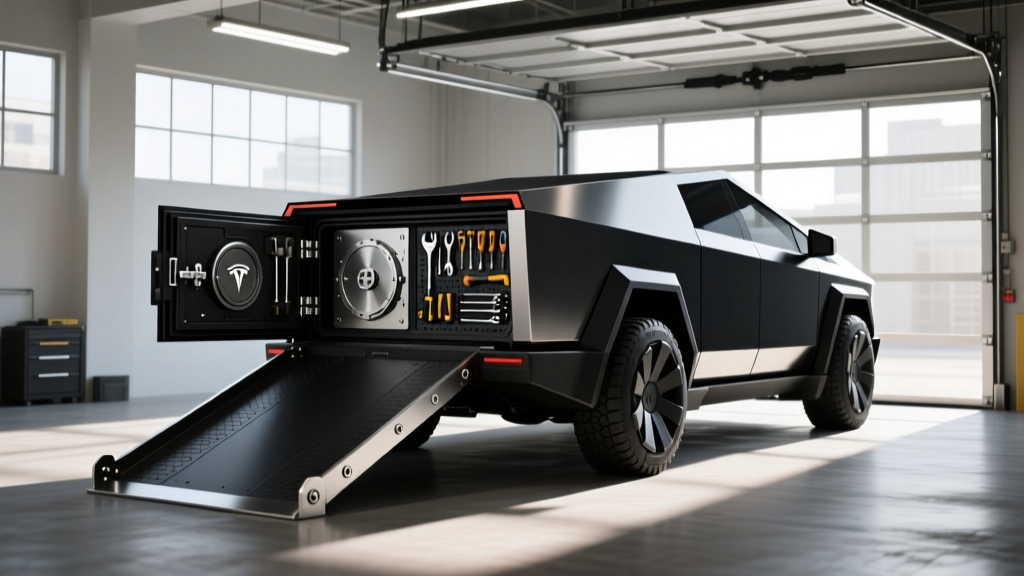
The Cybertruck's bed — Tesla calls it the "Vault" — measures 6 feet long and 4 feet wide between the wheel wells, offering approximately 74 cubic feet of cargo volume with the motorized hard tonneau cover closed. The cover itself is rated to support up to 300 pounds of distributed weight, meaning you can stand on it or stack gear without concern.
The integrated Cybertruck ramp deploys from the rear of the vault. It's a single-piece, telescoping aluminum ramp that slides out from under the bed floor and extends to the ground. At approximately 6 feet in deployed length, it provides a manageable incline for loading ATVs, motorcycles, pallets, and heavy equipment. The ramp is rated for up to 1,000 pounds, which covers most recreational and light-commercial loading scenarios.
Compared to folding aftermarket ramps you'd buy for a Ford F-150 or Chevrolet Silverado, the Cybertruck ramp is more convenient — no separate storage, no setup time. However, its fixed width (roughly 24 inches) means you're loading single-track vehicles or wheeled equipment one at a time. For wider loads like a riding mower, you'll still need a separate wider ramp or a two-ramp setup.
Vault Features Beyond the Ramp
- Lockable storage: The tonneau cover locks automatically with the vehicle, turning the entire bed into a secure trunk — a major advantage over open-bed trucks.
- 120V and 240V bed outlets: Up to 9.6 kW of continuous power export via the bed-mounted NEMA outlets, enough to run power tools, a welder, or campsite appliances.
- Compressed air outlet: A built-in air compressor with a bed-mounted hose connection, useful for inflating tires or running pneumatic tools.
- Frunk (front trunk): Approximately 7 cubic feet of additional enclosed storage up front.
Range, Battery & Real-World Efficiency
The Cybertruck is offered with a ~123 kWh usable battery pack (approximately 150 kWh gross) using a 4680-cell architecture. Tesla has not publicly disclosed whether the cells are NMC or a variant chemistry, though teardown analyses suggest a high-nickel NMC formulation optimized for the cell's structural role in the vehicle's exoskeleton.
EPA Estimated Range: 340 miles (AWD dual-motor) / 320 miles (Cyberbeast tri-motor)
Real-World Expectation: Expect 270–300 miles on mixed highway driving at 70+ mph. In cold weather (below 32°F), plan for 220–260 miles depending on cabin heating load and terrain. The Cybertruck's angular, un-aerodynamic profile (estimated Cd of ~0.38) hits efficiency hard at highway speeds — more so than a sleek sedan like the Model S.
| Specification | AWD (Dual-Motor) | Cyberbeast (Tri-Motor) |
|---|---|---|
| EPA Range | 340 mi | 320 mi |
| Battery (usable) | ~123 kWh | ~123 kWh |
| Efficiency | ~54 MPGe / ~48 kWh/100mi | ~52 MPGe / ~50 kWh/100mi |
| 0–60 mph | 4.1 sec | 2.6 sec |
| Horsepower | 600 hp | 845 hp |
| Drivetrain | Dual-Motor AWD | Tri-Motor AWD |
| Towing Capacity | 11,000 lbs | 11,000 lbs |
| Payload Capacity | 2,500 lbs | 2,500 lbs |
| Bed Volume | 74 cu ft | 74 cu ft |
| Bed Length | 6 ft | 6 ft |
| Base MSRP | $79,990 | $99,990 |
Efficiency is the Cybertruck's weak point relative to other EVs. At roughly 48–50 kWh per 100 miles, it consumes significantly more energy per mile than a Rivian R1T (~42 kWh/100mi) or a Ford F-150 Lightning (~43 kWh/100mi). This means higher charging costs and fewer real-world miles per charge session — a direct consequence of the truck's weight (nearly 7,000 lbs curb) and its brick-like aerodynamics.
Charging: DC Fast, Home Level 2 & the 400V Limitation
The Cybertruck uses a 400V electrical architecture (not 800V like the Hyundai Ioniq 5 or Porsche Taycan). This limits its peak DC fast-charging rate to approximately 250 kW at a V4 Supercharger or compatible CCS/NACS station.
| Charging Level | Power / Rate | Speed |
|---|---|---|
| Level 1 (120V household) | ~1.4 kW | ~3 mi/hr |
| Level 2 (240V, 48A Wall Connector) | 11.5 kW | ~28 mi/hr |
| Level 2 (240V, 80A Wall Connector) | 19.2 kW | ~44 mi/hr |
| DC Fast Charge (NACS Supercharger) | Peak 250 kW | 10–80% in ~30 min |
| DC Fast Charge (CCS adapter, 350 kW station) | ~250 kW peak | 10–80% in ~30 min |
The 10–80% DC fast-charge time of approximately 30 minutes is respectable but not class-leading. The Rivian R1T, with its 800V-compatible architecture in newer models, can achieve similar percentages slightly faster at compatible stations. The Cybertruck's charge curve tapers noticeably above 60% SoC — a function of the large battery pack and thermal management priorities.
For home charging, Tesla's Wall Connector at 80 amps delivers up to 19.2 kW, which fully replenishes the ~123 kWh battery in roughly 6.5 hours. Most residential panels will require a dedicated 100-amp circuit for 80A continuous charging — consult a licensed electrician, as a panel upgrade to 200A service may be necessary.
Performance & Driving Dynamics
The Cybertruck AWD dual-motor produces 600 hp and hits 0–60 mph in 4.1 seconds — quick for any truck, absurd for a 6,800-pound vehicle. The Cyberbeast tri-motor variant, at 845 hp and a 2.6-second 0–60 time, enters supercar territory. Both versions feature adaptive air suspension with up to 16 inches of ground clearance in Off-Road mode and a 12.9-inch ground clearance in standard ride height.
Steer-by-wire is standard on all Cybertruck trims, replacing the mechanical steering column with electronic actuators. The yoke-style steering wheel and variable-ratio steering mean low-speed maneuvers (parking, trail navigation) require minimal hand movement, while highway stability remains firm. Adaptation takes a few days for most drivers — it's not gimmicky, but it's not transparent either.
Towing capacity is rated at 11,000 pounds for both AWD and Cyberbeast. However, towing at or near max capacity will slash range by 40–50%, bringing real-world towed range down to approximately 150–180 miles. Plan charging stops accordingly on long hauls.
Pricing, Trims & Federal Tax Credit Eligibility
| Trim | Base MSRP | Destination | As-Tested (typical) | §30D Credit Eligible? |
|---|---|---|---|---|
| AWD (Dual-Motor) | $79,990 | $1,990 | $82,000–$86,000 | No — exceeds $80,000 MSRP cap for trucks |
| Cyberbeast (Tri-Motor) | $99,990 | $1,990 | $102,000–$110,000 | No — exceeds $80,000 MSRP cap for trucks |
| RWD (announced, late 2026/2027) | $60,990 (est.) | $1,990 | TBD | Likely yes — under $80,000 cap, pending sourcing rules |
Under current IRS §30D rules, the federal EV tax credit offers up to $7,500 for qualifying new EVs. However, pickup trucks face an $80,000 MSRP cap (lower than the $55,000 cap for sedans). Both the AWD and Cyberbeast Cybertruck trims exceed this cap at base MSRP, making them ineligible for the federal credit regardless of buyer income or battery sourcing.
The upcoming RWD single-motor trim, expected at approximately $60,990, would fall under the cap and could qualify — provided the buyer meets income thresholds ($150,000 single / $300,000 joint AGI) and the battery meets critical-mineral and component sourcing requirements. The point-of-sale transfer option allows dealers to apply the credit as a down-payment reduction at purchase. Always verify current eligibility on IRS.gov before purchasing, as sourcing rules tighten annually.
Interior, Tech & Driver Assistance
The Cybertruck's interior is minimalist even by Tesla standards. A single 18.5-inch touchscreen dominates the dash, handling all infotainment, climate, and vehicle controls. There is no instrument cluster — speed and range data appear in the upper-left corner of the main screen. Rear passengers get a 9.4-inch touchscreen for climate and media control.
Seating accommodates five adults, though rear legroom (approximately 36 inches) is tighter than a Ford F-150 Lightning or Rivian R1T. The rear bench is relatively flat and firm — fine for short trips, less ideal for long highway stretches. The stainless-steel dash trim looks striking but attracts fingerprints relentlessly.
Driver Assistance: Autopilot & FSD (Supervised)
SAE Automation Level: Level 2. Tesla's Autopilot and Full Self-Driving (Supervised) are driver-assistance systems that require continuous driver engagement, hands-on-wheel (or torque) monitoring, and full situational awareness. These are not autonomous driving systems.
Autopilot (standard) includes adaptive cruise control, lane-centering, and automatic emergency braking. FSD (Supervised), available as a $8,000 one-time purchase or $99/month subscription, adds automated lane changes, traffic-light and stop-sign recognition, and navigation-guided on/off-ramp transitions. In practice, FSD handles most highway scenarios competently but still requires intervention for construction zones, faded lane markings, and complex intersections. It does not replace the driver.
Warranty & Long-Term Ownership
Tesla provides a 4-year/50,000-mile basic vehicle warranty and an 8-year/120,000-mile battery and drive unit warranty for the Cybertruck. The battery warranty guarantees at least 70% capacity retention over the warranty period — consistent with Tesla's other vehicle lines.
Given the Cybertruck's 4680-cell pack and structural battery design, replacement costs remain uncertain but are expected to be significant — likely in the $15,000–$25,000 range based on pack size and labor complexity. Tesla's mobile service and Supercharger network remain strong ownership advantages, though body repair for the stainless-steel exoskeleton requires specialized collision centers, which can extend repair timelines after accidents.
Who Should Buy the Cybertruck?
Choose the Cybertruck if:
- You want a lockable, weather-sealed bed (the vault + tonneau combo is genuinely superior to a soft cover on a conventional truck)
- You need onboard power export (9.6 kW from the bed outlets is best-in-class for running tools or campsite loads)
- You value Tesla's Supercharger network for road-trip charging infrastructure
- You want supercar-level acceleration in a truck form factor (Cyberbeast)
Consider the Rivian R1T or F-150 Lightning instead if:
- You need more rear-seat comfort and legroom for family use
- You want a more conventional steering feel (no steer-by-wire learning curve)
- Bed length matters — the R1T's Gear Tunnel and pass-through offer creative storage the Cybertruck lacks
- You need a truck now at a lower price point (Lightning XLT starts around $55,000)
Pros & Cons
Pros
- Lockable vault with motorized tonneau — unmatched bed security
- 9.6 kW power export from bed outlets
- Integrated loading ramp (no aftermarket purchase needed)
- Supercharger network access for long-distance travel
- Cyberbeast acceleration (2.6 sec 0–60) is unmatched in any truck
- Air suspension with 16" ground clearance for off-road use
Cons
- Poor efficiency (~48 kWh/100mi) means higher charging costs
- Real-world highway range drops significantly below EPA estimates
- No federal tax credit on AWD or Cyberbeast (MSRP cap)
- Tight rear-seat legroom for a full-size truck
- Steer-by-wire requires adaptation period
- Stainless-steel body repair requires specialized shops
Frequently Asked Questions
What is the real-world range of the Cybertruck?
The EPA rates the AWD Cybertruck at 340 miles and the Cyberbeast at 320 miles. In real-world highway driving at 70–75 mph, expect 270–300 miles. In cold weather (below freezing), range drops to 220–260 miles depending on heating use and terrain. The truck's poor aerodynamics make highway efficiency notably worse than city driving — the opposite of most EVs.
How fast does the Cybertruck charge?
On a 250 kW NACS Supercharger, the Cybertruck charges from 10% to 80% in approximately 30 minutes. At home, a 48-amp Level 2 Wall Connector adds about 28 miles per hour (full charge in ~11 hours), while an 80-amp connector adds roughly 44 miles per hour (full charge in ~6.5 hours). The 400V architecture limits peak charge rate compared to 800V competitors.
Does the Cybertruck qualify for the federal EV tax credit?
As of current IRS §30D rules, neither the AWD ($79,990) nor Cyberbeast ($99,990) qualifies — both exceed the $80,000 MSRP cap for trucks. The upcoming RWD trim (~$60,990) may qualify, subject to buyer income limits and battery-sourcing requirements. Always check IRS.gov and consult a tax professional before relying on credit eligibility.
Is the Cybertruck ramp sturdy enough for heavy equipment?
The integrated ramp is rated for up to 1,000 pounds, which covers most ATVs, dirt bikes, pallets on a dolly, and compact equipment. It's a single-piece aluminum design that telescopes from the vault floor. For loads wider than ~24 inches, you'll need a separate wider ramp solution.
Is the Cybertruck worth buying vs the Rivian R1T or F-150 Lightning?
It depends on your priorities. The Cybertruck wins on bed security (lockable vault), power export (9.6 kW), and acceleration. The Rivian R1T wins on interior space, off-road capability (quad-motor), and creative storage (Gear Tunnel). The F-150 Lightning wins on price, conventional truck familiarity, and fleet/commercial support. If the vault and Tesla's charging network are your top priorities, the Cybertruck delivers. If you need a more practical family truck, the R1T or Lightning may serve better.
What is the Cybertruck's towing range?
When towing near the 11,000-pound maximum, expect range to drop by 40–50%, yielding approximately 150–180 real-world miles. For lighter trailers (5,000–7,000 lbs), expect 200–240 miles. Plan Supercharger stops every 2 hours when towing long-distance.