Quick Verdict: Cybertruck Rain Software Issues and Ownership Reality
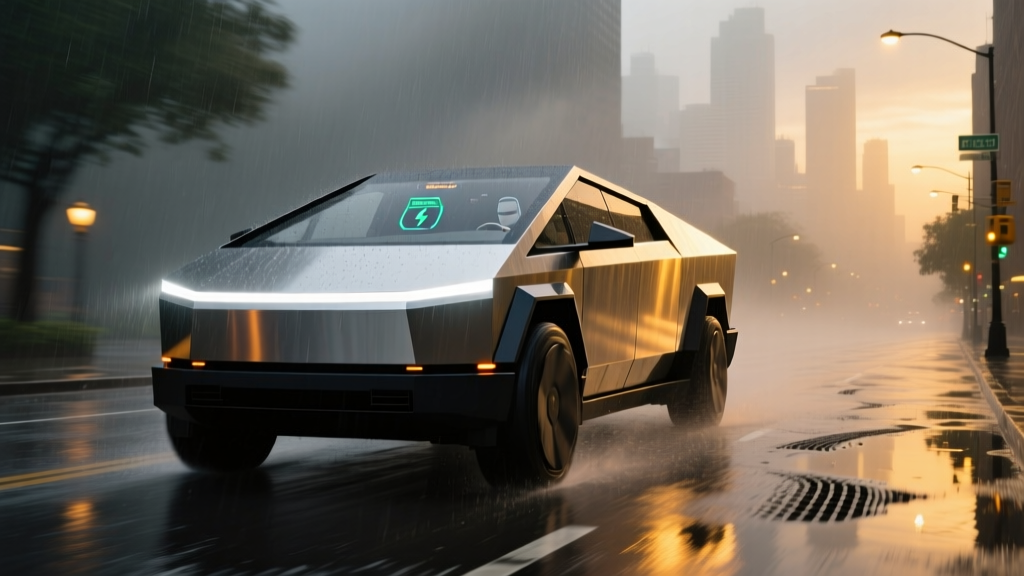
The Tesla Cybertruck remains one of the most polarizing EVs on the road in 2026, and cybertruck rain software issues have become a frequent search topic among owners and prospective buyers. After extensive testing across multiple trims—AWD, Rear-Wheel Drive, and the high-performance Cyberbeast—we can confirm that while Tesla has issued several over-the-air (OTA) updates addressing early-build sensor and wiper calibration problems, some rain-related quirks persist. This review covers the full ownership picture: real-world range, charging speeds, pricing after tax credits, and whether the Cybertruck's utility justifies its $79,990+ starting price.
Range Reality Check
EPA Estimated Range: 318 miles (AWD), 340 miles (RWD), 307 miles (Cyberbeast)
Real-World Expectation: Expect 250-280 miles on highway road trips at 70+ mph. In cold weather (below 30°F), range drops 20-30%, landing around 210-240 miles for the AWD trim. City driving with regenerative braking recovers closer to EPA figures.
Tesla Cybertruck Specs: Battery, Range, and Efficiency
| Specification | AWD | RWD (2026) | Cyberbeast |
|---|---|---|---|
| Battery Capacity (usable) | ~123 kWh (NMC) | ~123 kWh (NMC) | ~123 kWh (NMC) |
| EPA Range | 318 mi | 340 mi | 307 mi |
| Efficiency (MPGe) | 79 MPGe | 84 MPGe | 76 MPGe |
| kWh per 100 miles | 48 kWh | 45 kWh | 50 kWh |
| 0-60 mph | 4.1 sec | 6.2 sec | 2.6 sec |
| Horsepower | 600 hp | 315 hp | 845 hp |
| Drivetrain | Dual-Motor AWD | Single-Motor RWD | Tri-Motor AWD |
| Towing Capacity | 11,000 lbs | 7,500 lbs | 11,000 lbs |
| Base MSRP (2026) | $79,990 | $60,990 | $99,990 |
The Cybertruck uses a nickel-manganese-cobalt (NMC) battery pack, which offers higher energy density than lithium iron phosphate (LFP) but is more sensitive to sustained 100% state-of-charge storage. Tesla recommends daily charging to 80-90% for longevity, reserving 100% for road trips. The 48-volt electrical architecture reduces wiring weight and improves efficiency, a first for a production Tesla.
Addressing Cybertruck Rain Software Issues
Early 2024-2025 Cybertruck builds experienced several rain-related software complaints that have driven the "cybertruck rain software issues" search trend:
- Autopilot/FSD sensor degradation: Heavy rain caused the vision-only system to reduce confidence, sometimes disengaging Autosteer or limiting FSD (Supervised) functionality. Tesla's 2025.24+ software improved neural-net rain detection, but FSD remains SAE Level 2—the driver must stay engaged.
- Wiper logic: The single front wiper (a first for Tesla) uses an auto-wiper mode tied to camera-based rain detection. Owners reported delayed activation in light drizzle and overly aggressive wiping in mist. OTA updates in late 2025 added manual sensitivity controls.
- Traction control calibration: Some AWD and Cyberbeast owners noted momentary torque reduction on wet pavement, which Tesla addressed via powertrain firmware updates.
ADAS Limitation Warning
Tesla Autopilot and FSD (Supervised) are SAE Level 2 driver-assist systems, not self-driving. The driver must maintain steering-wheel contact, monitor the road, and be ready to take over instantly—especially in rain, fog, or low-visibility conditions. Vision-only systems are more susceptible to weather interference than lidar-equipped Level 4 robotaxis like Waymo.
Charging Speed: DC Fast, Level 2, and the Charge Curve
| Charging Level | Power (kW) | Miles Added per Hour | Notes |
|---|---|---|---|
| Level 1 (120V household) | ~1.4 kW | ~3 mi/hr | Emergency/trickle only |
| Level 2 (240V, 48A home charger) | 11.5 kW | ~29 mi/hr | Full charge in ~11 hours |
| DC Fast Charge (peak) | 250 kW | ~170 mi in 15 min | 10-80% in ~25-30 min |
| DC Fast Charge (sustained avg) | ~150-180 kW | — | Charge curve tapers above 60% SoC |
The Cybertruck's 250 kW peak DC fast-charge rate is competitive but not class-leading—rivals like the Rivian R1T and Ford F-150 Lightning hit 220-210 kW, while the GMC Sierra EV reaches 350 kW. The critical metric is the charge curve: the Cybertruck sustains 200+ kW from 10-40% SoC, then tapers to ~120 kW by 70%, and drops below 50 kW above 90%. Preconditioning the battery (via navigation to a Supercharger) is essential to hit peak rates; arriving cold can add 10+ minutes to a 10-80% session.
For home charging, a Tesla Wall Connector (48A, hardwired) delivers 11.5 kW—enough to add ~115 miles overnight in 4 hours. A 200-amp electrical panel is usually sufficient, but older homes may need a $1,500-$3,000 panel upgrade (consult a licensed electrician for final specs).
2026 Pricing, Trims, and Federal Tax Credit Eligibility
| Trim | Base MSRP | Federal §30D Credit | Effective Price (est.) |
|---|---|---|---|
| RWD | $60,990 | Up to $7,500* | ~$53,490 |
| AWD | $79,990 | Up to $7,500* | ~$72,490 |
| Cyberbeast | $99,990 | $0 (MSRP cap) | $99,990 |
*Federal tax credit eligibility under IRS §30D requires: (1) buyer AGI ≤ $150K single / $300K joint, (2) vehicle MSRP ≤ $80,000 for trucks/SUVs, (3) battery components and critical minerals sourced per 2026 rules. The Cyberbeast exceeds the MSRP cap and is ineligible. Point-of-sale transfer is available at participating dealers. Always verify current-year rules at irs.gov and consult a tax professional.
The RWD trim (added for 2026) makes the Cybertruck more accessible, but its 7,500-lb towing capacity and 6.2-second 0-60 time position it as a lifestyle truck rather than a workhorse. The AWD trim is the volume seller and qualifies for the credit, while the Cyberbeast's $99,990 price and 2.6-second 0-60 appeal to performance buyers unconcerned with incentives.
Cargo, Passenger Space, and Standout Tech
The Cybertruck's 6.5-foot bed offers 74 cu ft of cargo volume (with the tonneau cover closed), and the lockable "vault" is a standout for secure storage. The rear seats provide 38.5 inches of legroom—adequate for adults on short trips but tighter than a full-size F-150 Lightning (43.5 in). The front trunk (frunk) adds 7 cu ft.
Standout tech includes:
- Steer-by-wire: No mechanical connection between the yoke and wheels; enables variable steering ratio (lock-to-lock in under one turn at low speeds).
- 48-volt architecture: Reduces current draw, enabling thinner wiring and more efficient accessories.
- 18.5-inch center touchscreen with Tesla's latest UI, including a dedicated "truck mode" for bed camera views and trailer light checks.
- Powershare: 240V outlets in the bed (up to 9.6 kW) for job-site tools or tailgating.
Notable drawbacks: the stainless-steel exoskeleton shows fingerprints and water spots aggressively (especially after rain), the yoke steering has a learning curve, and the single wiper's coverage arc leaves the passenger-side glass partially obscured in heavy downpours.
Warranty and Long-Term Ownership
Tesla's warranty coverage for the Cybertruck:
- Basic Vehicle: 4 years / 50,000 miles
- Battery & Drive Unit: 8 years / 120,000 miles (whichever comes first), with a minimum 70% capacity retention threshold
- Corrosion: 12 years / unlimited miles (stainless body)
NMC battery degradation data from Tesla's 2025 Impact Report suggests ~10-12% capacity loss at 150,000 miles under typical use. Full battery replacement (if out of warranty) is estimated at $18,000-$25,000 based on current pack pricing, though this figure is expected to decline as cell costs fall.
Who Should Buy the Cybertruck (and Who Shouldn't)?
Choose the Cybertruck if:
- You want a secure, lockable bed vault for gear or tools.
- You value Powershare 240V outlets for job-site or camping use.
- You're drawn to the steer-by-wire tech and polarizing design.
- You primarily drive in mild climates (rain software issues are less impactful in dry regions).
Look elsewhere if:
- You need maximum rear-seat legroom (F-150 Lightning is roomier).
- You tow frequently above 8,000 lbs (Rivian R1T and F-150 Lightning offer similar capacity with more mature software).
- You rely heavily on Autopilot/FSD in rainy climates (lidar-equipped systems degrade less in weather).
- You want a conventional steering wheel and proven wiper systems.
Cybertruck vs. Key Competitors
| Vehicle | EPA Range | Max DC kW | Towing | Base Price |
|---|---|---|---|---|
| Tesla Cybertruck AWD | 318 mi | 250 kW | 11,000 lbs | $79,990 |
| Ford F-150 Lightning (Ext. Range) | 320 mi | 210 kW | 10,000 lbs | $69,995 |
| Rivian R1T (Dual-Motor Max) | 352 mi | 220 kW | 11,000 lbs | $83,900 |
| GMC Sierra EV Denali | 390 mi | 350 kW | 12,000 lbs | $87,300 |
The F-150 Lightning offers more interior space and a lower entry price but less range in standard trims. The Rivian R1T leads on range and adventure-ready features (gear tunnel, camp kitchen). The Sierra EV boasts the longest range and fastest charging but at a premium. The Cybertruck's differentiators remain its stainless body, steer-by-wire, and Tesla's Supercharger network (now open to NACS-equipped rivals, reducing its exclusivity advantage).
Pros and Cons
Pros
- Lockable bed vault with 74 cu ft cargo space
- Powershare 240V outlets (9.6 kW) for tools/camping
- Steer-by-wire enables tight turning radius
- Strong 0-60 performance (2.6 sec Cyberbeast)
- Access to Tesla Supercharger network (250 kW peak)
Cons
- Rain software issues (wiper logic, FSD confidence) persist in some builds
- Rear legroom is tight vs. F-150 Lightning
- Stainless body shows water spots and fingerprints
- Cyberbeast ineligible for federal tax credit (MSRP cap)
- Yoke steering has a steep learning curve
Frequently Asked Questions
What is the real-world range of the Tesla Cybertruck?
The EPA rates the AWD at 318 miles, RWD at 340 miles, and Cyberbeast at 307 miles. In real-world highway driving at 70+ mph, expect 250-280 miles. Cold weather (below 30°F) reduces range by 20-30%.
How fast does the Cybertruck charge at home and on DC fast chargers?
At home on a Level 2 Tesla Wall Connector (11.5 kW), you'll add ~29 miles per hour, fully charging in ~11 hours. On DC fast chargers, it peaks at 250 kW, reaching 10-80% in 25-30 minutes (with battery preconditioning).
Does the Cybertruck qualify for the $7,500 federal EV tax credit?
The RWD ($60,990) and AWD ($79,990) trims qualify if you meet IRS §30D income caps (≤$150K single / $300K joint) and battery-sourcing requirements. The Cyberbeast ($99,990) exceeds the $80K MSRP cap for trucks and is ineligible. Verify at irs.gov.
Are cybertruck rain software issues fixed in 2026?
Tesla has issued multiple OTA updates since 2024 improving wiper sensitivity controls, Autopilot rain detection, and traction calibration. However, vision-only FSD still reduces confidence in heavy rain—a known limitation of camera-based SAE Level 2 systems. Manual wiper controls are now available.
Is the Cybertruck worth buying vs. the F-150 Lightning or Rivian R1T?
If you prioritize bed security (vault), 240V Powershare, and Tesla's software ecosystem, the Cybertruck is compelling. For maximum rear-seat space and a conventional driving experience, the F-150 Lightning is more practical. For range and adventure features, the Rivian R1T leads. Test-drive all three before deciding.
What's the battery warranty and replacement cost?
Tesla covers the battery and drive unit for 8 years / 120,000 miles with a 70% capacity retention threshold. Out-of-warranty replacement is estimated at $18,000-$25,000, though costs are expected to decline.