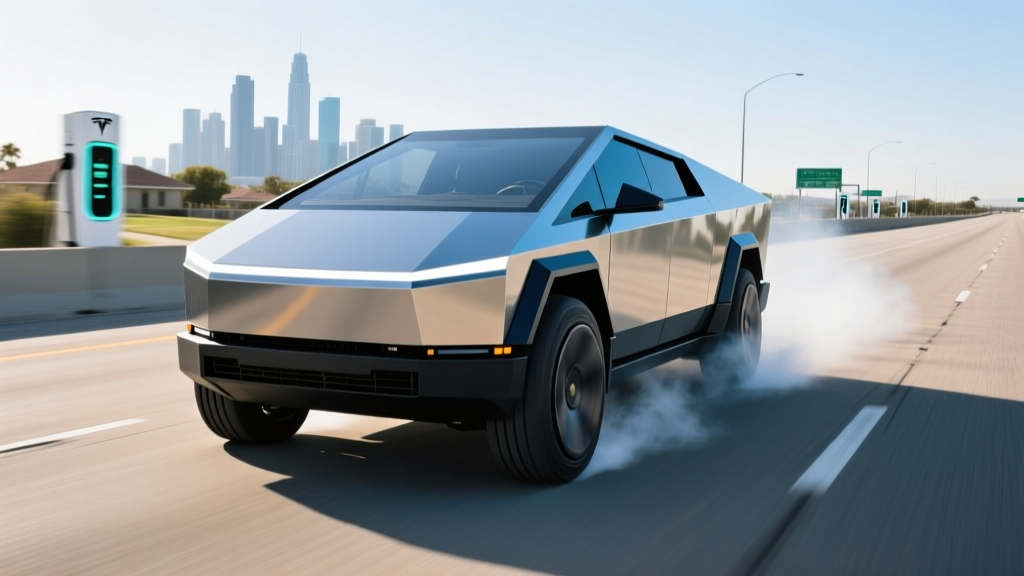
The Cybertruck's Drag-Strip Promise Meets Reality
When Tesla unveiled the Cybertruck, the headline numbers were staggering: sub-3-second 0-60 mph sprints, a stainless-steel exoskeleton, and a tri-motor powertrain that could embarrass supercars at the drag strip. But for EV buyers researching a six-figure electric truck purchase, the Cybertruck 1/4 mile time is only one piece of a far more complex ownership equation. How does the truck's straight-line performance translate to daily range, charging practicality, towing utility, and real-world cost?
We've analyzed Tesla's published specifications, independent testing data, and EPA filings to build the most complete buyer-focused Cybertruck profile available — covering both the dual-motor AWD and the tri-motor Cyberbeast trims that dominate the conversation.
Full Specifications at a Glance
| Specification | AWD (Dual-Motor) | Cyberbeast (Tri-Motor) |
|---|---|---|
| Battery Capacity (usable) | ~123 kWh (NMC) | ~123 kWh (NMC) |
| EPA Estimated Range | 340 miles | 320 miles |
| Horsepower | 600 hp | 845 hp |
| 0-60 mph | 4.1 seconds | 2.6 seconds |
| 1/4 Mile (est.) | ~12.3 sec @ ~115 mph | ~10.8 sec @ ~130 mph |
| Top Speed | 112 mph | 130 mph |
| Max DC Fast Charge | ~350 kW (800V architecture) | ~350 kW (800V architecture) |
| 10-80% DC Fast Charge | ~15 minutes | ~15 minutes |
| Level 2 Home Charging | 11.5 kW (~30 mi/hr) | 11.5 kW (~30 mi/hr) |
| Towing Capacity | 11,000 lbs | 11,000 lbs |
| Payload Capacity | 2,500 lbs | 2,500 lbs |
| Bed Length | 6 ft (72 in) | 6 ft (72 in) |
| Cargo Volume (bed + frunk) | ~67 cu ft bed + ~7 cu ft frunk | ~67 cu ft bed + ~7 cu ft frunk |
| Base MSRP | $79,990 | $99,990 |
| Battery/Powertrain Warranty | 8 yr / 120,000 mi | 8 yr / 120,000 mi |
| EPA Efficiency | ~65 MPGe / ~51 kWh/100mi | ~60 MPGe / ~56 kWh/100mi |
Source: fueleconomy.gov, Tesla official specifications. 1/4 mile figures reflect independent testing estimates; actual results vary with surface conditions, tire spec, and battery state of charge.
The Cybertruck 1/4 Mile: What the Numbers Actually Mean
The Cyberbeast's tri-motor layout — one motor on the front axle and two on the rear — delivers 845 horsepower and an estimated 1/4 mile time of approximately 10.8 seconds at roughly 130 mph. That puts the Cyberbeast in the territory of a Dodge Challenger SRT Hellcat Redeye or a base Porsche 911 Turbo, in a vehicle weighing over 6,800 pounds.
The dual-motor AWD trim, at 600 hp, posts an estimated 1/4 mile of around 12.3 seconds at approximately 115 mph — still quicker than most sport sedans and virtually every other production pickup truck on the road, including the Ford F-150 Lightning and Rivian R1T.
Here's where EV physics matters: Tesla's 800-volt electrical architecture allows the motors to sustain high power delivery deeper into a run than a 400V system could, reducing voltage sag under heavy load. However, repeated drag-strip passes will thermally stress the battery pack, and Tesla's battery management system will progressively limit peak output to protect cell longevity. Expect the first run to be the fastest.
Range and Efficiency: EPA vs. Real World
Real-World Range Reality Check
EPA Estimated Range: 340 miles (AWD) / 320 miles (Cyberbeast)
Real-World Highway Expectation: ~270–295 miles at 70-75 mph, moderate temperatures
Cold-Weather (below 30°F): ~220–260 miles depending on cabin heating demand and battery preconditioning
Towing (loaded, 8,000+ lbs): ~150–190 miles — aerodynamic drag at highway speeds decimates range when towing
The Cybertruck's angular stainless-steel body is iconic but aerodynamically penalizing compared to a smoothed-out SUV like the Tesla Model X. At highway speeds, the flat windshield rake and hard-edged fenders create substantial drag, which is why real-world highway range consistently falls 12–20% below the EPA combined estimate. This is normal for pickup trucks — the F-150 Lightning and Rivian R1T show similar real-world shortfalls — but buyers should plan trips around the lower figure, not the sticker.
The Cybertruck uses an NMC (nickel manganese cobalt) lithium-ion pack with approximately 123 kWh of usable capacity. NMC chemistry offers high energy density — critical for fitting this much range into a truck platform — but is more sensitive to sustained 100% states of charge than LFP chemistry. For daily driving, Tesla recommends an 80% charge limit to maximize long-term cell health.
Charging Speed: 800V Architecture Pays Off
| Charging Level | Max Power (kW) | Miles Added per Hour | Notes |
|---|---|---|---|
| Level 1 (120V household) | ~1.4 kW | ~3–4 mi/hr | Emergency/trickle only; full charge takes days |
| Level 2 (240V, 48A) | 11.5 kW | ~30 mi/hr | Home Wall Connector; full charge in ~11 hours |
| DC Fast Charge (V4 Supercharger) | ~350 kW peak | ~200+ mi in 15 min | 800V arch; tapers significantly above 60% SoC |
The Cybertruck's 800-volt battery architecture is the same platform used in the Porsche Taycan and Hyundai Ioniq 5, and it enables genuinely rapid DC charging. At a Tesla V4 Supercharger (capable of delivering 350+ kW), the Cybertruck can peak near its maximum charge rate and add roughly 200 miles of range in approximately 15 minutes under ideal conditions — meaning a preconditioned battery, moderate ambient temperature, and a state of charge below 30%.
Charging-curve reality: Like all EVs, the Cybertruck's charge rate tapers as the battery fills. You'll see peak kW between roughly 10–40% state of charge, with a significant reduction above 60% and a steep taper past 80%. A 10–80% charge takes approximately 15 minutes; an 80–100% top-off can take an additional 25–30 minutes. For road trips, plan to charge from 10% to 80% and skip the final 20% unless you need every mile.
For home charging, Tesla's Wall Connector at 48 amps on a 240V circuit delivers 11.5 kW — adding about 30 miles of range per hour or a full charge overnight. Installation typically requires a 60-amp dedicated circuit; budget $800–$2,000 for a licensed electrician depending on your panel capacity and run length. If your home has a 100-amp electrical panel, a panel upgrade to 200 amps may be necessary, adding $1,500–$3,000.
Pricing, Trims, and Federal Tax Credit Eligibility
| Trim | Base MSRP | §30D Credit Eligible? | Effective Price (if eligible) |
|---|---|---|---|
| AWD (Dual-Motor) | $79,990 | Yes (under $80K truck cap) | ~$72,490 |
| Cyberbeast (Tri-Motor) | $99,990 | No (exceeds $80K cap) | $99,990 |
The Cybertruck AWD, at a $79,990 MSRP, squeaks under the IRS §30D federal tax credit MSRP cap for vans, SUVs, and pickup trucks, which is set at $80,000. That means eligible buyers can claim up to $7,500 in federal tax credits — or, beginning in 2024, transfer the credit to the dealer at point of sale for an immediate purchase-price reduction.
The Cyberbeast, at $99,990, exceeds the cap and does not qualify for the federal purchase credit. Buyers of this trim pay full MSRP regardless of income or battery sourcing.
Critical eligibility requirements for the AWD trim (per IRS §30D rules):
- Buyer income caps: Modified AGI must not exceed $300,000 (joint), $225,000 (head of household), or $150,000 (single).
- Battery sourcing: The vehicle must meet critical-mineral and battery-component sourcing requirements that tighten annually. Verify the specific VIN's eligibility on the IRS qualified vehicles list before purchasing.
- Point-of-sale transfer: You can elect to transfer the credit to the dealer, reducing your out-of-pocket cost at purchase rather than waiting for a tax refund.
- One credit per VIN, one credit per taxpayer per year.
Always confirm eligibility with a tax professional and check the current IRS qualified vehicle list before signing a purchase agreement — sourcing rules change, and a vehicle that qualifies in January may lose eligibility if supply-chain composition shifts.
Interior, Tech, and Daily Livability
The Cybertruck's interior is minimalist even by Tesla standards. A single 18.5-inch front touchscreen handles infotainment, climate, and vehicle controls. A smaller rear touchscreen serves back-seat passengers. There are no physical buttons for climate or audio — everything routes through the screen, which takes adjustment but becomes intuitive within a week of ownership.
Passenger space is adequate but not class-leading: front legroom is generous at approximately 41 inches, while rear legroom comes in around 38 inches — tighter than an F-150 SuperCrew but comparable to the Rivian R1T. The rear bench seats three, though the middle position is best for short trips due to the floor hump from the structural battery pack.
Cargo utility centers on the 6-foot bed (72 inches long, 43 inches wide between wheel wells) with a motorized retractable tonneau cover that Tesla rates to support 300 pounds of distributed weight. The powered frunk (front trunk) adds approximately 7 cubic feet of lockable storage — useful for charging cables, groceries, or a small cooler. The bed offers integrated 120V and 240V outlets, enabling vehicle-to-load (V2L) capability: you can power tools at a job site, run appliances during an outage, or charge e-bikes without a separate generator.
Driver assistance: The Cybertruck ships with Tesla's Basic Autopilot (lane centering, adaptive cruise control, emergency braking). Tesla's Full Self-Driving (Supervised) — currently a SAE Level 2 system requiring constant driver attention — is available as a paid upgrade. FSD handles highway interchanges, city stoplights, and parking maneuvers with increasing competence, but it is emphatically not autonomous driving. The driver must remain engaged at all times.
Steer-by-wire: The Cybertruck uses a fully electronic steer-by-wire system with no mechanical connection between the yoke and the front wheels. This enables a variable steering ratio (fewer turns lock-to-lock at low speeds, more stability at highway speed) and a compact yoke that doesn't block the instrument display. Some drivers adapt instantly; others find the lack of mechanical feedback unsettling. A test drive is essential before committing.
Pros, Cons, and the Competition
Pros
- Cyberbeast 1/4 mile performance rivals supercars in a 6,800-lb truck
- 800V architecture enables ~350 kW peak DC charging
- 11,000-lb towing capacity leads the EV pickup segment
- V2L with 120V/240V bed outlets replaces a job-site generator
- Stainless-steel body is dent- and corrosion-resistant
- AWD trim qualifies for §30D tax credit (under $80K MSRP cap)
Cons
- Real-world highway range falls 12–20% below EPA estimates
- Angular design creates wind noise and limits visibility
- Steer-by-wire and yoke require significant adaptation
- Cyberbeast trim ($99,990) is ineligible for federal tax credit
- Towing range drops to 150–190 miles under heavy load
- Limited public charging compatibility (NACS only; CCS adapters available but add friction)
Vs. Ford F-150 Lightning: The Lightning offers more conventional truck ergonomics, a larger bed (5.5 ft or 6.5 ft), and a lower starting price (~$55,000). But it can't match the Cybertruck's charging speed (Lightning peaks at ~150 kW) or performance (0-60 in ~4.0 sec for the Platinum trim). If you need a traditional work truck, the Lightning wins on practicality. If you want performance and fast charging, the Cybertruck leads.
Vs. Rivian R1T (Dual-Motor Max): The R1T offers superior off-road capability with quad-motor torque vectoring, a more refined interior, and a gear tunnel for creative storage. Range is comparable (~352 miles EPA for the Max pack). The R1T starts around $75,000 and qualifies for the §30D credit on eligible trims. It's the more polished all-around vehicle; the Cybertruck is the bolder, faster statement.
Who Should Buy the Cybertruck?
The Cybertruck AWD makes the most sense for buyers who want a high-performance electric truck with fast charging for road trips, need V2L capability for work or recreation, and value the §30D tax credit. It's suited to tech-forward professionals, job-site operators who can leverage the 240V bed outlets, and enthusiasts who want sports-car acceleration in a truck body.
The Cyberbeast is a halo trim — justified only if the 1/4 mile performance and 845 hp genuinely matter to you, and you're willing to pay a $20,000 premium (and forfeit the tax credit) for it. For most buyers, the AWD delivers 90% of the Cybertruck experience at a meaningfully lower effective price.
This is not the right truck for buyers who prioritize maximum cargo space (the 6-foot bed is shorter than most full-size trucks), traditional steering feel, or the lowest possible cost of entry. If you need a no-compromise work truck on a budget, the F-150 Lightning or a Chevrolet Silverado EV Work Truck is a better fit.
Frequently Asked Questions
What is the Cybertruck's real 1/4 mile time?
The tri-motor Cyberbeast runs an estimated 1/4 mile of approximately 10.8 seconds at roughly 130 mph. The dual-motor AWD posts approximately 12.3 seconds at around 115 mph. Actual times vary with tire condition, track surface, battery state of charge, and ambient temperature.
What is the real-world range of the Cybertruck?
The EPA rates the AWD at 340 miles and the Cyberbeast at 320 miles. In real-world highway driving at 70–75 mph, expect approximately 270–295 miles. In cold weather (below 30°F), range drops to roughly 220–260 miles. When towing near max capacity, plan for 150–190 miles between charges.
How fast does the Cybertruck charge at home and on the road?
At home on a Level 2 Wall Connector (11.5 kW), the Cybertruck gains about 30 miles of range per hour, with a full charge taking approximately 11 hours. On a Tesla V4 Supercharger, it can peak near 350 kW and add roughly 200 miles in 15 minutes (10–80% SoC). Charging slows significantly above 80%.
Does the Cybertruck qualify for the federal EV tax credit?
The AWD trim ($79,990 MSRP) qualifies for up to $7,500 under IRS §30D, provided the buyer meets income caps ($300K joint / $150K single), the vehicle meets battery-sourcing requirements, and the credit is available for that model year. The Cyberbeast ($99,990) exceeds the $80,000 MSRP cap for trucks and does not qualify. Always verify current eligibility on the IRS qualified vehicles list.
Is the Cybertruck worth buying over the F-150 Lightning or Rivian R1T?
If you prioritize raw performance, 800V fast charging, and V2L capability, the Cybertruck leads the segment. If you need a conventional truck layout, lower pricing, or a more refined interior, the F-150 Lightning and Rivian R1T are more practical alternatives. Test-drive all three before deciding — the Cybertruck's steer-by-wire and yoke are polarizing, and a hands-on experience is the best way to determine fit.
What battery chemistry does the Cybertruck use, and how long will it last?
The Cybertruck uses NMC (nickel manganese cobalt) lithium-ion cells with approximately 123 kWh of usable capacity. Tesla warranties the battery and drive units for 8 years or 120,000 miles, whichever comes first, with a minimum 70% capacity retention threshold. NMC packs typically lose 10–15% capacity over the first 150,000 miles with proper care (avoiding frequent 100% charges and extreme heat exposure).