Can You Actually Buy a Purple Tesla Cybertruck in 2026?
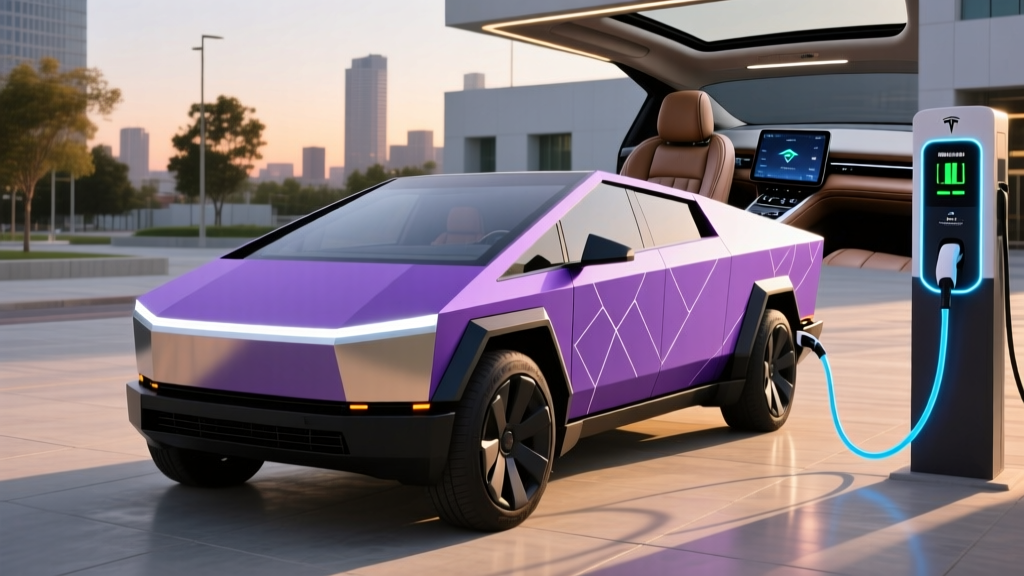
If you've been searching for a "Cybertruck purple" option, here's the honest answer straight from Tesla's configurator: Tesla does not offer a factory purple paint color for the Cybertruck. The stainless-steel exoskeleton ships in one of five factory finishes — Stainless Steel (bare), Satin Black, Matte Black, Pearl White, and Stealth Gray (added for 2025). That hasn't stopped thousands of owners from wrapping their trucks in vibrant purple vinyl, and the trend has only accelerated through 2026 as wrap-shop capacity and film quality have caught up with Cybertruck's angular geometry.
This review covers the Cybertruck as a vehicle — its real-world range, charging behavior, pricing, and tax-credit eligibility — and then tackles the purple question head-on: what a wrap costs, which films hold up best on stainless steel, and whether a color change affects your warranty.
Cybertruck Trim Lineup, Pricing & Federal Tax Credit
Tesla sells the Cybertruck in three trims for the 2026 model year. Pricing below reflects MSRP before any incentives, destination fees, or wrap costs.
| Trim | Drivetrain | Base MSRP | §30D Credit Eligible? | Effective Price (after credit) |
|---|---|---|---|---|
| Long Range AWD | Dual-Motor AWD | $79,990 | No — MSRP exceeds $80,000 truck cap | $79,990 |
| Cyberbeast | Tri-Motor AWD | $99,990 | No — MSRP exceeds $80,000 truck cap | $99,990 |
| Rear-Wheel Drive | Single-Motor RWD | $60,990 (est.) | Potentially — under $80K cap; depends on sourcing & buyer income | ~$53,490 (if $7,500 credit applies) |
Tax-credit reality check: Under IRS §30D rules, the Cybertruck qualifies as a light truck, so the MSRP cap is $80,000. Only the upcoming RWD trim falls under that threshold. Even then, buyers must meet adjusted gross income limits ($150K single / $300K joint), and the vehicle must satisfy critical-mineral and battery-component sourcing requirements that have tightened significantly since 2024. Always confirm eligibility on the IRS clean-vehicle credit page or with a tax professional before counting on the credit.
Range, Battery & Real-World Efficiency
EPA Estimated: 340 miles (Long Range AWD) / 320 miles (Cyberbeast)
Real-World Expectation: ~260–290 miles on highway road trips at 70–75 mph; ~210–240 miles in freezing weather with cabin heat running. The Cybertruck's brick-like 0.38 drag coefficient hits efficiency hard at sustained highway speed.
Tesla equips the Cybertruck Long Range and Cyberbeast with a ~123 kWh usable battery pack using 4680-format cells. Tesla has not published the exact cathode chemistry for the Cybertruck pack, but teardowns and supply-chain reporting indicate a high-nickel NMC (nickel-manganese-cobalt) formulation optimized for energy density and power delivery — not the LFP chemistry used in the Model 3 Standard Range.
Efficiency on the EPA combined cycle lands at roughly 2.0 kWh/mile (50 MPGe combined for the Long Range), per fueleconomy.gov. That's thirsty by EV standards — comparable to the Rivian R1T but worse than a Ford F-150 Lightning Extended Range. The stainless-steel body and massive frontal area are the culprits. Plan on 2.3–2.5 kWh/mile at sustained 75 mph in real-world highway driving, especially with the tonneau cover open or a bed load.
| Spec | Long Range AWD | Cyberbeast |
|---|---|---|
| EPA Range | 340 mi | 320 mi |
| Battery (usable) | ~123 kWh, NMC (4680) | ~123 kWh, NMC (4680) |
| 0–60 mph | 3.9 sec | 2.6 sec |
| Horsepower | 600 hp | 845 hp |
| Drivetrain | Dual-Motor AWD | Tri-Motor AWD |
| MPGe (combined) | ~50 MPGe | ~47 MPGe |
| Tow Rating | 11,000 lbs | 11,000 lbs |
| Battery Warranty | 8 yr / 120,000 mi | 8 yr / 120,000 mi |
Charging Speed: DC Fast, Level 2 & the 4680 Curve
Charging speed is where Cybertruck owners often feel the biggest gap between marketing and reality. Here's the breakdown:
| Charging Level | Power (kW) | Speed (mi/hr added) | Notes |
|---|---|---|---|
| Level 1 (120V) | ~1.4 kW | ~3 mi/hr | Emergency/trickle only on a 123 kWh pack |
| Level 2 (240V, 48A) | 11.5 kW | ~28 mi/hr | Full charge in ~11 hrs; standard home setup |
| DC Fast (peak) | ~250 kW | ~170 mi/15 min (peak) | 10–80% in ~28 min; tapers sharply above 80% |
What the charge curve actually looks like: The 4680 cells accept a peak of roughly 250 kW at a V4 Supercharger, but that rate only holds between approximately 10% and 35% state of charge. From 35–60%, power drops to ~170 kW; from 60–80%, it falls to ~100 kW. The result is a 10–80% session of about 28 minutes at a V3/V4 Supercharger — competitive with the F-150 Lightning but noticeably slower than Hyundai/Kia's 800V architecture (which does 10–80% in ~18 minutes). Above 80%, charging slows dramatically; plan your road-trip stops around 10–80% cycles to avoid wasting time at the stall.
For home charging, a Wall Connector on a 60A circuit (48A continuous) adds roughly 28 miles per hour. That's adequate for overnight replenishment of a daily commute, but if you're regularly towing and draining the pack, consider upgrading to a 100A circuit to support Tesla's higher-amperage Wall Connector options.
Performance, Cargo & Daily Practicality
The Cyberbeast's 2.6-second 0–60 time is absurd for a 6,800-pound truck, and the Long Range's 3.9 seconds still outruns most sports cars. Torque-vectoring on the tri-motor Cyberbeast enables a tank-turn feature (limited availability) and genuinely impressive trail manners. Steering is via a steer-by-wire system with a yoke — it takes about a week of daily driving to build muscle memory, and opinions among owners remain sharply divided.
Cargo dimensions:
- Bed length: 6 feet (with tailgate up); ~7 feet with tailgate down
- Bed volume: ~67 cu ft (with powered tonneau closed)
- Frunk (front trunk): ~7 cu ft — fits a large backpack or charging cables
- Interior passenger volume: ~68 cu ft; rear legroom ~38 inches (adequate for adults, not class-leading)
- Ground clearance: Up to 16 inches in Extract mode (air suspension)
Standout tech: The 18.5-inch center touchscreen runs Tesla's latest UI, with a rear-seat 9.4-inch display for passengers. The powered stainless-steel tonneau cover is standard and lockable. Tesla's Autopilot (Level 2 SAE driver assist) is included; Full Self-Driving (Supervised) remains a $8,000 add-on and still requires active driver supervision — it is not autonomous driving. Powershare capability lets you run 240V tools or appliances from the bed outlets (up to 9.6 kW continuous).
Going Purple: Wrap Options, Costs & Warranty Impact
Since Tesla doesn't sell a purple Cybertruck from the factory, a vinyl wrap is your path. Here's what Cybertruck owners are actually paying and choosing in 2026:
| Film Type | Popular Colors | Estimated Cost (full wrap) | Durability |
|---|---|---|---|
| Cast Vinyl (gloss) | Gloss Purple, Violet Metallic | $5,000–$7,500 | 5–7 years; UV-resistant topcoat |
| Cast Vinyl (satin/matte) | Satin Amethyst, Matte Plum | $5,500–$8,000 | 5–7 years; shows swirl marks less |
| Color-shift / Chromatic | Purple-to-Teal, Violet-Blue | $7,000–$10,000 | 4–6 years; specialty film, limited installers |
| PPF + Tint overlay | Subtle purple tint over clear PPF | $8,000–$12,000 | 7–10 years; protects + colors simultaneously |
Why Cybertruck wraps cost more: The angular stainless-steel panels require precise panel-by-panel application with fewer compound curves to work with but more edge-sealing challenges. Shops charge a 15–25% premium over wrapping a similarly sized F-150 Lightning. Expect a 3–5 day shop time.
Warranty question: A professionally installed vinyl wrap does not void Tesla's 8-year/120,000-mile battery and drive unit warranty. However, if wrap adhesive damages the stainless-steel finish during removal (rare with quality cast films, but possible with cheap calendared vinyl), cosmetic repair won't be covered. Use 3M, Avery Dennison, or XPEL films and keep your installer receipt.
Cybertruck vs. R1T vs. F-150 Lightning: Is It Worth It?
| Attribute | Tesla Cybertruck LR AWD | Rivian R1T Dual-Motor Max | Ford F-150 Lightning Ext. Range |
|---|---|---|---|
| EPA Range | 340 mi | ~410 mi | ~320 mi |
| Base MSRP | $79,990 | $89,900 | $69,995 |
| DC Fast Charge (peak) | ~250 kW | ~220 kW | ~150 kW |
| 0–60 mph | 3.9 sec | ~3.5 sec | ~3.8 sec |
| Tow Rating | 11,000 lbs | 11,000 lbs | 10,000 lbs |
| §30D Credit Eligible | No (over MSRP cap) | No (over MSRP cap) | Potentially (select trims under $80K) |
Choose the Cybertruck if: You want the Supercharger network, steer-by-wire novelty, Powershare V2L capability, and don't mind being the most visible vehicle on the road — especially in purple.
Choose the Rivian R1T if: Maximum range, refined interior quality, and genuine off-road capability (with quad-motor torque vectoring) are your priorities, and budget is flexible.
Choose the F-150 Lightning if: You want a conventional truck experience, BlueCruise hands-free highway driving, the best chance at the §30D tax credit, and the lowest entry price.
Frequently Asked Questions
What is the real-world range of the Cybertruck?
The EPA rates the Long Range AWD at 340 miles, but expect 260–290 miles on real highway trips at 70+ mph and as low as 210–240 miles in sub-freezing temperatures. The 0.38 drag coefficient and 6,800-lb curb weight punish highway efficiency more than most EVs.
How fast does the Cybertruck charge at home and on the road?
On a 250 kW V4 Supercharger, 10–80% takes approximately 28 minutes, with peak charge rates around 250 kW tapering to ~100 kW by 75% SoC. At home on a 48A Level 2 Wall Connector (11.5 kW), you'll add roughly 28 miles of range per hour — enough to refill a daily commute overnight, but a full 0–100% charge takes about 11 hours.
Does the Cybertruck qualify for the federal EV tax credit?
The Long Range AWD ($79,990) and Cyberbeast ($99,990) exceed the $80,000 MSRP cap for trucks under IRS §30D. The upcoming RWD trim, expected at ~$60,990, may qualify if it meets battery-sourcing requirements and the buyer falls within income limits ($150K single / $300K joint). Always verify on the IRS clean-vehicle credit portal before purchasing.
How much does a purple wrap cost on a Cybertruck?
Expect $5,000–$8,000 for a quality cast-vinyl wrap (gloss, satin, or matte purple) from a reputable installer. Color-shift films and PPF+tint combos can push to $10,000–$12,000. The Cybertruck's angular geometry adds a 15–25% premium over conventional truck wraps.
What are the biggest pros and cons of the Cybertruck?
- Supercharger network access (now with NACS native)
- Stainless-steel body resists dents and scratches
- Powershare V2L (9.6 kW) runs tools and appliances
- Air suspension with Extract mode (16" ground clearance)
- Class-leading acceleration for a full-size truck
- Highway efficiency is poor (~2.0+ kWh/mile real-world)
- No factory color options — wrap required for purple/custom
- Yoke steering and steer-by-wire polarize drivers
- Rear visibility is limited; relies heavily on cameras
- MSRP exceeds §30D tax-credit cap on AWD trims
- Build-quality consistency still trails legacy OEMs
Who should buy the Cybertruck?
The Cybertruck fits tech-forward buyers who value the Supercharger ecosystem, want V2L capability for job sites or camping, and enjoy the attention a stainless-steel wedge commands — especially wrapped in satin purple. It's less ideal for buyers prioritizing highway range efficiency, conventional truck ergonomics, or federal tax-credit savings. If your use case is daily commuting under 60 miles with weekend towing, the Cybertruck handles it — just budget for the electricity and the wrap.