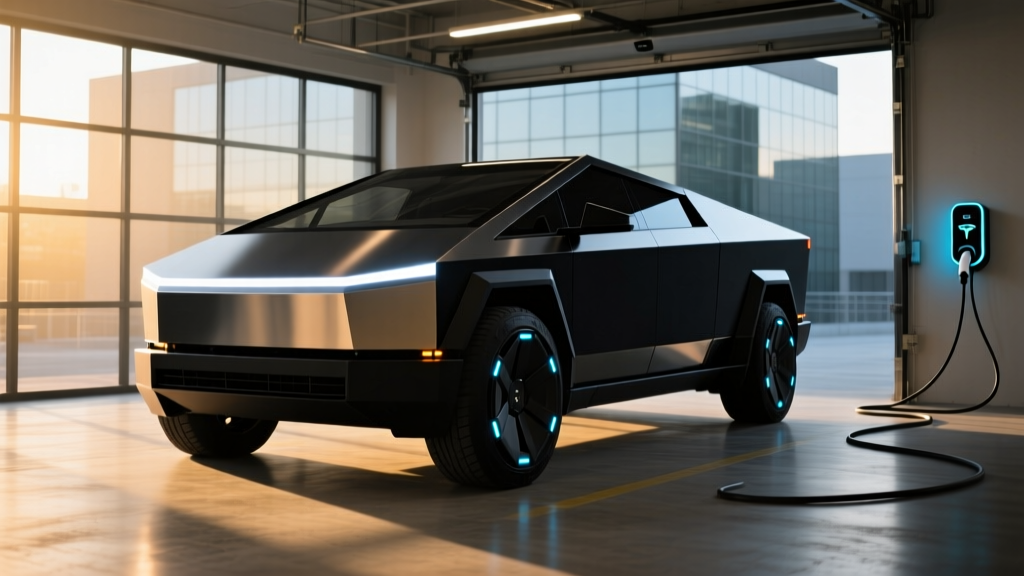
If you've searched "Cybertruck production stopped" recently, you've likely encountered a swirl of rumors, social media speculation, and misleading headlines. As of early 2026, Tesla has not officially halted Cybertruck production. However, Tesla has periodically adjusted production cadences at Giga Texas — pausing lines for retooling, managing supply chain bottlenecks for the 4680 cell, and balancing output against demand shifts. This guide cuts through the noise with verified production status, complete specs, real-world range data, and a clear-eyed look at whether the Cybertruck belongs on your shortlist.
Current Cybertruck Production Status (2026 Update)
Tesla's Giga Texas facility in Austin continues to produce the Cybertruck, though output has fluctuated throughout the vehicle's lifecycle. Several factors have fueled the "production stopped" narrative:
- 4680 cell supply constraints: The Cybertruck relies on Tesla's structurally integrated 4680 battery cells, which have faced yield and scaling challenges since launch.
- Recall-related rework: NHTSA-mandated recalls for accelerator pedal trim and windshield wiper issues required production-line modifications that temporarily slowed output.
- Demand recalibration: With the initial reservation backlog largely fulfilled, Tesla has adjusted production rates to match organic demand rather than building to inventory.
- Periodic line pauses: Like all automakers, Tesla occasionally halts production for equipment upgrades — these routine pauses are often misreported as permanent shutdowns.
As of this writing, the Cybertruck remains available for order through Tesla's website with estimated delivery windows, and vehicles continue to be delivered to customers. Tesla does not publish granular model-level production figures, but third-party registration data and Giga Texas satellite imagery confirm ongoing manufacturing activity.
Cybertruck Specs: Range, Battery, and Efficiency
| Specification | Dual Motor AWD | Cyberbeast (Tri-Motor) |
|---|---|---|
| EPA Estimated Range | 340 miles | 320 miles |
| Battery Capacity (usable) | ~123 kWh (estimated) | ~123 kWh (estimated) |
| Battery Chemistry | NMC (nickel manganese cobalt) | NMC |
| Efficiency (MPGe combined) | ~66 MPGe | ~62 MPGe |
| Energy Consumption | ~51 kWh/100 mi | ~54 kWh/100 mi |
| Drivetrain | Dual Motor AWD | Tri-Motor AWD |
| Horsepower | 600 hp | 845 hp |
| 0-60 mph | 3.9 seconds | 2.6 seconds |
| Towing Capacity | 11,000 lbs | 11,000 lbs |
| Payload Capacity | 2,500 lbs | 2,500 lbs |
| Bed Length | 6 ft (72 in) | 6 ft (72 in) |
Tesla has not published official battery capacity figures, but teardown analysis and range/efficiency calculations point to a usable capacity of approximately 123 kWh using NMC chemistry in a structural pack configuration with 4680-format cells. Tesla does not currently offer an LFP (lithium iron phosphate) variant of the Cybertruck — the energy density requirements of a full-size truck battery make NMC the necessary choice.
Charging Speed: DC Fast Charge and Home Level 2
| Charging Level | Max Rate | Speed / Time |
|---|---|---|
| DC Fast Charge (V4 Supercharger) | ~350 kW peak | 10-80% in approximately 20-25 minutes |
| DC Fast Charge (V3 Supercharger / third-party) | ~250 kW peak | 10-80% in approximately 28-35 minutes |
| Home Level 2 (Tesla Wall Connector, 48A) | 11.5 kW | ~30-35 miles of range per hour; full charge in ~11-12 hours |
| Level 1 (120V standard outlet) | ~1.4 kW | ~3-4 miles per hour (emergency/trickle only) |
The Cybertruck uses an 800-volt electrical architecture, which enables faster DC charging and more efficient power delivery compared to 400V systems. On Tesla's latest V4 Supercharger stalls — which support up to 350+ kW — the Cybertruck can accept peak charge rates around 350 kW, though sustained rates average closer to 200-250 kW across the 10-80% window due to charge-curve tapering.
Understanding the charge curve: Like all EVs, the Cybertruck charges fastest at low states of charge and progressively slows as the battery fills. You'll see peak kW only in the 10-30% SoC range; from 60-80%, the rate tapers significantly to protect cell longevity. This is why the 10-80% metric matters more than peak kW alone.
The Cybertruck uses the NACS (North American Charging Standard) connector natively, which is now the dominant standard in North America. This means seamless access to the entire Tesla Supercharger network — currently over 6,000 stations and 60,000+ connectors in the U.S. — without adapters. Third-party networks like Electrify America and EVgo are also adding NACS connectors, though CCS-to-NACS adapters may be needed at some legacy stations.
Pricing, Trims, and Federal Tax Credit Eligibility
| Trim | Base MSRP | §30D Tax Credit Eligibility | Effective Price (with credit) |
|---|---|---|---|
| Dual Motor AWD | $79,990 | Not eligible (exceeds $80,000 truck MSRP cap) | $79,990 |
| Cyberbeast (Tri-Motor) | $99,990 | Not eligible (exceeds $80,000 truck MSRP cap) | $99,990 |
Tax credit reality: Under current IRS §30D rules, the Cybertruck is classified as a pickup truck, which carries an $80,000 MSRP cap for tax credit eligibility. The Dual Motor AWD at $79,990 sits right at the threshold, but once destination fees and any options are added, it exceeds the cap. Additionally, §30D requires compliance with critical-mineral sourcing and battery-component manufacturing requirements, buyer income limits ($150,000 single / $300,000 joint MAGI), and the vehicle must be assembled in North America (the Cybertruck qualifies on this point). (Source: IRS §30D guidance)
In practice, most Cybertruck configurations will not qualify for the $7,500 federal tax credit due to the MSRP cap. Buyers should not factor the credit into their purchase budget for this vehicle. Some state-level incentives may still apply — check your local DMV or energy office for current programs.
Performance, Tech, and Interior
The Cybertruck's performance credentials are genuinely impressive, particularly in Cyberbeast trim. The tri-motor AWD configuration produces 845 horsepower and launches to 60 mph in 2.6 seconds — faster than most supercars and absurd for a 6,800-pound stainless-steel truck. The dual-motor variant's 3.9-second 0-60 time still outpaces nearly every conventional pickup on the market.
Key technology features:
- Steer-by-wire: The Cybertruck eliminates the mechanical connection between the steering yoke and wheels, using electronic actuators instead. This enables a variable steering ratio (fewer turns lock-to-lock at low speed) and a compact yoke design, though it takes acclimation.
- 48-volt electrical architecture: A first for a production vehicle at this scale, the 48V system reduces wiring harness weight and enables more powerful accessories.
- Armor glass: Tesla's laminated "armor glass" is designed for impact resistance, though early production units reported cracking issues that Tesla has addressed in subsequent builds.
- 18.5-inch center touchscreen: Runs Tesla's latest UI with navigation, media, climate, and vehicle controls. Rear passengers get a dedicated 9.4-inch screen.
- Autopilot / FSD (Supervised): Standard Autopilot includes adaptive cruise and lane-keeping. Full Self-Driving (Supervised) is available as an add-on — note that this remains an SAE Level 2 driver-assist system requiring full driver engagement at all times.
Interior and cargo: The Cybertruck seats five (bench rear) or optionally five with individual rear seats. Front legroom is generous at approximately 41.5 inches; rear legroom is tighter at roughly 38 inches due to the sloping roofline. The 6-foot bed offers approximately 67 cubic feet of cargo volume with the tonneau cover closed. A front trunk (frunk) adds roughly 7 cubic feet of lockable storage. The powered tonneau cover can support up to 300 pounds of distributed weight.
Warranty and Long-Term Ownership
| Coverage Area | Term |
|---|---|
| Basic Vehicle Limited Warranty | 4 years / 50,000 miles |
| Battery & Drive Unit Warranty | 8 years / 120,000 miles (whichever comes first, with minimum 70% capacity retention) |
| Restraint System | 5 years / 60,000 miles |
| Corrosion Perforation | 12 years / unlimited miles (stainless steel exoskeleton) |
Tesla's battery warranty guarantees that the pack will retain at least 70% of its original capacity over 8 years or 120,000 miles. Based on Tesla's historical degradation data across the Model S/3/X/Y fleet, NMC packs typically lose 8-12% capacity in the first 50,000 miles and then degrade more slowly. The structural 4680 pack is newer, so long-term data is still accumulating, but the warranty provides meaningful protection.
Insurance note: The Cybertruck carries significantly higher insurance premiums than conventional pickups — often 40-80% higher than a comparably priced Ford F-150 or Chevrolet Silverado. The stainless-steel exoskeleton, specialized glass, and expensive structural battery pack all contribute to elevated repair costs. Get insurance quotes before purchasing.
Cybertruck vs. Competitors: Rivian R1T, Ford F-150 Lightning, GMC Sierra EV
| Attribute | Tesla Cybertruck AWD | Rivian R1T Dual-Motor | Ford F-150 Lightning | GMC Sierra EV Denali |
|---|---|---|---|---|
| EPA Range | 340 mi | ~352 mi (Max Pack) | 320 mi (Ext. Range) | ~390 mi |
| Starting MSRP | $79,990 | $69,900 | ~$54,995 | $99,495 |
| 0-60 mph | 3.9 sec | ~4.5 sec | ~3.8 sec (Ext. Range) | ~4.3 sec |
| Towing | 11,000 lbs | 11,000 lbs | 10,000 lbs | 12,500 lbs |
| §30D Credit Eligible | No (MSRP cap) | Some trims eligible | Yes (select trims) | No (MSRP cap) |
| Bed Length | 6 ft | 4.5 ft (54 in) | 5.5 ft (66 in) | 5 ft 11 in |
The Cybertruck's strongest differentiators are its Supercharger network access, steer-by-wire technology, and polarizing design that commands attention. Its weaknesses relative to competitors include the shorter bed, limited rear-seat headroom, yoke-style steering acclimation period, and ineligibility for the federal tax credit at most trim levels.
The Ford F-150 Lightning remains the most practical and affordable electric pickup, with a conventional truck layout, available Pro Power Onboard (V2L/V2H), and tax credit eligibility on qualifying trims. The Rivian R1T offers the best blend of off-road capability, adventure features (gear tunnel, camp kitchen), and build quality, though at a premium price. The GMC Sierra EV leads in range and towing but commands six-figure pricing.
Frequently Asked Questions
Has Tesla actually stopped Cybertruck production?
No. As of early 2026, Tesla continues to manufacture the Cybertruck at Giga Texas. Periodic production-line pauses for retooling, supply adjustments, or recall rework are normal and have been misinterpreted as permanent shutdowns. The vehicle remains available for order with estimated delivery timelines.
What is the real-world highway range of the Cybertruck?
While the EPA rates the Dual Motor at 340 miles, real-world highway driving at 70-75 mph typically yields 260-290 miles due to the Cybertruck's poor aerodynamics. In cold weather (below 32°F), expect a further 20-30% reduction, bringing effective range to approximately 200-230 miles on the highway.
Does the Cybertruck qualify for the $7,500 federal EV tax credit?
In most configurations, no. The §30D tax credit imposes an $80,000 MSRP cap for trucks, and the Cybertruck Dual Motor starts at $79,990 before destination and options — pushing it over the limit. The Cyberbeast at $99,990 is well above the cap. Additionally, buyers must meet income thresholds and battery-sourcing requirements. Always verify current eligibility on IRS.gov.
How fast does the Cybertruck charge at home and on the road?
At home on a Level 2 Tesla Wall Connector (48A / 11.5 kW), the Cybertruck gains approximately 30-35 miles of range per hour, with a full charge taking 11-12 hours. On a V4 Supercharger, it can accept up to ~350 kW peak, achieving a 10-80% charge in approximately 20-25 minutes. On older V3 Superchargers, expect 28-35 minutes for 10-80%.
Is the Cybertruck worth buying over the F-150 Lightning or Rivian R1T?
It depends on your priorities. Choose the Cybertruck if you value Supercharger network access, cutting-edge tech (steer-by-wire, 48V architecture), and maximum acceleration performance. Choose the F-150 Lightning for the most conventional truck experience, tax credit eligibility, and lower starting price. Choose the Rivian R1T for the best off-road capability, adventure-oriented features, and premium build quality.
What's the biggest drawback of owning a Cybertruck?
Beyond the high purchase price and lack of tax credit eligibility, the most-cited ownership challenges include: the short 6-foot bed limits utility for traditional truck buyers; the yoke steering and steer-by-wire system requires an adjustment period; rear visibility is compromised by the angular design; insurance premiums are significantly elevated; and the polarizing styling attracts both admiration and vandalism risk.
The Bottom Line
The "Cybertruck production stopped" narrative is not supported by available evidence — the vehicle remains in production and available for order, albeit with fluctuating output levels typical of a complex new platform. For buyers who can absorb the premium pricing without a tax credit, accept the real-world range limitations of an aerodynamically challenged stainless-steel truck, and want access to the most reliable DC fast-charging network in North America, the Cybertruck delivers genuinely unique technology and supercar-level performance in a pickup form factor. For traditional truck buyers prioritizing bed length, practicality, and value, the F-150 Lightning remains the more rational electric pickup choice.