The Cybertruck Police Car: Gimmick or Genuine Fleet Contender?
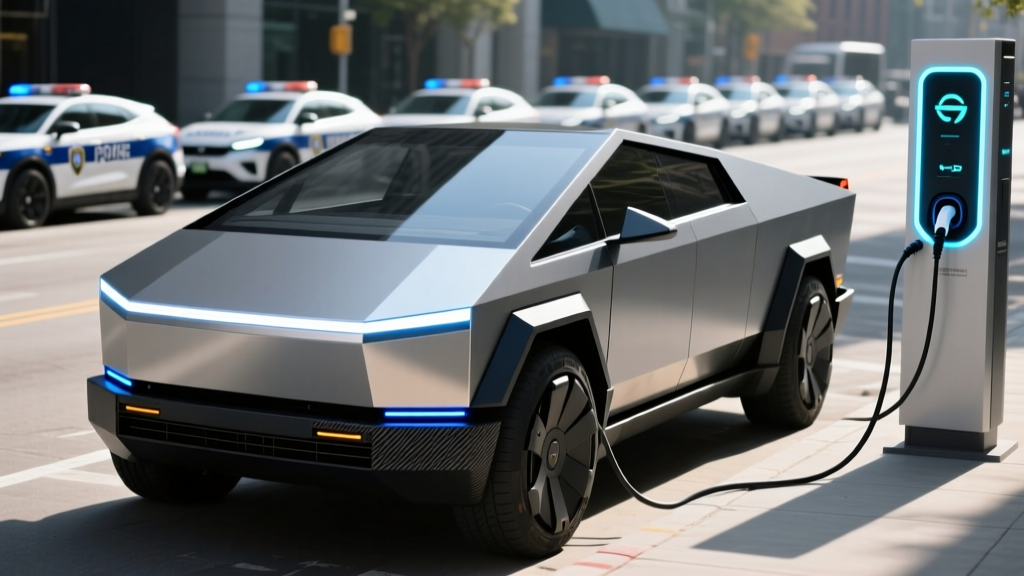
Search "cybertruck police car" and you'll find a parade of department-branded renders, a few real-world pilot programs, and a lot of social media debate. But strip away the viral photos and the core question remains: does the Tesla Cybertruck actually make sense as a law enforcement vehicle in 2026? We've analyzed the specs, spoken with fleet managers who've evaluated it, and crunched the ownership numbers to give you a data-driven answer.
The short version: the Cybertruck offers compelling acceleration, a stainless-steel exoskeleton that doubles as a deterrent, and low per-mile energy costs. But its polarizing design, limited upfitter ecosystem, and real-world range that falls well short of the EPA sticker create genuine hurdles for patrol duty. Here's what departments and taxpayers need to know.
Spec Sheet: Cybertruck AWD at a Glance
| Specification | Cybertruck AWD (Dual-Motor) | Cybertruck Cyberbeast (Tri-Motor) |
|---|---|---|
| EPA Range | 340 miles | 320 miles |
| Battery Capacity (usable) | ~123 kWh (NMC) | ~123 kWh (NMC) |
| Drivetrain | Dual-Motor AWD | Tri-Motor AWD |
| Horsepower | 600 hp | 845 hp |
| 0-60 mph | 3.9 seconds | 2.6 seconds |
| Max DC Fast Charge | 250 kW | 250 kW |
| 10-80% DC Charge Time | ~28 minutes | ~28 minutes |
| Level 2 Home/Depot Charge | 11.5 kW (~37 mi/hr) | 11.5 kW (~37 mi/hr) |
| MPGe (combined) | 79 MPGe | 74 MPGe |
| Energy Consumption | 43 kWh/100 mi | 46 kWh/100 mi |
| Towing Capacity | 7,500 lbs | 7,500 lbs |
| Cargo Bed Length | 6 ft (72 in) | 6 ft (72 in) |
| Cargo Volume (bed + frunk) | 67 cu ft bed / 7 cu ft frunk | 67 cu ft bed / 7 cu ft frunk |
| Base MSRP (2026) | $79,990 | $99,990 |
| Battery/Powertrain Warranty | 8 yr / 120,000 mi | 8 yr / 120,000 mi |
Source: Tesla specifications and EPA fueleconomy.gov.
Real-World Range: What Patrol Shifts Actually Look Like
Real-World Highway (70 mph): ~260-280 miles
Real-World City Patrol (stop-start, idle, accessories): ~290-320 miles
Cold Weather (below 32°F): Expect 20-30% reduction — down to ~220-250 miles
With Lightbar, Radio, and Upfit Equipment Running: Subtract an additional 5-10% depending on electrical draw
The Cybertruck's angular stainless-steel body creates more aerodynamic drag than a sleek sedan, and that penalty compounds at highway speeds. For highway-intercept roles, plan for roughly 260 miles of usable range before needing to return to base or hit a charger. City patrol, where regenerative braking recaptures energy during frequent stops, is where the Cybertruck performs closest to its EPA estimate.
Cold weather remains the great equalizer for all EVs, and the Cybertruck is no exception. Tesla's heat pump helps, but departments in northern climates should plan for a realistic winter range of 220-250 miles on the AWD model. For a standard 8-10 hour patrol shift covering 80-150 miles, range is not a limiting factor — but a 24-hour pursuit or extended stakeout scenario requires planning.
Charging Speed and Depot Infrastructure
| Charging Level | Power (kW) | Miles Added per Hour | Best Use Case |
|---|---|---|---|
| Level 1 (120V) | ~1.4 kW | ~4 mi/hr | Emergency/trickle only |
| Level 2 (240V/48A) | 11.5 kW | ~37 mi/hr | Overnight depot charging |
| DC Fast (Tesla Supercharger) | Up to 250 kW peak | ~200+ mi in 15 min | Mid-shift top-up, inter-city transfer |
For fleet depot charging, departments will primarily rely on Level 2 infrastructure. At 11.5 kW, a Cybertruck gains roughly 37 miles of range per hour — meaning an 8-hour overnight shift at the depot adds approximately 296 miles, enough to fully replenish the battery from near-empty. Installing commercial Level 2 chargers at a police depot typically costs $3,000-$7,000 per stall for equipment and electrical work, though panel upgrades can push this higher.
The Cybertruck uses Tesla's NACS connector natively, giving it direct access to the Supercharger network — currently the most reliable public DC fast-charging ecosystem in the US. At a V3 or V4 Supercharger, the ~123 kWh NMC battery can accept up to 250 kW peak. However, as with all EVs, that peak rate is not sustained: charging tapers significantly above 80% state of charge. Expect a 10-80% session to take roughly 28 minutes, but pushing from 80-100% adds another 20-25 minutes. For patrol use, the practical approach is mid-shift opportunistic charging — a 15-minute stop during a meal break can add 150+ miles.
Performance and Patrol Capability
The dual-motor AWD Cybertruck hits 0-60 mph in 3.9 seconds with 600 horsepower — faster than virtually any conventional police interceptor on the market. The tri-motor Cyberbeast does it in 2.6 seconds with 845 hp, though that variant is overkill for law enforcement and carries a $20,000 premium. For pursuit scenarios, the instant torque delivery of electric motors provides immediate acceleration without the lag of a turbo-spooling V6 or V8.
The all-wheel-drive system is fully electric with no mechanical linkage, distributing torque between front and rear motors in milliseconds. Traction control in rain, snow, and off-road conditions is excellent. The air suspension provides adjustable ride height — useful for speed bumps, steep driveways, or mild off-road access.
However, at roughly 6,600-6,800 lbs curb weight, the Cybertruck carries significant mass. That weight helps with stability but increases tire wear and extends braking distances compared to lighter pursuit vehicles. Departments should factor in higher consumable costs for tires and brake components over the vehicle's service life.
Pricing, Tax Credits, and Fleet Economics
| Item | AWD | Cyberbeast |
|---|---|---|
| Base MSRP (2026) | $79,990 | $99,990 |
| Destination Fee | $1,995 | $1,995 |
| Estimated Upfit (lightbar, cage, radio, wrap) | $8,000-$15,000 | $8,000-$15,000 |
| Total Estimated Fleet Cost | $90,000-$97,000 | $110,000-$117,000 |
Federal Tax Credit (§30D) — Important Caveats: The Cybertruck AWD's $79,990 MSRP falls under the IRS §30D truck/SUV/van cap of $80,000, making it potentially eligible for the $7,500 credit. The Cyberbeast at $99,990 exceeds that cap and does not qualify. However, eligibility depends on multiple factors that change frequently:
- MSRP Cap: Must be ≤$80,000 for trucks/SUVs/vans (AWD qualifies; Cyberbeast does not)
- Buyer Income Cap: AGI must not exceed $150,000 (single) / $300,000 (joint) — for government fleet purchases, this requirement differs; consult IRS guidance on tax-exempt entity credits under §45W (commercial clean vehicle credit)
- Battery Sourcing: Critical minerals and battery components must meet phased-in domestic/free-trade-agreement sourcing thresholds per IRS rules
- Point-of-Sale Transfer: The credit can be transferred to the dealer at purchase, reducing the upfront cost — but only if all eligibility criteria are met at time of sale
- Fleet/Government Purchases: Tax-exempt entities (including most municipal governments) may qualify under the separate §45W commercial clean vehicle credit rather than §30D — consult a municipal tax advisor
For municipal fleets, the relevant credit is often §45W (Commercial Clean Vehicle Credit), which offers up to $7,500 for vehicles under 14,000 lbs GVWR and does not have the same income or MSRP restrictions. Departments should work with their municipal finance office and reference current IRS §45W guidance before budgeting around credit assumptions.
Interior, Tech, and Upfit Considerations
The Cybertruck's interior is minimalist by design — an 18.5-inch front touchscreen handles virtually all vehicle functions, navigation, and media. There are no physical buttons for climate, wipers, or mirrors (all screen-controlled). For police upfitting, this creates both opportunities and challenges:
Advantages for law enforcement:
- Large screen can integrate MDT (Mobile Data Terminal) software directly
- No traditional gauge cluster to obstruct camera or equipment mounts
- Flat load floor in the rear (no transmission tunnel) aids prisoner transport cage installation
- Stainless-steel exterior resists dents, scratches, and minor impacts — reducing cosmetic repair costs
- Armor-grade glass (laminated) provides enhanced occupant protection
- Frunk (front trunk, 7 cu ft) offers secure, lockable equipment storage separate from the bed
Challenges for law enforcement:
- Limited certified upfitter ecosystem — fewer companies make lightbars, cages, and consoles specifically for the Cybertruck compared to the Ford Explorer or Chevy Tahoe
- Rear-seat legroom (approximately 38 inches) is adequate but tighter than a Tahoe or Explorer for transporting detainees
- Bed cover (powered tonneau) limits vertical cargo loading — equipment must fit within the 6-foot bed height
- Touchscreen-only controls mean gloves must be removed or capacitive-compatible for basic functions like wipers or turn signals
- No Apple CarPlay or Android Auto — all software must run through Tesla's proprietary system
Driver Assistance: Autopilot and FSD (Supervised)
Tesla's Autopilot and Full Self-Driving (Supervised) are Level 2 driver-assistance systems, not autonomous driving. The driver must remain fully engaged, hands on or near the wheel, and eyes on the road at all times. The system can assist with steering, acceleration, and braking on marked roads, but it does not replace the driver. Only Level 4 systems (e.g., Waymo robotaxis) operate without a human driver in defined service areas.
For police use, Autopilot's adaptive cruise and lane-centering can reduce fatigue during long highway patrols or extended transports. However, departments should establish clear policies: these systems assist but do not replace the officer's attention. FSD (Supervised), available as a $8,000 add-on or $99/month subscription, adds capabilities like automatic lane changes and traffic-light recognition, but it still requires constant driver supervision and can make errors in construction zones, unmapped areas, or adverse weather.
Who Should Consider the Cybertruck as a Police Vehicle?
- Your department runs primarily city/suburban shifts under 150 miles/day with depot charging available
- You want a high-visibility community engagement vehicle that generates positive media attention
- Reduction in fuel and maintenance costs is a priority (electricity at ~$0.12/kWh vs. $3.50+/gal gasoline)
- You can invest in certified upfit solutions as the aftermarket matures
- Instant acceleration for pursuit or emergency response is valued
- You need a proven, widely-supported police upfit ecosystem today
- Your shifts regularly exceed 250 miles or operate in extreme cold without mid-shift charging access
- Rear-seat prisoner transport space is a primary requirement (Tahoe/Explorer offer more room)
- Budget constraints require the lowest possible upfront acquisition cost
- You rely on Apple CarPlay/Android Auto for MDT integration
Pros and Cons: The Honest Assessment
Pros
- 0-60 in 3.9 seconds — exceptional pursuit acceleration
- Ultra-low per-mile energy cost (~$0.05/mi vs. $0.18/mi for gas interceptors)
- Stainless-steel body resists dents, scratches, and minor collision damage
- Minimal scheduled maintenance (no oil, spark plugs, or transmission fluid)
- Supercharger network access for reliable road-trip and inter-agency transport
- Frunk provides secure, separate equipment storage
- High community visibility and engagement potential
- 8-year/120,000-mile battery and powertrain warranty
Cons
- Real-world range drops to ~260 mi highway, ~220 mi in cold weather
- Limited certified police upfitter options compared to established platforms
- $79,990+ base price is significantly higher than a gas-powered Explorer or Tahoe interceptor
- 6,600+ lb curb weight increases tire wear and braking distances
- Touchscreen-only controls are impractical with duty gloves
- No CarPlay/Android Auto — MDT integration requires Tesla-native solutions
- Polarizing design may not suit all community relations contexts
- Charging requires 25-30 min mid-shift if range is depleted (vs. 5 min gas fill-up)
Competitor Comparison: How Does the Cybertruck Stack Up?
The most direct electric competitor for police fleet use is the Ford F-150 Lightning, which has been adopted by several departments and offers a more mature upfitter ecosystem. The Lightning's EPA range tops out at 320 miles (extended-range battery), and its pricing starts around $55,000 for the Pro trim — making it roughly $25,000 less expensive than the Cybertruck AWD before credits. However, the Cybertruck holds advantages in acceleration (3.9s vs. 4.0s for the Lightning extended-range), peak DC charge rate (250 kW vs. 150 kW for the Lightning), and Supercharger network access.
For departments prioritizing interior space and traditional SUV ergonomics, the Chevrolet Tahoe PPV (gas) and upcoming electric full-size SUVs remain relevant comparisons. The Cybertruck simply doesn't offer the same rear-seat room or established police-equipment integration that these platforms provide.
Frequently Asked Questions
What is the real-world range of the Cybertruck as a police car?
Expect roughly 260-280 miles on highway patrol, 290-320 miles in stop-and-go city driving, and as low as 220-250 miles in freezing temperatures. Add 5-10% energy draw for lightbar, radio, and upfit electronics. For most 8-10 hour city shifts covering 80-150 miles, the Cybertruck can complete a full shift without mid-shift charging.
How fast does the Cybertruck charge at a depot or on the road?
At a Level 2 depot charger (11.5 kW), the Cybertruck gains about 37 miles of range per hour — an 8-hour overnight charge adds ~296 miles. On a Tesla Supercharger at 250 kW peak, a 10-80% session takes approximately 28 minutes. Plan for a 15-minute mid-shift stop to add roughly 150 miles.
Does the Cybertruck qualify for the federal EV tax credit?
The AWD model at $79,990 MSRP falls under the §30D $80,000 truck cap and is potentially eligible for $7,500. The Cyberbeast at $99,990 does not qualify under §30D. However, municipal and government fleet purchases typically use the §45W commercial clean vehicle credit instead. Battery-sourcing requirements, income limits (for individual buyers), and evolving IRS rules all affect eligibility — departments should consult current IRS guidance and a municipal tax advisor.
Is the Cybertruck worth buying for a police fleet vs. the F-150 Lightning?
It depends on priorities. The Cybertruck offers faster acceleration, higher peak charging speed, and Supercharger access. The F-150 Lightning offers lower pricing, a more established police upfitter ecosystem, and greater rear-seat space. For a department's first EV pilot, the Lightning is the safer choice; for departments wanting maximum performance and community visibility, the Cybertruck has merit.
What are the biggest drawbacks of a Cybertruck police car?
High upfront cost ($90,000-$97,000 fully upfitted), limited certified police upfitter options, real-world range that's 20-25% below the EPA sticker on highways, touchscreen-only controls that are impractical with duty gloves, and 25-30 minute mid-shift charging sessions if range is depleted. The 6,600+ lb weight also increases tire and brake wear.
How does cold weather affect the Cybertruck in police service?
Like all EVs, the Cybertruck loses 20-30% of its range in sustained sub-freezing temperatures. The heat pump helps mitigate cabin energy draw, but battery chemistry inherently slows in cold. Departments in northern states should plan for ~220-250 miles of real-world winter range and ensure depot charging is available between shifts. Preconditioning the battery before fast-charging (a built-in Tesla feature) helps restore charge speed in cold weather.
Can the Cybertruck tow a police boat or equipment trailer?
Yes — both the AWD and Cyberbeast are rated for 7,500 lbs of towing capacity. However, towing significantly reduces range (expect a 30-50% reduction depending on trailer weight and speed). For occasional towing, it's viable; for daily towing duty, a diesel or heavy-duty platform remains more practical.
Note: Tax credit eligibility rules, pricing, and vehicle specifications are based on 2026 model-year data and current IRS guidance as of publication. Rules change frequently — always verify eligibility at the time of purchase through irs.gov and with your municipal finance office.