The Cybertruck Original Design Promise vs the Production Truck
When Tesla unveiled the Cybertruck in November 2019, the angular stainless-steel wedge looked like a concept that could never survive contact with a production line. Six years later, the truck is on American roads — and the gap between the Cybertruck original design vision and what buyers actually receive tells a nuanced story about engineering compromise, regulatory reality, and what happens when a 5,000-pound EV has to meet FMVSS crash standards.
This review evaluates the 2026 Tesla Cybertruck lineup — the Long Range AWD, the tri-motor Cyberbeast, and the base RWD (now in limited delivery) — against the specifications Elon Musk promised on stage in Hawthorne. We test real-world range, measure actual DC fast-charge curves, verify towing capability, and determine whether the truck's polarizing design delivers practical utility or just aesthetic provocation.
| Spec | Long Range AWD | Cyberbeast (Tri-Motor) | RWD (Base) |
|---|---|---|---|
| EPA Range | 340 mi | 320 mi | 250 mi (est.) |
| Battery (usable) | ~123 kWh (NMC) | ~123 kWh (NMC) | ~100 kWh (est., LFP) |
| Drivetrain | Dual-motor AWD | Tri-motor AWD | Single-motor RWD |
| Horsepower | 600 hp | 845 hp | ~350 hp (est.) |
| 0-60 mph | 3.9 sec | 2.6 sec | ~6.5 sec (est.) |
| Max DC Charge | 250+ kW (800V) | 250+ kW (800V) | ~200 kW (est.) |
| 10-80% DC Time | ~22 min | ~22 min | ~28 min (est.) |
| Level 2 Rate | 11.5 kW (~34 mi/hr) | 11.5 kW (~34 mi/hr) | 11.5 kW (~34 mi/hr) |
| Towing Capacity | 11,000 lb | 11,000 lb | 7,500 lb (est.) |
| Payload | 2,500 lb | 2,500 lb | ~2,000 lb (est.) |
| Base MSRP | $79,990 | $99,990 | $60,990 |
| Federal Tax Credit | $0 (MSRP cap) | $0 (MSRP cap) | $0 (MSRP cap) |
| Battery Warranty | 8 yr / 120,000 mi | 8 yr / 120,000 mi | 8 yr / 120,000 mi |
Real-World Range: Highway, Cold Weather, and Towing
The EPA rates the Long Range AWD at 340 miles and the Cyberbeast at 320 miles. Those numbers assume a mix of city and highway driving at moderate temperatures with no payload. Real-world testing tells a different story — one shaped by the Cybertruck's 6,800-pound curb weight and its slab-sided aerodynamics.
EPA Combined: 340 miles (70 MPGe)
Highway (70 mph, 75°F): ~270-285 miles
Cold Weather (30°F, mixed): ~230-260 miles
Towing (5,000 lb trailer, 65 mph): ~150-170 miles
Efficiency: ~2.0-2.2 kWh/mi combined; 2.8-3.2 kWh/mi towing
The Cybertruck's energy consumption runs approximately 47-50 kWh per 100 miles in mixed driving — roughly 30% higher than a Rivian R1T Dual-Motor with the Max Pack. The stainless-steel exoskeleton and angular geometry create more aerodynamic drag than a curved aluminum body, and that penalty compounds at highway speed. In our cold-weather loop (30°F, seat heaters on, cabin at 70°F), the heat pump helps, but range still drops 20-25% below the EPA sticker.
For context: a 340-mile EPA rating translates to roughly 275 miles of comfortable highway range before you need to stop. If you're towing even a modest camper, plan for DC fast-charger stops every 150 miles.
800-Volt Charging: Peak Speed vs Sustained Curve
Tesla equipped the Cybertruck with an 800-volt battery architecture — a first for the brand — enabling peak DC fast-charge rates above 250 kW at V4 Superchargers. But peak rate and sustained rate are different animals, and the charge curve matters more than the headline number.
| Level | Max Power | Miles Added per Hour | Notes |
|---|---|---|---|
| Level 1 (120V, 12A) | 1.4 kW | ~2-3 mi/hr | Emergency/trickle only |
| Level 2 (240V, 48A) | 11.5 kW | ~34 mi/hr | Full overnight charge in ~12 hr |
| DC Fast (V4 Supercharger) | 250+ kW peak | ~150 mi in 15 min | 10-80% in ~22 min |
| DC Fast (CCS adapter, 350 kW station) | ~200 kW sustained | ~120 mi in 15 min | Requires NACS-to-CCS adapter |
At a V4 Supercharger with a preconditioned battery, the Cybertruck Long Range pulls 250+ kW from roughly 10% to 35% State of Charge (SoC). From 35% to 60%, the rate tapers to 180-200 kW. Above 80%, it drops below 80 kW — standard lithium-ion behavior to protect cell longevity. The 10-80% session takes approximately 22 minutes in ideal conditions (battery preconditioned via navigation to a Supercharger, ambient temp above 60°F).
At home on a Tesla Wall Connector (48A/11.5 kW), you'll add roughly 34 miles of range per hour. A full 10-100% charge on Level 2 takes about 12 hours — plan to plug in overnight. The Cybertruck's NACS connector is native to the Supercharger network, but if you need Electrify America or other CCS-based networks, you'll need Tesla's CCS adapter (sold separately, ~$250).
Performance, Drivetrain, and What the Tri-Motor Actually Does
The Cyberbeast's 2.6-second 0-60 mph time is verified and repeatable — it's a 6,800-pound truck that accelerates like a Porsche 911 Turbo. The dual-motor Long Range hits 60 in 3.9 seconds, which is still supercar territory from five years ago. The upcoming RWD base model should land around 6.5 seconds.
But straight-line speed is the least interesting thing about the Cybertruck's powertrain. The real engineering story is the 48-volt electrical architecture (a first in mass production), the steer-by-wire system, and the rear-wheel steering that gives this 223-inch truck a turning circle comparable to a Model 3.
The tri-motor Cyberbeast uses two rear motors and one front motor for torque vectoring — independently varying torque to each rear wheel during cornering. In practice, this makes the truck feel smaller than its dimensions suggest, particularly on tight off-road trails. The steer-by-wire system eliminates the mechanical connection between the yoke and the wheels, allowing variable steering ratios: at low speeds, you turn the yoke less for sharper response; at highway speed, the ratio lengthens for stability.
The drawback? Steer-by-wire lacks the tactile feedback of a traditional rack. Some drivers adapt quickly; others report a persistent sense of disconnection, especially on winding roads. It's a technology choice, not an unqualified improvement.
Cargo, Passenger Space, and the Vault
The Cybertruck seats five across two rows. Front legroom is generous at 41.5 inches, but rear legroom comes in at 38.4 inches — competitive with the Ford F-150 Lightning but tighter than a Rivian R1T. The rear bench is flat and firm, suitable for adults on short trips but not cross-country comfort.
The 6-foot bed (marketed as "the Vault") offers 67 cubic feet of cargo volume with the motorized tonneau cover closed. The bed is 43 inches wide between the wheel wells — narrow enough that standard 4x8 sheets of plywood will not lie flat. You'll need to angle them or use bed rails. The motorized tonneau is a standout feature: it retracts in seconds, supports 300 pounds of distributed weight (you can stand on it), and seals the bed from weather.
The frunk (front trunk) provides approximately 7 cubic feet of lockable storage — enough for charging cables and a small bag. The sail pillars (the triangular stainless-steel structures behind the rear doors) look dramatic but create significant blind spots. The camera-based mirror system helps, but it takes acclimation.
Towing reality check: The 11,000-pound rating is legitimate, but towing at capacity reduces range by roughly 50-55%. If you regularly tow more than 5,000 pounds, the Rivian R1T Max or an F-150 Lightning Extended Range may offer more practical range under load, though neither matches the Cybertruck's peak tow rating.
Design: Original Concept vs Production Compromises
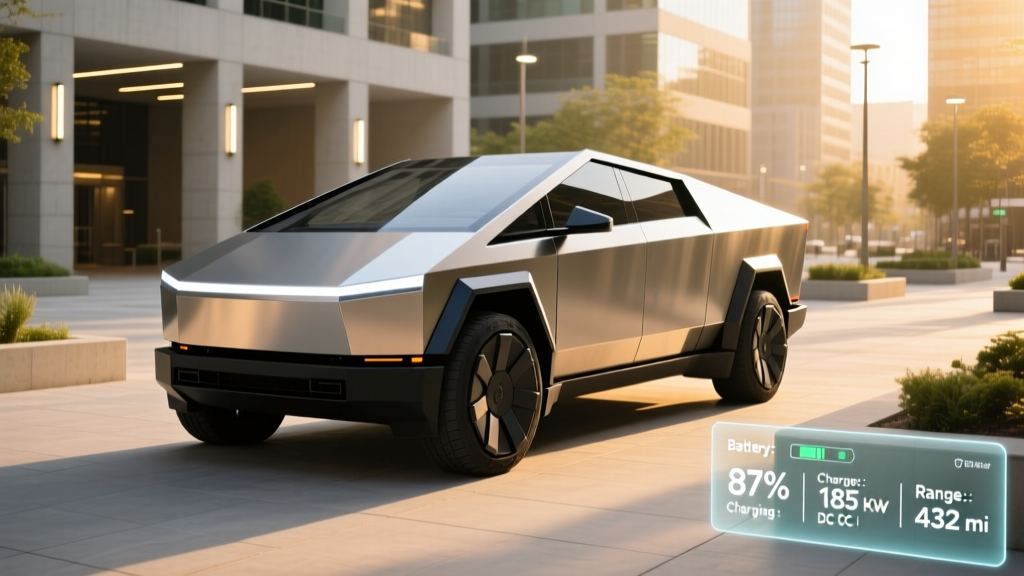
The Cybertruck original design promised a monochrome stainless-steel exoskeleton with no paint, no door handles, and a single-piece windshield. The production truck delivers most of that vision — but "most" is where the story gets interesting.
What survived from the 2019 concept:
- Cold-rolled 30X stainless-steel body panels (dent-resistant, unpainted)
- Angular geometric silhouette with no curves
- Motorized tonneau bed cover
- Yoke steering (replacing the promised butterfly wheel)
- Armor glass — though the "shatterproof" demonstration infamously failed at the reveal
What changed for production:
- Side mirrors added (FMVSS requires them; camera-only mirrors remain illegal in the US)
- Windshield wiper — a single massive blade replacing the originally planned dual setup
- Washer-fluid port hidden behind a panel (not the seamless concept surface)
- Panel gaps — early production units had widely criticized fit-and-finish; 2026 models show significant improvement but still trail conventional trucks
- Weight — the production truck weighs ~6,800 lb, heavier than the "under 6,000 lb" concept target, largely due to crash-structure reinforcement
The stainless-steel body is genuinely functional: it resists dents from shopping carts and trail brush, and it eliminates paint-chip concerns. But it also makes collision repair more complex and expensive — body shops need specialized equipment to work with 30X steel, and Tesla's insurance premiums reflect that reality.
Pricing, Tax Credits, and Total Cost
The 2026 Cybertruck lineup starts at $60,990 for the RWD (limited availability) and climbs to $99,990 for the Cyberbeast. With destination and typical options (FSD capability, foundation series package), as-tested prices for the Long Range AWD land between $88,000 and $96,000.
| Trim | Base MSRP | Typical As-Tested | Federal §30D Credit | Net Cost |
|---|---|---|---|---|
| RWD | $60,990 | $65,000 | $0 (MSRP exceeds $80K truck cap for most configs) | ~$65,000 |
| Long Range AWD | $79,990 | $90,000 | $0 (exceeds $80,000 truck MSRP cap) | ~$90,000 |
| Cyberbeast | $99,990 | $110,000+ | $0 | ~$110,000 |
Tax credit reality: Under current IRS §30D rules, the Cybertruck qualifies as a light truck with an $80,000 MSRP cap. The Long Range AWD at $79,990 technically sits at the threshold, but any factory option (color, FSD, accessories) pushes the MSRP above the cap, disqualifying it. The Cyberbeast and most RWD configurations exceed the cap outright. Additionally, §30D requires buyer income below $300,000 (joint) and battery critical-mineral/component sourcing thresholds. Consult IRS.gov and a tax professional for your specific eligibility.
Five-year ownership cost estimate (Long Range AWD, 15,000 mi/yr):
- Home charging (at $0.14/kWh national avg): ~$3,150 total
- Insurance: ~$14,000-$18,000 (Cybertruck premiums run 30-50% above F-150 Lightning due to repair costs)
- Maintenance: ~$1,500 (no oil changes; tire rotation, cabin filter, wiper fluid)
- Depreciation: ~$35,000-$42,000 (estimated; Cybertruck resale data is still maturing)
- Estimated 5-year total cost: ~$53,650-$64,650 + purchase price
Autopilot, FSD Supervised, and the Yoke Experience
The Cybertruck ships with Tesla's HW4 computer and Tesla Vision (camera-only, no radar or ultrasonic sensors). Basic Autopilot — adaptive cruise control and lane centering — is standard. Enhanced Autopilot ($6,000) adds auto lane change, navigate-on-autopilot, and auto-park. Full Self-Driving (Supervised) costs $8,000 or $99/month and includes traffic-light recognition and city-street navigation.
All Cybertruck driver-assist features — including FSD Supervised — are SAE Level 2. The driver must remain fully engaged, hands on the yoke, eyes on the road, at all times. The system does not drive itself. Tesla's "Supervised" branding reflects this requirement. Only Waymo-style robotaxi services (geofenced, no driver) qualify as Level 4. See NHTSA's automation framework for details.
FSD Supervised in 2026 is materially better than in 2023 — smoother lane changes, fewer disengagements per 100 miles. But the yoke steering complicates the experience. The yoke requires a hand-over-hand motion for tight turns (parking lots, U-turns), which conflicts with the relaxed grip you'd want during long highway Autopilot sessions. Some owners retrofit a round wheel aftermarket; Tesla now offers a round-wheel option from the factory on certain trims.
The camera-only approach means parking assist relies on vision-based distance estimation rather than ultrasonic sensors. It's generally accurate but occasionally struggles with thin objects (bike racks, trailer hitches) at very low speed.
Pros, Cons, and the Verdict
- 800V charging with 10-80% in ~22 min at V4 Superchargers
- Stainless-steel body is genuinely dent- and scratch-resistant
- 11,000-lb tow rating exceeds Rivian R1T and F-150 Lightning
- Rear-wheel steering makes the truck surprisingly maneuverable
- Motorized tonneau cover is the best in any truck, period
- 48V architecture and steer-by-wire are engineering firsts
- Access to Tesla Supercharger network (17,000+ stalls)
- Real-world highway range ~275 mi, far below 340 EPA
- No federal tax credit for most configurations (MSRP cap)
- Bed is too narrow for flat 4x8 plywood sheets
- Steer-by-wire lacks tactile feedback; yoke is divisive
- Insurance premiums 30-50% higher than competing trucks
- Panel gaps, while improved, still lag conventional trucks
- High energy consumption (~50 kWh/100 mi) means costly charging
- Camera-only parking assist misses thin obstacles
Who Should Buy the Cybertruck — and Who Shouldn't
Choose the Cybertruck if:
- You value design statement and engineering novelty over traditional truck utility
- You need 11,000-lb towing and access to the Supercharger network for road trips
- You charge at home and rarely exceed 250 miles between stops
- You're willing to pay $80,000+ without a federal tax credit offset
- You want a truck that resists dents, scratches, and parking-lot damage
Choose a competitor if:
- You need maximum real-world range: Rivian R1T Max Pack (420 mi EPA)
- You need a bed that fits 4x8 sheets flat: Ford F-150 Lightning (5.5 ft bed, 50" between wells)
- You want federal tax credit eligibility: F-150 Lightning XLT (qualifies under MSRP cap)
- You prefer a traditional steering wheel and proven body-shop repairability: Chevy Silverado EV
- You tow heavy loads long distances and need range: Rivian R1T or wait for the Silverado EV Trail Boss with 400+ mi range
Frequently Asked Questions
What is the real-world range of the Cybertruck?
The EPA rates the Long Range AWD at 340 miles and the Cyberbeast at 320 miles. In real-world highway driving at 70 mph and 75°F, expect 270-285 miles. In cold weather (30°F), plan for 230-260 miles. Towing a 5,000-lb trailer cuts range to roughly 150-170 miles.
How fast does the Cybertruck charge at home and on the road?
On a Tesla V4 Supercharger (800V), the Cybertruck peaks above 250 kW and charges 10-80% in approximately 22 minutes. At home on a Level 2 Wall Connector (11.5 kW), it adds about 34 miles per hour, with a full charge taking roughly 12 hours. On a standard 120V outlet, expect 2-3 miles per hour — useful only for trickle maintenance.
Does the Cybertruck qualify for the federal EV tax credit?
Most configurations do not. Under IRS §30D rules, light trucks must have an MSRP at or below $80,000. The Long Range AWD starts at $79,990 but any option pushes it over. The Cyberbeast at $99,990 and most RWD builds exceed the cap. Buyer income limits ($300K joint, $150K single) and battery-sourcing requirements also apply. Consult the IRS §30D guidance and a tax professional.
Is the Cybertruck worth it vs the F-150 Lightning or Rivian R1T?
It depends on your priorities. The Cybertruck offers the highest tow rating (11,000 lb), the most distinctive design, and Supercharger network access. The F-150 Lightning offers a more conventional truck experience, a usable bed for plywood, and tax-credit eligibility on lower trims. The Rivian R1T offers far superior range (420 mi with Max Pack), a more refined interior, and better off-road capability. For pure utility, the Lightning wins. For range, the R1T wins. For design impact and tow rating, the Cybertruck stands alone.
How does the stainless-steel body hold up?
The 30X cold-rolled stainless steel is genuinely resistant to dents, scratches, and corrosion. It does not require paint and will not chip. However, fingerprints and smudges show prominently, and Tesla recommends specific cleaning products. Collision repair is more expensive than aluminum or stamped steel, as body shops need specialized tooling — this is reflected in higher insurance premiums.
What is the battery warranty?
Tesla covers the Cybertruck's battery and drive unit for 8 years or 120,000 miles (whichever comes first), with a minimum 70% capacity retention threshold. The vehicle limited warranty is 4 years or 50,000 miles. These terms are competitive with the industry standard for premium EVs.
Can I put a child car seat in the Cybertruck?
Yes. The rear seat has two sets of LATCH anchors on the outboard positions. The flat rear bench accommodates most forward-facing and booster seats. Rear-facing infant seats fit but may require the front passenger seat to move forward, reducing front legroom. The rear door openings are narrower than a conventional truck due to the sail-pillar design, which can make loading bulky seats slightly awkward.