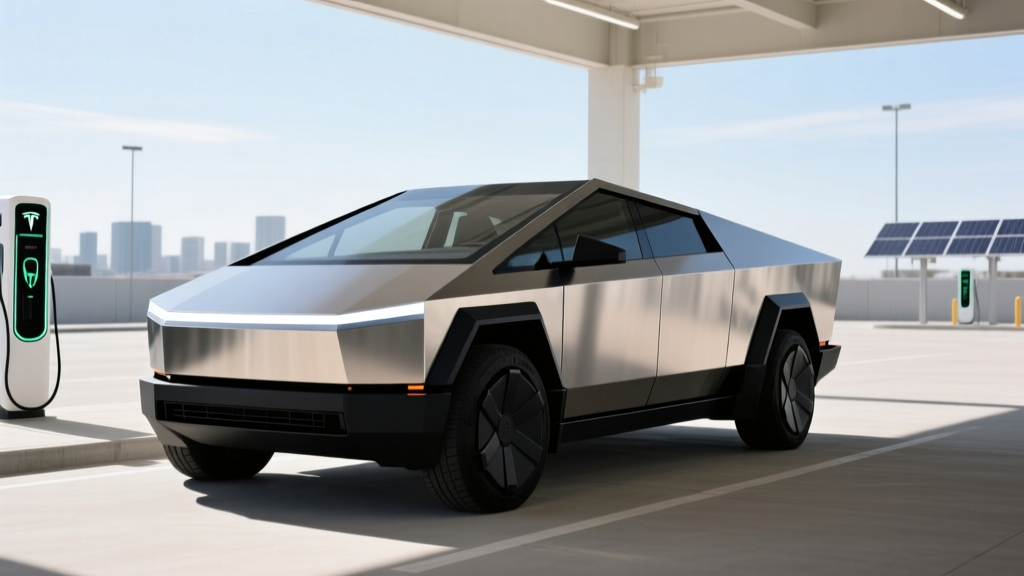
If you've been monitoring Cybertruck orders since Tesla opened the reservation floodgates, you already know the stainless-steel pickup has been one of the most polarizing — and closely watched — EVs on the road. Now well into its second full year of production, the Cybertruck has moved from early-adopter curiosity to a measurable presence in the electric truck segment. But for buyers placing an order today, the questions have shifted from "Will it ever ship?" to "Which trim should I get, how long is the wait, and does it actually deliver on range and charging promises?"
This review breaks down everything a current or prospective Cybertruck order holder needs to know: real-world range versus EPA stickers, 800V DC fast-charging performance, pricing across trims, federal tax credit eligibility under current IRS §30D rules, and how the truck stacks up against the Ford F-150 Lightning and Rivian R1T. All figures reflect the 2026 model year.
2026 Cybertruck Trim Lineup and Order Status
Tesla currently offers the Cybertruck in three trims. The once-promised base Rear-Wheel Drive model was quietly shelved before reaching volume production, so every Cybertruck on the road today is dual-motor all-wheel drive or tri-motor. Here's the current order menu:
| Trim | Drivetrain | Horsepower | 0-60 mph | EPA Range | Base MSRP |
|---|---|---|---|---|---|
| Long Range AWD | Dual Motor AWD | 600 hp | 3.9 sec | 340 mi | $79,990 |
| Cyberbeast | Tri-Motor AWD | 845 hp | 2.6 sec | 320 mi | $99,990 |
As of early 2026, Tesla reports estimated delivery windows of 1 to 3 months for new Long Range orders and 2 to 4 months for Cyberbeast configurations — a dramatic improvement from the 12-to-18-month waits early reservation holders endured. Order fees remain at $250, applied toward the purchase price. Tesla's order management system now allows trim and option changes without losing your queue position, though switching from Long Range to Cyberbeast (or vice versa) may reset your estimated delivery window.
Battery, Chemistry, and the Real-World Range Question
The Cybertruck uses a structural battery pack with an estimated 123 kWh of usable capacity (gross capacity is higher, with a top/bottom buffer for longevity). Tesla has not publicly confirmed the cell chemistry for the 2026 model year, but industry teardowns and supply-chain reporting point to a nickel-manganese-cobalt (NMC) formulation supplied primarily by Panasonic's 4680 cell production lines. NMC offers higher energy density than LFP, which matters in a vehicle this heavy — the Cybertruck's curb weight exceeds 6,600 lbs.
EPA Estimated Range: 340 miles (Long Range AWD) / 320 miles (Cyberbeast)
What to expect in practice:
- City/suburban mixed driving (65°F): ~310-330 miles achievable with moderate regen use
- Highway sustained (75 mph, 70°F): ~260-290 miles — the Cybertruck's brick-like 0.38 Cd drag coefficient punishes efficiency at speed
- Cold weather (30°F, highway): Expect 200-230 miles; the stainless exoskeleton offers less insulation than traditional unibody construction, and battery preconditioning draws from the pack
- Towing (5,000-lb trailer, flat terrain): ~150-180 miles before needing a charge stop
Source: fueleconomy.gov — EPA combined MPGe rated at 68 MPGe (Long Range), translating to roughly 49 kWh per 100 miles.
That 49 kWh/100mi figure is the Cybertruck's Achilles' heel for efficiency-minded buyers. For context, the Ford F-150 Lightning Extended Range achieves roughly 47 kWh/100mi, and the Rivian R1T Dual-Motor Max Pack lands near 44 kWh/100mi. The Cybertruck's angular stainless-steel body simply moves more air.
Charging Performance: 800V Architecture in Practice
Tesla equipped the Cybertruck with an 800-volt electrical architecture, enabling higher DC fast-charging power without proportionally increasing current (and therefore heat). Here's the full charging picture:
| Charging Level | Power / Rate | Time / Miles Added | Connector |
|---|---|---|---|
| Level 1 (120V household) | ~1.4 kW | ~3 mi/hr | NACS (native) |
| Level 2 (240V home, 48A) | 11.5 kW | ~28 mi/hr; full charge in ~11 hrs | NACS (native) |
| DC Fast Charge (V4 Supercharger) | Peak 350 kW | 10-80% in ~18 min | NACS (native) |
| DC Fast Charge (CCS adapter, 3rd-party) | Peak ~250 kW (adapter-limited) | 10-80% in ~28 min | NACS-to-CCS adapter required |
A few ownership realities about Cybertruck charging:
- Peak vs. sustained kW: The 350 kW peak occurs only between roughly 10-30% state of charge (SoC) at a V4 Supercharger with a preconditioned battery. The charge curve tapers significantly — expect an average of ~200 kW across the full 10-80% session. This is why the 10-80% time is 18 minutes, not the 12 minutes a sustained 350 kW would suggest.
- Preconditioning matters: Navigate to a Supercharger using the truck's built-in navigation, and the battery thermal management system begins warming the pack 15-20 minutes before arrival. Skipping this step — for instance, pulling into a charger after the truck has sat cold — can add 5-8 minutes to your session.
- Home charging setup: The 123 kWh pack is enormous. Even at 11.5 kW Level 2, a full 0-100% charge takes roughly 11 hours. Most owners charge nightly from 30-80%, which takes about 5-6 hours on a Tesla Wall Connector (48A circuit, requiring a 60A breaker). If your home has a 200A electrical panel with spare capacity, installation typically runs $800-$2,000 depending on conduit length. A panel upgrade to 200A or higher can add $2,000-$5,000.
- CCS adapter for non-Tesla networks: Tesla sells an official NACS-to-CCS adapter (~$250). With it, you can access Electrify America, EVgo, and other CCS networks, though at reduced peak power (~250 kW) due to adapter thermal limits.
Performance, Towing, and Cargo Utility
The Cyberbeast's 845 hp and 2.6-second 0-60 time make it the quickest production pickup ever sold — a remarkable stat for a 6,600-lb vehicle. But most Cybertruck orders are placed for the Long Range AWD, where 600 hp and a 3.9-second sprint are more than adequate for any real-world scenario.
Utility specifications matter for truck buyers:
| Spec | Cybertruck (All Trims) |
|---|---|
| Bed length | 6 ft (72 in) |
| Cargo bed volume | 67 cu ft (bed) + 7.4 cu ft (frunk) |
| Max payload | 2,500 lbs |
| Max towing capacity | 11,000 lbs |
| Front legroom | 41.3 in |
| Rear legroom | 35.4 in |
| Seating capacity | 5 passengers (2+3 bench) |
| Ground clearance | Up to 16 in (adaptive air suspension) |
| Approach/departure angle | 35° / 28° (max ride height) |
The 11,000-lb tow rating exceeds the F-150 Lightning's 10,000-lb max but trails heavy-duty ICE trucks. As noted above, towing at max capacity roughly halves the Cybertruck's range. The integrated trailer brake controller and tow-assist camera views are well-executed, but the bed's short 6-foot length (dictated by the cab-forward design) limits utility for contractors who regularly haul 8-foot lumber or full sheets of plywood — they won't fit flat without an extender.
Pricing, Tax Credits, and Total Cost of Ownership
Cybertruck pricing has stabilized after Tesla's initial post-launch increases. Here's where the numbers land for 2026 buyers, including the critical tax credit question:
| Cost Factor | Long Range AWD | Cyberbeast |
|---|---|---|
| Base MSRP | $79,990 | $99,990 |
| Destination fee | $1,995 | $1,995 |
| Federal §30D tax credit | Up to $7,500 (see eligibility below) | Up to $7,500 (see eligibility below) |
| Effective price (with full credit) | ~$74,485 | ~$94,485 |
| Est. annual insurance | $2,800-$3,600 | $3,200-$4,200 |
| Est. annual electricity (12,000 mi) | ~$810 (at $0.14/kWh) | ~$810 |
The Cybertruck qualifies for the full $7,500 federal tax credit if and only if the buyer meets all of the following current-year requirements (per IRS §30D guidelines):
- MSRP cap: The Cybertruck's MSRP is under the $80,000 cap for trucks/vans/SUVs ✅ (Long Range qualifies; Cyberbeast at $99,990 does NOT qualify based on MSRP cap)
- Buyer income cap: Modified AGI ≤ $150,000 (single) / ≤ $300,000 (married filing jointly)
- Battery sourcing: Critical minerals and battery components must meet phased percentage thresholds from US/free-trade-agreement sources — Tesla's Panasonic-supplied 4680 cells currently meet these requirements, but always verify at point of sale
- Point-of-sale transfer: You can elect to transfer the credit to the dealer (Tesla) at purchase, reducing your out-of-pocket cost by $7,500 immediately — no need to wait for tax filing
- One credit per VIN: The credit applies once per vehicle, not per buyer; verify the specific VIN hasn't previously been credited
Key takeaway: Only the Long Range AWD at $79,990 MSRP clears the truck MSRP cap. Cyberbeast buyers at $99,990 do not qualify for §30D, which significantly affects the value equation between trims.
Over five years of ownership, the Long Range Cybertruck's total cost (purchase + insurance + electricity + maintenance, minus residual value) remains competitive with a similarly priced F-150 Lightning Lariat, though insurance premiums for the Cybertruck run 15-25% higher due to stainless-steel body repair costs and limited collision-shop familiarity.
Tech, Driver Assistance, and Notable Drawbacks
The Cybertruck's cabin is unmistakably Tesla: an 18.5-inch central touchscreen dominates the dash, running Tesla's latest vehicle software. Rear passengers get a secondary 9.4-inch touchscreen for climate and media control. Notable tech features include:
- Steer-by-wire: The Cybertruck eliminates the mechanical steering column, using redundant electronic actuators. This enables the yoke-style steering wheel and a variable steering ratio — roughly 340° lock-to-lock at low speeds (tight parking maneuvers) and much heavier weighting at highway speed. Adaptation takes most drivers 2-3 days.
- Autopilot (standard) / FSD Supervised (optional, $8,000): Autopilot includes adaptive cruise, lane centering, and automatic emergency braking. Full Self-Driving (Supervised) adds automatic lane changes, traffic-light recognition, and city-street navigation. Important: FSD is SAE Level 2 — the driver must remain fully engaged and responsible at all times.
- Armor glass: The laminated "armor glass" windows are shatter-resistant (Tesla demonstrated this with a baseball test at delivery events), but replacements for chips or cracks are expensive and have had supply-chain delays.
- Bioweapon Defense Mode: HEPA-grade cabin air filtration, carried over from Model X/S.
- Powershare: Up to 11.5 kW of vehicle-to-load (V2L) and vehicle-to-home (V2H) power export through bed-mounted and frunk outlets — enough to run power tools at a job site or essential home circuits during an outage.
- Rear visibility: The sail-pillar design and small rear window create significant blind spots. The backup camera is essential, but side-rear visibility while changing lanes remains a common complaint.
- Panel-gap inconsistency: While improved from early 2024 deliveries, stainless-steel panel alignment still varies unit to unit. Not cosmetic-only — misaligned panels can generate wind noise above 65 mph.
- Wiper and washer design: The single front wiper (a first for a production vehicle this size) covers a large area but can miss the driver-side corner in heavy rain. Tesla added a secondary wiper in late-2025 production updates, but early builds have only one.
- Bed access: The motorized tonneau cover is slick and secure, but the bed sides are tall (~36 inches from ground), making it difficult to load cargo from the side without stepping onto the rear wheel or using the tailgate.
- Insurance costs: Expect premiums 15-25% above comparable pickups due to specialized stainless-steel repair requirements and limited body-shop certification.
Cybertruck vs. F-150 Lightning vs. Rivian R1T: Which Should You Order?
| Attribute | Tesla Cybertruck LR AWD | Ford F-150 Lightning Ext. Range | Rivian R1T Dual-Motor Max |
|---|---|---|---|
| EPA Range | 340 mi | 320 mi | 410 mi |
| Battery (usable kWh) | ~123 kWh | ~131 kWh | ~149 kWh |
| Peak DC Fast Charge | 350 kW | 150 kW | 220 kW |
| 10-80% DCFC Time | ~18 min | ~41 min | ~30 min |
| 0-60 mph | 3.9 sec | 3.8 sec | 3.5 sec |
| Max Tow Rating | 11,000 lbs | 10,000 lbs | 11,000 lbs |
| Bed Length | 6 ft | 5.5 ft | 4.5 ft (+ Gear Tunnel) |
| Base MSRP | $79,990 | $69,995 | $87,900 |
| Federal §30D Credit | Yes (LR only) | Yes | Yes |
Order the Cybertruck Long Range if: You prioritize the fastest DC charging in the segment (350 kW peak, 18-min 10-80%), want V2H backup power capability, and value Tesla's Supercharger network for road trips. The steer-by-wire system and angular design are either a feature or a dealbreaker — test-drive before committing.
Order the F-150 Lightning if: You want the most conventional truck experience, the lowest starting price, and need Pro Power Onboard for job-site use. Its 150 kW peak charging is the slowest of the three, but Ford's dealer network simplifies service and repairs.
Order the Rivian R1T if: Maximum range (410 mi EPA) and off-road capability are priorities. The R1T's quad-motor option and gear-tunnel storage are unique, but pricing starts higher and the service network is smaller than Tesla's or Ford's.
Warranty Coverage
Tesla backs the Cybertruck with the following warranty terms:
- Basic vehicle: 4 years / 50,000 miles
- Battery and drive units: 8 years / 120,000 miles (whichever comes first), with a minimum 70% capacity retention guarantee over the warranty period
- Restraint system: 5 years / 60,000 miles
- Corrosion (perforation): 12 years / unlimited miles — notable given the stainless-steel exoskeleton's theoretical corrosion resistance
The 8-year/120,000-mile battery warranty is slightly more generous in mileage than the industry standard 8-year/100,000-mile coverage, and aligns with Tesla's other AWD vehicles. Real-world degradation data for the 4680 structural pack is still accumulating, but early high-mileage Cybertruck owners (50,000+ miles) report approximately 6-8% capacity loss — consistent with NMC chemistry under typical use patterns. Avoid routine charging to 100% and frequent DC fast-charging from very low SoC to maximize long-term battery health.
Frequently Asked Questions
How long is the current Cybertruck order wait time?
As of early 2026, Tesla estimates 1-3 months for Long Range AWD orders and 2-4 months for Cyberbeast configurations. These windows fluctuate based on demand and production cadence at Giga Texas. Placing a $250 refundable order locks your position in the queue.
Does the Cybertruck qualify for the $7,500 federal EV tax credit?
The Long Range AWD qualifies (MSRP of $79,990 is under the $80,000 truck cap), provided the buyer meets IRS income limits (≤$150K single / ≤$300K joint) and battery-sourcing requirements are met at point of sale. The Cyberbeast at $99,990 does not qualify because it exceeds the MSRP cap. Always verify current eligibility at irs.gov before finalizing your order.
What's the real cost to charge a Cybertruck at home?
At the US average residential electricity rate of ~$0.14/kWh, charging the 123 kWh pack from 10% to 80% (roughly 86 kWh added) costs about $12. Over 12,000 miles of annual driving at 49 kWh/100mi, expect approximately $810 per year in electricity — compared to roughly $1,800-$2,200 per year in gasoline for a similarly sized ICE pickup at 17 mpg combined and $3.50/gallon.
Can the Cybertruck tow a camper or boat?
Yes — with an 11,000-lb max tow rating, it handles most travel trailers, boat trailers, and car haulers. However, towing at or near max capacity reduces range to approximately 150-180 miles. Plan charging stops accordingly and use the truck's built-in trailer routing in navigation, which accounts for grade and charge-station availability along your route.
Is the Cybertruck's steer-by-wire system safe?
Tesla's steer-by-wire uses triple-redundant electronic actuators, and the system has received NHTSA compliance certification. There is no mechanical backup column. Early reliability data from 2024-2025 production vehicles has not surfaced widespread failures, but the system is novel at this production scale. If the concept of zero mechanical linkage makes you uneasy, a thorough test drive is essential before ordering.
Is the Cybertruck worth ordering over the F-150 Lightning or R1T?
It depends on your priorities. If fastest DC charging (350 kW, 18-min 10-80%) and Supercharger network access for road trips are your top needs, the Cybertruck Long Range has no equal in the truck segment. If you want lower entry pricing and a more traditional truck layout, the F-150 Lightning wins. If maximum range (410 mi EPA) and off-road capability matter most, the Rivian R1T Max Pack leads. All three are competent electric trucks — the right choice depends on your specific use case and budget.