Tesla Cybertruck Off-Road: Quick Verdict
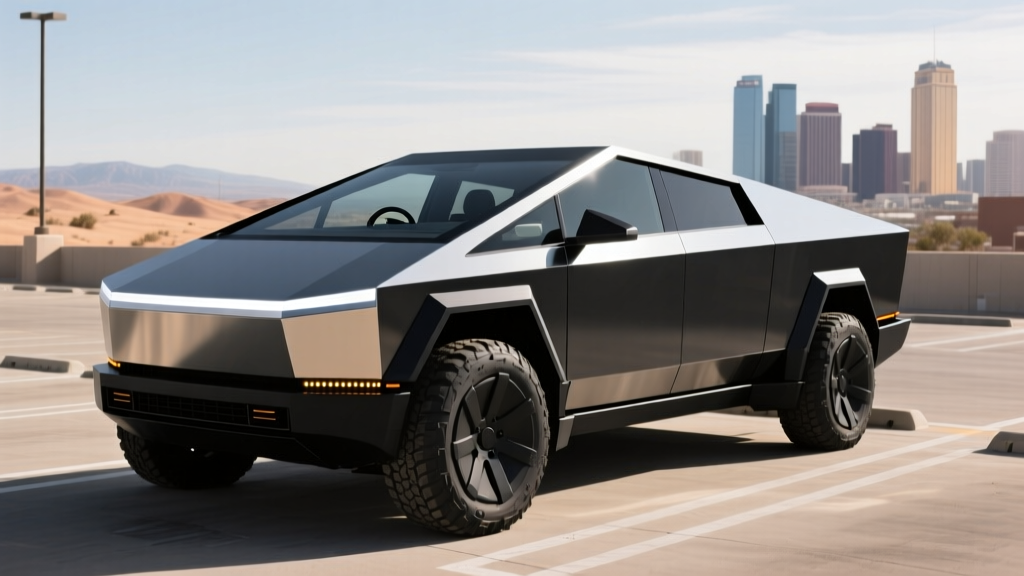
The Tesla Cybertruck off-road proposition is unlike anything else in the electric truck segment. With standard all-wheel drive across all dual- and tri-motor trims, an adaptive air suspension offering up to 17.44 inches of ground clearance, and a stainless steel exoskeleton that shrugs off trail pinstriping, the Cybertruck brings genuine overlanding potential to the EV truck market. But off-road capability is only half the equation — buyers also need to know how far it actually goes on a charge when loaded for a trail run, how quickly it replenishes at a DC fast charger, and whether the $79,990+ entry price makes sense against rivals like the Rivian R1T and Ford F-150 Lightning.
This review covers the 2025-2026 Cybertruck lineup — the Long Range AWD, the Cyberbeast tri-motor, and the rear-wheel-drive model announced for later availability — with a focus on real-world range, charging behavior, off-road hardware, and ownership economics.
Range, Battery, and Efficiency
The Cybertruck uses a large NMC (nickel manganese cobalt) lithium-ion battery pack with approximately 123 kWh of usable capacity. Tesla has not published the exact cell chemistry breakdown, but the energy density and performance characteristics are consistent with high-nickel NMC cells, likely the 4680-format structural battery pack that also serves as a stressed chassis member.
- Cybertruck Long Range AWD: EPA 340 miles — expect ~270-290 miles at sustained 70-75 mph highway speeds; ~230-260 miles in cold weather (below 32°F) or with a full bed load and rooftop tent.
- Cyberbeast (Tri-Motor AWD): EPA 320 miles — expect ~255-275 miles highway; ~215-245 miles in cold or loaded conditions.
- Cybertruck RWD (announced, preliminary): EPA 250 miles (est.) — expect ~200-220 miles highway.
The Cybertruck's angular, flat-panel design yields a drag coefficient higher than most modern EVs. At highway speeds, aerodynamic drag dominates energy consumption, which is why real-world highway range falls noticeably short of the EPA combined figure. Off-road use at low speeds is more efficient per mile, but accessory loads (lights, winch, HVAC in extreme temps) erode range quickly.
| Spec | Long Range AWD | Cyberbeast (Tri-Motor) | RWD (Announced) |
|---|---|---|---|
| EPA Range | 340 mi | 320 mi | ~250 mi (est.) |
| Battery (usable) | ~123 kWh, NMC | ~123 kWh, NMC | ~123 kWh, NMC |
| Drivetrain | Dual-motor AWD | Tri-motor AWD | Rear-wheel drive |
| Horsepower | 600 hp | 845 hp | |
| 0-60 mph | 4.1 sec | 2.6 sec | |
| MPGe (combined) | 72 MPGe | 69 MPGe | |
| Efficiency | 47 kWh/100 mi | 49 kWh/100 mi | |
| Max Tow Capacity | 11,000 lbs | 11,000 lbs | |
| Ground Clearance (max) | 17.44 in | 17.44 in | |
| Approach / Departure Angle | 35° / 30° | 35° / 30° | |
| Bed Length | 6 ft (72 in) | 6 ft (72 in) | |
| Cargo Volume (bed + frunk) | ~67 cu ft bed + ~7 cu ft frunk | ~67 cu ft bed + ~7 cu ft frunk | |
| Base MSRP | $79,990 | $99,990 | $60,990 (announced) |
Efficiency figures sourced from fueleconomy.gov. The Cybertruck's ~47-49 kWh/100 mi consumption is high compared to more aerodynamic EVs (a Model Y uses ~26 kWh/100 mi), reflecting its 6,800+ lb curb weight and slab-sided profile. This matters for road-trip planning: you'll stop to charge more often than in a lighter EV.
Charging Speed: DC Fast, Level 2, and the 800-Volt Architecture
The Cybertruck runs on an 800-volt electrical architecture, enabling faster DC charging and more efficient power delivery to the motors. Here's how the charging speeds break down across all three levels:
| Charging Level | Max Power (kW) | Rate / Time | Notes |
|---|---|---|---|
| Level 1 (120V household) | ~1.4 kW | ~3-4 mi/hr | Emergency/trickle only; ~80+ hrs for full charge |
| Level 2 (240V home, 48A) | 11.5 kW | ~29 mi/hr (~11 hrs 10-100%) | Requires NACS (J3400) connector; Tesla Wall Connector or equivalent |
| DC Fast Charge (V4 Supercharger) | 250 kW (peak) | 10-80% in ~28 min | Peak rate sustained to ~50% SoC; tapers significantly above 80% |
Charging curve reality check: The Cybertruck peaks near 250 kW at low states of charge (10-30% SoC), but the rate tapers progressively. Expect an average rate closer to 170-190 kW across a full 10-80% session, which is why the total time is ~28 minutes rather than the theoretical ~20 minutes a sustained 250 kW would deliver. This is normal for large battery packs — the 123 kWh capacity means even a modest C-rate delivers substantial power, but thermal management limits sustained peak input.
At home, a Level 2 Tesla Wall Connector at 48 amps (11.5 kW) adds roughly 29 miles of range per hour of charging. For most owners, an overnight charge from 20% to 80% takes about 6-7 hours — practical for daily use. Off-road enthusiasts planning multi-day trips should map Supercharger or NACS-compatible DC fast-charging stops along trail routes, as remote areas may lack charging infrastructure entirely.
The Cybertruck uses the NACS (North American Charging Standard / J3400) connector natively, giving it direct access to the Tesla Supercharger network — currently the largest and most reliable DC fast-charging network in North America. Adapters for CCS1 stations are available but add a connection step.
Off-Road Hardware and Trail Capability
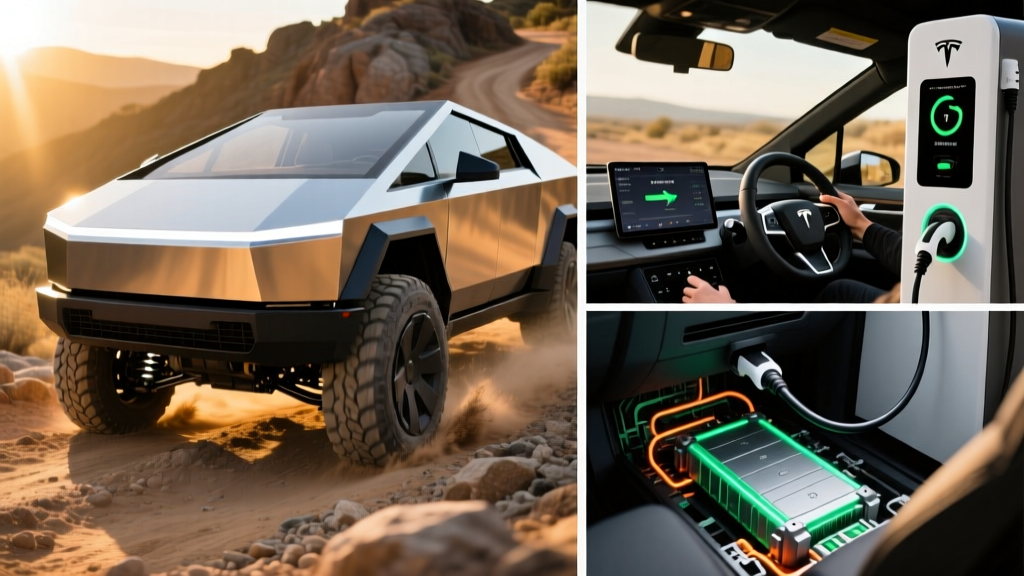
The Cybertruck's off-road credentials rest on several key hardware advantages:
- Adaptive air suspension: Offers approximately 12 inches of vertical travel, adjustable from a low entry height to 17.44 inches of ground clearance in Extract mode. This is competitive with the Rivian R1T's quad-motor air suspension (14.9 inches max).
- Stainless steel exoskeleton: The ultra-hard 30X cold-rolled stainless steel body panels resist dents and scratches from trail brush — a genuine advantage over painted aluminum or steel bodies on technical trails.
- Underbody armor: A full-length skid plate protects the battery pack and drivetrain components. The structural battery pack sits low, contributing to a low center of gravity despite the vehicle's height.
- Torque vectoring: Dual- and tri-motor configurations allow independent torque delivery to each axle (and individual rear wheels on the Cyberbeast), improving traction on loose surfaces without traditional locking differentials.
- Steer-by-wire: The Cybertruck uses a fully electronic steering system with no mechanical connection between the yoke and the wheels. This enables a variable steering ratio — as little as 340° of yoke rotation lock-to-lock — reducing arm-shuffling on tight switchbacks. However, some off-road drivers report a less connected feel compared to traditional hydraulic or electric power steering on technical rock-crawling terrain.
- Wading depth: Tesla rates the Cybertruck for up to ~26 inches of water fording, aided by the sealed battery and drivetrain.
The Cybertruck's 6,843-lb curb weight (Cyberbeast: ~6,850 lbs) is a double-edged sword off-road. On soft sand or deep mud, that mass increases sinkage and energy consumption. Recovery is more difficult — you'll need a heavy-duty kinetic rope and a capable recovery vehicle. The steer-by-wire system, while innovative, lacks the tactile feedback that experienced off-road drivers rely on for precise wheel placement on rocks. There is also no traditional spare tire — the Cybertruck relies on a tire inflator kit and Tesla's roadside assistance, which is a concern in remote areas with no cell coverage.
Pricing, Tax Credits, and Ownership Cost
The Cybertruck's pricing has shifted since its initial announcement, and current MSRP figures reflect Tesla's 2025-2026 adjustments:
| Trim | Base MSRP | §30D Federal Credit | Effective Price (before state incentives) |
|---|---|---|---|
| Long Range AWD | $79,990 | $0 (exceeds $80K truck MSRP cap) | $79,990 |
| Cyberbeast Tri-Motor | $99,990 | $0 (exceeds $80K truck MSRP cap) | $99,990 |
| RWD (announced) | $60,990 | Up to $7,500 (if income/sourcing rules met) | ~$53,490 (est.) |
Critical tax credit detail: Under IRS §30D rules, pickup trucks classified as SUVs/trucks face an $80,000 MSRP cap for federal credit eligibility. The Long Range AWD at $79,990 sits right at the threshold, but destination fees and any factory options push it above the cap — making it ineligible in most configurations. The Cyberbeast is well above the cap. Only the base RWD model, when it becomes available, is likely to qualify, and even then the buyer must meet income caps ($150K single / $300K joint AGI) and the vehicle must satisfy critical mineral and battery component sourcing requirements that phase in through 2026. Always verify current eligibility at IRS.gov's qualified vehicle list before purchase. The credit can be transferred to the dealer as a point-of-sale discount under current rules.
5-year ownership cost context: Electricity costs for the Cybertruck are higher than lighter EVs due to its ~47-49 kWh/100 mi consumption. At the national average of $0.16/kWh, charging costs roughly $0.075-$0.078 per mile at home — compared to $0.14-$0.18/mile for a gas F-150 at 18 MPG combined and $3.20/gallon. Insurance premiums for the Cybertruck run 30-50% above comparable trucks due to repair costs for the stainless body and high replacement parts pricing. Factor in $2,500-$3,500/year for insurance depending on your state and driving record.
Interior, Tech, and Daily Practicality
The Cybertruck's cabin follows Tesla's minimalist playbook: a single 18.5-inch front touchscreen handles infotainment, climate, vehicle settings, and off-road telemetry. A rear 9.4-inch screen serves second-row passengers. There are no physical buttons for climate or audio — everything routes through the touchscreen, which some drivers find distracting on rough terrain where precise inputs are harder.
Passenger space: The second row offers approximately 38.5 inches of legroom — adequate for adults on short trips but tighter than a full-size F-150 SuperCrew. Headroom is generous thanks to the angular roofline. The front trunk (frunk) provides ~7 cubic feet of lockable storage, useful for trail gear or charging cables.
Bed utility: The 6-foot bed includes a powered tonneau cover that Tesla claims supports 300 lbs of distributed weight. The bed features 120V and 240V power outlets (up to 9.6 kW of continuous output via the Powershare feature), making the Cybertruck a capable mobile generator for camping or job-site use. The tailgate includes a ramp extension for loading ATVs or motorcycles.
Driver assistance: The Cybertruck ships with Tesla's Autopilot (adaptive cruise + lane centering), which is an SAE Level 2 system — the driver must remain fully engaged and supervise at all times. Tesla's Full Self-Driving (Supervised) is available as a $8,000 option or $99/month subscription and adds automated lane changes, intersection handling, and parking, but remains Level 2. It is not a self-driving system. Off-road, Tesla has introduced trail-specific camera views and terrain mapping via the front and side cameras, which help with obstacle awareness when visibility over the hood is limited.
How the Cybertruck Stacks Up Against Rivals
| Spec | Tesla Cybertruck LR AWD | Rivian R1T Dual-Motor | Ford F-150 Lightning Lariat |
|---|---|---|---|
| EPA Range | 340 mi | 352 mi (Max Pack: 420 mi) | 320 mi (Extended Range) |
| Max Ground Clearance | 17.44 in | 14.9 in | ~8.9 in (standard) |
| 0-60 mph | 4.1 sec | 4.5 sec | ~5.0 sec |
| Tow Rating | 11,000 lbs | 11,000 lbs | 10,000 lbs |
| Bed Length | 6 ft | 4.5 ft (with Gear Tunnel) | 5.5 ft |
| Starting MSRP | $79,990 | $69,900 | $62,974 |
| DC Fast Charge Peak | 250 kW | 220 kW | 150 kW |
| Spare Tire | No (inflator kit) | Yes (full-size) | Yes (full-size) |
The Rivian R1T remains the strongest direct competitor for serious off-road use. It offers a full-size spare tire, the Gear Tunnel for secure gear storage, a more traditional steering feel, and the available Max Pack battery for 420 miles of range. The F-150 Lightning is the practical, value-oriented choice with a conventional truck layout, widely available service network, and lower starting price — but it lacks the ground clearance for technical trails.
The Cybertruck's advantages are its ground clearance, Supercharger network access, Powershare vehicle-to-load capability, and the scratch-resistant body. Its disadvantages are weight, the lack of a spare tire, steer-by-wire acclimation, and the polarizing design that limits rearward visibility.
Warranty and Long-Term Battery Outlook
Tesla covers the Cybertruck with the following warranty terms:
- Basic vehicle: 4 years / 50,000 miles
- Battery and drive units: 8 years / 120,000 miles, with a minimum 70% capacity retention threshold
- Roadside assistance: 4 years / 50,000 miles
The 8-year/120,000-mile battery warranty is competitive and slightly more generous in mileage than Tesla's sedan warranties (100,000 miles for Model 3/Y). NMC chemistry typically sees 8-12% degradation over the first 100,000 miles based on fleet data from Model S/X, though the 4680 cell format in the Cybertruck has less long-term field data. For off-road-heavy use, monitor State of Health (SoH) through the Tesla app and avoid routinely charging to 100% — daily charging to 80% significantly extends NMC battery life.
Who Should Buy the Cybertruck for Off-Road Use?
- You want maximum ground clearance in an EV truck and plan to run moderate-to-difficult trails (forest roads, sand washes, rocky fire roads).
- You rely on the Tesla Supercharger network for road trips to trailheads and value NACS-native charging.
- You need 9.6 kW of vehicle-to-load power for camping, overlanding, or job-site use.
- You're willing to forgo a spare tire and accept the steer-by-wire learning curve.
- You run remote, technical trails where a full-size spare tire is non-negotiable.
- You prefer conventional steering feedback and a more proven off-road platform.
- You need the Gear Tunnel for secure, weather-sealed gear storage.
- Your off-road use is limited to graded dirt roads and light trails.
- You want the lowest starting price, broadest dealer network, and a conventional truck experience.
Frequently Asked Questions
What is the real-world range of the Cybertruck off-road?
On moderate trails at 15-25 mph, the Cybertruck consumes roughly 40-55 kWh/100 mi depending on terrain grade and accessory load. With the 123 kWh battery, that translates to approximately 220-300 miles of trail range. However, aggressive hill climbing, sand driving, or cold temperatures can reduce this to 180-220 miles. Always plan charging stops with a 20-30% buffer.
How fast does the Cybertruck charge on the trail or at home?
On a V4 Supercharger, expect 10-80% in approximately 28 minutes (peak 250 kW, tapering above 50% SoC). At home on a 48A Level 2 charger (11.5 kW), a full overnight charge adds roughly 290 miles in 10 hours. Remote trail charging requires either a destination with Level 2 infrastructure or a portable generator/EVSE setup — there is no off-grid fast-charging solution.
Does the Cybertruck qualify for the federal EV tax credit?
The Long Range AWD ($79,990) and Cyberbeast ($99,990) exceed or effectively exceed the IRS §30D $80,000 MSRP cap for trucks/SUVs once destination and options are added, making them ineligible. The upcoming RWD model at $60,990 may qualify for up to $7,500, subject to buyer income limits ($150K single / $300K joint), battery sourcing requirements, and point-of-sale transfer rules. Check the current fueleconomy.gov tax credit tool before purchasing.
Is the Cybertruck better off-road than the Rivian R1T?
It depends on the terrain. The Cybertruck's 17.44 inches of ground clearance and approach/departure angles (35°/30°) exceed the R1T's 14.9 inches and 32.5°/34.2°. For high-clearance forest roads and sand, the Cybertruck has an edge. For technical rock crawling and remote expeditions, the R1T's full-size spare, conventional steering, and available 420-mile Max Pack make it the more pragmatic choice.
Can I put all-terrain or mud-terrain tires on the Cybertruck?
Yes. The Cybertruck uses a 35-inch tire from the factory (285/65R20), and several manufacturers now offer all-terrain options in this size. Larger tires may require a software calibration update for speedometer accuracy and will reduce range by 5-10%. Verify that any tire change does not interfere with the air suspension's full travel range.
What are the biggest pros and cons of the Cybertruck for off-road use?
- Class-leading 17.44" ground clearance with air suspension
- Scratch-resistant stainless body ideal for brush-heavy trails
- 9.6 kW vehicle-to-load power for camping/job-site
- Native Supercharger (NACS) access for trailhead road trips
- 845 hp Cyberbeast for sand dunes and steep grades
- Full-length underbody skid plate armor
- No spare tire — inflator kit only (critical off-road gap)
- 6,843-lb curb weight hurts soft-surface performance and recovery
- Steer-by-wire lacks tactile feedback for technical rock crawling
- High consumption (~47-49 kWh/100 mi) limits trail range
- $79,990+ starting price; no federal tax credit on AWD trims
- Limited rearward visibility from the angular bed design