Quick Verdict: Which Cybertruck Motor Configuration Wins?
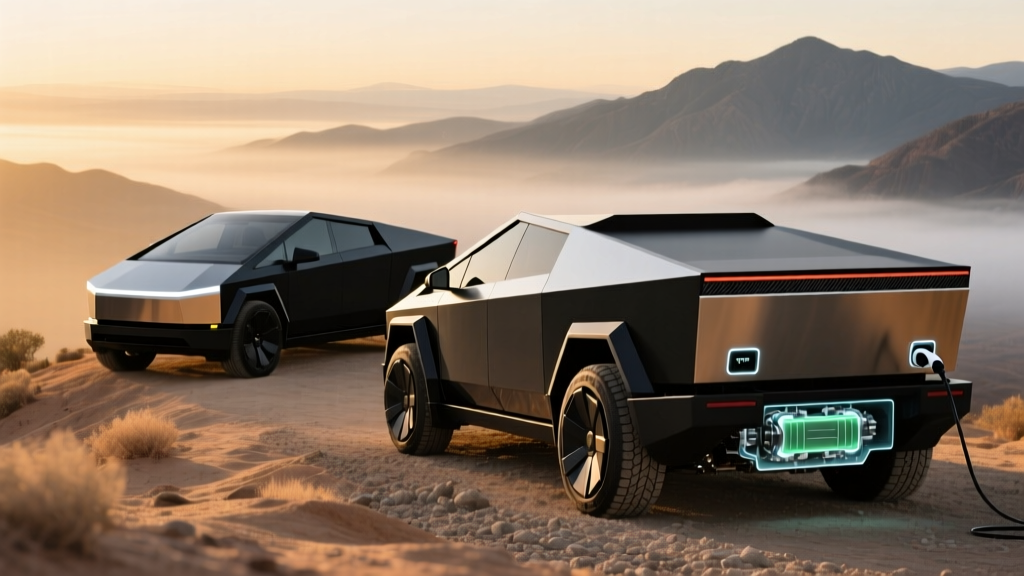
The Tesla Cybertruck enters 2026 with two primary motor configurations on sale: the dual-motor All-Wheel Drive (AWD) and the tri-motor Cyberbeast. Each uses Tesla's permanent magnet synchronous reluctance motor architecture on the rear axle paired with an induction motor up front — but the output, range, and price differ substantially. If you're researching the Cybertruck motor options to decide which trim fits your towing, commuting, or performance needs, the numbers below tell the full story.
The AWD dual-motor delivers the best range and value in the lineup. The Cyberbeast tri-motor sacrifices roughly 20 miles of EPA range for a sub-2.7-second 0-60 mph time and 845 horsepower. Neither qualifies for the federal §30D tax credit due to the $80,000 MSRP cap for trucks. If raw acceleration defines your purchase, the Cyberbeast is unmatched in the electric truck segment. If you want the most usable range per dollar, the dual-motor AWD is the rational pick.
Cybertruck Motor Specifications at a Glance
| Spec | AWD (Dual-Motor) | Cyberbeast (Tri-Motor) |
|---|---|---|
| Motor Count | 2 (1 front induction, 1 rear PMaSRM) | 3 (1 front induction, 2 rear PMaSRM) |
| Horsepower | 600 hp | 845 hp |
| Torque | ~740 lb-ft | ~1,029 lb-ft (with torque vectoring) |
| 0-60 mph | 3.9 seconds | 2.6 seconds |
| Top Speed | 112 mph | 130 mph |
| EPA Range | 340 miles | 320 miles |
| Battery (usable) | ~123 kWh, NMC (2170 cells, 4680 structural pack) | ~123 kWh, NMC (2170 cells, 4680 structural pack) |
| Efficiency | ~48 MPGe / ~70 kWh/100mi | ~45 MPGe / ~75 kWh/100mi |
| Max DC Fast Charge | 250 kW (CCS via adapter or native NACS) | 250 kW (CCS via adapter or native NACS) |
| 10-80% DC Charge Time | ~30 minutes | ~30 minutes |
| Level 2 Home Charge Rate | 11.5 kW (~30 mi/hr) | 11.5 kW (~30 mi/hr) |
| Towing Capacity | 11,000 lbs | 11,000 lbs |
| Payload Capacity | 2,500 lbs | 2,500 lbs |
| Base MSRP (2025/2026) | $79,990 | $99,990 |
| Federal §30D Tax Credit | Not eligible (exceeds $80,000 truck MSRP cap) | Not eligible (exceeds $80,000 truck MSRP cap) |
| Battery/Drive Unit Warranty | 8 years / 120,000 miles | 8 years / 120,000 miles |
Sources: Tesla Cybertruck specifications, fueleconomy.gov. Pricing and specs reflect latest available model-year data.
Real-World Range: What the EPA Sticker Doesn't Tell You
AWD Dual-Motor: EPA 340 mi → Expect ~280-310 mi highway, ~240-260 mi in freezing weather
Cyberbeast Tri-Motor: EPA 320 mi → Expect ~260-290 mi highway, ~220-240 mi in freezing weather
The Cybertruck's stainless-steel exoskeleton is aerodynamically cleaner than a conventional boxy truck, but it is still a 6,800+ lb vehicle pushing a wide frontal area. Highway driving at 75 mph consistently yields 15-20% less range than the EPA combined figure. Cold weather (below 32°F / 0°C) compounds the loss: the battery's internal resistance rises, the heat pump works harder, and regenerative braking is initially limited until the pack warms. Expect a combined highway-plus-cold penalty of 25-30%.
The Cybertruck uses a ~123 kWh usable NMC (nickel manganese cobalt) battery pack built around Tesla's 4680 structural cell architecture. NMC chemistry provides higher energy density than LFP (lithium iron phosphate), which is critical for a truck this heavy. However, NMC cells degrade slightly faster over thousands of cycles compared to LFP. Tesla's battery management system (BMS) and thermal preconditioning mitigate this — and the 8-year/120,000-mile warranty covers capacity loss below 70%.
If you plan to tow, plan your charging stops aggressively. Towing a 7,000 lb trailer can cut effective range to 150-180 miles in the AWD model. The tri-motor Cyberbeast will see similar or slightly worse towing range due to its higher baseline energy consumption.
Charging Speed: DC Fast Charging and Home Level 2
Tesla's Supercharger network remains the gold standard for public DC fast charging in the U.S. The Cybertruck supports a peak charge rate of 250 kW on V3 Superchargers and is compatible with the broader NACS (North American Charging Standard) ecosystem now adopted by most automakers. For CCS-equipped chargers (Electrify America, EVgo), a NACS-to-CCS adapter is required.
The charge curve matters more than the peak number. The Cybertruck sustains roughly 200-250 kW from 10% to about 40% state of charge, then tapers progressively. By 60% SoC, you're typically seeing 120-150 kW; by 80%, it drops to ~60-75 kW. This taper is why the 10-80% time is approximately 30 minutes — not the ~18 minutes you might calculate from peak kW alone. Above 80%, charging slows dramatically to protect cell longevity; a 80-100% top-off can add another 25-35 minutes.
At home on a Level 2 wall connector (48A / 11.5 kW on a 60A circuit), the Cybertruck recovers roughly 30 miles of range per hour. A full 10-100% charge takes about 12-13 hours. This is perfectly adequate for overnight charging — plug in at 9 PM, and you'll wake up to a full battery by 8 AM. If your home electrical panel only supports a 40A circuit (9.6 kW), expect ~25 mi/hr recovery.
Preconditioning tip: Always navigate to a Supercharger using the Cybertruck's built-in navigation. This triggers battery preconditioning — warming the pack to the optimal temperature for maximum charge acceptance. Arriving at a charger without preconditioning in cold weather can double your 10-80% charge time.
Performance: Dual-Motor vs. Tri-Motor Cyberbeast
The dual-motor AWD Cybertruck uses one induction motor on the front axle and one permanent magnet synchronous reluctance motor (PMaSRM) on the rear. This combination is a Tesla hallmark: the induction motor can freewheel with zero drag when not needed, improving efficiency, while the PMaSRM delivers high torque density for acceleration. The result is 600 horsepower, a 3.9-second 0-60 mph time, and confident passing power at any speed.
The Cyberbeast adds a second rear PMaSRM, creating a tri-motor layout with torque vectoring across the rear axle. Total output jumps to 845 horsepower and the 0-60 time drops to 2.6 seconds — making it one of the quickest production vehicles ever sold, regardless of powertrain. The torque-vectoring rear axle also improves cornering stability for a vehicle with a 6,800+ lb curb weight, actively overdriving the outside wheel in turns.
Both configurations feature adaptive air suspension with up to 16 inches of ground clearance in Extract mode (useful for off-road trails or deep snow), and both share the 11,000-lb towing rating. The motor hardware difference is purely about performance envelope, not capability.
On the road, the steer-by-wire system (no mechanical linkage between steering wheel and rack) takes roughly 100 miles to acclimate to. It's precise and adjustable but provides less tactile feedback than a conventional setup. Rear-wheel steering up to 10 degrees gives the 18.5-foot-long truck a surprisingly tight turning circle of ~40 feet.
Pricing, Trims, and Federal Tax Credit Reality
Under current IRS rules, the Cybertruck does not qualify for the up-to-$7,500 federal EV tax credit. The §30D credit imposes an $80,000 MSRP cap for trucks, vans, and SUVs. The AWD trim at $79,990 sits exactly at the threshold, but with destination fees and any options, it exceeds the cap. The Cyberbeast at $99,990 is well above it. Additionally, buyer income caps ($150K single / $300K joint AGI) and critical-mineral/battery-sourcing requirements further limit eligibility for vehicles near the price boundary. Always verify current-year rules at irs.gov and consult a tax professional.
| Trim | Base MSRP | As-Tested (typical) | After §30D Credit |
|---|---|---|---|
| AWD (Dual-Motor) | $79,990 | $82,000-$85,000 | $82,000-$85,000 (no credit) |
| Cyberbeast (Tri-Motor) | $99,990 | $102,000-$108,000 | $102,000-$108,000 (no credit) |
Tesla discontinued the initially announced rear-wheel-drive "Foundation Series" pricing, and the RWD single-motor variant has not materialized as a production offering as of early 2026. The AWD is now the entry point to the Cybertruck lineup.
Cargo, Interior, and Daily Usability
The Cybertruck seats five across two rows. Front legroom is generous at ~41.5 inches, while rear legroom measures ~38.2 inches — adequate for adults but tighter than a Ford F-150 Lightning's rear seat due to the sloping roofline. Headroom in the rear is constrained by the angular roof; taller passengers will notice this on longer trips.
The 6-foot bed (vault) offers 74 cubic feet of lockable storage under the motorized tonneau cover, which Tesla rates to support 300 lbs of distributed weight when closed. The front trunk (frunk) adds roughly 7 cubic feet — enough for charging cables and a small bag. The bed features built-in ramps and a tailgate that deploys as a ramp for loading ATVs or motorcycles.
Interior tech centers on an 18.5-inch touchscreen running Tesla's latest software, with a rear 9.4-inch screen for passengers. There are no physical buttons or stalks; turn signals are on the steering wheel (a consequence of steer-by-wire's yoke or round wheel design), and gear selection is via the touchscreen or a roof-mounted backup panel. The cabin uses vegan leather and recycled materials. Build quality has improved since early 2024 deliveries, but panel-gap consistency still varies unit to unit.
Notable tech includes Tesla's Autopilot (SAE Level 2 driver assistance) with Full Self-Driving (Supervised) available as a paid option. FSD Supervised is not autonomous driving — it requires active driver supervision, hands-on-wheel monitoring, and full attention at all times. It handles highway lane changes, on-ramps, and some city intersections competently, but disengagements and interventions are still routine.
Warranty and Long-Term Ownership
Tesla provides a 4-year/50,000-mile basic vehicle limited warranty and an 8-year/120,000-mile battery and drive unit warranty. The battery warranty guarantees at least 70% capacity retention over that period. For a truck, this battery warranty mileage is competitive — the Ford F-150 Lightning offers 8 years/100,000 miles, while the Rivian R1T also provides 8 years/120,000 miles on the battery.
Replacement cost for a Cybertruck battery pack is not yet publicly listed by Tesla, but based on comparable large-pack EVs, expect a range of $15,000-$25,000 out of warranty. The 4680 structural pack design makes individual cell replacement impractical; the entire pack is swapped as a unit. However, real-world degradation data for the 4680 cells is still limited — most Cybertrucks on the road have fewer than 40,000 miles. Early data suggests ~3-5% degradation in the first 20,000 miles, which is typical for NMC chemistry.
Insurance costs run 20-35% higher than comparable ICE trucks, driven by repair complexity (stainless-steel body panels require specialized body shops), parts availability, and the vehicle's high replacement cost. Get quotes before purchasing.
Pros
- Tri-motor Cyberbeast: 2.6s 0-60 in a 6,800-lb truck
- 340-mile EPA range (AWD) is class-leading for electric trucks
- 11,000-lb towing capacity
- Supercharger network access (most reliable public DC charging)
- Stainless-steel body resists dents and corrosion
- Adaptive air suspension with Extract mode
- Lockable bed vault with integrated ramps
Cons
- No federal §30D tax credit eligibility
- Steer-by-wire requires adaptation; no tactile feedback
- Rear headroom limited by roofline
- Panel-gap quality inconsistency
- High insurance premiums
- 250 kW peak DC charge rate trails some competitors' 350 kW capability
- Screen-only gear selection and turn signals on wheel
Who Should Buy the Cybertruck (and Who Shouldn't)?
Choose the AWD Dual-Motor if: You want the best range-per-dollar in the Cybertruck lineup, you tow occasionally (not daily), you commute 50-150 miles round trip and can charge at home, and you value practicality over headline acceleration.
Choose the Cyberbeast Tri-Motor if: Performance is a primary purchase driver, you want torque-vectoring for spirited driving or off-road traction, budget is flexible above $100K, and you accept the ~20-mile range trade-off.
Look elsewhere if: You need a crew-cab truck with spacious rear seating for three adults regularly (consider the F-150 Lightning or Rivian R1T), you require the federal tax credit to make the math work (consider the Chevrolet Silverado EV or base F-150 Lightning trims under $80K), or you prefer conventional steering feel and physical controls.
Frequently Asked Questions
What is the real-world range of the Cybertruck?
The dual-motor AWD carries a 340-mile EPA rating, but expect 280-310 miles on highway trips at 75 mph and 240-260 miles in freezing temperatures. The Cyberbeast tri-motor is EPA-rated at 320 miles with similar real-world reductions. Towing a trailer halves effective range.
How fast does the Cybertruck charge at home and on the road?
On a DC fast charger, the Cybertruck peaks at 250 kW and completes a 10-80% charge in approximately 30 minutes. At home on a Level 2 wall connector (11.5 kW / 48A), it recovers about 30 miles of range per hour, requiring roughly 12-13 hours for a full charge from near-empty.
Does the Cybertruck qualify for the federal EV tax credit?
No. Under IRS §30D rules, trucks must have an MSRP at or below $80,000 to qualify. The AWD starts at $79,990 but exceeds the cap with destination and options. The Cyberbeast at $99,990 is well above. Buyer income limits and battery-sourcing requirements add further restrictions. Consult irs.gov for current-year rules.
What type of motors does the Cybertruck use?
The AWD uses a front induction motor and a rear permanent magnet synchronous reluctance motor (PMaSRM). The Cyberbeast adds a second rear PMaSRM for torque vectoring, totaling three motors. This dual-chemistry motor approach lets the front induction unit freewheel with zero drag when not needed, boosting efficiency.
Is the Cybertruck worth buying over the F-150 Lightning or Rivian R1T?
It depends on priorities. The Cybertruck AWD offers more EPA range (340 mi vs. the Lightning's ~320 mi Extended Range) and a more robust Supercharger network. The F-150 Lightning has a more conventional truck interior, better rear-seat space, and sub-$80K trims that qualify for the tax credit. The Rivian R1T offers superior off-road capability and a quad-motor option but at a higher starting price. Cross-shop all three based on your specific towing, seating, and budget needs.
What is the Cybertruck's battery warranty?
Tesla covers the battery and drive units for 8 years or 120,000 miles (whichever comes first), guaranteeing at least 70% capacity retention. This is competitive with or slightly better than rivals in the electric truck segment.