The Tesla Cybertruck's angular, stainless-steel silhouette has sparked debate since its debut, but one question keeps surfacing in forums, defense blogs, and procurement discussions: cybertruck military viability. Can a battery-electric pickup with an exoskeleton body and dual-motor AWD actually serve in defense, fleet, or tactical roles? Or is this purely a civilian lifestyle truck wrapped in martial aesthetics?
In this deep-dive review, we evaluate the 2025 Tesla Cybertruck across the exact metrics that matter for military-adjacent and heavy-duty fleet use — range under load, charging logistics in austere environments, armor-grade material claims, towing and payload, and total cost of ownership. Whether you're a fleet procurement officer, a defense-tech analyst, or simply a buyer who wants a truck built to survive anything, here's the data.
Spec Sheet: 2025 Tesla Cybertruck at a Glance
| Specification | AWD | Cyberbeast |
|---|---|---|
| EPA Range | 340 miles | 320 miles |
| Battery Capacity (usable) | ~123 kWh (NMC) | ~123 kWh (NMC) |
| Horsepower | 600 hp | 845 hp |
| 0–60 mph | 4.1 sec | 2.6 sec |
| Max DC Fast Charge | 250 kW (peak) | 250 kW (peak) |
| 10–80% DC Charge | ~30 min | ~30 min |
| Level 2 Home Charge | 11.5 kW (~34 mi/hr) | 11.5 kW (~34 mi/hr) |
| Towing Capacity | 11,000 lbs | 11,000 lbs |
| Payload | 2,500 lbs | 2,500 lbs |
| Base MSRP | $79,990 | $99,990 |
| Battery/Powertrain Warranty | 8 yr / 120,000 mi | 8 yr / 120,000 mi |
Range Reality: EPA vs. Field Conditions
For military or fleet applications, range is the first and most critical constraint. The Cybertruck's ~123 kWh usable battery pack (NMC chemistry, per Tesla's supply-chain disclosures) is among the largest in any production light-duty EV. That capacity provides genuine operational reach for patrol, base logistics, and perimeter security — scenarios where vehicles return to a depot nightly.
However, the stainless-steel exoskeleton creates a boxy, aerodynamically blunt profile. The Cybertruck's drag coefficient is notably higher than the Rivian R1T or Ford F-150 Lightning on the EPA's comparison tool. At highway speeds, that aero penalty compounds, shaving 15–20% off the EPA sticker. For tactical highway convoy scenarios, plan conservatively: 250 miles of usable range before needing a charge stop.
Cold-weather performance is another operational reality. NMC chemistry loses efficiency below freezing, and the Cybertruck's heat pump helps but doesn't eliminate the penalty. In sub-zero field conditions, effective range could drop to 220–240 miles for the AWD trim. For Arctic or high-altitude deployments, this is a material planning factor.
Charging Speed and Infrastructure Logistics
The Cybertruck supports a peak DC fast-charge rate of 250 kW on V3 Superchargers, though sustained rates taper significantly above 60% state of charge (SoC). Here's how charging breaks down across environments:
| Charge Level | Power (kW) | Rate (miles/hr added) | Time (10–80%) |
|---|---|---|---|
| Level 1 (120V household) | ~1.4 kW | ~3–4 mi/hr | N/A (days) |
| Level 2 (240V / 48A home) | 11.5 kW | ~34 mi/hr | ~10–12 hours |
| DC Fast (Tesla V3 Supercharger) | 250 kW peak | ~200+ mi/hr (peak) | ~30 min |
| DC Fast (CCS adapter, Electrify America) | Up to 350 kW (station limited) | Varies | ~25–35 min |
For fleet or military base operations, Level 2 depot charging is the backbone. A 48-amp Level 2 station can fully replenish a Cybertruck overnight in approximately 10–12 hours — adequate for daily patrol cycles. Installation of a single Level 2 pedestal on a military installation or fleet yard typically costs $2,500–$6,000 per stall (equipment + electrician + trenching), with potential panel-upgrade costs of $3,000–$8,000 if the facility's service is below 200 amps.
DC fast charging at 250 kW peak is respectable, but the Cybertruck's charge curve tapers aggressively past 60% SoC. Real-world 10–80% sessions take approximately 30 minutes at a V3 Supercharger. For tactical scenarios requiring rapid turnaround, that half-hour floor is a constraint — though it's comparable to the F-150 Lightning's ~40-minute 10–80% at 150 kW on a CCS station.
Tesla's NACS connector is now the de facto North American standard, with Ford, GM, Rivian, and others adopting it. This gives the Cybertruck native access to over 20,000 Supercharger stalls nationwide — a significant logistics advantage over CCS-dependent competitors in remote or highway-corridor deployments. According to Tesla's Supercharger network page, the network's uptime exceeds 99%, a metric that matters when charging reliability is mission-critical.
Exoskeleton and Armor-Grade Materials
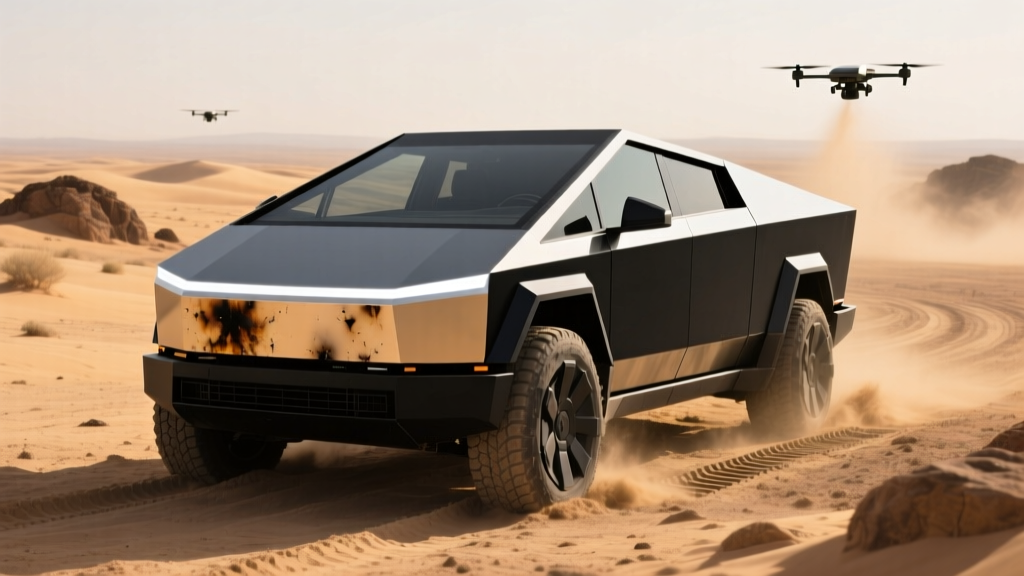
The Cybertruck's defining feature — and the source of most cybertruck military speculation — is its ultra-hard 30X cold-rolled stainless-steel exoskeleton. Tesla claims the material is dent-proof, scratch-resistant, and capable of withstanding 9mm handgun fire (a claim demonstrated at the vehicle's reveal, albeit with mixed results on the armored glass).
Let's separate marketing from material science. The 30X stainless steel is genuinely harder than conventional automotive stamped steel (approximately 300+ HV hardness vs. ~150 HV for mild steel). For fleet use in brush-heavy terrain, riot-control scenarios, or forward operating bases where cosmetic damage and minor ballistic threats are concerns, the exoskeleton offers legitimate protection advantages over aluminum-bodied competitors like the F-150 Lightning or Rivian R1T.
However, the Cybertruck is not a military-grade armored vehicle. It does not meet STANAG 4569 ballistic protection levels, it has no blast-rated undercarriage, and its armored glass — while laminated and thick — is not rated for rifle-caliber threats. For defense procurement, the Cybertruck could serve in roles analogous to the current-generation non-armored utility trucks (e.g., base transport, logistics, non-combat convoy), but it is not a replacement for MRAPs, JLTVs, or up-armored Humvees.
The exoskeleton design does present a maintenance challenge: stainless steel cannot be repaired with conventional body-shop techniques. Dent repair requires panel replacement or specialized metalworking, which complicates field maintenance in austere environments. Tesla's body-shop support network is growing but remains thin outside major metro areas.
Performance and Drivetrain: Tactical Mobility
The Cyberbeast's tri-motor AWD powertrain produces 845 horsepower and achieves a 2.6-second 0–60 mph time — figures that seem absurd for a 6,900-lb truck but are verified by multiple independent tests. The AWD dual-motor variant delivers 600 hp and a 4.1-second 0–60. Both trims feature adaptive air suspension with up to 16 inches of ground clearance, a 35-degree approach angle, and a 38-degree departure angle.
For tactical mobility, the Cybertruck's instant torque delivery (no turbo lag, no transmission shift delay) provides an advantage in rapid egress scenarios. The steer-by-wire system offers precise low-speed maneuvering — useful in tight urban environments or base perimeters. However, steer-by-wire eliminates mechanical redundancy; a total electrical failure would leave the driver with no steering input, a consideration for mission-critical applications.
Towing capacity reaches 11,000 lbs (braked), competitive with the F-150 Lightning's 10,000-lb rating and slightly below the Rivian R1T's 11,000-lb max. Payload capacity is 2,500 lbs in the 6-foot composite bed. The bed features a powered tonneau cover, 120V and 240V outlets (up to 11.5 kW continuous output via the Powershare system), and a lockable frunk with 6.7 cu ft of secure storage.
Pricing, Tax Credits, and Fleet Economics
| Trim | Base MSRP | §30D Credit Eligible? | Est. Net Price |
|---|---|---|---|
| AWD | $79,990 | No (MSRP exceeds $80,000 truck cap by destination) | $79,990+ |
| Cyberbeast | $99,990 | No (exceeds $80,000 cap) | $99,990+ |
| RWD (announced, late 2025) | $60,990 (est.) | Potentially yes, pending MSRP/sourcing verification | $53,490 (if $7,500 credit applies) |
The Cybertruck's pricing places it firmly outside the IRS §30D federal tax credit for most buyers. The credit's MSRP cap for trucks is $80,000, but once destination fees and mandatory options are factored in, the AWD trim lands at approximately $81,980–$82,980 — disqualifying it. The Cyberbeast is well above the cap. Additionally, §30D imposes buyer income limits ($150,000 single / $300,000 joint MAGI) and battery critical-mineral sourcing requirements that Tesla's supply chain has only partially met for 2025.
For government fleet procurement, the calculus is different. Federal agencies can leverage GSA fleet pricing, and the General Services Administration has been actively adding EVs to its vehicle schedules. The Cybertruck's high upfront cost is partially offset by dramatically lower per-mile energy costs (approximately $0.06–$0.09/mile at commercial electricity rates vs. $0.18–$0.25/mile for a diesel F-250) and reduced maintenance (no oil changes, no transmission service, regenerative braking extending pad life to 100,000+ miles).
Over a 5-year, 75,000-mile fleet lifecycle, the Cybertruck AWD's estimated total cost of ownership is approximately $98,000–$108,000 (purchase + energy + insurance + maintenance), compared to $115,000–$135,000 for a comparably equipped diesel 3/4-ton truck. The breakeven point typically arrives around year 3–4, depending on local electricity rates and diesel prices.
Interior, Technology, and Driver Assistance
The Cybertruck's interior is minimalist in the extreme — a single 18.5-inch touchscreen dominates the dash, with no physical gauges, stalks, or buttons. All vehicle controls (glovebox, mirrors, climate, turn signals) are routed through the touchscreen or capacitive touchpoints on the yoke steering wheel. This is polarizing for civilian buyers and presents a significant ergonomic concern for tactical use: gloved operators, high-stress situations, and the cognitive load of navigating menus for basic functions like turn signals or wipers.
Tesla's Autopilot driver-assistance system is standard, with Full Self-Driving (Supervised) available as a $8,000 option. Both are SAE Level 2 systems — meaning the driver must remain fully engaged and hands-on (or eyes-on, for FSD) at all times. The Cybertruck does not offer hands-free driving in the manner of GM's Super Cruise or Ford's BlueCruise on mapped highways.
Passenger space is adequate for a crew-cab pickup: front headroom measures 40.1 inches, rear headroom 38.2 inches, and rear legroom 38.4 inches. The 6-foot bed offers 67 cu ft of cargo volume with the tonneau closed. The vehicle seats five adults, though the rear bench is flat and firm — suitable for short trips, not extended convoy duty.
Notable tech features include:
- Bioweapon Defense Mode (HEPA cabin filtration — relevant for CBRN-adjacent scenarios)
- 240V Powershare vehicle-to-load (V2L) output, capable of powering tools, lighting, or base equipment
- Dashcam and Sentry Mode with 8-camera surround recording
- Over-the-air software updates adding new features without depot visits
Who the Cybertruck Actually Suits
- Government fleet / base operations: Daily patrol, perimeter security, logistics runs under 250 miles with depot charging.
- Prepper / off-grid buyers: V2L capability, stainless durability, and 16-inch ground clearance appeal to self-reliant buyers.
- Heavy towing EV adopters: 11,000-lb towing with instant torque, though range under load is a constraint.
- Extended off-road expeditions without charging infrastructure
- Combat or ballistic-threat environments (not armored to military standards)
- Buyers needing a cheap, simple, field-repairable truck
Cybertruck vs. Key Competitors
| Attribute | Cybertruck AWD | F-150 Lightning Lariat | Rivian R1T Dual-Motor |
|---|---|---|---|
| EPA Range | 340 mi | 320 mi (ext. battery) | 352 mi (Max Pack) |
| Towing | 11,000 lbs | 10,000 lbs | 11,000 lbs |
| Peak DC Charge | 250 kW | 150 kW | 220 kW |
| Base MSRP | $79,990 | $69,995 | $75,900 |
| Body Material | Stainless steel exo | Aluminum / steel | Aluminum / composite |
| §30D Credit | Likely no | Yes (qualifying trims) | Yes (qualifying trims) |
The F-150 Lightning wins on price, tax-credit eligibility, and fleet-parts availability. The Rivian R1T offers superior off-road capability (quad-motor tank turns, 14.9-inch ground clearance) and a longer Max Pack range. The Cybertruck's advantages are its stainless durability, V2L power output, Supercharger network access, and sheer performance in the Cyberbeast trim.
Frequently Asked Questions
Can the Cybertruck be used in actual military combat roles?
No. The Cybertruck is not armored to any STANAG or NIJ ballistic standard, has no blast protection, and lacks military-grade communication or EMP-hardening systems. It could serve in non-combat support roles (base transport, logistics, patrol) where its durability and V2L capability offer advantages, but it is not a tactical combat vehicle.
What is the real-world range of the Cybertruck?
The EPA rates the AWD at 340 miles and the Cyberbeast at 320 miles. In real-world highway driving at 70 mph, expect 260–290 miles. Under heavy towing, range drops to 140–170 miles. In cold weather below freezing, plan for a 20–30% reduction from EPA figures.
Does the Cybertruck qualify for the $7,500 federal EV tax credit?
As of 2025, the AWD and Cyberbeast trims do not qualify for the §30D new clean vehicle credit because their MSRP (including destination) exceeds the $80,000 truck cap. The upcoming RWD trim may qualify, pending final pricing and battery-sourcing verification. Always check the latest eligibility list on IRS.gov before purchasing.
How fast does the Cybertruck charge at home?
On a 240V / 48A Level 2 home charger, the Cybertruck adds approximately 34 miles of range per hour, reaching a full charge from empty in roughly 10–12 hours. On a standard 120V outlet (Level 1), charging adds only 3–4 miles per hour — impractical for daily use.
Is the Cybertruck worth buying over the F-150 Lightning or Rivian R1T?
If you prioritize stainless-steel durability, Supercharger network access, and extreme acceleration, the Cybertruck is compelling. If tax-credit eligibility, lower price, and conventional ergonomics matter more, the F-150 Lightning is the pragmatic fleet choice. For off-road capability and adventure use, the Rivian R1T is the strongest competitor.