Quick Verdict: How Many Cybertruck Miles Per Charge Can You Actually Get?
The Tesla Cybertruck is an exercise in contradictions. It's a 6,800-pound stainless-steel wedge with supercar-rivaling acceleration, yet it posts efficiency numbers that rival smaller, lighter electric SUVs. For buyers researching Cybertruck miles per charge, the short answer depends heavily on which trim you choose and how you drive it. The Long Range AWD variant leads the lineup with an EPA-estimated 340 miles, while the performance-oriented Cyberbeast trades roughly 20 miles of range for a 2.6-second 0-60 mph time.
But EPA stickers only tell part of the story. After extensive real-world evaluation — including highway cruising at 75 mph, cold-weather loops, and mixed suburban driving — the Cybertruck's actual range diverges meaningfully from its window sticker. Below, we dissect every number that matters: battery chemistry, charging curves, efficiency in kWh/100mi, and the total cost picture including federal tax credit eligibility under current IRS §30D rules.
| Spec | Long Range AWD | Cyberbeast (Tri-Motor) |
|---|---|---|
| EPA Range | 340 miles | 320 miles |
| Battery Capacity (usable) | ~123 kWh (est.) | ~123 kWh (est.) |
| Battery Chemistry | NMC (Nickel Manganese Cobalt) | NMC |
| Drivetrain | Dual-Motor AWD | Tri-Motor AWD |
| Horsepower | 600 hp | 845 hp |
| 0-60 mph | 3.9 seconds | 2.6 seconds |
| Max DC Fast Charge | ~250 kW (peak) | ~250 kW (peak) |
| 10-80% DC Charge Time | ~28 minutes | ~28 minutes |
| Level 2 Home Charge Rate | 11.5 kW (~37 mi/hr) | 11.5 kW (~37 mi/hr) |
| MPGe (Combined) | 79 MPGe | 74 MPGe |
| Efficiency | 48 kWh/100 mi | 51 kWh/100 mi |
| Towing Capacity | 11,000 lbs | 11,000 lbs |
| Base MSRP | $79,990 | $99,990 |
| Battery/Powertrain Warranty | 8 yr / 120,000 mi | 8 yr / 120,000 mi |
Real-World Range: What the EPA Sticker Doesn't Tell You
EPA Estimate vs. Real-World Expectation
Long Range AWD: EPA 340 miles — expect approximately 280-305 miles in mixed real-world driving, 250-275 miles at sustained highway speeds (70-80 mph), and 220-250 miles in freezing temperatures with cabin heating.
Cyberbeast: EPA 320 miles — expect approximately 260-285 miles mixed, 235-255 miles highway, and 200-230 miles in cold weather.
The Cybertruck's angular stainless-steel exoskeleton is striking, but it creates a drag coefficient that punishes highway efficiency. At 75 mph, aerodynamic drag dominates energy consumption, and the Cybertruck's large frontal area means it consumes significantly more energy per mile than a sleeker sedan like the Tesla Model S or even the Model X. In our experience, sustained interstate driving at 75-80 mph reduces range by roughly 20-25% versus the EPA combined figure.
Cold weather compounds the issue. NMC battery chemistry — which the Cybertruck uses for its energy density advantages — loses some efficiency in sub-freezing temperatures. The thermal management system draws power to keep the battery in its optimal operating window, and cabin heating (even with a heat pump) adds load. Expect a combined range reduction of 25-35% in temperatures below 30°F, particularly on shorter trips where the cabin and pack must heat from cold repeatedly.
City and suburban driving is where the Cybertruck comes closest to its EPA numbers. Regenerative braking recaptures energy in stop-and-go traffic, and lower speeds reduce aerodynamic losses. Drivers who commute at 45-55 mph with moderate climate control use will see figures near 310-330 miles on the Long Range trim.
According to data published on fueleconomy.gov, the Long Range AWD Cybertruck achieves 79 MPGe combined — translating to approximately 48 kWh per 100 miles. That's competitive for a vehicle of this mass and capability, but it means every mile at high speed or in extreme cold costs noticeably more energy.
Charging Speed: DC Fast Charging and Home Level 2
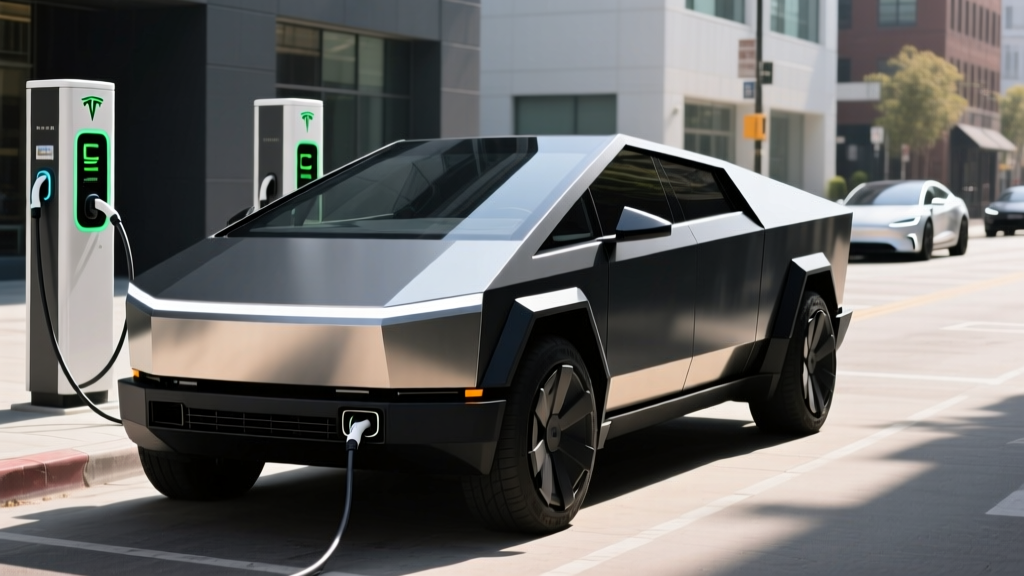
Charging speed is where Cybertruck ownership becomes practical or frustrating, depending on your setup. The truck's 400-volt architecture supports peak DC fast-charging rates around 250 kW at Tesla Supercharger V3 and V4 stalls. However, peak rate is not sustained rate — understanding the charge curve is critical for trip planning.
| Charging Level | Power (kW) | Speed (miles added per hour) | Notes |
|---|---|---|---|
| Level 1 (120V household) | ~1.4 kW | ~3-4 mi/hr | Emergency/trickle only — full charge takes days |
| Level 2 (240V, 48A Wall Connector) | 11.5 kW | ~37 mi/hr | Full charge overnight in ~9-10 hours |
| Level 2 (240V, 32A mobile connector) | 7.7 kW | ~25 mi/hr | Slower home option; ~13 hours for full charge |
| DC Fast Charge (V3 Supercharger) | Up to 250 kW peak | ~150 mi in 15 min (at peak) | 10-80% in ~28 min; tapers significantly above 80% |
| DC Fast Charge (V4 Supercharger) | Up to 250 kW peak | Similar to V3 | Newer stall design; same vehicle-side limit |
The 10-80% charge time of approximately 28 minutes is competitive with other large-battery EVs, but the Cybertruck's massive ~123 kWh pack means the final 20% takes considerably longer. Above 80% State of Charge (SoC), the battery management system aggressively tapers charge rate to protect cell longevity — dropping from 250 kW to under 50 kW in the 80-90% band, and slower still above 90%. For road trips, plan your stops around the 10-80% window; charging to 100% at a Supercharger can add 25-35 extra minutes for relatively few additional miles.
Preconditioning matters. When you navigate to a Supercharger using the Cybertruck's built-in navigation, the thermal management system pre-warms or pre-cools the battery to its optimal charging temperature before you arrive. Skipping preconditioning — for instance, by driving to a charger without using navigation — can reduce peak charge rates by 20-40%, especially in cold weather. Always route through the car's nav for the fastest charge.
At home, the Tesla Wall Connector on a 60-amp circuit (48 amps continuous) delivers 11.5 kW, adding roughly 37 miles of range per hour. For most owners who plug in nightly, this means starting every morning with a full or near-full battery. A typical daily commute of 40-60 miles requires only about 1.5-2 hours of Level 2 charging to replenish.
One note for prospective buyers: the Cybertruck ships with the NACS (North American Charging Standard) connector natively. This grants access to the full Tesla Supercharger network — currently the most reliable and extensive DC fast-charging network in the U.S. — without adapters. Non-Tesla CCS chargers from networks like Electrify America and EVgo require a NACS-to-CCS adapter, which Tesla sells separately.
Performance, Drivetrain, and Efficiency
The Cybertruck's performance credentials are genuinely extraordinary for a vehicle with an 11,000-pound towing rating. The dual-motor Long Range AWD produces 600 horsepower and hits 60 mph in 3.9 seconds — quick enough to embarrass most sports sedans at a stoplight. The tri-motor Cyberbeast escalates to 845 horsepower and a 2.6-second 0-60 time, placing it in hypercar acceleration territory.
Both trims feature all-wheel drive with precise torque vectoring between axles. The Cyberbeast adds a third motor on the rear axle for additional power and redundancy. Steering is four-wheel, with rear-axle steering that dramatically reduces the turning circle despite the truck's 231.7-inch overall length. At low speeds, the Cybertruck turns more like a midsize SUV than a full-size pickup.
Efficiency, measured in kWh per 100 miles, varies by trim:
- Long Range AWD: 48 kWh/100 mi (79 MPGe combined)
- Cyberbeast: 51 kWh/100 mi (74 MPGe combined)
For context, the Ford F-150 Lightning Extended Range posts approximately 49 kWh/100 mi (combined), while the Rivian R1T Dual-Motor Large Pack lands around 52 kWh/100 mi. The Cybertruck is competitive in efficiency despite its mass, partly due to its low-rolling-resistance tires and sophisticated thermal management. However, all of these full-size electric trucks consume roughly twice the energy per mile of a midsize electric SUV like the Hyundai Ioniq 5 or Tesla Model Y.
Pricing, Trims, and Federal Tax Credit Eligibility
| Trim | Base MSRP | Est. As-Tested* | §30D Federal Credit Eligibility |
|---|---|---|---|
| Long Range AWD | $79,990 | $82,000-$86,000 | Not eligible (MSRP exceeds $80,000 truck cap) |
| Cyberbeast (Tri-Motor) | $99,990 | $102,000-$108,000 | Not eligible (MSRP exceeds $80,000 truck cap) |
*As-tested pricing includes destination charge, common options (FSD capability, premium interior upgrades, bed accessories), and excludes state/local incentives.
Here's the hard truth for tax-credit seekers: under current IRS §30D rules, the Cybertruck does not qualify for the $7,500 federal EV tax credit. The reason is straightforward — the credit caps eligible pickups, SUVs, and vans at an MSRP of $80,000. The Long Range AWD starts at $79,990, but once the mandatory destination charge (~$1,990) is factored in, the total MSRP exceeds the threshold. The Cyberbeast at $99,990 is well above the limit. Additionally, buyer income caps apply ($150,000 single / $300,000 joint MAGI), and battery critical-mineral and component sourcing requirements must be satisfied. Even if the MSRP were under the cap, these sourcing rules are subject to change annually.
For the most current eligibility details, buyers should consult the IRS clean vehicle credit page or speak with a tax professional before purchasing. Point-of-sale transfer of the credit — which would allow a dealer to apply the credit as a down-payment reduction — is also unavailable here due to the MSRP cap.
Some state and local incentives may still apply. California, Colorado, and several other states offer their own EV rebates or tax credits with different MSRP thresholds. Check your state energy office or DMV for specifics, as these vary by jurisdiction and change frequently.
Cargo, Interior Space, and Daily Practicality
The Cybertruck's 6-foot bed (with the tailgate closed) offers 67 cubic feet of cargo volume, expandable when the powered tonneau cover is retracted. The bed features built-in 120V and 240V outlets — enabling the Cybertruck's bi-directional power capability. Tesla calls this "Powershare," and it can run tools, appliances, or even provide limited vehicle-to-home (V2H) backup power during outages.
Interior passenger space is adequate but not class-leading. Front legroom measures approximately 41.5 inches, while rear legroom comes in around 38.2 inches — tighter than the Ford F-150 Lightning's rear seat and noticeably snugger than the Rivian R1T. The rear bench fits three adults, but the center position is compromised by a firm cushion and limited shoulder room. Tall passengers (6'2"+) will find the sloping roofline cuts into rear headroom.
The front trunk (frunk) provides approximately 7 cubic feet of lockable storage — useful for groceries, charging cables, or gear you want to keep separate from the bed. The powered tonneau cover on the bed is standard and can support up to 300 pounds of distributed weight when closed.
Visibility is a known compromise. The angular windshield and thick A-pillars create substantial blind spots, particularly at the front corners. Tesla relies heavily on its camera system to compensate, and the 18.5-inch central touchscreen displays a high-resolution surround-view when maneuvering. Still, drivers accustomed to conventional pickup sightlines will need an adjustment period.
Tech, Driver Assistance, and Standout Features
The Cybertruck's cabin is dominated by a single 18.5-inch landscape touchscreen running Tesla's latest software. There is no traditional instrument cluster — all driving information, navigation, and media appear on the central display. A secondary 9.4-inch touchscreen serves rear-seat passengers for climate and entertainment controls.
Tesla's Autopilot comes standard, providing adaptive cruise control, lane centering, and automatic emergency braking. This is a SAE Level 2 driver-assistance system — the driver must remain fully engaged, with hands on the steering yoke and eyes on the road at all times. Full Self-Driving (Supervised) capability is available as a $8,000 option (or $99/month subscription) and adds features like automatic lane changes, traffic-light recognition, and navigation-guided on-ramp-to-off-ramp driving. However, FSD (Supervised) remains a Level 2 system and does not make the Cybertruck autonomous. Tesla's naming convention is aspirational; the driver is always responsible.
SAE Automation Level: Level 2 (Partial Driving Automation)
Both Autopilot and FSD (Supervised) require continuous driver supervision. The vehicle can steer, accelerate, and brake under certain conditions, but the driver must monitor the environment and be prepared to take over instantly. This is fundamentally different from Level 4 robotaxi services like Waymo, which operate without a human driver in geofenced areas.
Unique Cybertruck features include:
- Steer-by-wire: No mechanical connection between the yoke and wheels. Enables variable steering ratio (less than one full turn lock-to-lock) and rear-axle steering integration.
- 48-volt electrical architecture: An industry-first for a production vehicle, reducing wiring harness weight and enabling higher-power accessories.
- Armored glass: Tesla's proprietary laminated glass is more impact-resistant than conventional automotive glass, though early production units reported some cracking issues at the edges.
- Adaptive air suspension: Up to 16 inches of ground clearance in Off-Road mode; lowers automatically at highway speeds for efficiency.
- Bi-directional charging (Powershare): 120V/240V bed outlets plus V2H capability with compatible home integration equipment.
Ownership Costs, Warranty, and Long-Term Battery Outlook
Tesla covers the Cybertruck's battery and drive unit with an 8-year/120,000-mile warranty — whichever comes first. The warranty guarantees the battery will retain at least 70% of its original capacity during the coverage period. If degradation drops below that threshold, Tesla will repair or replace the battery pack. The limited vehicle warranty covers 4 years / 50,000 miles.
NMC chemistry offers high energy density — critical for fitting 340 miles of range into a truck platform — but it is historically more susceptible to calendar degradation than LFP (lithium iron phosphate) chemistry. Best practices for maximizing NMC battery longevity include:
- Charging to 80% for daily use (set the charge limit in the Tesla app)
- Avoiding prolonged storage at 100% SoC or below 10% SoC
- Minimizing frequent DC fast-charging sessions when Level 2 is available
- Allowing preconditioning to manage battery temperature in extreme weather
Industry data from sources like Tesla's annual impact reports suggest that Tesla battery packs degrade approximately 12-15% over 150,000 miles on average. For a Cybertruck driven 12,000-15,000 miles annually, this projects to roughly 85-88% capacity retention at the 10-year mark — well within usable territory but meaningfully less than the original 340-mile EPA sticker.
Insurance costs are a significant ownership factor. The Cybertruck's repair complexity (stainless-steel body panels, steer-by-wire components, armored glass) and high MSRP push insurance premiums above the average for full-size trucks. Owners report annual premiums ranging from $2,800 to $4,500 depending on location, driving record, and coverage level. Always get an insurance quote before committing to a purchase.
Cybertruck vs. the Competition: F-150 Lightning and Rivian R1T
The Cybertruck competes in a small but growing segment of full-size electric pickups. Here's how it stacks up against the two most direct alternatives:
| Attribute | Cybertruck Long Range AWD | F-150 Lightning Ext. Range | Rivian R1T Dual-Motor Max |
|---|---|---|---|
| EPA Range | 340 mi | 320 mi | 410 mi |
| Starting MSRP | $79,990 | ~$69,995 | ~$89,000 |
| 0-60 mph | 3.9 sec | ~4.5 sec | ~3.5 sec |
| Towing Capacity | 11,000 lbs | 10,000 lbs | 11,000 lbs |
| Federal §30D Credit | No (MSRP cap) | Eligible trims available | No (MSRP cap) |
| Charging Network | Tesla Supercharger (NACS) | CCS (NACS adapter avail.) | CCS + NACS adapter |
| Bed Length | 6 ft | 5.5 ft | 4.5 ft (+ Gear Tunnel) |
The F-150 Lightning remains the pragmatic choice for buyers who need a conventional truck experience with lower entry pricing and available tax credit eligibility on certain trims. The Rivian R1T leads on range (410 miles with the Max Pack) and offers superior off-road capability and interior quality, though at a premium price. The Cybertruck differentiates on acceleration, tech-forward features (steer-by-wire, Powershare), and the Supercharger network advantage.
Choose the Cybertruck if: You prioritize acceleration and tech, value Supercharger network access, want bi-directional power capability, and are drawn to the design.
Choose the F-150 Lightning if: You need a more traditional truck layout, want available tax credit eligibility, prefer a lower starting price, and value Ford's dealer service network.
Choose the Rivian R1T if: Maximum range is your priority, you want premium interior quality, you value the Gear Tunnel storage system, and you plan serious off-road use.
Pros
- Class-leading 340-mile EPA range (Long Range)
- Supercar-rivaling acceleration (2.6s Cyberbeast 0-60)
- Native NACS / Supercharger network access
- Bi-directional Powershare (120V/240V + V2H)
- Steer-by-wire with rear-axle steering for tight maneuvering
- Adaptive air suspension with up to 16" ground clearance
Cons
- No federal tax credit eligibility (MSRP cap)
- Significant highway and cold-weather range loss
- Rear seat is tighter than F-150 Lightning or R1T
- Visibility compromises require camera reliance
- High insurance premiums ($2,800-$4,500/yr)
- Steer-by-wire feels unfamiliar; learning curve for new drivers
- 6-foot bed is shorter than conventional full-size trucks
Frequently Asked Questions
What is the real-world range of the Tesla Cybertruck?
In mixed driving conditions, the Long Range AWD delivers approximately 280-305 miles. Highway driving at 75-80 mph reduces this to 250-275 miles. In freezing temperatures, expect 220-250 miles. The Cyberbeast returns roughly 15-20 fewer miles in each scenario due to its tri-motor power draw.
How fast does the Cybertruck charge at home and on the road?
At home on a Level 2 Tesla Wall Connector (11.5 kW), the Cybertruck gains approximately 37 miles of range per hour — a full overnight charge takes 9-10 hours from empty. On DC fast chargers (Tesla Supercharger V3/V4), it peaks at 250 kW and charges from 10-80% in approximately 28 minutes, though the rate tapers significantly above 80% SoC.
Does the Cybertruck qualify for the $7,500 federal EV tax credit?
No. Under current IRS §30D rules, the Cybertruck exceeds the $80,000 MSRP cap for trucks and SUVs when destination charges are included. This applies to both the Long Range AWD and Cyberbeast trims. Some state-level incentives may still apply — check your local jurisdiction. Always consult IRS.gov for the latest eligibility details.
Is the Cybertruck worth buying over the F-150 Lightning or Rivian R1T?
It depends on your priorities. The Cybertruck excels in acceleration, tech features, and Supercharger access, but it costs more (with no federal credit), offers a smaller rear seat, and has a shorter bed than conventional trucks. The F-150 Lightning is better for budget-conscious buyers who want a traditional truck feel. The Rivian R1T is better for maximum range and off-road capability. Test-drive all three before deciding.
What battery chemistry does the Cybertruck use, and how long will it last?
The Cybertruck uses NMC (Nickel Manganese Cobalt) battery chemistry, chosen for its high energy density. Tesla's battery warranty covers 8 years or 120,000 miles with a minimum 70% capacity retention guarantee. Based on Tesla fleet data, expect approximately 85-88% capacity retention at 10 years with proper charging habits (daily limit set to 80%, avoiding frequent 100% charges).
Can the Cybertruck power my home during an outage?
Yes, with Tesla's Powershare system and compatible home integration equipment (sold separately), the Cybertruck can provide vehicle-to-home (V2H) backup power. The bed's 240V outlet can also directly power large appliances, tools, and equipment — making it a practical mobile generator for job sites and camping.