Beyond the Memes: The Cybertruck by the Numbers
Search "cybertruck memes" and you'll find thousands of jokes about window-armor fails, panel gaps, and the truck's angular silhouette photoshopped into everything from medieval paintings to low-poly video games. The internet turned Tesla's stainless-steel pickup into a cultural punchline before most buyers ever sat in one. But memes don't tow trailers, and screenshots don't tell you how fast a 48-volt architecture charges at a Supercharger.
For 2026, the Cybertruck lineup has settled into three production trims: the Long Range AWD, the Dual Motor AWD (now the volume seller), and the tri-motor Cyberbeast. Tesla has quietly addressed many early-build quality complaints, updated the steer-by-wire calibration, and expanded Supercharger V4 stall availability with native NACS compatibility. The question for serious buyers isn't whether the Cybertruck looks funny in a meme — it's whether the engineering delivers once you leave the driveway.
We've compiled the exact specifications, real-world range data, charging curves, and ownership costs that matter when the jokes stop and the commute begins.
| Spec | Long Range AWD | Dual Motor AWD | Cyberbeast (Tri-Motor) |
|---|---|---|---|
| EPA Range | 340 mi | 318 mi | 301 mi |
| Battery (usable) | ~123 kWh (NMC) | ~123 kWh (NMC) | ~123 kWh (NMC) |
| Max DC Fast Charge | 250 kW | 250 kW | 250 kW |
| 10–80% DCFC Time | ~35 min | ~35 min | ~35 min |
| Level 2 (11.5 kW) | ~44 mi/hr | ~44 mi/hr | ~44 mi/hr |
| 0–60 mph | 4.1 sec | 3.9 sec | 2.6 sec |
| Horsepower | 600 hp | 600 hp | 845 hp |
| MPGe (combined) | 66 MPGe | 64 MPGe | 61 MPGe |
| Towing Capacity | 11,000 lbs | 11,000 lbs | 11,000 lbs |
| Base MSRP | $79,990 | $84,990 | $104,990 |
Real-World Range: What the EPA Sticker Doesn't Show
Real-World Highway (70 mph, moderate climate): ~260–275 miles
Cold-Weather Highway (30°F, heater on): ~220–240 miles
Towing (5,000 lb trailer, 65 mph): ~150–170 miles
The Cybertruck's 123 kWh usable battery pack is one of the largest in any production consumer vehicle, but mass and aerodynamics work against it. At roughly 6,800 lbs curb weight with a drag coefficient that improves on the highway but still exceeds a sedan's, efficiency drops sharply above 70 mph. In EPA testing, the Dual Motor achieves 64 MPGe combined, which translates to approximately 51 kWh per 100 miles — thirsty by EV standards.
Cold weather compounds the penalty. The structural battery pack and heat pump help, but any EV loses 15–30% of range in sustained sub-freezing driving due to cabin heating demand and increased internal battery resistance. On a 30°F January highway run from Denver to Vail, expect to arrive at a Supercharger with less buffer than the navigation predicts.
The meme about "running out of juice" in a Cybertruck ignores that Tesla's route planner preconditions the battery for fast charging when a Supercharger is set as the destination. The real limitation isn't range — it's that towing a 7,000 lb boat effectively turns the Cybertruck into a 150-mile vehicle between charge stops.
Charging Speed: 250 kW Peaks and Sustained Reality
| Charging Level | Power | Speed (Approx.) | Notes |
|---|---|---|---|
| Level 1 (120V) | ~1.4 kW | ~5 mi/hr | Emergency/trickle only |
| Level 2 (240V, 48A) | 11.5 kW | ~44 mi/hr | Full charge overnight (~7 hr) |
| DC Fast (V3 Supercharger) | 250 kW peak | 10–80% in ~35 min | Sustained rate ~170 kW avg |
| DC Fast (V4 Supercharger) | 250 kW peak | 10–80% in ~35 min | Native NACS, no adapter needed |
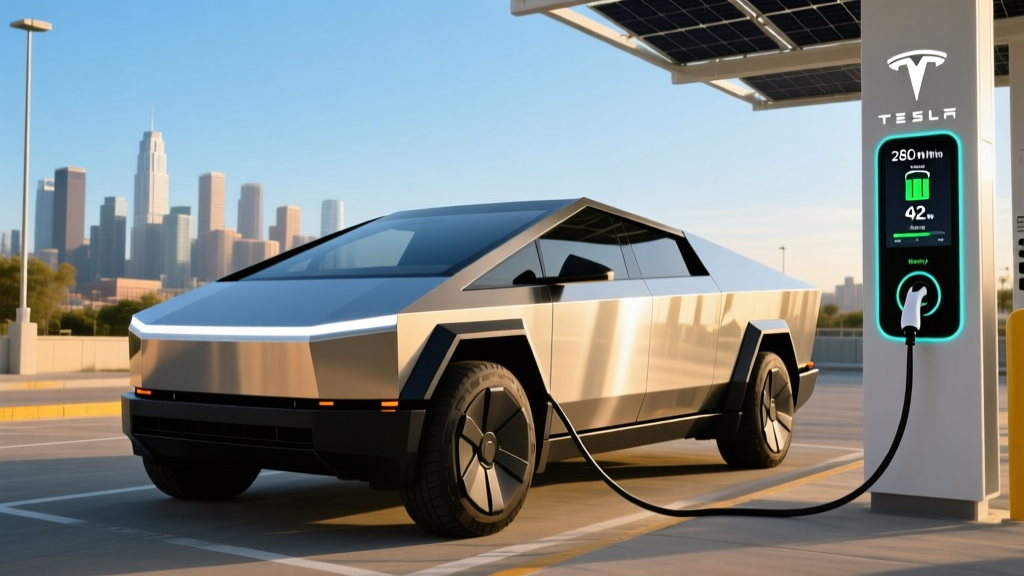
The Cybertruck peaks at 250 kW on DC fast chargers, but like every EV, that number is a momentary maximum, not a sustained average. The charge curve tapers significantly above 55% state of charge (SoC). In practice, the 10–80% session averages roughly 170 kW, meaning a 35-minute stop adds about 220 miles of range — enough for most road-trip legs but not class-leading.
For comparison, the Hyundai Ioniq 5 and Kia EV9 on 800V architectures sustain higher average rates and hit 10–80% in roughly 18 minutes at 350 kW chargers. The Cybertruck's 48-volt electrical architecture is innovative for vehicle systems, but the pack's charging C-rate is limited by its NMC chemistry and thermal management profile.
At home, a Wall Connector on a 60A circuit (48A continuous) delivers 11.5 kW, replenishing the pack from 20–80% overnight in about 6.5 hours. If your electrical panel supports only a 40A circuit (32A continuous), expect ~7.7 kW and roughly 30 mi/hr — still adequate for daily commuting but slower for back-to-back road trip days.
Performance and Drivetrain: The Numbers Behind the Smug
Whatever the Cybertruck memes say about its looks, the performance figures are difficult to mock. The Cyberbeast's tri-motor setup produces 845 horsepower and rockets to 60 mph in 2.6 seconds — faster than a Porsche 911 Turbo S. Even the base Long Range AWD hits 60 in 4.1 seconds, which is sports-car territory in a vehicle with an 11,000-lb towing rating.
The steer-by-wire system, which eliminates the mechanical connection between the yoke and the front wheels, remains the most polarizing feature. At low speeds, the variable ratio makes parking-lot maneuvering absurdly easy — less than one full turn lock-to-lock. At highway speeds, the calibration firms up, but some drivers report a "video game" sensation that takes weeks to trust. Tesla's 2026 software updates have smoothed the transition between speed-dependent ratios, but it remains a love-it-or-return-it feature.
The 48-volt electrical architecture (replacing the industry-standard 12V) reduces wiring harness weight and enables higher-power accessories. The stainless-steel exoskeleton, meanwhile, is genuinely dent-resistant to minor impacts but shows fingerprints relentlessly and is far more expensive to repair after a collision than stamped aluminum or steel unibodies.
Pricing, Tax Credits, and Ownership Economics
| Trim | Base MSRP | §30D Credit Eligible? | Effective Price (if eligible) |
|---|---|---|---|
| Long Range AWD | $79,990 | No — exceeds $80,000 truck cap* | $79,990 |
| Dual Motor AWD | $84,990 | No — exceeds $80,000 truck cap | $84,990 |
| Cyberbeast | $104,990 | No — exceeds $80,000 truck cap | $104,990 |
*Under IRS §30D rules, the MSRP cap for trucks, SUVs, and vans is $80,000. As of the 2026 tax year, all Cybertruck trims exceed this threshold. Some buyers have attempted to classify the Long Range at $79,990 under the cap, but destination and mandatory fees push the final MSRP above $80,000 on the Monroney sticker, disqualifying it. Always verify with a tax professional and the IRS clean vehicle list.
Beyond the MSRP cap, §30D also imposes buyer income limits ($300,000 joint / $150,000 single for new vehicles) and battery critical-mineral and component sourcing requirements. Even if a trim were under the cap, these hurdles must all clear. The Cybertruck currently qualifies for zero federal purchase incentive at any trim level.
State incentives vary. Colorado, for example, may offer a separate state credit that does not mirror federal MSRP caps — check your state energy office for specifics.
Cargo, Interior, and Daily Practicality
The 6-foot bed (74.3 inches long) offers 67 cu ft of volume with the tonneau cover closed. The vault-style powered cover is genuinely useful — it's lockable, supports distributed weight up to 300 lbs, and integrates with the bed's 120V and 240V power outlets for job-site or camping use. The frunk adds 7.1 cu ft of sealed storage.
Interior space is adequate rather than generous. Rear legroom measures 38.1 inches — less than a Ford F-150 Lightning or Rivian R1T — and the upright seatback angle on long drives becomes a complaint from passengers over 6 feet. The 18.5-inch front touchscreen handles nearly all vehicle controls, including glove-box release and mirror adjustment, which is minimalist to the point of frustration for some buyers.
The yoke steering wheel, standard across all trims, remains the most debated interior choice. For drivers who hand-over-hand in parking lots, the yoke forces a relearning of muscle memory. Tesla offers a round wheel option on 2026 models at no additional cost, and most delivery specialists recommend it unless you are committed to the aesthetic.
Driver Assistance: Autopilot and FSD Supervised
Tesla's Autopilot (standard) provides adaptive cruise control and lane centering on divided highways. The optional Full Self-Driving (Supervised) package, priced at $8,000 or $99/month in 2026, adds automatic lane changes, traffic-light and stop-sign recognition, and city-street navigation assistance. FSD has improved measurably with the end-to-end neural network architecture introduced in v12, but it still requires active supervision and will make unexpected decisions in construction zones, unprotected left turns, and adverse weather.
The Cybertruck's sensor suite relies on Tesla Vision (cameras only, no LiDAR or radar). This approach works well in clear conditions but can degrade in heavy rain, fog, or when camera lenses are obscured by road grime — a more frequent issue with the Cybertruck's flat front fascia than with sloped-hood vehicles.
Warranty, Reliability, and the Stainless-Steel Question
Tesla covers the Cybertruck with a 4-year/50,000-mile basic warranty and an 8-year/120,000-mile battery and drive unit warranty. The battery warranty guarantees at least 70% capacity retention over the coverage period — consistent with industry norms for NMC packs.
Early-build (2024–2025) Cybertrucks experienced well-documented issues: accelerator pedal trim dislodging, steer-by-wire calibration faults, and tonneau cover seal failures. Tesla issued recalls and service campaigns for the most critical items. The 2026 production run has benefited from these corrections, but the stainless-steel body panels remain a wildcard for collision repair. Few body shops have the tooling or training to work with cold-rolled 30X stainless steel, and panel replacement rather than repair is often the only option after an impact — driving insurance costs higher than comparable aluminum-body trucks.
Verdict: Who Should Actually Buy a Cybertruck?
Pros
- Tri-motor Cyberbeast performance is unmatched in the truck segment
- 11,000-lb towing and 240V bed outlets for real job-site utility
- Stainless-steel exoskeleton resists dents and minor abrasions
- Tesla Supercharger network remains the most reliable DC fast-charging ecosystem
- 48V architecture and steer-by-wire are genuinely novel engineering
Cons
- No federal §30D tax credit eligibility at any trim
- Real-world highway range significantly below EPA sticker, especially while towing
- Rear seat comfort and legroom trail F-150 Lightning and Rivian R1T
- Insurance premiums among the highest in the EV truck class
- Stainless-steel collision repair is expensive and shop availability is limited
- Yoke steering and screen-dependent controls are polarizing
Choose a competitor if: You need maximum real-world range (Rivian R1T Dual-Motor Max offers ~352 EPA miles), a conventional steering wheel and physical controls (Ford F-150 Lightning), a lower purchase price with tax credit eligibility (Chevrolet Silverado EV under $80K trims), or proven long-term reliability data that a two-year-old nameplate cannot yet provide.
Frequently Asked Questions
What is the real-world range of the Cybertruck on a road trip?
On a 70-mph highway drive in moderate temperatures (60–80°F), expect 260–275 miles from the Dual Motor AWD before needing to charge, versus the 318-mile EPA sticker. In cold weather or while towing, that drops to 150–240 miles depending on conditions.
How fast does the Cybertruck charge at a Supercharger?
It peaks at 250 kW but averages ~170 kW over a 10–80% session, which takes approximately 35 minutes. This adds roughly 220 miles of range per stop.
Does the Cybertruck qualify for the $7,500 federal EV tax credit in 2026?
No. All three Cybertruck trims exceed the $80,000 MSRP cap for trucks under IRS §30D rules. Even the Long Range AWD at $79,990 base MSRP exceeds the cap once destination fees are included on the Monroney sticker.
Is the Cybertruck worth buying over the F-150 Lightning or Rivian R1T?
It depends on priorities. The F-150 Lightning offers a lower price, available tax credits on sub-$80K trims, better rear-seat comfort, and physical controls. The Rivian R1T offers more range (Max pack), a quad-motor option, and a conventional steering wheel. The Cybertruck wins on raw tri-motor performance, the Supercharger network, and stainless-steel durability — if you accept the trade-offs.
Is Tesla's Full Self-Driving actually self-driving?
No. FSD (Supervised) is an SAE Level 2 driver-assistance system. The driver must remain fully attentive, keep hands available, and be prepared to take over instantly. It is not autonomous driving.
Why are Cybertruck insurance rates so high?
Insurers factor in the 845-hp Cyberbeast's performance risk, the stainless-steel body's expensive collision-repair requirements (panel replacement over repair), and limited historical claims data. Expect annual premiums of $2,800–$3,500 depending on your state, age, and driving record — significantly more than a comparably priced F-150 Lightning.