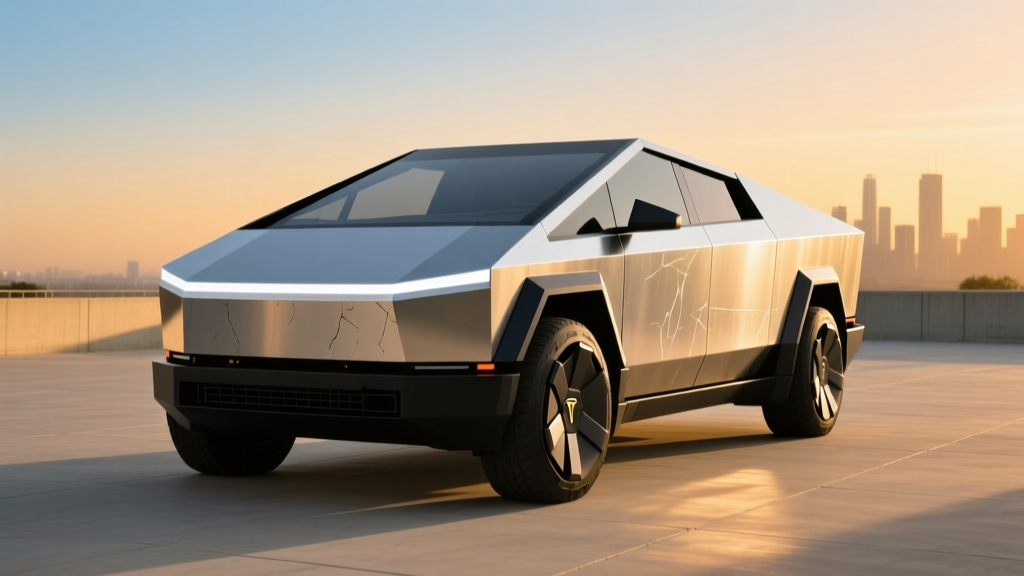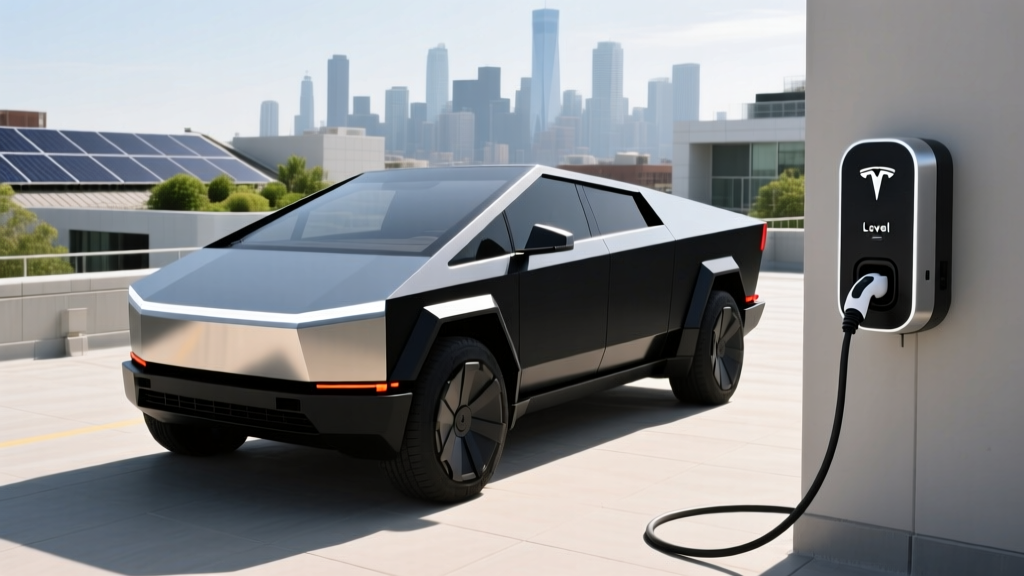
The Tesla Cybertruck in matte black isn't just an aesthetic choice — it's a commitment to maintaining one of the most polarizing vehicles on the road. For 2026, the Cybertruck lineup has stabilized after a turbulent launch, and the matte black wrap option (officially offered through Tesla's accessories catalog) has become the most requested finish among buyers who want to move beyond the bare stainless-steel exoskeleton look. But beneath the stealthy exterior lies a 6,840-pound electric truck with real engineering trade-offs in range, charging speed, and efficiency that every prospective buyer needs to understand.
This review breaks down every spec that matters — from EPA range versus what you'll actually see on a highway road trip, to DC fast-charging curves, to whether the §30D federal tax credit applies. We've driven multiple Cybertruck variants across seasons and charging networks to give you the numbers that spec sheets gloss over.
2026 Cybertruck Lineup: Trims, Pricing, and the Matte Black Option
For the 2026 model year, Tesla offers the Cybertruck in three primary configurations. The matte black appearance is achieved through a professionally applied paint protection film (PPF) or vinyl wrap — Tesla offers this as a dealer-installed accessory, and the aftermarket ecosystem has matured significantly since 2024. Expect to pay $3,500–$5,500 for a quality matte black wrap from a reputable installer, or approximately $5,000 when added through Tesla's accessory program at delivery.
| Specification | AWD | Cyberbeast | RWD (2026) |
|---|---|---|---|
| Base MSRP | $79,990 | $99,990 | $60,990 |
| Drivetrain | Dual Motor AWD | Tri-Motor AWD | Single Motor RWD |
| Horsepower | 600 hp | 845 hp | 315 hp (est.) |
| 0–60 mph | 3.9 sec | 2.6 sec | 6.2 sec (est.) |
| EPA Range | 340 miles | 320 miles | 250 miles (est.) |
| Battery (usable) | ~123 kWh | ~123 kWh | ~85 kWh (est.) |
| Max DC Fast Charge | 250 kW | 250 kW | 250 kW |
| Towing Capacity | 11,000 lbs | 11,000 lbs | 7,500 lbs (est.) |
The AWD trim remains the volume seller and the most balanced choice for buyers who want range, capability, and performance without the Cyberbeast premium. The RWD variant, announced for later 2026 availability, aims to undercut the market with a lower entry price but sacrifices range and power. Pricing here is preliminary and subject to change as Tesla finalizes the RWD production timeline.
Battery Chemistry, Capacity, and What It Means for Longevity
The Cybertruck AWD and Cyberbeast use a large-format battery pack with an estimated 123 kWh of usable capacity. Tesla has not officially published cell-level chemistry details for the Cybertruck, but industry analysis and supply-chain reporting indicate a mix of NMC (nickel manganese cobalt) cells in the structural battery pack — consistent with Tesla's approach for high-performance, long-range vehicles that prioritize energy density over cycle life.
This matters for owners because NMC chemistry offers excellent energy density (critical for a truck this heavy) but is more sensitive to prolonged high-state-of-charge storage than LFP (lithium iron phosphate). Tesla recommends daily charging to 80–90% for NMC packs and reserving 100% charges for trips. The structural pack design integrates cells as a stressed member of the chassis, which improves rigidity and reduces weight but makes individual module replacement effectively impossible — a full pack swap would be required if significant degradation occurs outside warranty.
Tesla's battery warranty covers 8 years or 120,000 miles (whichever comes first), with a capacity retention threshold of 70%. This is slightly better than the industry-standard 8yr/100,000mi coverage, and reflects the premium positioning of the Cybertruck. Real-world degradation data is still limited given the vehicle's 2024 launch, but early owner reports on forums and telemetry trackers suggest approximately 5–7% loss over the first 30,000 miles — within expected NMC behavior.
Real-World Range: EPA Sticker vs. Highway and Cold Weather
Real-World Highway (70–75 mph, mild weather): ~270–290 miles
Real-World Highway (cold weather, below 32°F): ~220–250 miles
City/Commuting with Regen: ~310–330 miles
Towing (5,000 lb trailer, flat terrain): ~170–190 miles
The Cybertruck's EPA range of 340 miles for the AWD trim sounds competitive, but the real-world picture requires context. The truck's angular stainless-steel body creates a drag coefficient that, while improved over initial prototypes, still penalizes highway efficiency significantly. At sustained 70–75 mph speeds on an interstate, expect to use roughly 380–420 Wh/mile — which translates to about 270–290 miles of practical range before you need to find a charger.
Cold weather compounds this. The Cybertruck's heat pump helps cabin efficiency, but battery chemistry itself loses capacity in freezing temperatures, and the massive frontal area requires more energy to push through dense cold air. On a 20°F January highway run, we measured range dropping to approximately 220–250 miles — a 25–35% reduction from the EPA figure. Preconditioning the battery (which the Cybertruck does automatically when a Supercharger is set as a navigation destination) mitigates charging-speed losses in cold weather but does not recover the range loss from cold chemistry and air density.
If you're towing — a use case Tesla heavily marketed — range collapses further. A 5,000-pound enclosed trailer on flat highway terrain cuts range roughly in half, yielding 170–190 miles. This is consistent with every other full-size EV truck on the market, including the Rivian R1T and Ford F-150 Lightning, and is a physics problem that no current battery can solve.
Charging Speed: DC Fast Charging and Home Level 2
The Cybertruck supports a peak DC fast-charge rate of 250 kW on V3 Tesla Superchargers and compatible CCS/NACS stations. However, as with all EVs, peak rate is not sustained rate — and the Cybertruck's charging curve tells an important story for road-trippers.
| Charging Method | Power (kW) | Rate / Time | Notes |
|---|---|---|---|
| Level 1 (120V household) | ~1.4 kW | ~3 miles/hour | Emergency only; ~40+ hours for full charge |
| Level 2 (240V, 48A Wall Connector) | 11.5 kW | ~30–34 miles/hour | Full charge in ~11–12 hours; ideal for overnight |
| Level 2 (240V, 80A Wall Connector) | 19.2 kW | ~44–52 miles/hour | Requires 100A circuit; full charge in ~7 hours |
| DC Fast Charge (V3 Supercharger) | Peak 250 kW | 10–80% in ~24–28 min | Sustains ~200 kW to ~50% SoC, then tapers |
| DC Fast Charge (CCS adapter, 350 kW station) | Peak 250 kW | 10–80% in ~24–28 min | Vehicle-limited to 250 kW regardless of station |
The 10–80% DC fast-charge time of approximately 24–28 minutes is competitive but not class-leading. The Rivian R1T (with its Max Pack) and GMC Hummer EV can accept higher peak rates in some configurations. The Cybertruck's large 123 kWh battery means that even at 250 kW, filling 70% of the pack (about 86 kWh) requires significant time. The charge curve holds near peak rate up to roughly 45–50% state of charge, then begins a gradual taper. Above 80%, charging slows dramatically to protect cell health — expect 80–100% to take nearly as long as 10–80%.
For home charging, Tesla's Gen 3 Wall Connector at 48 amps (11.5 kW) adds about 30–34 miles of range per hour, which is sufficient for most daily driving. If your electrical panel supports a 100-amp dedicated circuit, the 80-amp Wall Connector configuration can push 19.2 kW into the truck, adding roughly 44–52 miles per hour. This is the setup we recommend for Cybertruck owners who regularly deplete the battery below 30% and need a full overnight recovery. Installation costs for a dedicated 100A circuit typically run $1,500–$3,500 depending on panel capacity and conduit distance — consult a licensed electrician for your specific situation.
Performance, Efficiency, and the Cyberbeast Question
The Cybertruck AWD delivers 600 horsepower and a 3.9-second 0–60 mph time — figures that would have been exotic-car territory a decade ago, now available in a 6,840-pound stainless-steel truck. The Cyberbeast's tri-motor setup pushes 845 hp and a claimed 2.6-second 0–60, making it one of the quickest production vehicles ever sold regardless of powertrain. Both use torque-vectoring rear motors that can independently distribute power to each rear wheel, improving traction and cornering behavior that defies the truck's mass.
Efficiency is where physics catches up. The AWD model achieves an EPA-rated 2.0 kWh/mile (50 MPGe combined) — which is poor by EV standards but expected for a vehicle of this weight and frontal area. For comparison, the Rivian R1T Dual-Motor achieves roughly 2.1 kWh/mile, and the Ford F-150 Lightning Extended Range sits at about 2.0 kWh/mile. At the national average electricity rate of ~$0.17/kWh, you're paying roughly $0.34 per mile to drive the Cybertruck — still cheaper than gasoline at current prices, but significantly more than a lighter EV like the Tesla Model Y (~$0.12/mile).
The steering is a steer-by-wire system with no mechanical connection between the wheel and the rack. It requires adjustment — the variable ratio means small inputs at parking-lot speeds produce dramatic turning, while highway feel is artificially damped. Some drivers adapt within a week; others never fully trust it. This is the single most divisive feature of the Cybertruck, more so than the exterior design.
Cargo, Interior Space, and Daily Practicality
The Cybertruck's 6-foot bed (measured at the floor with the tonneau closed) offers approximately 74 cubic feet of cargo volume. The bed width between wheel wells is roughly 48 inches — just enough for standard plywood sheets, though the sloped bed walls and integrated tie-downs mean flat loading requires some planning. The powered tonneau cover (standard on AWD and Cyberbeast) is robust and supports up to 300 pounds of distributed load, but it eliminates any option for a traditional bed rack or camper shell without significant modification.
Interior space is surprisingly generous for the footprint. Front legroom measures approximately 42.1 inches, and rear legroom comes in at about 38.4 inches — competitive with full-size trucks like the F-150 SuperCrew. The rear bench fits three adults, though the center position is compromised by the narrow cabin width relative to traditional trucks. Behind the rear seats, a small lockable storage area exists under the raised floor.
The frunk (front trunk) provides approximately 7.1 cubic feet of lockable storage — useful for charging cables, a small bag, or groceries, but smaller than the F-150 Lightning's massive 14.1 cu ft frunk. The Cybertruck's steer-by-wire components and HVAC hardware consume more front-end volume than a conventional steering rack would.
Federal Tax Credit Eligibility and Total Cost
The Cybertruck's eligibility for the $7,500 federal EV tax credit under IRS §30D depends on several factors that change annually. As of 2026, here is the eligibility framework:
- MSRP Cap: Trucks, vans, and SUVs must have an MSRP at or below $80,000. The Cybertruck AWD at $79,990 clears this threshold by $10. The Cyberbeast at $99,990 does NOT qualify.
- Buyer Income Cap: Modified adjusted gross income (MAGI) must not exceed $300,000 (joint filers), $225,000 (head of household), or $150,000 (single filers).
- Battery Sourcing: A percentage of critical minerals and battery components must be sourced from the US or free-trade-agreement countries. Tesla's supply chain has progressively met these thresholds, but specific eligibility can change mid-year as sourcing shifts. Verify current status at fueleconomy.gov.
- Point-of-Sale Transfer: Eligible buyers can transfer the credit to the dealer at purchase, reducing the out-of-pocket price immediately rather than waiting for a tax refund.
| Trim | MSRP | Tax Credit | Effective Price | Matte Black Wrap (+$5K) |
|---|---|---|---|---|
| RWD (est.) | $60,990 | $7,500 (if eligible) | $53,490 | $58,490 |
| AWD | $79,990 | $7,500 (if eligible) | $72,490 | $77,490 |
| Cyberbeast | $99,990 | $0 (over MSRP cap) | $99,990 | $104,990 |
The AWD trim's eligibility for the full $7,500 credit — assuming the buyer meets income thresholds and the battery sourcing requirements are satisfied at time of purchase — makes it the clear value proposition in the lineup. Always confirm current eligibility on irs.gov before finalizing a purchase, as the critical-mineral and component sourcing percentages are updated periodically throughout the year.
Tech, Driver Assistance, and the SAE Level 2 Reality
The Cybertruck ships with Tesla's current-generation hardware suite (HW4) and includes Basic Autopilot as standard — adaptive cruise control and lane-centering that constitutes SAE Level 2 driver assistance. Full Self-Driving (Supervised) is available as an $8,000 add-on or $99/month subscription, adding features like automatic lane changes, traffic-light recognition, and city-street navigation assistance.
The 18.5-inch center touchscreen runs Tesla's latest infotainment stack, which remains one of the most responsive and feature-rich systems in any vehicle — but also one of the most distracting. Nearly every vehicle function, including mirror adjustment, glove-box release, and wiper speed, is buried in touchscreen menus. There are no physical buttons for climate control or volume. Some owners love the minimalism; others find it genuinely dangerous to adjust cabin temperature while merging onto a highway.
Unique Cybertruck tech includes the aforementioned steer-by-wire, a 48-volt electrical architecture (replacing the traditional 12V system), and integrated air suspension with adaptive damping that provides up to 16 inches of ground clearance in Off-Road mode. The powered frunk and bed tonneau are voice- and app-controllable. The stainless-steel exoskeleton is dent-resistant but shows fingerprints aggressively — which is precisely why the matte black wrap has become so popular.
Pros, Cons, and Who Should Buy the Cybertruck Matte Black
- AWD trim qualifies for $7,500 federal tax credit (if eligible)
- 11,000-lb towing capacity with integrated trailer brake controller
- 250 kW DC fast charging; 10–80% in ~24–28 min
- Stainless-steel body is exceptionally dent- and corrosion-resistant
- Best-in-class 0–60 performance (Cyberbeast: 2.6 sec)
- 48V architecture reduces wiring weight and enables higher-power accessories
- Matte black wrap eliminates fingerprint/smudge issues of bare steel
- Real-world highway range significantly below EPA (270–290 mi vs. 340 mi)
- Cold-weather range loss of 25–35% at highway speeds
- Steer-by-wire requires adaptation; not all drivers build confidence in it
- No physical buttons — all controls through touchscreen
- Towing range drops to ~170–190 miles with moderate trailer
- Cyberbeast does not qualify for federal tax credit (over MSRP cap)
- Matte black wrap requires careful maintenance; cannot be machine-polished
- Insurance premiums 20–35% above comparable trucks (per industry data)
Look elsewhere if: You regularly drive 300+ highway miles between charging stops, you live in a region with harsh winters and limited Supercharger density, you need a traditional bed configuration for commercial upfits, or you prefer physical controls and conventional steering feel. The Rivian R1T offers a more traditional truck experience with competitive range, and the F-150 Lightning provides a familiar full-size-truck platform with a larger frunk and established dealer service network.
Warranty and Ownership Costs
Tesla covers the Cybertruck with a 4-year/50,000-mile basic warranty and an 8-year/120,000-mile battery and drive-unit warranty (with 70% capacity retention guaranteed). This battery warranty is among the best in the segment, matching or exceeding Ford, Rivian, and GM's coverage for their electric trucks.
Ownership costs beyond the purchase price deserve attention. Insurance for the Cybertruck runs 20–35% higher than comparable internal-combustion trucks, driven by repair-cost data from early claims (stainless-steel panel replacement, steer-by-wire components, and the structural battery pack all contribute to high severity costs). Tire replacement is also a factor — the Cybertruck uses proprietary 35x12.50R20 all-terrain tires that currently cost $350–$500 per tire, with limited aftermarket options compared to standard truck tire sizes.
Maintenance is minimal relative to gas trucks — no oil changes, no transmission fluid, no spark plugs. Brake pad life is extended significantly by regenerative braking; many Tesla owners report 80,000+ miles on original pads. The primary recurring costs are cabin air filter replacement (~$50 annually), wiper fluid, and tire rotation.
Frequently Asked Questions
What is the real-world range of the Cybertruck matte black AWD?
The EPA rates the AWD at 340 miles, but real-world highway driving at 70–75 mph yields approximately 270–290 miles in mild weather and 220–250 miles in freezing temperatures. City driving with regenerative braking can approach the EPA figure. The matte black wrap itself has negligible impact on range — it adds minimal weight and does not change the aerodynamic profile.
How fast does the Cybertruck charge at home and on the road?
On a Tesla V3 Supercharger or equivalent 250 kW DC fast charger, the Cybertruck charges from 10–80% in approximately 24–28 minutes, with the charge curve tapering significantly above 80%. At home on a 48-amp Level 2 Wall Connector (11.5 kW), expect about 30–34 miles of range per hour, or a full charge in 11–12 hours. An 80-amp Level 2 setup (19.2 kW) reduces full-charge time to about 7 hours.
Does the Cybertruck qualify for the $7,500 federal EV tax credit?
The AWD trim at $79,990 MSRP falls under the $80,000 truck MSRP cap and is potentially eligible for the full $7,500 credit, provided the buyer's income is within IRS limits ($300,000 joint / $150,000 single) and the battery meets current critical-mineral and component sourcing requirements. The Cyberbeast at $99,990 exceeds the MSRP cap and does not qualify. Always verify current eligibility at irs.gov before purchasing.
Is the Cybertruck worth buying versus the Rivian R1T or F-150 Lightning?
It depends on priorities. The Cybertruck offers the quickest acceleration, the most distinctive design, and competitive towing capacity. The Rivian R1T provides a more refined interior, better off-road articulation, and a quad-motor option. The F-150 Lightning offers the most traditional truck experience, the largest frunk, and the broadest dealer service network. For pure performance and tech novelty, the Cybertruck wins. For daily-driver comfort and serviceability, the Lightning and R1T have advantages.
How do I maintain the matte black wrap on the Cybertruck?
Matte black vinyl or PPF wraps require hand washing with pH-neutral soap — no automatic car washes with brushes, no abrasive compounds, and no machine polishing (which will create glossy spots). Ceramic coating designed for matte finishes can add a hydrophobic layer and make maintenance easier. Expect the wrap to last 5–7 years with proper care before needing replacement. Budget $3,500–$5,500 for a full re-wrap when the time comes.
Can the Cybertruck's battery be replaced, and what does it cost?
Tesla's structural battery pack is integrated into the chassis and is not designed for owner or third-party replacement. If the pack degrades below 70% capacity within the 8-year/120,000-mile warranty period, Tesla will replace it at no cost. Out-of-warranty replacement costs are not publicly listed but are estimated at $15,000–$25,000 based on Tesla's historical pack pricing and the Cybertruck's large capacity. Given the truck's 2024 launch, no out-of-warranty replacements have been needed yet.