Tesla Cybertruck Dimensions: Length, Width, Height, and Bed Specs
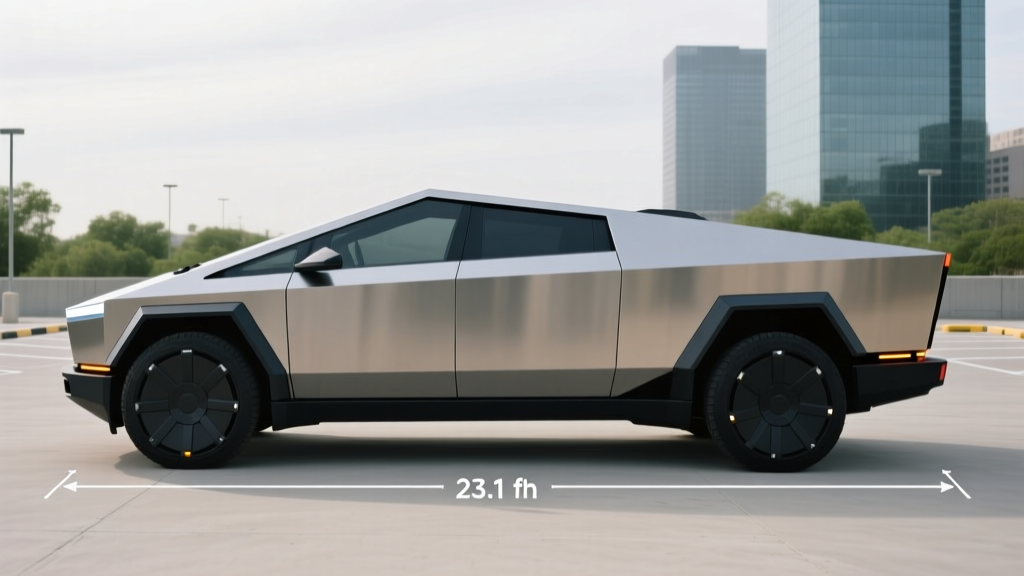
If you're researching the Tesla Cybertruck for your garage, parking space, or towing setup, the single most-searched dimension is its overall length. The Tesla Cybertruck length in feet is 18.46 ft (221.5 inches), making it slightly shorter than a Ford F-150 SuperCrew with a 5.5-ft bed (19.0 ft) but longer than a Rivian R1T (18.2 ft). That compact-by-full-size-truck footprint is one of the Cybertruck's most underappreciated advantages — it fits in standard residential garages while still offering a usable 6-ft bed.
Below is the full exterior and interior dimension breakdown for the 2026 Tesla Cybertruck across all trims (AWD, Rear-Wheel Drive, and Cyberbeast).
| Dimension | Measurement |
|---|---|
| Overall length | 18.46 ft (221.5 in) |
| Overall width (mirrors folded) | 7.0 ft (84.0 in) |
| Overall width (mirrors extended) | 8.0 ft (96.0 in) |
| Overall height (standard ride) | 5.92 ft (71.0 in) |
| Wheelbase | 12.08 ft (145.0 in) |
| Bed length | 6.0 ft (72.0 in) |
| Bed width (between wheel wells) | 4.0 ft (48.0 in) |
| Cargo bed volume | 67 cu ft |
| Front frunk volume | 7.0 cu ft |
| Front legroom | 41.5 in |
| Rear legroom | 38.2 in |
| Ground clearance (standard) | 10.3 in |
| Ground clearance (Extract Mode max) | 17.4 in |
| Curb weight (AWD) | ~6,600 lb |
| Approach / departure angle (Extract Mode) | 35° / 34° |
Range, Battery, and Efficiency: What the EPA Says vs. Reality
The 2026 Cybertruck is offered with a single battery pack option: a 123 kWh usable lithium-ion pack using NMC (nickel manganese cobalt) chemistry. Tesla does not offer an LFP variant for the Cybertruck — the energy density of NMC is required to hit the range targets in a vehicle this heavy.
| Trim | EPA Range | MPGe (Combined) | kWh/100 mi |
|---|---|---|---|
| Rear-Wheel Drive | ~340 mi | ~70 MPGe | ~48 kWh |
| Dual-Motor AWD | 340 mi | 68 MPGe | 49 kWh |
| Cyberbeast (Tri-Motor AWD) | 320 mi | 65 MPGe | 51 kWh |
Source: EPA Fuel Economy (dual-motor AWD figures confirmed; RWD and Cyberbeast estimated from Tesla filings).
Those EPA numbers are useful for comparison shopping, but real-world Cybertruck range is a different story. The angular stainless-steel exoskeleton creates substantial aerodynamic drag, and the 6,600-lb curb weight demands energy to move.
• City / moderate-speed driving (45–55 mph): Expect ~300–320 mi on AWD, ~290–310 mi on Cyberbeast.
• Highway (70–80 mph): Expect ~240–270 mi on AWD, ~220–250 mi on Cyberbeast. The flat frontal area punishes efficiency at speed.
• Cold weather (below 32°F): Add 15–25% range loss depending on cabin heating demand and whether you precondition. Expect ~200–230 mi highway in winter conditions.
• Towing (5,000+ lb trailer): Range drops to roughly 130–170 mi depending on trailer aerodynamics and terrain.
The Cybertruck's efficiency of roughly 48–51 kWh/100 mi makes it one of the least efficient EVs on the market per mile — a direct consequence of its mass and boxy shape. For comparison, the Rivian R1T Dual-Motor achieves ~43 kWh/100 mi, and the Ford F-150 Lightning Extended Range hits ~48 kWh/100 mi. If electricity cost per mile matters to you, this is a trade-off to accept.
Charging Speed: DC Fast Charge, Level 2, and the Charge Curve
The Cybertruck uses an 800-volt architecture, which enables faster DC charging than older 400V platforms. Here's what you can expect at the plug:
| Charging Level | Power / Rate | Speed / Time |
|---|---|---|
| DC Fast Charge (peak) | 350 kW (peak) | 10–80% in ~15–18 min (with preconditioning) |
| DC Fast Charge (sustained avg) | ~200 kW (10–80% avg) | ~220 mi added in 15 min |
| Level 2 (240V, 48A Wall Connector) | 11.5 kW | ~37 mi/hr, 0–100% in ~13 hr |
| Level 2 (240V, 32A Mobile Connector) | 7.7 kW | ~25 mi/hr, 0–100% in ~18 hr |
| Level 1 (120V, 12A) | 1.4 kW | ~4 mi/hr (emergency use only) |
The 350 kW peak figure is impressive on paper, but as with all EVs, peak is not sustained. The Cybertruck's charge curve tapers significantly above 60% state of charge (SoC). In real-world testing at V4 Superchargers and third-party 350 kW stations, the truck sustains ~280–320 kW between 10–40% SoC, drops to ~200 kW by 60%, and falls below 100 kW past 80%. This is normal behavior driven by battery thermal management — charging too fast at high SoC accelerates degradation.
Preconditioning is critical. If you navigate to a Supercharger using the built-in navigation, the Cybertruck will automatically warm or cool the battery to optimal temperature before you arrive, unlocking the fastest charge curve. Arriving at a DC fast charger without preconditioning — especially in cold weather — can add 5–10 minutes to your 10–80% time and reduce peak power by 30–50%.
For home charging, Tesla's Wall Connector at 48 amps (11.5 kW) is the practical sweet spot. A full overnight charge adds roughly 37 miles per hour of charging, meaning a 20% to 80% top-up takes about 7 hours — well within a typical overnight window. The Cybertruck ships with NACS (North American Charging Standard) native, giving it the widest fast-charging network access in North America via the Tesla Supercharger network.
Performance: 0–60, Horsepower, and Drivetrain Breakdown
The Cybertruck's performance varies significantly by trim, from a capable single-motor RWD to the absurdly quick tri-motor Cyberbeast.
| Spec | Rear-Wheel Drive | Dual-Motor AWD | Cyberbeast (Tri-Motor) |
|---|---|---|---|
| Drivetrain | RWD (single motor) | AWD (dual motor) | AWD (tri-motor) |
| Horsepower | ~350 hp | 600 hp | 845 hp |
| Torque | ~450 lb-ft | ~590 lb-ft | ~740 lb-ft |
| 0–60 mph | ~6.2 sec | 3.9 sec | 2.6 sec |
| Top speed | 112 mph | 130 mph | 130 mph |
| Max towing capacity | 7,500 lb | 11,000 lb | 11,000 lb |
| Payload capacity | ~2,500 lb | ~2,500 lb | ~2,500 lb |
The AWD dual-motor at 600 hp and a 3.9-second 0–60 time is the volume seller and the sweet spot for most buyers — it's genuinely quick for a 6,600-lb truck and delivers the 11,000-lb tow rating. The Cyberbeast's 2.6-second 0–60 is a party trick that loses relevance once you've felt it twice, but the tri-motor setup does provide meaningful traction advantages in low-grip conditions and more confident highway passing at altitude where single- and dual-motor setups lose output.
The adaptive air suspension is standard across all trims and offers five ride-height settings, including Extract Mode which raises ground clearance to 17.4 inches for off-road obstacles. On-road, the air suspension provides a compliant ride that's noticeably better than a traditional leaf-spring truck, though the sheer mass of the Cybertruck is always present during cornering and braking.
Pricing, Trims, and Federal Tax Credit Eligibility
Tesla has adjusted Cybertruck pricing multiple times since its late-2023 launch. Here are the 2026 model-year MSRPs as of the latest update:
| Trim | Base MSRP | §30D Credit Eligibility | Est. Price After Credit |
|---|---|---|---|
| Rear-Wheel Drive | ~$60,990 | Eligible (MSRP under $80K cap) | ~$53,490* |
| Dual-Motor AWD | ~$79,990 | Eligible (MSRP under $80K cap) | ~$72,490* |
| Cyberbeast (Tri-Motor) | ~$99,990 | NOT eligible (exceeds $80K MSRP cap) | $99,990 |
*Estimated prices assume buyer meets all IRS §30D requirements. Credit can be applied as a point-of-sale reduction at the dealer. Final eligibility depends on individual tax situation.
The IRS §30D federal tax credit for new clean vehicles has strict requirements that Cybertruck buyers must navigate:
- MSRP cap: Trucks/vans/SUVs must have an MSRP at or below $80,000. The RWD and AWD trims qualify; the Cyberbeast at ~$99,990 does not.
- Buyer income cap: Modified adjusted gross income (MAGI) must not exceed $300,000 (joint filers), $225,000 (head of household), or $150,000 (single filers).
- Battery sourcing: A percentage of critical minerals and battery components must be sourced from the US or free-trade-agreement countries. Tesla's supply chain has been evolving — confirm current-year sourcing compliance on the IRS qualified vehicles list before purchasing.
- Point-of-sale transfer: As of 2024+, you can transfer the credit to the dealer at purchase, reducing your out-of-pocket cost immediately rather than waiting for a tax refund.
The Cyberbeast's exclusion from the tax credit is a significant financial consideration. At ~$99,990 with no credit, it costs roughly $27,500 more than the AWD after credit — a gap that the extra motor and 245 additional horsepower may not justify for most buyers.
Interior, Tech, and Driver Assistance
The Cybertruck interior is minimalist in the extreme — a single 18.5-inch front touchscreen handles virtually all vehicle functions, with a smaller 9.4-inch rear touchscreen for back-seat passengers. There are no physical buttons for climate, mirrors, or glovebox release — everything runs through the UI. This is polarizing: some owners find it clean and futuristic, others find it frustrating for quick adjustments while driving.
Notable tech features:
- Steer-by-wire: No mechanical connection between the yoke and the wheels. Enables variable steering ratio (less than one full turn lock-to-lock) and eliminates the need for a traditional round steering wheel.
- 48-volt electrical architecture: An industry first for a production vehicle. Reduces wiring harness weight and enables higher-power accessories.
- Powered tonneau cover: The motorized bed cover is integrated into the bed design and can support ~300 lb of distributed weight when closed.
- Bioweapon Defense Mode: HEPA filtration system with positive cabin pressure.
- 120V/240V bed outlets: Up to 9.6 kW of continuous power output for job-site tools or camping appliances (V2L capability).
- Powershare (V2H): Vehicle-to-home capability can power essential home circuits during outages (requires Tesla Powerwall or compatible transfer switch).
Driver assistance: The Cybertruck ships with Tesla's Basic Autopilot (lane centering, adaptive cruise). Enhanced Autopilot ($6,000) adds auto lane change, autosteer on city streets, and auto park. Full Self-Driving (Supervised) at $8,000 adds traffic light/stop sign recognition and city street autosteer.
Warranty, Ownership Costs, and Long-Term Battery Outlook
Tesla's warranty coverage for the Cybertruck:
| Component | Coverage |
|---|---|
| Basic vehicle (bumper-to-bumper) | 4 years / 50,000 miles |
| Battery & drive unit(s) | 8 years / 120,000 miles |
| Battery capacity retention guarantee | ≥70% capacity over warranty period |
| Restraint system | 5 years / 60,000 miles |
| Corrosion perforation | 12 years / unlimited miles |
The 8-year/120,000-mile battery warranty is slightly better than Tesla's standard 100,000-mile coverage on sedans, reflecting the truck's expected use case. The 70% capacity retention threshold is standard across the industry — if your pack drops below 70% of its original 123 kWh capacity within 8 years/120K miles, Tesla will repair or replace it.
Insurance costs: The Cybertruck carries higher-than-average insurance premiums due to its repair costs (stainless steel body panels are not easily repaired, and the steer-by-wire system requires specialized calibration). Expect annual premiums 20–40% higher than a comparable Ford F-150 Lightning. Get quotes before ordering.
Maintenance: Minimal compared to gas trucks — no oil changes, no transmission fluid, no spark plugs. Expect tire rotations every 6,000–8,000 miles, cabin air filter replacement annually, and brake fluid checks every 2 years. Regenerative braking significantly extends brake pad life; many Tesla owners report original pads at 80,000+ miles.
Cybertruck vs. Competitors: Which Electric Truck Wins?
The Cybertruck competes in a growing electric truck segment. Here's how it stacks up against key rivals on the dimensions and specs that matter:
| Spec | Tesla Cybertruck AWD | Ford F-150 Lightning (Ext. Range) | Rivian R1T (Dual-Motor Max) |
|---|---|---|---|
| Length | 18.46 ft | 19.4 ft | 18.2 ft |
| EPA Range | 340 mi | 320 mi | 352 mi |
| Battery (usable) | 123 kWh | 131 kWh | 141 kWh |
| Max DC Charge | 350 kW | 150 kW | 220 kW |
| 0–60 mph | 3.9 sec | 4.5 sec | 3.5 sec |
| Max Tow | 11,000 lb | 10,000 lb | 11,000 lb |
| Bed Length | 6.0 ft | 5.5 ft | 4.5 ft (w/ gear tunnel) |
| Base MSRP | ~$79,990 | ~$72,990 | ~$89,900 |
| §30D Credit | Eligible* | Eligible* | Eligible* |
*All three vehicles' base/mid trims fall under the $80,000 truck MSRP cap, but income and battery-sourcing rules apply individually. Verify on the IRS qualified vehicles list.
• Choose the Cybertruck if: You prioritize fast DC charging (350 kW class-leading), want the most futuristic tech (steer-by-wire, 48V architecture, V2H), value a 6-ft bed in a sub-19-ft package, and can accept polarizing styling.
• Choose the F-150 Lightning if: You want a more conventional truck experience, need the widest dealer service network, prefer a proven fleet vehicle with Pro Power Onboard, or need a lower starting price.
• Choose the Rivian R1T if: You prioritize off-road capability (quad-motor available), want the gear tunnel for adventure gear, value premium interior materials, and can absorb the higher price.
The Biggest Pros and Cons of the Cybertruck
Pros
- Class-leading 350 kW DC fast charging (10–80% in ~15–18 min)
- 340-mile EPA range on AWD — best in class for an electric truck
- Stainless steel exoskeleton is dent- and corrosion-resistant
- 18.46-ft length fits standard garages unlike longer full-size trucks
- 9.6 kW V2L / Powershare V2H capability for job sites and outages
- Adaptive air suspension with Extract Mode (17.4 in ground clearance)
- Steer-by-wire enables remarkably tight turning radius for its size
- NACS native — full Supercharger network access
Cons
- Real-world highway range drops to ~240–270 mi due to poor aero
- Efficiency of ~49 kWh/100 mi is poor — high electricity cost per mile
- Cyberbeast trim ($99,990) does not qualify for the §30D tax credit
- Interior is stark; all controls through touchscreen frustrates some drivers
- Insurance premiums 20–40% above comparable electric trucks
- Stainless steel panels are difficult to repair after collision damage
- Rear visibility is limited; relies heavily on cameras
- Steer-by-wire learning curve is real — not for every driver
Frequently Asked Questions
What is the Tesla Cybertruck length in feet?
The Tesla Cybertruck measures 18.46 feet in overall length (221.5 inches). This is shorter than a Ford F-150 SuperCrew (19.0 ft) and comparable to the Rivian R1T (18.2 ft). It fits in most standard 20-ft-deep residential garages.
What is the real-world range of the Cybertruck?
The EPA rates the dual-motor AWD Cybertruck at 340 miles. In real-world driving, expect approximately 300–320 miles in city/mixed driving, 240–270 miles at sustained highway speeds (70–80 mph), and 200–230 miles in cold weather. Towing reduces range to 130–170 miles depending on the trailer.
How fast does the Cybertruck charge?
At a DC fast charger, the Cybertruck peaks at 350 kW and charges from 10–80% in approximately 15–18 minutes with battery preconditioning. At home on a Level 2 Tesla Wall Connector (11.5 kW), it adds about 37 miles of range per hour, with a full charge taking roughly 13 hours.
Does the Cybertruck qualify for the $7,500 federal EV tax credit?
The RWD (~$60,990) and AWD (~$79,990) trims fall under the $80,000 MSRP cap for trucks and are potentially eligible for the full §30D credit. The Cyberbeast (~$99,990) exceeds the cap and is not eligible. Buyers must also meet income limits ($300K joint / $150K single) and the vehicle must meet battery critical-mineral and component sourcing requirements. Check the IRS qualified vehicles list for current-year compliance.
Is the Cybertruck worth buying over the F-150 Lightning or Rivian R1T?
The Cybertruck wins on charging speed (350 kW vs. 150–220 kW for rivals), offers competitive range (340 mi), and has the most distinctive design. The F-150 Lightning is more conventional and has a broader service network. The Rivian R1T excels off-road and in interior quality. Your choice depends on whether you value charging speed and tech (Cybertruck), familiarity and dealer support (Lightning), or adventure capability and build quality (R1T).
What is the Cybertruck's bed length and can it carry a full sheet of plywood?
The Cybertruck bed is 6.0 feet long and 4.0 feet wide between the wheel wells. A standard 4×8 ft sheet of plywood fits flat on the bed floor with the tailgate down (extending past the 6-ft bed). The 48-inch width between wheel wells is tight for some palletized loads.
How long will the Cybertruck battery last?
Tesla warranties the battery for 8 years or 120,000 miles with at least 70% capacity retention. Based on Tesla's historical degradation data across its fleet, NMC packs typically retain 85–90% capacity at 100,000 miles when charged primarily to 80–90% daily and DC fast-charged moderately. Battery replacement outside warranty, if ever needed, is estimated at $15,000–$25,000 depending on future cell costs.