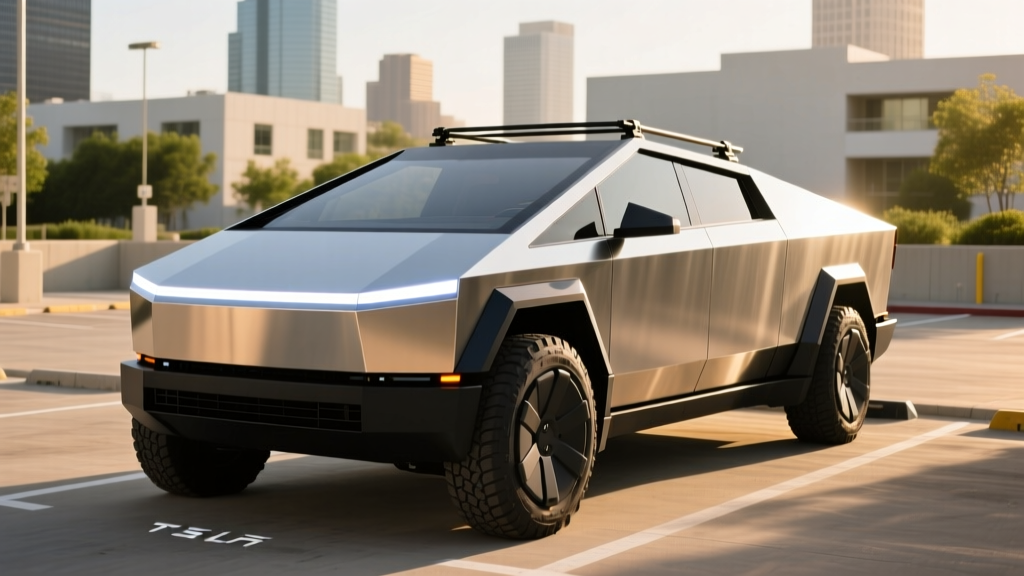
The Cybertruck Lease Landscape in 2026
If you've been watching Tesla's angular electric pickup from the sidelines, 2026 is the first year where Cybertruck lease deals have become genuinely accessible. After a turbulent 2024 launch marked by delivery delays, limited trims, and a controversial "Foundation Series" markup, Tesla has normalized production and expanded its leasing program to all three Cybertruck trims. Monthly payments now start in the mid-$700s for well-qualified lessees — a significant drop from the $1,000+ quotes early adopters faced.
But leasing a Cybertruck isn't the same as leasing a conventional truck or even a mainstream EV. The stainless-steel body, steer-by-wire system, 48-volt architecture, and Tesla's closed insurance ecosystem create ownership dynamics that make leasing particularly attractive — and in some cases, strategically smarter than buying. Here's everything you need to evaluate before signing.
2026 Cybertruck Specs: Range, Battery, and Efficiency
| Spec | Long Range AWD | Cyberbeast (Tri-Motor) |
|---|---|---|
| EPA Range | 340 miles | 320 miles |
| Battery Capacity (usable) | ~123 kWh (NMC) | ~123 kWh (NMC) |
| Efficiency | 56 MPGe / 36 kWh/100mi (est.) | 53 MPGe / 38 kWh/100mi (est.) |
| 0-60 mph | 3.9 seconds | 2.6 seconds |
| Horsepower | 600 hp | 845 hp |
| Drivetrain | Dual-motor AWD | Tri-motor AWD |
| Towing Capacity | 11,000 lbs | 11,000 lbs |
| Payload | 2,500 lbs | 2,500 lbs |
| Bed Length | 6 ft (vault) | 6 ft (vault) |
| Cargo Volume (bed + frunk) | ~67 cu ft bed + 7 cu ft frunk | ~67 cu ft bed + 7 cu ft frunk |
| Base MSRP | $79,990 | $99,990 |
Tesla uses an NMC (nickel manganese cobalt) battery pack in the Cybertruck, which offers high energy density necessary for a vehicle this heavy. Unlike the LFP chemistry found in the Model 3 RWD, NMC cells are more sensitive to sustained 100% state of charge — Tesla recommends daily charging to 80-90% and reserving 100% for road trips. The usable capacity is approximately 123 kWh, making it one of the largest battery packs in any consumer vehicle on the road.
Charging Speed: DC Fast Charging and Home Setup
| Charging Method | Power | Speed / Time |
|---|---|---|
| DC Fast Charge (peak) | 250 kW (V3 Supercharger) | 10-80% in ~30 minutes |
| DC Fast Charge (V4 Supercharger) | Up to 350 kW | 10-80% in ~22 minutes (est.) |
| Home Level 2 (Wall Connector) | 11.5 kW (48A) | ~30 miles per hour of charging |
| Home Level 2 (NEMA 14-50) | 7.7 kW (32A) | ~20 miles per hour of charging |
| Level 1 (120V standard outlet) | ~1.4 kW | ~3-4 miles per hour |
The Cybertruck charges at a peak rate of 250 kW on Tesla's widespread V3 Supercharger network, which translates to a 10-80% session in roughly 30 minutes. On newer V4 Supercharger cabinets being deployed through 2025-2026, the Cybertruck can accept up to 350 kW, though sustained rates taper significantly above 60% state of charge — expect the second half of the charge to take nearly as long as the first. This is a function of battery physics, not a Tesla limitation specifically; large packs like the Cybertruck's take longer to fill than smaller sedan packs even at equivalent kW rates.
For home charging, Tesla's Wall Connector on a 60-amp circuit delivers 11.5 kW, adding roughly 30 miles of range per hour. An overnight 10-hour charge easily replenishes 250+ miles — more than enough for most daily use. If your electrical panel supports only a 50-amp circuit (NEMA 14-50), you'll get about 20 miles per hour at 7.7 kW, which is still sufficient for most commuters driving under 80 miles round-trip daily.
Lease Pricing vs. Purchase: 2026 Numbers
Here's where the Cybertruck lease story gets interesting for 2026. Tesla's leasing program, offered directly through Tesla Financial Services, has become more competitive as production has stabilized and the initial demand frenzy has cooled.
| Cost Factor | Long Range AWD | Cyberbeast |
|---|---|---|
| Base MSRP | $79,990 | $99,990 |
| Estimated Lease (36 mo / 10k mi/yr) | ~$799-$899/mo | ~$1,049-$1,199/mo |
| Money Down (typical) | $5,000-$7,500 | $7,500-$10,000 |
| Federal Tax Credit (§30D) | Not applicable on leases* | Not applicable on leases* |
| Tesla Lease-End Purchase Option | Available (residual ~55-60%) | Available (residual ~50-55%) |
*Under current IRS §30D rules, the $7,500 federal clean vehicle credit applies only to purchases, not leases. However, some lessors may pass through a commercial clean vehicle credit (§45W) benefit as a capitalized-cost reduction — ask Tesla Financial directly whether any lease incentive is being applied to your deal.
For buyers, the §30D credit has strict requirements: modified adjusted gross income caps ($300,000 joint / $150,000 single), vehicle MSRP caps (trucks: $80,000), and battery-sourcing/critical-minerals requirements that change annually. The Long Range AWD at $79,990 squeaks under the truck MSRP cap, but the Cyberbeast at $99,990 exceeds it entirely — making it ineligible for the federal credit regardless of your income. Battery-sourcing rules for 2026 further restrict eligibility; always verify current-year requirements on IRS.gov before counting on the credit.
This MSRP-cap situation is precisely why leasing gains an edge for the Cyberbeast. Lease payments are based on the vehicle's depreciation curve rather than its sticker price, and you avoid the purchase credit disqualification entirely. You also sidestep Tesla's notoriously volatile resale-value risk — stainless-steel bodies and steer-by-wire are unproven in the long-term used market.
Who Should Lease the Cybertruck (And Who Shouldn't)
- You want the Cyberbeast trim (MSRP exceeds the §30D $80K truck cap for purchase)
- You're uncertain about long-term reliability of steer-by-wire and 48V architecture
- You plan to drive 10,000-15,000 miles per year (within standard lease limits)
- You want to avoid depreciation risk on a polarizing, first-generation design
- You have home Level 2 charging and a daily commute under 100 miles round-trip
- You qualify for the §30D credit on the Long Range AWD (income + sourcing requirements met)
- You drive over 15,000 miles per year (lease overage penalties are steep at ~$0.25/mi)
- You plan to tow regularly and put heavy commercial use on the truck
- You want to modify the vehicle (lift kits, wraps, aftermarket racks — leases restrict this)
- You plan to keep it 7+ years and ride out the depreciation curve
The Cybertruck excels as a daily-driver commuter truck with occasional towing and hauling needs. Its 11,000-lb towing capacity and 2,500-lb payload are legitimate, but towing at capacity will slash range by 40-50% — plan for 150-170 miles between Supercharger stops when pulling a heavy trailer. For road trips without a trailer, the Supercharger network makes the Cybertruck one of the most practical EVs for long-distance travel, despite its size.
Where it falls short: the rear seat, while spacious in legroom (approximately 41 inches), has a relatively upright seatback that compromises long-distance comfort. The bed vault is only 6 feet long, shorter than a standard full-size truck bed. And the stainless-steel exoskeleton, while dent-resistant, shows fingerprints aggressively and requires specific cleaning products to maintain its appearance.
Technology, Driver Assistance, and Standout Features
The Cybertruck runs Tesla's latest hardware suite with AI5 processing for Autopilot and Full Self-Driving (Supervised). It's critical to understand that FSD is an SAE Level 2 driver-assistance system — you must remain fully engaged, hands on the yoke, eyes on the road. This is not self-driving. The system handles highway lane-keeping, adaptive cruise, and some city-street navigation impressively well, but requires constant supervision.
Unique Cybertruck technology includes:
- Steer-by-wire: No physical connection between the yoke and wheels. Enables variable steering ratios — roughly 340° lock-to-lock at low speeds, reducing to under 180° at highway speed. The learning curve is real but brief; most drivers adapt within a few days.
- 48-volt electrical architecture: Replaces the traditional 12V system, reducing wiring harness weight by ~70% and enabling higher-power accessories. Industry-first in a production vehicle.
- Adaptive air suspension: Up to 17 inches of ground clearance in Extract Mode, lowering for highway efficiency. Approach/departure angles rival dedicated off-road trucks.
- 18.5-inch front touchscreen + 9.4-inch rear screen: Runs Tesla's latest UI with integrated navigation, streaming, and vehicle controls.
- Bioweapon Defense Mode: HEPA filtration system carried over from Model S/X.
- Powershare: Up to 11.5 kW of vehicle-to-load (V2L) power output — enough to run power tools at a job site or essential home circuits during an outage.
Notable drawbacks: the yoke steering is controversial and not adjustable to a traditional round wheel. Visibility is compromised by the angular A-pillars and small rear window — the digital rearview camera mirror is mandatory. Panel gap consistency has improved since 2024 but still draws scrutiny. And at nearly 6,800 lbs, tire wear and replacement costs are significant — expect $400-600 per tire for the specialized 35-inch all-terrains.
Warranty Coverage
Tesla covers the Cybertruck with the following warranty structure:
- Basic Vehicle: 4 years / 50,000 miles
- Battery & Drive Unit: 8 years / 120,000 miles (whichever comes first), with minimum 70% capacity retention
- Restraint System: 5 years / 60,000 miles
- Corrosion: 12 years, unlimited miles (stainless body panels)
The 8-year/120,000-mile battery warranty is competitive and provides meaningful coverage through a standard lease term (typically 36-48 months). If battery degradation exceeds 30% within the warranty period, Tesla will replace or repair the pack. Given the large 123 kWh NMC pack, a full out-of-warranty replacement would be costly — likely $18,000-$25,000+ based on current cell pricing — making the warranty coverage essential.
Cybertruck vs. Key Competitors: Is It Worth It?
The Cybertruck doesn't compete in a traditional truck segment — it occupies its own category. But if you're cross-shopping electric pickups:
- Ford F-150 Lightning: More conventional truck experience, larger bed (5.5 ft box but more traditional shape), lower starting price (~$55,000), CCS charging. Less range (EPA 230-320 mi depending on pack), slower charging. Better for traditional truck buyers who want an EV.
- Rivian R1T: More refined interior, quad-motor option, better off-road capability, ~$70,000-$95,000. Smaller bed (4.5 ft). Better for adventure-oriented buyers who prioritize build quality and off-road chops.
- Chevrolet Silverado EV: Longer range option (up to EPA 440 mi on max pack), more traditional truck layout, available in fleet configurations. Starts ~$55,000-$80,000+. Better for range-priority buyers and fleet operators.
- Supercharger network access (most reliable DC fast-charging network in the US)
- Exceptional performance (2.6s 0-60 Cyberbeast) in a 6,800-lb truck
- Powershare V2L capability (11.5 kW) for job-site and backup power
- Stainless-steel body is dent- and corrosion-resistant
- Adaptive air suspension with up to 17" ground clearance
- Strong lease residuals reduce monthly payment vs. purchase depreciation risk
- Real-world highway range 15-20% below EPA estimates
- Cyberbeast MSRP exceeds §30D tax credit cap for purchase
- Steer-by-wire and yoke steering have a learning curve; no round-wheel option
- Bed is only 6 ft; shorter than full-size truck competitors
- Heavy tire wear; replacement tires are expensive and specialized
- Rear-seat comfort is adequate but not class-leading
- First-generation platform — long-term reliability of 48V architecture unproven
Frequently Asked Questions
What is the real-world range of the 2026 Cybertruck?
The EPA rates the Long Range AWD at 340 miles and the Cyberbeast at 320 miles. Real-world highway driving at 70 mph yields approximately 280-300 miles (Long Range) and 255-275 miles (Cyberbeast). Cold weather below 30°F can reduce range by 20-30%. Towing at capacity cuts range roughly in half.
How fast does the Cybertruck charge?
On a V3 Supercharger, the Cybertruck peaks at 250 kW and charges from 10-80% in approximately 30 minutes. On newer V4 cabinets, peak rates reach 350 kW with 10-80% in roughly 22 minutes. At home on a Level 2 Wall Connector (11.5 kW), expect about 30 miles of range added per hour of charging.
Does the Cybertruck qualify for the $7,500 federal EV tax credit?
It depends. The Long Range AWD at $79,990 is under the $80,000 MSRP cap for trucks, so it may qualify if you meet income requirements ($300K joint / $150K single) and the vehicle meets 2026 battery-sourcing and critical-minerals rules. The Cyberbeast at $99,990 exceeds the MSRP cap and does not qualify. Always check current rules on IRS.gov and consult a tax professional.
Is leasing the Cybertruck better than buying in 2026?
For the Cyberbeast, leasing avoids the §30D MSRP disqualification and protects you from depreciation risk on a first-generation platform. For the Long Range AWD, buying with the $7,500 tax credit (if eligible) may result in lower total cost over 3-5 years, especially if you drive over 12,000 miles annually. Lease if you want payment predictability and plan to upgrade in 3 years; buy if you'll keep the truck long-term and drive high mileage.
Can I charge a Cybertruck at non-Tesla charging stations?
Yes. The Cybertruck uses the NACS (North American Charging Standard) connector natively. As of 2025-2026, most major charging networks (Electrify America, EVgo, ChargePoint) have deployed NACS connectors or offer CCS-to-NACS adapters. Tesla also provides a CCS adapter for the Cybertruck, enabling access to virtually all public DC fast-charging stations.
What does Cybertruck insurance cost?
Insurance premiums for the Cybertruck are above average for the truck segment, typically $2,500-$4,000 annually depending on your location, driving record, and trim. Tesla offers its own insurance product in many states that uses real-time driving data to set premiums, which can be competitive for safe drivers. Get quotes from both Tesla Insurance and at least two traditional carriers before signing a lease.