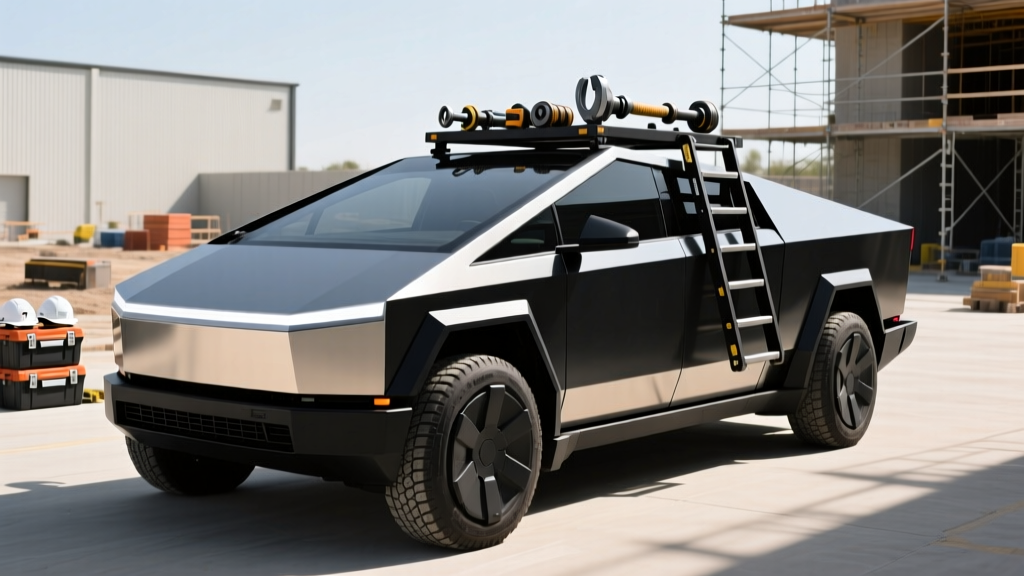
If you're a contractor, electrician, or fleet manager researching a Cybertruck ladder rack, you're likely asking a bigger question first: Can the Tesla Cybertruck actually serve as a daily work truck? Lumber racks, ladder racks, and bed-mounted utility systems add weight and aerodynamic drag — two factors that hit an electric vehicle's range harder than they do a gas truck's fuel economy. Before you bolt on a rack and head to the job site, you need hard numbers on range, towing, payload, and charging infrastructure.
This guide covers the 2026 Tesla Cybertruck lineup from a work-truck perspective, with the exact specs you need to decide whether it fits your fleet — or whether a Rivian R1T or Ford F-150 Lightning makes more sense for your use case.
2026 Cybertruck Trim Lineup and Key Specs
Tesla currently offers the Cybertruck in three main configurations for the 2026 model year. The entry-level Rear-Wheel-Drive (RWD) model is expected later in 2026, while the Dual Motor AWD and the high-performance Cyberbeast are available now. Here's what matters for work-truck duty:
| Spec | AWD (Dual Motor) | Cyberbeast (Tri-Motor) | RWD (Expected Late 2026) |
|---|---|---|---|
| EPA Range | 340 miles | 320 miles | ~250 miles (preliminary) |
| Battery (usable) | ~123 kWh, NMC | ~123 kWh, NMC | TBD (likely smaller pack) |
| Horsepower | 600 hp | 845 hp | TBD |
| 0–60 mph | 3.9 sec | 2.6 sec | TBD |
| Max Towing | 11,000 lbs | 11,000 lbs | TBD |
| Payload Capacity | 2,500 lbs | 2,500 lbs | TBD |
| Bed Length | 6 ft (72 in) | 6 ft (72 in) | 6 ft (72 in) |
| Base MSRP | $79,990 | $99,990 | ~$60,990 (preliminary) |
The stainless-steel exoskeleton and 6-foot composite bed are standard across trims. Tesla sells a bed-mounted crossbar system rated for dynamic loads, which serves as the base for third-party ladder racks from brands like Adarac, Yakima, and custom fabricators. The powered tonneau cover (standard on AWD and Cyberbeast) retracts under the bed floor and is compatible with most T-slot bed rail adapters.
Real-World Range: What Happens When You Load a Ladder Rack
EPA estimated range for the Cybertruck AWD is 340 miles. In real-world highway driving at 70–75 mph, expect approximately 260–290 miles unloaded. Add a ladder rack with 200–400 lbs of ladders and conduit, and range drops further — plan for 230–260 miles depending on speed, terrain, and temperature. In cold weather (below 32°F), lithium-ion battery chemistry loses efficiency; expect an additional 15–25% reduction, bringing effective range to roughly 190–220 miles on a winter highway run.
Why does a ladder rack hit EV range so hard? Two physics factors:
- Aerodynamic drag — Ladder racks disrupt the airflow over the bed, increasing the drag coefficient. EVs are far more sensitive to drag than ICE trucks because regenerative braking can't recover energy lost to air resistance at highway speeds.
- Rolling mass — Every additional pound requires more energy to accelerate and maintain speed. A fully loaded rack with extension ladders, PVC conduit, and brackets can add 300–500 lbs.
According to fueleconomy.gov, the Cybertruck AWD achieves approximately 67 MPGe combined (about 50 kWh per 100 miles). That's less efficient than a Model Y, but competitive with the F-150 Lightning's 66–70 MPGe combined.
Charging Speed: Job-Site and Depot Considerations
For fleet operators and contractors, charging logistics are the make-or-break factor. Here's what the Cybertruck's charging architecture looks like in practice:
| Charging Level | Max Power | Speed (Approx.) | Use Case |
|---|---|---|---|
| Level 1 (120V) | ~1.4 kW | ~3 miles/hour | Emergency/trickle only |
| Level 2 (240V, 48A) | 11.5 kW | ~28–32 miles/hour | Overnight at home or depot |
| DC Fast Charge | Peak 250 kW | 10–80% in ~28 min | Road trips, mid-day top-ups |
Key charging insight: The Cybertruck's ~123 kWh battery is large. Even at a 48-amp Level 2 home charger (11.5 kW), a full 10–100% charge takes roughly 10–11 hours. For a contractor doing 150 miles of daily driving, an overnight Level 2 charge easily replenishes the pack. But if you're running high-mileage days (250+ miles), you'll need mid-day DC fast charging — and that means route-planning around Tesla Superchargers.
The Cybertruck uses Tesla's NACS connector natively, giving it access to the full Supercharger network (over 6,000 U.S. stations as of early 2026). The charge curve peaks at 250 kW up to approximately 40% SoC, then tapers progressively — typical of NMC chemistry at high states of charge. Expect 10–80% in roughly 28 minutes at a V3 or V4 Supercharger, but 80–100% can add another 30+ minutes due to tapering.
Performance, Payload, and Towing for Work Use
The Dual Motor AWD produces 600 hp and hits 0–60 mph in 3.9 seconds — brisk for a 6,800-lb truck. More relevant for work: the 11,000-lb max towing capacity and 2,500-lb payload rating put the Cybertruck in the same class as a half-ton F-150 Lightning (max 10,000-lb tow, 2,235-lb payload on Pro Power models).
However, towing and payload both compress range significantly. Tesla's own range estimator shows that towing a 7,000-lb trailer reduces effective range to approximately 150–180 miles depending on speed and grade. Add a loaded ladder rack (300–500 lbs) on top of that, and you're looking at a working range of roughly 130–160 miles before needing a charge. This is the critical constraint for contractors working rural job sites or long highway routes.
The Cybertruck's air suspension provides up to 16 inches of ground clearance (in Extract mode) and self-levels under load — useful when the bed is loaded with materials or a rack system. The 48-volt electrical architecture (a first for a production truck) powers the steer-by-wire system and the powered tonneau cover.
Pricing and Federal Tax Credit Eligibility
The Cybertruck is not a budget work truck. Here's the current pricing landscape:
| Trim | Base MSRP | As-Tested (Typical) | §30D Credit Eligible? |
|---|---|---|---|
| AWD (Dual Motor) | $79,990 | $84,000–$88,000 | No — exceeds $80,000 truck MSRP cap |
| Cyberbeast (Tri-Motor) | $99,990 | $104,000+ | No — exceeds MSRP cap |
| RWD (Expected Late 2026) | ~$60,990 | TBD | Potentially — under $80,000 cap |
IRS §30D tax credit rules (2026): Under current federal law, the new clean vehicle credit offers up to $7,500 — split into $3,750 for battery-component sourcing and $3,750 for critical-minerals sourcing. However, trucks (classified as SUVs/trucks by the IRS) face an $80,000 MSRP cap. The Cybertruck AWD at $79,990 sits right at the threshold, but destination fees and mandatory options can push it over. The Cyberbeast is well above the cap.
Additionally, buyer income limits apply: $150,000 single / $300,000 joint modified AGI. Battery sourcing requirements (critical minerals and component manufacturing in the U.S. or FTA-partner countries) must also be met. The point-of-sale transfer option allows eligible buyers to apply the credit as a down-payment reduction at the dealer. Always verify current eligibility at IRS.gov or consult a tax professional before purchase.
For the upcoming RWD model at ~$60,990, the §30D credit could apply — potentially bringing the effective price to ~$53,490 for eligible buyers. That would make it far more competitive as a fleet work truck.
Tech, Interior, and Work-Site Features
The Cybertruck's interior is minimalist: an 18.5-inch front touchscreen handles all infotainment, climate, and vehicle controls. A 9.4-inch rear touchscreen serves back-seat passengers. Key features relevant to contractors include:
- Powered tonneau cover — Lockable, motorized, and compatible with bed-rail T-slot adapters for rack systems.
- 120V and 240V bed outlets — The Cybertruck offers up to 9.6 kW of vehicle-to-load (V2L) power, enough to run job-site power tools, compressors, or lights directly from the truck's battery.
- Steer-by-wire — No mechanical linkage between the yoke and wheels. Takes adaptation but enables a tighter turning radius than the truck's length suggests.
- Tesla Autopilot — Standard adaptive cruise and lane-keeping (SAE Level 2). Full Self-Driving (Supervised) is an optional $8,000 add-on but remains Level 2 — the driver must stay engaged at all times.
- Sentry Mode and cameras — 8-camera system records job-site activity around the truck; useful for fleet monitoring and security.
Notable drawbacks for work use: The 6-foot bed is shorter than the 6.5- or 8-foot beds on most full-size trucks. The stainless-steel body panels are dent-resistant but difficult to repair if damaged. The steer-by-wire system and yoke steering are polarizing — test-drive before committing to a fleet purchase. And Tesla's service network, while growing, is less dense than Ford or GM dealer coverage in rural areas.
Cargo Space and Dimensions
| Dimension | Measurement |
|---|---|
| Bed Length | 72 in (6 ft) |
| Bed Width (between wheel wells) | ~48 in |
| Bed Volume (with tonneau closed) | ~42 cu ft |
| Front Trunk (Frunk) | ~7 cu ft |
| Front Legroom | 41.8 in |
| Rear Legroom | 36.0 in |
| Seating Capacity | 5 passengers |
| Curb Weight (AWD) | ~6,800 lbs |
| GVWR | ~9,300 lbs |
For ladder rack installations, the 48-inch width between the wheel wells means standard 4x8 sheets of plywood won't lay flat — they'll need to ride on top of the bed rails or on a rack platform. Most ladder rack systems (e.g., Yakima Outdoorsman, Adarac Aluminum) mount to the bed rails via T-slot channels that Tesla has integrated into the Cybertruck's bed design.
Warranty and Long-Term Ownership
Tesla's warranty coverage for the Cybertruck:
- Basic Vehicle: 4 years / 50,000 miles
- Battery & Drive Unit: 8 years / 120,000 miles (whichever comes first), with a minimum 70% capacity retention guarantee
- Stainless-Steel Body: 5 years / 60,000 miles against corrosion
The 8-year/120,000-mile battery warranty is competitive with the F-150 Lightning (8 yr/100,000 mi) and Rivian R1T (8 yr/175,000 mi on the battery). For fleet use, the 120,000-mile threshold may be reached in 4–5 years of heavy daily driving. Battery replacement costs for the Cybertruck are not yet widely documented, but based on Tesla's ~123 kWh NMC pack, expect estimates in the $15,000–$25,000 range if out of warranty.
Insurance costs are notably high for the Cybertruck. Industry data suggests annual premiums of $3,500–$5,000+ depending on state, driving record, and coverage level — significantly above the F-150 Lightning average. Factor this into your total cost of ownership.
Who Should Buy the Cybertruck as a Work Truck?
Choose the Cybertruck if:
- You drive under 200 miles/day and can charge overnight at a depot or home Level 2
- You value the 9.6 kW V2L capability for running job-site tools without a generator
- You want the security of a lockable, powered tonneau with T-slot rack compatibility
- You operate primarily in urban/suburban areas with good Supercharger access
- You regularly drive 250+ miles/day or tow heavy loads over long distances
- You need a longer bed (6.5 ft or 8 ft) for materials transport
- You operate in rural areas with limited DC fast-charging infrastructure
- You need established fleet-service dealer networks for maintenance
Pros and Cons: Cybertruck for Contractors
- 9.6 kW V2L eliminates the need for a job-site generator
- Stainless-steel body resists dents and scratches from job-site abuse
- Lockable powered tonneau + T-slot rails for ladder rack integration
- 11,000-lb towing capacity matches conventional half-tons
- Supercharger network access for long-distance route flexibility
- Low "fuel" cost: ~$0.06–$0.12/mile on home electricity vs. $0.20+/mile on gas
- 6-foot bed is shorter than most full-size work trucks
- High MSRP — no federal tax credit on AWD or Cyberbeast trims
- Range drops significantly with loaded rack and/or towing
- Insurance premiums are 40–80% higher than comparable ICE trucks
- Steer-by-wire and yoke steering require adaptation
- Rural service-center coverage still limited vs. Ford/GM
Frequently Asked Questions
What is the real-world range of the Cybertruck with a ladder rack?
Unloaded, the Cybertruck AWD delivers approximately 260–290 miles on the highway (vs. the 340-mile EPA sticker). With a loaded ladder rack adding 300–500 lbs and aerodynamic drag, expect 230–260 miles in moderate weather. In cold conditions (below 32°F), plan for 190–220 miles.
How fast does the Cybertruck charge at home and on the road?
On a 48-amp Level 2 home charger (11.5 kW), the Cybertruck gains about 28–32 miles of range per hour — a full overnight charge covers most daily work routes. At a 250 kW DC Supercharger, 10–80% takes approximately 28 minutes, though the charge curve tapers significantly above 80%.
Does the Cybertruck qualify for the $7,500 federal EV tax credit?
As of 2026, the Cybertruck AWD ($79,990 MSRP) sits at the IRS §30D truck MSRP cap of $80,000. Destination charges or mandatory options may push it over, disqualifying it. The Cyberbeast ($99,990) exceeds the cap. The upcoming RWD model (~$60,990) may qualify for eligible buyers meeting income limits ($150K single / $300K joint) and battery-sourcing requirements. Verify at IRS.gov.
Is the Cybertruck worth buying vs. the F-150 Lightning for work?
The Cybertruck wins on V2L power output (9.6 kW vs. Lightning's 9.6 kW Pro Power Onboard — comparable), bed security (powered tonneau), and Supercharger network access. The F-150 Lightning wins on bed length (5.5 ft or 8 ft options), dealer service network, lower starting price (~$55,000 for base Pro), and available federal tax credit eligibility on lower trims. For high-mileage rural routes, the Lightning's broader service footprint is a significant advantage.
What ladder rack systems are compatible with the Cybertruck?
The Cybertruck's bed features integrated T-slot channels along the bed rails, compatible with rack systems from Yakima, Adarac, and custom fabricators. The powered tonneau cover retracts under the bed floor and does not interfere with most bed-rail-mounted rack designs. Confirm load ratings with the rack manufacturer — dynamic (driving) load limits are typically lower than static (parked) ratings.
What's the total cost of ownership for a Cybertruck work truck?
Over 5 years and 75,000 miles, a Cybertruck AWD's estimated TCO includes ~$80,000 purchase price, ~$20,000 in insurance, ~$3,500 in electricity (at $0.13/kWh), and ~$2,500 in maintenance (tires, cabin filter, wiper fluid — no oil changes). Total: roughly $106,000. A comparably equipped F-150 Lariat gas truck might total ~$90,000–$95,000 over the same period (higher fuel and maintenance, lower purchase price and insurance). The EV savings on fuel and maintenance are real, but the Cybertruck's high upfront cost and insurance premiums narrow the gap significantly.