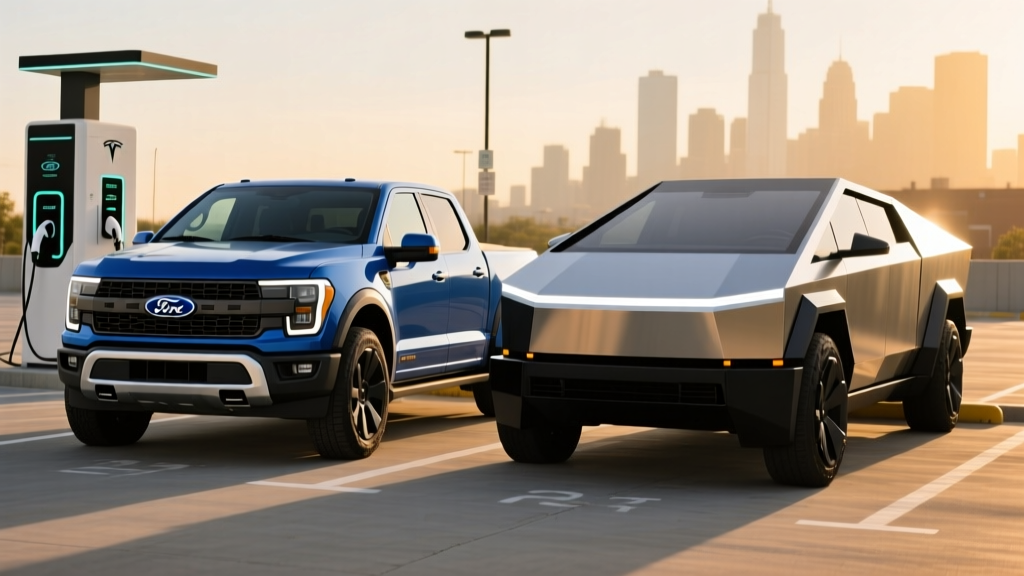
The Tesla Cybertruck polarizes on the outside, but it's the cabin where owners spend every mile. This Tesla Cybertruck interior review breaks down what living with the angular pickup actually feels like — from the minimalist dash and 18.5-inch touchscreen to real-world passenger space, cargo utility, and the tech stack that runs it all. We pair that with the hard numbers buyers need: EPA range, charging speeds, pricing, and federal tax-credit reality for 2026.
Cybertruck at a Glance: Core Specs
Before we get inside, here's the spec sheet that frames every interior decision Tesla made. The Cybertruck currently ships in two dual-motor and tri-motor configurations; the promised rear-wheel-drive base model remains announced but not yet in production as of early 2026.
| Spec | AWD (Dual-Motor) | Cyberbeast (Tri-Motor) |
|---|---|---|
| EPA Range | 340 miles | 320 miles |
| Battery (usable, est.) | ~123 kWh, NMC | ~123 kWh, NMC |
| Max DC Fast Charge | 250 kW (peak) | 250 kW (peak) |
| 10–80% DC Time | ~28 minutes | ~28 minutes |
| Level 2 Home Charging | 11.5 kW (~37 mi/hr) | 11.5 kW (~37 mi/hr) |
| 0–60 mph | 3.9 seconds | 2.6 seconds |
| Horsepower | 600 hp | 845 hp |
| Drivetrain | Dual-Motor AWD | Tri-Motor AWD |
| Efficiency | 56 MPGe / 60 kWh/100mi | 52 MPGe / 65 kWh/100mi |
| Towing Capacity | 11,000 lbs | 11,000 lbs |
| Base MSRP | $79,990 | $99,990 |
| Battery/Drive Warranty | 8 yr / 120,000 mi | 8 yr / 120,000 mi |
Inside the Cabin: Materials, Layout, and the 18.5-Inch Screen
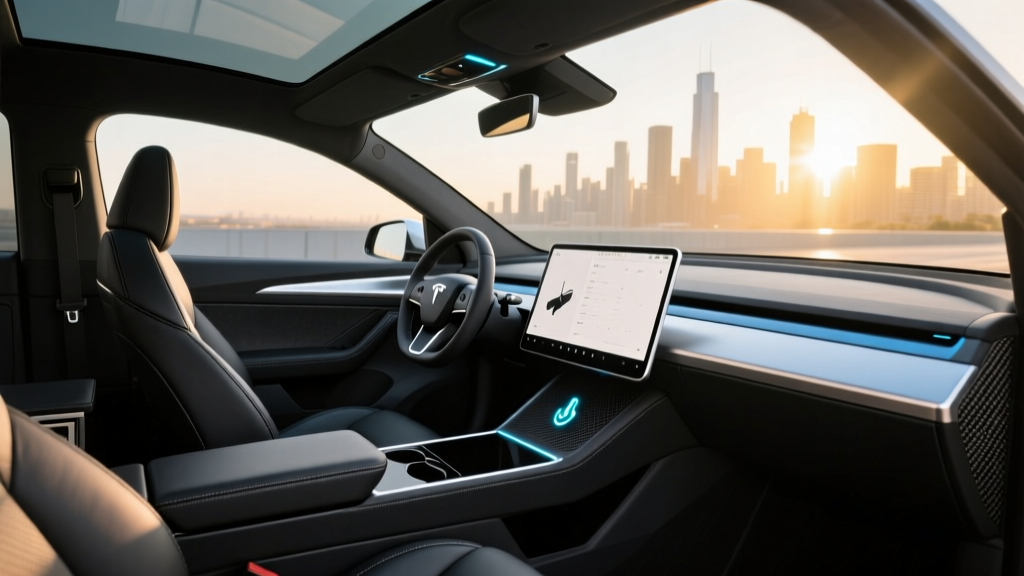
Opening the Cybertruck's door reveals a cabin that is aggressively minimalist — even by Tesla standards. There are no physical buttons on the dash, no traditional instrument cluster, and no stalks for turn signals or wipers. Everything routes through the central 18.5-inch touchscreen or the yoke-style steering wheel (a conventional round wheel is available on request at no extra cost, and most buyers should take it).
Material quality is a step up from the Model 3/Y. The dashboard is wrapped in a microfiber-like suede material, door panels use a mix of soft-touch and textured hard plastics, and the seats are trimmed in a synthetic leather that Tesla calls "vegan leather." Fit and finish on 2025–2026 build vehicles has improved noticeably over the earliest 2024 deliveries, though panel-gap consistency on the stainless-steel exterior still varies truck to truck.
The front seats are power-adjustable, heated, and ventilated. Rear seats are heated but not ventilated. Ambient lighting runs along the dash and doors, and a panoramic glass roof — with no shade — floods the cabin with light. In summer heat, the tinted glass does a reasonable job of IR rejection, but owners in the Southwest will likely add an aftermarket shade.
Infotainment and Tech Stack
The infotainment system runs Tesla's proprietary OS. It's fast, responsive, and includes navigation with real-time Supercharger routing, Netflix/YouTube/Theater for parked viewing, a full web browser, and over-the-air updates that add features monthly. Apple CarPlay and Android Auto remain not supported — a dealbreaker for some truck buyers accustomed to phone projection.
Audio is a 15-speaker premium system with immersive sound. It's strong for the class, though it doesn't quite match the 22-speaker Rivian R1T system in bass depth.
Passenger Space and Cargo Utility
The Cybertruck seats five across two rows. Here's how the dimensions stack up for real-world use:
- Front headroom: 40.3 inches — generous, even with the sloping roofline.
- Front legroom: 42.1 inches — comfortable for tall drivers.
- Rear headroom: 37.2 inches — adequate for adults under 6'2", but taller passengers will notice the roof taper.
- Rear legroom: 36.5 inches — tighter than a Ford F-150 Lightning (43.6 in) or Rivian R1T (38.6 in). Long trips with adult rear passengers aren't ideal.
- Bed length: 6 feet (with tailgate closed); extends to ~8 feet with the powered tonneau-style "sail" retracted and tailgate down.
- Bed volume: ~67 cu ft (bed alone).
- Frunk (front trunk): ~7.1 cu ft — lockable, with a drain plug for use as a cooler.
- Max towing: 11,000 lbs (best-in-class for electric pickups).
The powered stainless-steel tonneau cover is a standout feature. It retracts electrically, supports up to 300 lbs of distributed load when closed, and seals the bed from weather. The trade-off: it limits vertical cargo height and makes installing a traditional bed rack or toolbox more complex than on a conventional pickup.
Real-World Range and Efficiency
AWD: EPA 340 miles. Real-world highway (70–75 mph, moderate temps): ~280–310 miles. Cold weather (below 30°F, highway): expect ~230–260 miles.
Cyberbeast: EPA 320 miles. Real-world highway: ~260–290 miles. Cold weather highway: ~215–245 miles.
The Cybertruck's large frontal area and stainless-steel skin hurt highway efficiency compared to a sedan or crossover. Towing cuts range roughly in half — plan for ~150–170 miles between charges when pulling a 7,000+ lb trailer.
Efficiency of 60–65 kWh/100 miles is higher (worse) than the Ford F-150 Lightning Extended Range at ~49 kWh/100mi. That's the aerodynamic cost of the angular design. On Level 2 home charging at 11.5 kW, a full 0–100% charge takes roughly 11–12 hours — plan overnight sessions accordingly.
Charging Speed: DC Fast and Home Level 2
The Cybertruck uses the NACS (Tesla) connector natively and charges on the full Tesla Supercharger network — the most reliable DC fast-charging ecosystem in North America as of 2026.
| Charging Level | Power / Rate | What You Get |
|---|---|---|
| Level 1 (120V household) | ~1.4 kW | ~4–5 miles per hour |
| Level 2 (240V, 48A home charger) | 11.5 kW | ~37 miles per hour; full charge ~11–12 hr |
| DC Fast (Supercharger V3/V4) | 250 kW peak | 10–80% in ~28 min; tapers sharply above 80% |
The 250 kW peak charge rate is competitive, but like all large-battery EVs, the Cybertruck doesn't sustain peak power for long. Expect ~200–220 kW through the 10–50% window, then a taper to ~100 kW by 70%, and ~50 kW by 85%. On a road trip, charging from 10–80% in ~28 minutes is realistic if you precondition the battery (the nav system does this automatically when a Supercharger is your destination).
The Cybertruck also supports 800-volt architecture, which Tesla leverages primarily for efficiency and motor performance rather than ultra-fast 350+ kW charging (the truck's pack configuration limits peak acceptance to 250 kW on current V3/V4 Superchargers).
Pricing, Trims, and Federal Tax Credit Eligibility
Cybertruck pricing has stabilized after the volatile 2024 launch period. Here's where trims land for 2026:
| Trim | Base MSRP | §30D Credit Eligible? | Effective Price (if eligible) |
|---|---|---|---|
| AWD (Dual-Motor) | $79,990 | Yes — under $80K truck cap | ~$72,490* |
| Cyberbeast (Tri-Motor) | $99,990 | No — exceeds $80K truck MSRP cap | $99,990 |
*Assumes buyer meets all IRS §30D requirements: income caps ($150K single / $300K joint MAGI), the vehicle's battery sourcing and critical-mineral content meet current-year thresholds, and the truck is purchased new for personal use. The AWD trim's $79,990 MSRP sits just under the $80,000 truck/van/SUV cap. Adding options can push it over — verify your build's final MSRP before assuming eligibility. The credit can now be transferred to the dealer at point of sale as an instant discount. Consult a tax professional for your specific situation.
A well-optioned AWD with Full Self-Driving (Supervised) capability ($8,000 add-on), premium paint, and accessories can land between $90,000–$95,000 before any credit. The Cyberbeast, at $99,990 base, is ineligible for §30D regardless of options due to the MSRP cap on trucks.
Driver Assistance and Autonomy
Tesla's Autopilot (standard) and Full Self-Driving Supervised ($8,000 option) are SAE Level 2 systems. The driver must remain fully engaged, hands on or near the wheel, eyes on the road, at all times. The Cybertruck is not self-driving. Only Level 4 robotaxi services like Waymo operate without a human driver in geofenced areas.
Standard Autopilot includes adaptive cruise control, lane-centering, and automatic emergency braking. FSD Supervised adds automatic lane changes, traffic-light and stop-sign recognition, and city-street navigation — all requiring active supervision. The Cybertruck's camera-only vision stack (no radar or ultrasonic sensors) performs well in clear conditions but can be less confident in heavy rain, construction zones, or poorly marked roads compared to sensor-fusion systems like GM's Super Cruise.
Ownership: Warranty, Reliability, and Who It Suits
Tesla covers the Cybertruck with a 4-year/50,000-mile basic warranty and an 8-year/120,000-mile battery and drive-unit warranty — retaining at least 70% capacity over that period. That battery warranty mileage is slightly higher than the Ford F-150 Lightning's 8-yr/100,000-mi, giving a modest edge for high-mileage buyers.
Early 2024 Cybertrucks had a notable recall history (accelerator pedal trim cover, windshield wiper motor, and frunk latch issues among them). Tesla addressed most via OTA updates and service campaigns. Build quality on 2025–2026 vehicles is measurably better, but buyers should still inspect panel gaps and tonneau operation at delivery.
Who Should Buy the Cybertruck?
Choose the Cybertruck AWD if: You want a high-towing (11,000 lb) electric pickup with Supercharger access, appreciate the security of a lockable powered tonneau, and can live with tight rear-seat legroom. The AWD's sub-$80K MSRP keeps the §30D credit in play.
Choose the Cyberbeast if: Performance is the priority (2.6-sec 0–60 is supercar territory in a truck), you don't need the tax credit, and you're paying for the tri-motor experience.
Look elsewhere (Rivian R1T, F-150 Lightning) if: Rear-seat comfort for adults is essential, you need Apple CarPlay/Android Auto, or you want a conventional open bed for aftermarket racks and toolboxes.
Pros and Cons
Pros
- Best-in-class 11,000-lb towing for electric pickups
- Access to Tesla Supercharger network (most reliable DC charging)
- Powered stainless-steel tonneau cover — secure, weather-sealed
- 8-yr/120,000-mi battery warranty
- AWD trim qualifies for §30D credit at base MSRP
- 800V architecture; strong real-world efficiency for its size
Cons
- Rear legroom (36.5 in) trails F-150 Lightning and Rivian R1T
- No Apple CarPlay or Android Auto
- Highway efficiency hurt by angular aero (~60–65 kWh/100mi)
- Cyberbeast exceeds §30D MSRP cap — no federal credit
- Yoke steering default; turn signals on wheel (controversial)
- Towing cuts range roughly in half (~150–170 mi real-world)
Frequently Asked Questions
What is the real-world range of the Cybertruck?
The AWD's EPA estimate is 340 miles, but expect 280–310 miles on the highway in moderate weather and 230–260 miles in freezing temperatures. The Cyberbeast delivers roughly 260–290 real-world highway miles. Towing a heavy trailer drops range to approximately 150–170 miles.
How fast does the Cybertruck charge at home and on the road?
On a 240V Level 2 home charger (48A/11.5 kW), you'll add roughly 37 miles of range per hour, with a full charge taking 11–12 hours. On a Tesla Supercharger at up to 250 kW DC, a 10–80% session takes about 28 minutes with battery preconditioning enabled.
Does the Cybertruck qualify for the federal EV tax credit?
The AWD trim at $79,990 MSRP qualifies for up to $7,500 under IRS §30D — provided the buyer meets income caps ($150K single / $300K joint), the battery meets critical-mineral and sourcing requirements for the current tax year, and the final MSRP with options doesn't exceed $80,000. The Cyberbeast at $99,990 does not qualify. Always verify with a tax professional.
Is the Cybertruck worth buying over the F-150 Lightning or Rivian R1T?
If Supercharger network access, 11,000-lb towing, and the powered tonneau are priorities, the Cybertruck AWD makes a strong case — especially with the §30D credit. If rear-seat comfort, CarPlay, or an open bed for aftermarket accessories matter more, the F-150 Lightning or Rivian R1T may serve you better. Check fueleconomy.gov to compare efficiency and range head-to-head.
What's the biggest complaint about the Cybertruck interior?
Rear-seat legroom at 36.5 inches is the most common critique — it's noticeably tighter than competing electric trucks. The lack of Apple CarPlay/Android Auto and the yoke-style steering wheel (with wheel-mounted turn signals) are also frequent pain points for new owners adjusting to the interface.
How does cold weather affect Cybertruck range?
Expect 20–30% range reduction in sustained sub-freezing highway driving. The Cybertruck uses a heat pump for cabin and battery thermal management, which is more efficient than resistive heating, but the large 123 kWh battery and angular aerodynamics still take a hit. Preconditioning while plugged in at home mitigates the worst of the loss.