The Cybertruck Interior and What It Means for Real Ownership
The Tesla Cybertruck polarizes like no other vehicle on the road. Its angular stainless-steel exoskeleton grabs headlines, but for buyers spending $80,000–$100,000, the daily experience happens inside the cabin. The interior of a Cybertruck strips away decades of automotive convention: no stalks, no instrument cluster, no physical buttons beyond a handful on the yoke steering wheel. Everything routes through an 18.5-inch central touchscreen up front and a 9.4-inch screen for rear passengers.
This review covers the 2025 Tesla Cybertruck lineup — the Dual Motor AWD, the Cyberbeast tri-motor, and the Long Range variant — with exact specs on range, charging, performance, and the tax-credit picture that every buyer needs before signing a purchase agreement.
Spec Sheet: 2025 Tesla Cybertruck at a Glance
| Spec | Dual Motor AWD | Cyberbeast (Tri-Motor) | Long Range (RWD) |
|---|---|---|---|
| EPA Range | 318 miles | 320 miles | 340+ miles (est.) |
| Battery (usable) | ~123 kWh, NMC | ~123 kWh, NMC | ~123 kWh, NMC |
| Drivetrain | Dual Motor AWD | Tri-Motor AWD | Single Motor RWD |
| Horsepower | 600 hp | 845 hp | TBA |
| 0–60 mph | 3.9 sec | 2.6 sec | ~5.5 sec (est.) |
| Max DC Fast Charge | 250 kW | 250 kW | 250 kW |
| 10–80% DCFC Time | ~25 min | ~25 min | ~25 min |
| Level 2 Home Charging | 11.5 kW (~37 mi/hr) | 11.5 kW (~37 mi/hr) | 11.5 kW (~37 mi/hr) |
| EPA Efficiency | 2.0 kWh/mi (50 MPGe) | 2.2 kWh/mi (46 MPGe) | ~1.8 kWh/mi (est.) |
| Towing Capacity | 11,000 lbs | 11,000 lbs | 11,000 lbs |
| Base MSRP | $79,990 | $99,990 | ~$69,990 (est.) |
| Battery Warranty | 8 yr / 120,000 mi | 8 yr / 120,000 mi | 8 yr / 120,000 mi |
Sources: fueleconomy.gov, Tesla Cybertruck specs.
Range, Efficiency, and the Real-World Reality
Dual Motor AWD: EPA 318 miles. Expect ~270–290 miles on mixed highway driving at 70–80 mph. In freezing temperatures (below 32°F), range can drop to 220–250 miles due to battery heating demands and cabin HVAC load.
Cyberbeast: EPA 320 miles. Aggressive driving and the tri-motor's higher energy draw push real-world highway range closer to 240–270 miles.
Long Range (RWD): Tesla targets 340+ miles EPA. Real-world highway expectation: ~290–310 miles.
The Cybertruck's stainless-steel body and angular profile create a drag coefficient that hurts highway efficiency compared to more aerodynamic pickups like the Rivian R1T. At a steady 75 mph, the Dual Motor consumes roughly 2.0 kWh per mile — meaning a 300-mile road trip will require at least one DC fast-charge stop. The Cyberbeast's additional front motor and performance tuning push consumption to about 2.2 kWh/mi under normal driving, and considerably more under hard acceleration.
For city and suburban driving with frequent regenerative braking opportunities, efficiency improves noticeably. Owners in mild climates regularly report 280–310 real-world miles on the Dual Motor before needing a charge, but anyone planning winter road trips through mountain passes should plan conservatively around 220 miles of usable range.
Inside the Interior of a Cybertruck: Cabin, Cargo, and Tech
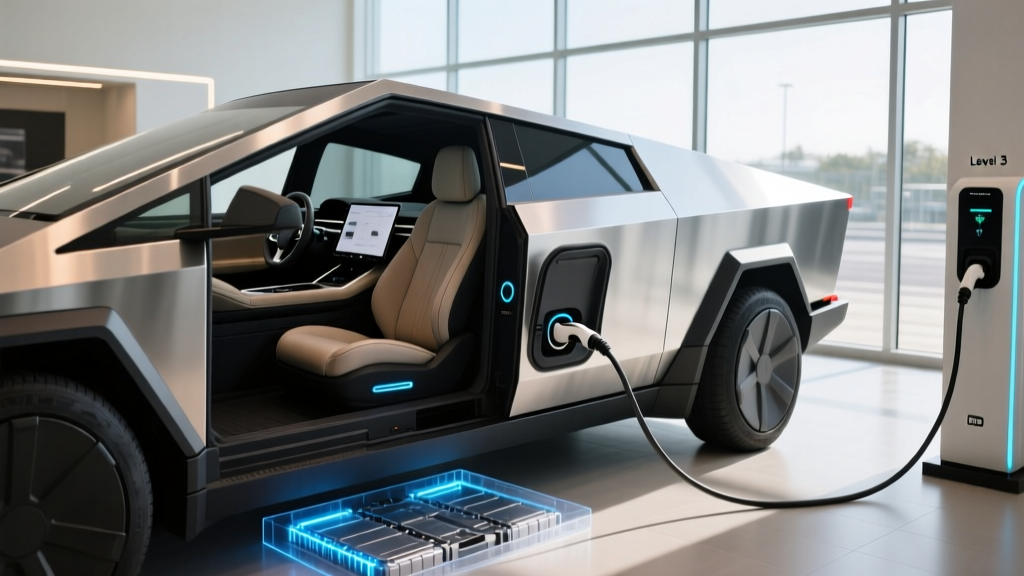
The interior of a Cybertruck is simultaneously its most impressive and most divisive feature. Tesla calls the design "brutalist minimalism," and that's accurate. The dashboard is a single flat slab of materials with no vents visible (airflow routes through hidden channels), no gauge cluster, and no physical controls beyond the yoke.
Front Cabin
- Seating: Synthetic leather (vegan) with heated and ventilated front seats. The driver gets 12-way power adjustment; the passenger gets 8-way.
- Displays: The 18.5-inch central touchscreen handles everything — climate, media, navigation, vehicle settings, and the speedometer/speed-limit readout that replaces a traditional instrument cluster.
- Steering: The yoke-style wheel eliminates traditional stalks. Turn signals, wipers, and drive-mode selection are all button- or screen-activated. This requires a genuine learning curve — expect 2–4 weeks before muscle memory adapts.
- Front legroom: 41.7 inches
- Front headroom: 40.2 inches
Rear Cabin
- Rear legroom: 38.4 inches — adequate for adults on trips under two hours, but the upright seatback angle limits long-haul comfort.
- Rear display: A 9.4-inch touchscreen mounted on the back of the center console lets rear passengers control climate and media.
- Seating capacity: 5 passengers (bench-style rear seat with 60/40 split fold).
Cargo and the Vault
The 6-foot bed (Tesla calls it "the Vault") offers 67 cubic feet of lockable storage with the powered tonneau cover closed. The bed floor is composite, and the tailgate doubles as a ramp rated for 1,500 lbs — useful for loading ATVs or motorcycles. The front trunk (frunk) adds approximately 7 cubic feet of additional sealed storage, enough for charging cables and a soft bag.
Standout Tech
- 48-volt electrical architecture: The Cybertruck is the first mass-production vehicle to use a 48V low-voltage system (replacing the industry-standard 12V), reducing wiring harness weight and enabling higher-power accessories.
- Steer-by-wire: No mechanical connection between the yoke and the wheels. Steering ratio adjusts dynamically — fewer turns lock-to-lock at low speeds, more at highway speeds.
- Autopilot: Standard adaptive cruise control and lane-keeping. Full Self-Driving (Supervised) is a $8,000 add-on or $99/month subscription. Note: FSD is SAE Level 2 driver-assist — the driver must remain fully engaged and hands-on at all times.
- Bioweapon Defense Mode: HEPA-grade cabin air filtration system.
- Powershare: Up to 11.5 kW of bi-directional power output (V2L/V2H capable), enough to run power tools at a job site or essential home circuits during an outage.
Notable Drawbacks
- No traditional side mirrors at launch: Tesla initially planned camera-only mirrors, but DOT requirements forced the addition of physical mirrors — creating aerodynamic drag and wind noise that the camera-only design was meant to eliminate.
- Visibility: The angular windshield and thick A-pillars create larger blind spots than most pickups. The rear-view camera partially compensates, but the small rear window limits direct sightlines.
- Yoke adaptation: Hand-over-hand parking maneuvers are genuinely awkward with the yoke. Some owners retrofit a round wheel; Tesla now offers one as an option.
- Panel gaps and build quality: Early-production units (2024) had widely documented stainless-steel panel alignment issues. 2025 build quality has improved but still trails legacy automaker consistency.
Charging Speed: DC Fast, Level 2, and the Supercharger Advantage
The Cybertruck uses Tesla's proprietary NACS connector natively — no adapter needed for the Supercharger network, which remains the most reliable DC fast-charging infrastructure in the U.S. For non-Tesla CCS chargers (Electrify America, EVgo), Tesla includes a NACS-to-CCS adapter in the vehicle.
| Charging Level | Power / Rate | Miles Added per Hour | Notes |
|---|---|---|---|
| Level 1 (120V outlet) | ~1.4 kW | ~3–4 mi/hr | Emergency/trickle only |
| Level 2 (240V home) | 11.5 kW (48A) | ~37 mi/hr | Full charge overnight (~10 hrs) |
| DC Fast (Supercharger V3) | Peak 250 kW | ~150 mi in 15 min | 10–80% in ~25 min; tapers above 80% |
| DC Fast (Supercharger V4) | Up to 350 kW (future) | TBD | Cybertruck hardware currently caps at 250 kW |
Understanding the Charge Curve
The Cybertruck's ~123 kWh NMC battery peaks at 250 kW on a V3 Supercharger, but that peak holds only from roughly 10–35% state of charge. From 35–60%, the rate tapers to approximately 175–200 kW. Above 80%, charging slows significantly to protect battery longevity — expect the final 80–100% to take an additional 25–30 minutes. For road-trip planning, the practical routine is 10–80% in about 25 minutes, then move on.
At home on a Wall Connector (11.5 kW / 48 amps), a full 0–100% charge takes approximately 10–11 hours. Most owners who charge nightly from 30–80% need only 4–5 hours on Level 2, easily achievable with off-peak electricity rates.
Preconditioning Matters
When you navigate to a Supercharger in the Tesla app or onboard nav, the battery management system automatically warms or cools the pack to optimal temperature before arrival. Skipping preconditioning — for example, pulling into a random charger without nav guidance — can reduce peak charge rate by 30–50% in cold weather. Always route through the car's navigation for fastest DC charging.
Performance and Driving Dynamics
The Cyberbeast's 2.6-second 0–60 mph time makes it one of the quickest production vehicles ever sold, let alone a 6,800-lb pickup. The Dual Motor's 3.9 seconds is equally absurd for the segment. But straight-line speed is only part of the picture.
Steer-by-wire gives the Cybertruck an unusually quick steering ratio at low speeds — the yoke requires less than one full turn lock-to-lock in parking lots. At highway speeds, the ratio lengthens for stability. The adaptive air suspension offers up to 12 inches of ground clearance in Off-Road mode and drops 2 inches in highway cruise mode for efficiency.
Towing capacity is rated at 11,000 lbs across all trims. However, towing at max capacity will cut range roughly in half — plan for ~150–170 miles between charges when pulling a heavy trailer. The Cybertruck's integrated trailer brake controller and camera-based trailer monitoring are well-executed.
Pricing, Trims, and Federal Tax Credit Eligibility
| Trim | Base MSRP | Est. §30D Credit | Effective Price |
|---|---|---|---|
| Long Range (RWD) | ~$69,990 | Up to $7,500* | ~$62,490* |
| Dual Motor AWD | $79,990 | Up to $7,500* | ~$72,490* |
| Cyberbeast | $99,990 | Up to $7,500* | ~$92,490* |
*Federal EV tax credit eligibility under IRS §30D depends on multiple requirements:
- MSRP cap: Trucks and SUVs must have an MSRP at or below $80,000. The Long Range and Dual Motor qualify; the Cyberbeast at $99,990 exceeds the cap and does not qualify for the federal credit.
- Buyer income limits: Modified AGI must not exceed $300,000 (married filing jointly), $225,000 (head of household), or $150,000 (single).
- Battery sourcing: Critical minerals and battery components must meet phased-in domestic-content thresholds that tighten annually. Tesla's supply chain has largely met these requirements for U.S.-built vehicles, but always verify current-year compliance on the IRS eligible vehicle list before purchase.
- Point-of-sale transfer: As of 2024, buyers can transfer the credit to the dealer at purchase, reducing the out-of-pocket price immediately rather than waiting for tax filing.
Cybertruck vs. the Competition: Is It Worth Buying?
The Cybertruck competes in the premium electric pickup segment against the Rivian R1T, Ford F-150 Lightning, and (indirectly) the Chevrolet Silverado EV. Here's how it stacks up on the dimensions that matter:
- Range: The Rivian R1T Dual-Motor Max Pack offers up to 420 EPA miles — substantially more than the Cybertruck's 318–340. The F-150 Lightning Extended Range hits 320 miles.
- Charging: The R1T supports up to 220 kW DCFC; the F-150 Lightning peaks at 150 kW (2024+) on some trims. The Cybertruck's 250 kW is competitive but not class-leading against 800V architectures like the Hyundai Ioniq 5 (though that's not a truck).
- Towing: The Cybertruck's 11,000-lb rating beats the R1T (11,000 lbs comparable) and the F-150 Lightning (10,000 lbs max).
- Interior practicality: The R1T offers a more conventional, higher-quality interior with a gear tunnel for creative storage. The F-150 Lightning is essentially a normal F-150 cabin. The Cybertruck's minimalist approach is a personal preference — some buyers love it, others find it spartan for the price.
- Off-road: The Cybertruck's air suspension and armor-package option give it genuine off-road chops. The R1T with its quad-motor tank turns is more capable in technical terrain.
Pros
- Class-leading acceleration (2.6s Cyberbeast)
- NACS native — full Supercharger network access
- 11,000-lb towing with integrated brake controller
- 48V architecture and steer-by-wire are genuinely novel
- 11.5 kW Powershare for job-site and home backup
- Stainless-steel body resists dents and corrosion
Cons
- Real-world highway range falls well short of EPA (270 mi typical)
- Cyberbeast exceeds $80K MSRP cap — no federal tax credit
- Yoke steering requires significant adaptation
- Visibility and mirror design compromise situational awareness
- Build-quality inconsistency on early and some 2025 units
- Efficiency (2.0+ kWh/mi) lags more aerodynamic EVs
Who Should Buy the Cybertruck?
Best for: Tesla ecosystem enthusiasts who want a statement vehicle with genuine utility — towing a boat or camper on weekends, running power tools from the bed via Powershare, and daily-driving something that turns every parking lot into a conversation. The Dual Motor AWD at ~$72,500 after the federal credit (if eligible) is the value pick in the lineup.
Skip it if: Maximum range is your priority (the Rivian R1T Max Pack offers 420 miles), you prefer a conventional interior with physical controls, you need the Cyberbeast's performance and resent that it doesn't qualify for the tax credit, or you're unwilling to tolerate the yoke-learning curve and panel-gap variability.
The Long Range RWD, once it enters full production, will be the most accessible entry point — potentially under $62,500 after credits — and the most efficient variant for buyers who don't need AWD.
Frequently Asked Questions
What is the real-world range of the Tesla Cybertruck?
The Dual Motor AWD has an EPA rating of 318 miles, but real-world highway driving at 70–80 mph typically yields 270–290 miles. In freezing temperatures, expect 220–250 miles. The Cyberbeast averages slightly less due to its tri-motor power draw. Always plan road trips around 80% of the EPA number for a comfortable buffer.
How fast does the Cybertruck charge at home and on the road?
On a Level 2 home charger (11.5 kW), the Cybertruck gains about 37 miles of range per hour, with a full 0–100% charge taking roughly 10–11 hours. On a Tesla V3 Supercharger, it peaks at 250 kW and charges from 10–80% in approximately 25 minutes. Charging slows significantly above 80% to protect battery health.
Does the Cybertruck qualify for the $7,500 federal EV tax credit?
It depends on the trim. The Dual Motor AWD ($79,990) and Long Range (~$69,990) fall under the $80,000 MSRP cap for trucks/SUVs under IRS §30D and may qualify, subject to buyer income limits and battery-sourcing requirements. The Cyberbeast ($99,990) exceeds the cap and does not qualify. Always verify current eligibility on irs.gov and consult a tax professional.
Is the Cybertruck worth it over the Rivian R1T or F-150 Lightning?
The Cybertruck wins on acceleration, NACS Supercharger access, and Powershare utility. The Rivian R1T wins on range (420 mi with Max Pack), interior quality, and off-road capability. The F-150 Lightning wins on conventional usability, interior space, and lower starting price. Your choice depends on which attributes matter most — there is no objectively "best" truck in this segment.
What battery chemistry does the Cybertruck use?
The Cybertruck uses an NMC (nickel manganese cobalt) lithium-ion battery pack with approximately 123 kWh of usable capacity. NMC offers higher energy density than LFP (lithium iron phosphate), which is necessary given the Cybertruck's weight and range targets. Tesla recommends daily charging to 80–90% for NMC longevity, with 100% reserved for road trips.
How does steer-by-wire feel in daily driving?
Steer-by-wire eliminates the mechanical connection between the yoke and the wheels. At low speeds, the ratio is extremely quick — parking requires minimal hand movement. At highway speeds, it lengthens for stability. Most drivers report a 2–4 week adaptation period. The lack of physical feedback from the road surface is the most common complaint from traditionalists.
Can the Cybertruck power my home during an outage?
Yes. Tesla's Powershare system supports up to 11.5 kW of bi-directional power output (V2H/V2L). With the Tesla Powerwall or a compatible home integration setup, the Cybertruck can back up essential home circuits during an outage. A fully charged pack (~123 kWh) could power an average home's essential loads for multiple days.
Final Assessment
The interior of a Cybertruck reflects Tesla's philosophy that a vehicle should be a software-defined platform first and a traditional automobile second. Whether that resonates depends entirely on your tolerance for unconventional controls, your appetite for attention, and how much you value the Tesla Supercharger ecosystem. As a tool — 11,000-lb towing, 11.5 kW mobile power, 67 cu ft of lockable storage — it delivers. As a daily-driver cabin for a family, it asks more adaptation than any competitor. The Dual Motor AWD with the §30D credit is the rational buy; the Cyberbeast is the emotional one, tax consequences be damned.