If you've been searching for Cybertruck interior pictures to decide whether Tesla's polarizing electric pickup is livable day-to-day, you're not alone. The stainless-steel exoskeleton grabs headlines, but it's the cabin — stripped of traditional buttons, gauges, and even a conventional instrument cluster — that determines whether owners love or regret the truck after the first month. This review pairs an in-depth look at the Cybertruck's interior design with the hard EV data buyers actually need: real-world range, charging speeds, tax-credit eligibility, and how it stacks up against the Ford F-150 Lightning and Rivian R1T in 2026.
Cybertruck Interior Pictures: A Radical Minimalist Cabin
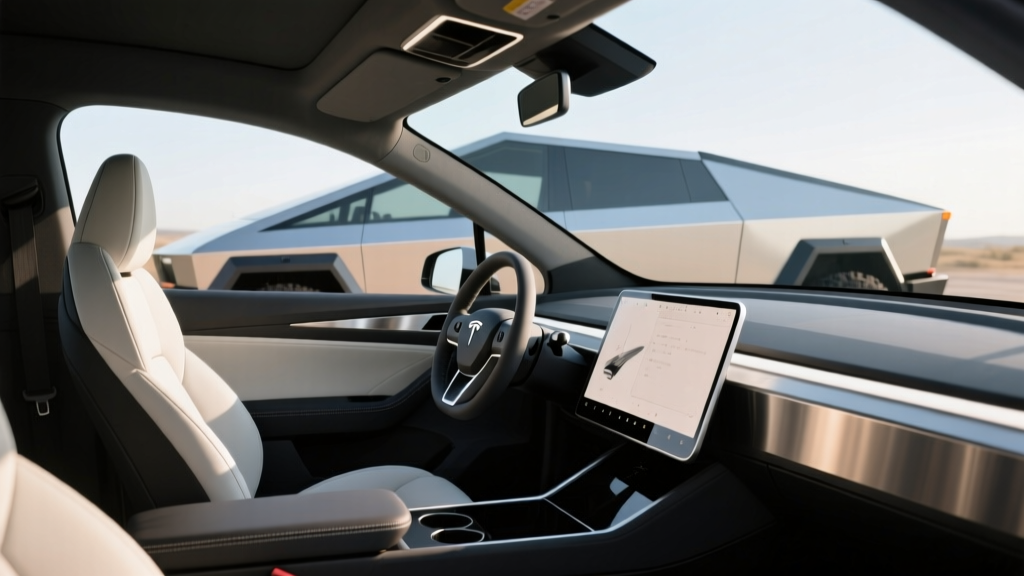
Tesla's design philosophy has always trended sparse, but the Cybertruck takes it to an extreme. Step inside and you're met with a single horizontal slab of what Tesla calls "vegan leather" across the dash, an 18.5-inch center touchscreen that handles virtually every vehicle function, and a yoke-style steering wheel (a conventional round wheel is available as a no-cost option on 2025+ models). There is no instrument cluster behind the wheel — speed, range, and navigation all live on the right side of the center display.
The front row offers generous shoulder room (approximately 62 inches of hip room up front) and heavily bolstered seats that hold you well during the Cybertruck's startling acceleration. Rear-seat passengers get a 60/40 split bench with a fold-down center armrest, USB-C ports, and a 9.4-inch rear touchscreen for climate and media control. Legroom in the back measures roughly 41 inches — competitive with midsize pickups but tighter than a full-size F-150 Lightning's rear seat.
Materials are durable rather than luxurious. The stainless-steel dash trim is fingerprint-prone, the hard-touch plastics on the lower door panels feel utilitarian, and the headliner is a simple molded composite. For a vehicle starting near $80,000, the interior reads more "concept car" than "luxury truck," which is either a feature or a bug depending on your taste.
Range, Battery, and Real-World Efficiency
Real-World Expectation: Plan for ~270–290 miles on sustained highway driving at 70+ mph. In cold weather (below 32°F), expect a 15–25% reduction, dropping effective range to ~220–250 miles depending on cabin heating and terrain.
| Spec | AWD | Cyberbeast |
|---|---|---|
| Battery Capacity (usable) | ~123 kWh (NMC) | ~123 kWh (NMC) |
| EPA Range | 340 mi | 320 mi |
| EPA Efficiency | ~58 MPGe / ~58 kWh/100mi | ~54 MPGe / ~62 kWh/100mi |
| 0–60 mph | 4.1 sec | 2.6 sec |
| Horsepower | 600 hp | 845 hp |
| Drivetrain | Dual-Motor AWD | Tri-Motor AWD |
| Towing Capacity | 11,000 lbs | 11,000 lbs |
The Cybertruck uses an NMC (nickel-manganese-cobalt) battery pack — chosen for its high energy density, which is necessary to push a 6,800-pound stainless-steel vehicle past 300 miles. Efficiency is the truck's weak point: at roughly 58 kWh/100 miles, it consumes significantly more energy per mile than a comparable EV SUV. For context, the Rivian R1T Dual-Motor achieves around 2.0 kWh/mile, while the Cybertruck AWD runs closer to 1.7–2.0 kWh/mile in mixed driving but spikes above 2.2 kWh/mile at highway speeds due to its brick-like aerodynamics.
Charging Speed: DC Fast Charge and Home Level 2
Charging a 123 kWh battery is a time commitment, and the Cybertruck's charge curve reflects that. Tesla quotes a peak DC fast-charge rate of 250 kW at V3/V4 Superchargers, but as with all large packs, sustained rates matter more than the peak.
| Charging Level | Power | Speed / Time |
|---|---|---|
| DC Fast Charge (Tesla Supercharger V3/V4) | Peak 250 kW | 10–80% in ~35 min; tapers significantly above 80% |
| DC Fast Charge (NACS adapter at non-Tesla networks) | Up to ~200 kW (varies by station) | 10–80% in ~40–45 min |
| Level 2 Home (Tesla Wall Connector, 48A / 11.5 kW) | 11.5 kW | ~37 mi/hr of range; 0–100% in ~11 hours |
| Level 2 Home (32A / 7.7 kW) | 7.7 kW | ~25 mi/hr of range; 0–100% in ~16 hours |
| Level 1 (120V / 12A) | 1.4 kW | ~4–5 mi/hr; not practical for daily use |
A critical ownership note: preconditioning the battery before a DC fast-charge session is essential. The Cybertruck's thermal management system needs 15–30 minutes of navigation-routed preconditioning to hit peak charge rates. Arrive at a Supercharger cold and you may see peak rates closer to 100–130 kW until the pack warms up. On a 48-amp home Level 2 circuit (the recommended setup for any large-battery EV), a full overnight charge from 20% to 100% takes roughly 11 hours — plan your electrical panel accordingly, as this circuit requires a 60-amp breaker.
Pricing, Trims, and Federal Tax Credit Eligibility
| Trim | 2026 MSRP | Federal §30D Credit | Effective Price |
|---|---|---|---|
| Rear-Wheel Drive (announced, limited availability) | $60,990 | Up to $7,500* | ~$53,490* |
| AWD (Dual-Motor) | $79,990 | Up to $7,500* | ~$72,490* |
| Cyberbeast (Tri-Motor) | $99,990 | Up to $7,500* | ~$92,490* |
*Federal EV tax credit eligibility under IRS §30D depends on multiple factors for 2026:
- MSRP Cap: Pickup trucks must have an MSRP at or below $80,000 to qualify. This means the AWD trim at $79,990 qualifies, but the Cyberbeast at $99,990 does NOT qualify for the federal credit.
- Buyer Income Cap: Modified AGI must not exceed $150,000 (single), $225,000 (head of household), or $300,000 (joint filers).
- Battery Sourcing: The full $7,500 requires meeting both critical-mineral ($3,750) and battery-component ($3,750) sourcing requirements. Tesla's supply chain has shifted significantly, and partial credit ($3,750) may apply depending on the build date and mineral sourcing. Confirm current eligibility on the IRS clean vehicle list before purchasing.
- Point-of-Sale Transfer: As of 2024+, eligible buyers can transfer the credit to the dealer at purchase for an immediate price reduction rather than waiting for tax filing.
Cargo, Towing, and Utility
The Cybertruck's 6-foot vault-style bed offers approximately 67 cubic feet of cargo volume with the tonneau cover closed. The bed is constructed from the same ultra-hard stainless steel as the body, with no painted surfaces to scratch — a genuine advantage for work use. A powered retractable tonneau cover is standard, and the bed includes built-in LED lighting, 120V and 240V outlets (enabling up to 11.5 kW of vehicle-to-load power), and integrated tie-downs.
Behind the rear seats, the Cybertruck provides roughly 35 cubic feet of enclosed storage when seats are folded. The front trunk (frunk) adds approximately 7 cubic feet — enough for a charging cable kit and a small bag, but far smaller than the F-150 Lightning's massive 14.1-cubic-foot Mega Power Frunk.
Towing capacity is rated at 11,000 pounds across all trims. However, towing at capacity will slash range dramatically — expect effective range to drop below 150 miles when pulling a heavy trailer, consistent with all electric pickups. The Cybertruck includes an integrated trailer brake controller and Tesla's trailer-assist camera integration.
Tech, Driver Assistance, and the Yoke Question
The 18.5-inch touchscreen runs Tesla's latest vehicle software, handling navigation, media, climate, vehicle settings, and the "frunk" and bed controls. There are no physical buttons for climate or volume — everything routes through the screen or voice commands. The rear 9.4-inch screen lets passengers control their own climate zone and entertainment.
Tesla's Autopilot comes standard, with FSD (Supervised) available as a $8,000 add-on or $99/month subscription. FSD (Supervised) handles highway lane changes, city-street navigation, and parking maneuvers, but requires constant supervision. On the Cybertruck, the yoke steering wheel can make low-speed maneuvering and hand-over-hand parking more awkward than a conventional round wheel — a real consideration if you frequently navigate tight urban environments or parking garages.
Notable tech drawbacks include the lack of Apple CarPlay and Android Auto (Tesla uses its own interface exclusively), no physical climate knobs, and reliance on the touchscreen for the glovebox release, mirror adjustment, and wiper controls — all of which can be frustrating while driving.
Pros and Cons at a Glance
Pros
- Tri-motor Cyberbeast delivers supercar-rivaling 2.6-second 0–60 mph
- Stainless-steel exoskeleton is dent- and scratch-resistant for work use
- 11,000-lb towing capacity with integrated V2L power (up to 11.5 kW)
- Access to Tesla Supercharger network — the most reliable DC fast-charge network in North America
- Distinctive design with genuine head-turning factor
Cons
- Efficiency is poor (~58 kWh/100mi) — high electricity cost per mile vs. rivals
- Interior materials and finish don't match the $80K+ price point
- Yoke steering is impractical for low-speed/parking maneuvers
- Rear-seat legroom is tighter than full-size competitors
- Cyberbeast trim exceeds $80K MSRP cap — no federal tax credit
- Large 123 kWh pack means long home-charging times (11+ hours on Level 2)
Who Should Buy the Cybertruck?
Choose the Cyberbeast if: Performance is your priority and the $100K price (without tax-credit help) doesn't deter you. You want 845 hp and 2.6-second sprints and accept the range and efficiency trade-offs.
Look at the Ford F-150 Lightning or Rivian R1T instead if: You need a more traditional interior with physical controls, greater rear-seat space, a larger frunk, or better efficiency. The Lightning also starts significantly lower and qualifies for the full tax credit on more trims.
Frequently Asked Questions
What is the real-world range of the Tesla Cybertruck?
The EPA rates the AWD at 340 miles and the Cyberbeast at 320 miles. In real-world highway driving at 70–75 mph, expect roughly 270–290 miles. In freezing temperatures, range can drop to 220–250 miles. Towing a heavy trailer will cut range below 150 miles.
How fast does the Cybertruck charge?
At a Tesla V3/V4 Supercharger, it peaks at 250 kW and charges from 10–80% in approximately 35 minutes. At home on a 48-amp Level 2 charger (11.5 kW), it adds about 37 miles of range per hour, requiring roughly 11 hours for a full charge.
Does the Cybertruck qualify for the federal EV tax credit?
The AWD trim at $79,990 MSRP is below the $80,000 pickup cap and may qualify for up to $7,500 under IRS §30D, subject to buyer income limits and battery-sourcing requirements. The Cyberbeast at $99,990 exceeds the MSRP cap and does not qualify.
Is the Cybertruck worth buying vs. the F-150 Lightning or Rivian R1T?
It depends on priorities. The Cybertruck wins on acceleration, Supercharger access, and stainless-steel durability. The F-150 Lightning wins on price, interior practicality, frunk space, and traditional controls. The Rivian R1T wins on build quality, adventure features, and efficiency. Test-drive all three before deciding.
What's the biggest complaint about the Cybertruck interior?
Owners most frequently cite the lack of physical buttons (climate, mirrors, and glovebox all require the touchscreen), the yoke steering wheel's awkwardness at low speeds, and interior materials that feel basic for a vehicle in the $80K–$100K range.
How long is the battery and powertrain warranty?
Tesla covers the Cybertruck battery and drive unit for 8 years or 150,000 miles (whichever comes first), with a guaranteed minimum 70% capacity retention over that period. The vehicle limited warranty is 4 years or 50,000 miles.