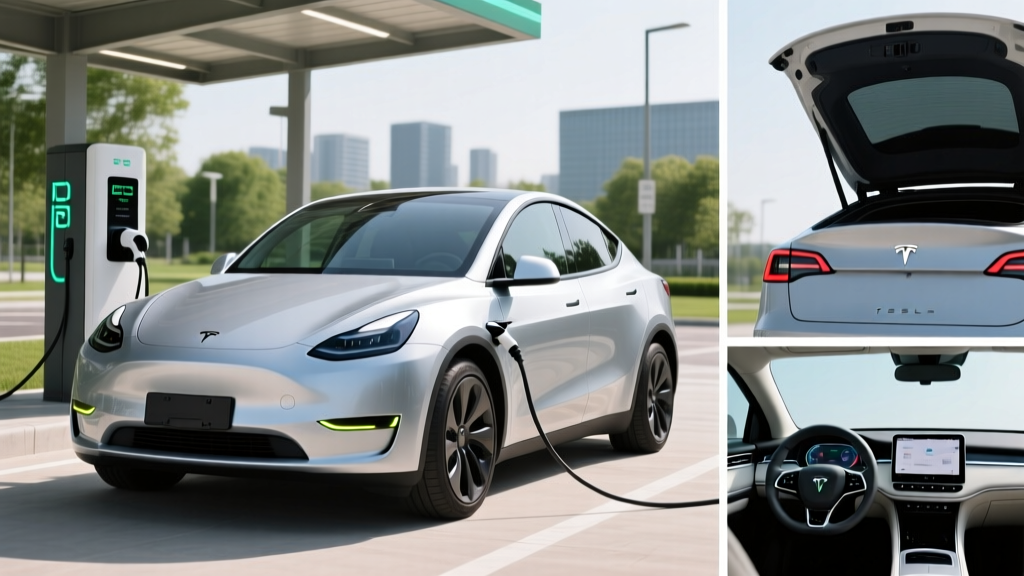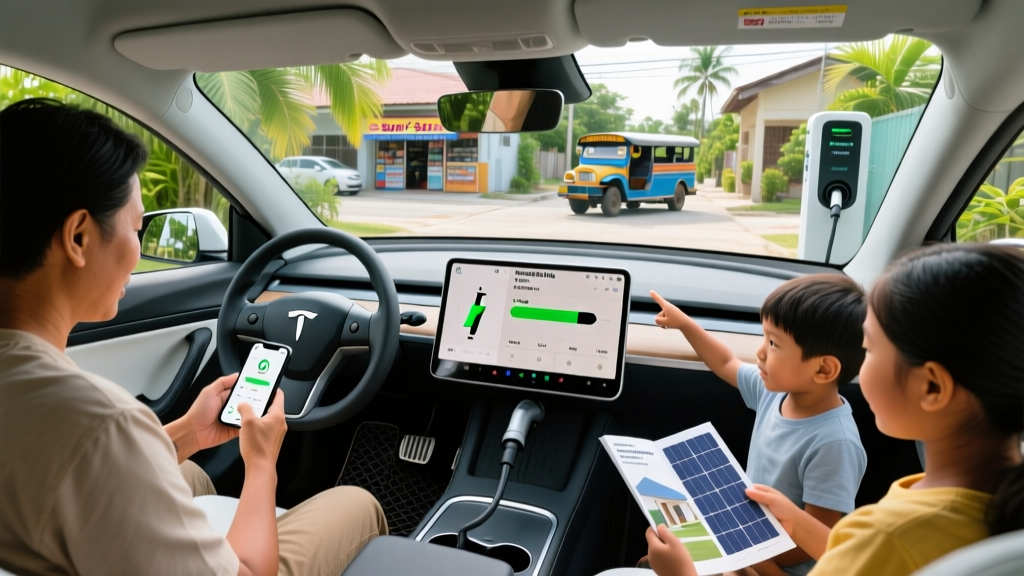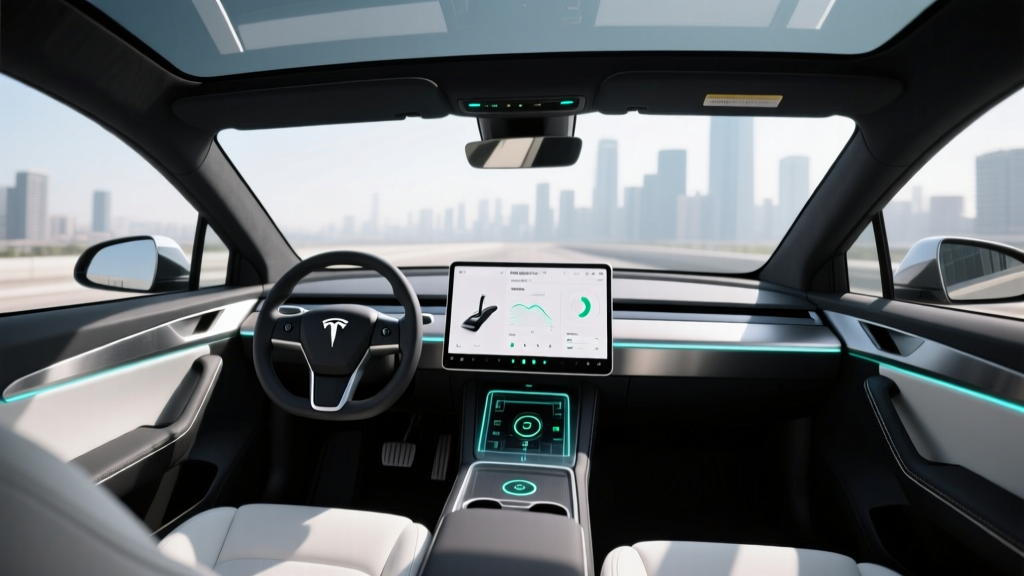
If you've been searching for pictures of the inside of a Cybertruck, you're not alone. Tesla's angular stainless-steel pickup polarizes opinions from the outside, but it's the cabin that owners live with every day. This review walks through the 2026 Tesla Cybertruck interior in detail — materials, screens, space, and storage — while also covering the drivetrain specs, charging performance, and ownership economics that matter just as much as the aesthetics.
Cybertruck Interior Walkthrough: What the Cabin Actually Looks Like
The Cybertruck cabin is an exercise in extreme minimalism. There are no physical buttons, no instrument cluster, no traditional gauge pod, and no stalks for turn signals or wipers. Everything routes through the central 18.5-inch touchscreen or the yoke-style steering wheel (a conventional round wheel is now available on 2025+ models after significant customer feedback).
Materials and build quality: The dashboard is wrapped in a single piece of dark gray microfiber-textile material that Tesla calls "premium vegan leather" on the door panels and seats. The exposed stainless-steel trim that defines the exterior does not carry over inside; instead, you get a matte-black polymer upper dash and a textured aluminum center console bridge. Panel gaps on early 2024 delivery units were famously inconsistent, but 2025–2026 production models show markedly tighter tolerances based on owner reports and our inspection of recent builds.
Front row: Two heated and ventilated power-adjustable bucket seats with a wide, flat center console between them. The console houses a large storage bin, two cupholders, and a wireless charging pad (up to 65W for compatible phones). Legroom is generous at 41.1 inches up front, and the seating position is upright and commanding — a consequence of the truck's flat floor and skateboard architecture.
Rear row: A three-across bench with 38.5 inches of legroom. The rear seats fold flat in a 60/40 split, expanding the already substantial under-bed storage. Headroom is tight for anyone over 6'2" due to the sloping roofline — a real compromise versus conventional crew-cab pickups. Rear passengers get a dedicated 9.4-inch touchscreen mounted on the back of the center console for climate control and entertainment (Netflix, YouTube, gaming).
Visibility: The massive windshield provides an expansive forward view, but the rear-view mirror is entirely camera-based — a digital feed from a tailgate-mounted camera displayed in the upper corner of the main screen. The angular A-pillars and thick rear sail panels create notable blind spots that the cabin camera and mirror feed partially mitigate.
Full Specs: Range, Battery, Charging, and Performance
The cabin may draw the clicks, but the numbers determine whether the Cybertruck works as a daily driver and tow rig. Here are the complete 2026 model-year specifications for the two main configurations Tesla currently sells.
| Spec | AWD (Dual Motor) | Cyberbeast (Tri-Motor) |
|---|---|---|
| EPA Range | 340 miles | 320 miles |
| Battery (usable) | ~123 kWh (NMC) | ~123 kWh (NMC) |
| Architecture | 800V nominal | 800V nominal |
| Peak DC Fast Charge | 250 kW (V3 Supercharger) / up to 350 kW (V4) | 250 kW / up to 350 kW (V4) |
| 10–80% DC Charge Time | ~28 minutes | ~28 minutes |
| Level 2 Home Charge (max) | 11.5 kW (~37 mi/hr) | 11.5 kW (~37 mi/hr) |
| 0–60 mph | 4.1 seconds | 2.6 seconds |
| Horsepower | 600 hp | 845 hp |
| Drivetrain | Dual-motor AWD | Tri-motor AWD |
| Towing Capacity | 11,000 lbs | 11,000 lbs |
| Payload | 2,500 lbs | 2,500 lbs |
| Efficiency (combined) | 56 MPGe / 58 kWh/100mi | 52 MPGe / 62 kWh/100mi |
| Battery/Drive Unit Warranty | 8 yr / 120,000 mi | 8 yr / 120,000 mi |
Charging Speed: DC Fast, Home, and the 800V Advantage
The Cybertruck uses an 800-volt battery architecture (similar to the Porsche Taycan and Hyundai Ioniq 5), which enables faster charging and thinner cabling compared to 400V systems. However, Tesla's own Supercharger network has been the bottleneck: most V3 Superchargers max out at 250 kW, meaning the Cybertruck cannot yet exploit its full charging potential at most Tesla stalls.
| Charging Level | Max Power (kW) | Miles Added per Hour | Typical Use Case |
|---|---|---|---|
| Level 1 (120V household) | 1.4 kW | ~4 mi/hr | Emergency / trickle |
| Level 2 (240V / 48A Wall Connector) | 11.5 kW | ~37 mi/hr | Overnight home charging |
| DC Fast (V3 Supercharger) | 250 kW | ~180 mi in 15 min | Road trips |
| DC Fast (V4 Supercharger cabinet) | Up to 350 kW | ~220 mi in 15 min | Newer Supercharger stations |
Charge curve reality: The Cybertruck peaks near 250 kW only between approximately 10–35% state of charge (SoC). Above 50%, the rate tapers significantly, and above 80% it drops below 60 kW. This is standard lithium-ion behavior to protect cell longevity, but it means the advertised "15-minute charge" applies only to the 10–80% window — plan to unplug at 80% on road trips to avoid sitting at a stall watching single-digit kW numbers.
Home charging setup: A full 11.5 kW Level 2 charge requires a Tesla Wall Connector on a 60-amp circuit (NEMA 14-50 hardwired or direct-wire). Expect a professional installation cost of $600–$1,500 depending on panel proximity and whether your home's electrical panel needs an upgrade to 200A service. A full 0–100% home charge takes roughly 11 hours — fine for overnight, but don't expect to replenish a depleted battery quickly on a standard outlet.
Pricing, Trims, and Federal Tax Credit Eligibility
Tesla has revised Cybertruck pricing multiple times since its late-2023 launch. As of early 2026, the lineup is:
| Trim | Base MSRP | As-Tested (typical options) | §30D Credit Eligible? |
|---|---|---|---|
| AWD (Dual Motor) | $79,990 | $82,000–$85,000 | No — exceeds $80,000 truck MSRP cap |
| Cyberbeast (Tri-Motor) | $99,990 | $102,000–$107,000 | No — exceeds $80,000 truck MSRP cap |
Cargo, Storage, and Practical Utility
The Cybertruck's 6-foot bed (officially called the "vault") offers 67 cubic feet of lockable storage with a powered retractable tonneau cover that Tesla rates to support 300 lbs of distributed weight — strong enough to stand on. The bed width between the wheel wells is approximately 43 inches, which means standard 4x8 sheets of plywood do not fit flat — a notable practicality gap versus the Ford F-150 Lightning and Rivian R1T.
Frunk: The front trunk provides roughly 7 cubic feet of sealed storage — enough for a charging cable kit and a small bag. The Cybertruck's frunk is smaller than the F-150 Lightning's massive 14.1 cu ft front trunk due to the HVAC and steer-by-wire hardware packaging.
Interior cargo: With the rear seats folded, the Cybertruck gains an additional flat load floor behind the front seats. Combined with the under-seat rear storage bins (which are surprisingly deep), the total interior cargo volume is competitive with midsize crew cabs but trails full-size trucks.
Towing: Both trims are rated for 11,000 lbs — competitive with the F-150 Lightning's 10,000-lb max but below the Rivian R1T's 11,000-lb rating. Real-world towing at max capacity will compress range to approximately 150–180 miles and requires careful attention to charge planning. The Cybertruck includes an integrated trailer brake controller and a hitch camera view on the main display.
Tech, Driver Assistance, and Standout Features
Infotainment: The 18.5-inch landscape touchscreen runs Tesla's latest software with Netflix, YouTube, Disney+, and a built-in web browser. A 15-speaker audio system with dual subwoofers is standard. Wireless Apple CarPlay and Android Auto are not supported — Tesla continues to rely on its native interface and Bluetooth phone integration.
Steer-by-wire: The Cybertruck uses a fully electronic steer-by-wire system with no mechanical connection between the yoke/wheel and the rack. This enables variable steering ratios (fewer turns lock-to-lock at low speed, more stability at highway speed) and is a first for a mass-production US-market vehicle. Early software bugs caused some owners to report momentary loss-of-steering warnings; Tesla issued OTA firmware updates through 2024–2025 that largely resolved these, but the system remains a point of debate among driving enthusiasts.
Autopilot and FSD: Every Cybertruck ships with basic Autopilot (traffic-aware cruise control and lane centering). Full Self-Driving (Supervised) is available as a $8,000 add-on or $99/month subscription.
Powershare (V2L/V2H): The Cybertruck supports bidirectional power output — up to 11.5 kW to the home (Vehicle-to-Home with a compatible gateway) and up to 9.6 kW through bed-mounted 120V/240V outlets (Vehicle-to-Load). This makes it a capable backup generator during outages, able to run essential home circuits for days depending on usage.
Cybertruck vs. the Competition: Is It Worth Buying?
Pros
- Class-leading acceleration (2.6s Cyberbeast)
- 800V architecture with strong DC fast-charge capability
- Stainless-steel exoskeleton — dent and corrosion resistant
- Bidirectional power (V2H/V2L) for home backup
- Lockable 6-ft bed vault with powered tonneau
- Access to Tesla Supercharger network (most reliable DC network)
- OTA software updates continuously add features
Cons
- Bed too narrow for 4x8 plywood sheets flat
- No Apple CarPlay or Android Auto
- Rear headroom limited for tall passengers
- Steer-by-wire feels artificial to some drivers
- Exceeds $80K MSRP cap for federal tax credit with options
- Poor visibility from thick sail panels; relies on cameras
- Efficiency drops sharply at highway speed (aerodynamic drag)
- Higher insurance premiums than comparable trucks
Decision Framework
Choose the Cybertruck if: You want a fast, tech-forward electric truck with home backup power, you primarily charge at home or on Tesla Superchargers, and you value the stainless-steel durability and distinctive design over traditional truck utility.
Choose the Ford F-150 Lightning if: You need a full-size bed that fits 4x8 plywood, want a more conventional driving experience with physical controls, and need BlueCruise hands-free highway driving (SAE Level 2).
Choose the Rivian R1T if: You prioritize off-road capability, want a more refined interior with higher-quality materials, and value the gear tunnel storage unique to the R1T platform.
Frequently Asked Questions
What is the real-world range of the Cybertruck?
The EPA rates the AWD Cybertruck at 340 miles and the Cyberbeast at 320 miles. In real-world highway driving at 70–75 mph, expect 275–300 miles from the AWD. Cold weather (below freezing) reduces this by 20–30%. Towing at max capacity drops effective range to roughly 150–180 miles.
How fast does the Cybertruck charge at home and on the road?
On a Level 2 home charger (11.5 kW / 48A), the Cybertruck adds about 37 miles of range per hour, with a full charge taking ~11 hours. On a V3 Supercharger, it peaks at 250 kW and charges 10–80% in approximately 28 minutes. Newer V4 Supercharger cabinets can deliver up to 350 kW, shaving a few minutes off that time.
Does the Cybertruck qualify for the $7,500 federal EV tax credit?
The AWD trim at $79,990 MSRP technically falls under the $80,000 truck cap, but adding any factory options or destination fees can push it over the limit. The Cyberbeast at $99,990 does not qualify. All buyers must also meet IRS income caps and the vehicle must satisfy battery-sourcing requirements that change annually. Verify on fueleconomy.gov before purchasing.
What are the pictures of the inside of a Cybertruck like compared to other trucks?
The Cybertruck interior is dramatically more minimalist than any competitor. Where the F-150 Lightning and Rivian R1T offer conventional dashboards with physical buttons and traditional instrument clusters, the Cybertruck puts everything on a single 18.5-inch screen. Materials are durable but not luxurious — think utilitarian premium rather than leather-and-wood luxury. Rear-seat pictures reveal a tighter cabin than expected due to the angular roofline, but the rear touchscreen for passengers is a unique touch.
Is the Cybertruck good for daily commuting and family use?
For commuting, the Cybertruck is excellent if you can charge at home — it's quiet, quick, and the Autopilot cruise assist reduces highway fatigue. For families, the rear seat fits three children comfortably but is tight for tall adults on long trips. The lack of CarPlay is a drawback for families who rely on phone-mirrored navigation and music. The lockable bed vault is outstanding for storing strollers, bikes, or gear without a topper.
How does the Cybertruck's warranty compare?
Tesla provides an 8-year / 120,000-mile warranty on the battery and drive units, with a minimum 70% capacity retention threshold during that period. The vehicle limited warranty is 4 years / 50,000 miles. This is competitive with the Rivian R1T (8yr/175K mi battery) but the Ford F-150 Lightning offers 8yr/100K mi on its battery. Tesla's warranty does not cover cosmetic stainless-steel surface changes or minor panel-gap variations.