The Tesla Cybertruck remains one of the most polarizing vehicles on the road, and stepping inside its angular stainless-steel shell reveals a cabin that is simultaneously futuristic and austere. For 2026, Tesla has refined the interior with incremental software updates and material tweaks, but the core experience — a minimalist, screen-dominated cockpit built around a massive 18.5-inch front display — remains unchanged. This Cybertruck inside view goes beyond the headlines to deliver hard data on range, charging speed, pricing, tax-credit eligibility, and the real-world ownership calculus buyers need before signing a purchase agreement.
Quick Verdict: Who Should Buy the Cybertruck?
The Cybertruck is engineered for buyers who want a full-size electric pickup with sports-car acceleration, a distinctive design statement, and access to the Tesla Supercharger network. It works best for tech-forward commuters, light-to-moderate towers, and early adopters who prioritize performance over traditional truck utility. If you need a conventional work truck with a massive bed, proven long-term durability data, or a rear-seat experience that rivals the Ford F-150 or Rivian R1T, the Cybertruck falls short. For everyone else willing to embrace its quirks, it delivers an unmatched combination of speed, efficiency, and charging infrastructure.
Cybertruck Inside View: Cabin, Tech & Dimensions
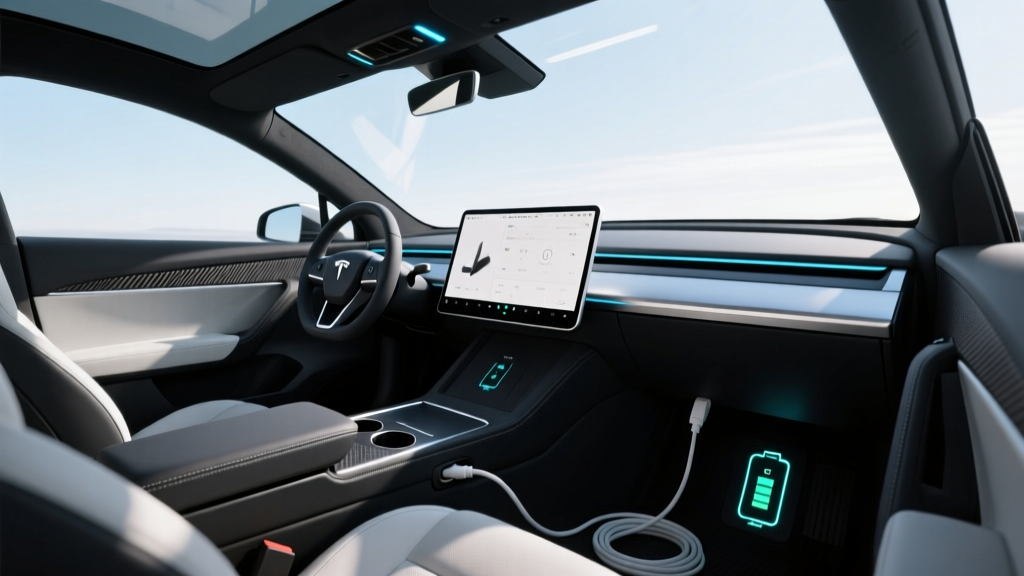
Opening the Cybertruck's doors reveals a cabin that strips away nearly every physical control. The front dashboard is dominated by an 18.5-inch touchscreen that handles navigation, climate, media, vehicle settings, and even the glovebox release. A smaller 9.4-inch rear touchscreen serves second-row passengers for climate and entertainment. The steering wheel is a squared-off yoke design with integrated touch-capacitive buttons, and there is no traditional instrument cluster — all driving information appears on the central display.
Materials have improved modestly for 2026. The dashboard and door panels use a combination of vegan leather and recycled textile surfaces, with brushed aluminum accents throughout. The seats are power-adjustable, heated and ventilated in all three rows (front and rear outboard), with a perforated synthetic leather upholstery. Build quality on 2026 models has tightened compared to early 2024 production, with more consistent panel gaps and fewer interior rattles, though some owners still report wind noise from the triangular door windows at highway speeds.
| Measurement | Cybertruck (Dual Motor / Cyberbeast) |
|---|---|
| Front headroom | 41.0 in |
| Front legroom | 41.2 in |
| Rear headroom | 38.4 in |
| Rear legroom | 35.2 in |
| Bed length (tailgate closed) | 72.0 in (6 ft) |
| Bed width (between wheel wells) | 43.0 in |
| Bed cargo volume | 67.0 cu ft |
| Front trunk (frunk) | 7.1 cu ft |
| Under-bed lockable storage | Yes (sealed, drainable) |
| Towing capacity (max) | 11,000 lbs |
| Payload capacity | 2,500 lbs |
The rear seat accommodates three adults, though the middle position is tight for anyone over six feet tall due to the sloping roofline. The rear seats fold flat in a 60/40 split, extending usable cargo length into the cabin. The motorized tonneau cover over the bed is a standout feature — it retracts silently, supports up to 300 lbs of distributed weight, and integrates with the tailgate, which deploys as a ramp for loading ATVs or motorcycles.
Standout Tech Features
- Steer-by-wire: The Cybertruck uses a fully electronic steering system with no mechanical connection between the yoke and wheels. This enables variable steering ratios — fewer than one full turn lock-to-lock — eliminating the need for hand-over-hand maneuvers.
- 48-volt architecture: The first production vehicle to use a 48V low-voltage system, reducing wiring harness weight by roughly 70% compared to traditional 12V systems.
- Bioweapon Defense Mode: HEPA-grade cabin air filtration with positive pressurization.
- Powershare: 120V and 240V outlets in the bed and cabin (up to 11.5 kW output) for powering tools, appliances, or even home backup during outages via the optional PowerShare gateway.
- Autopilot: Standard Tesla Autopilot (SAE Level 2) with adaptive cruise and lane centering. Full Self-Driving (Supervised) remains an optional $8,000 add-on — it is not autonomous driving and requires continuous driver attention.
Tesla Autopilot and FSD (Supervised) are SAE Level 2 driver-assistance systems. The driver must remain fully engaged, keep hands on the yoke, and monitor the road at all times. These systems do not make the Cybertruck self-driving.
Range, Battery & Efficiency: The Real Numbers
The 2026 Cybertruck is offered in two main trims with distinct battery configurations and EPA range ratings. Tesla uses a structural battery pack where the cells themselves form part of the vehicle's chassis, reducing weight and improving rigidity.
Dual Motor AWD: EPA 340 miles — expect approximately 270–300 miles in mixed highway/city driving; 220–250 miles in sustained highway driving at 75 mph; and 200–230 miles in cold weather (below 32°F) with cabin heating.
Cyberbeast (Tri-Motor AWD): EPA 320 miles — expect approximately 250–285 miles mixed; 210–240 miles sustained highway; and 190–220 miles in cold weather.
Real-world range is affected by speed, temperature, elevation, payload, and tire pressure. These estimates are based on owner-reported data and independent testing from 2024–2025 model years; 2026 figures track similarly.
| Specification | Dual Motor AWD | Cyberbeast (Tri-Motor) |
|---|---|---|
| EPA estimated range | 340 miles | 320 miles |
| Battery capacity (estimated usable) | ~123 kWh | ~123 kWh |
| Battery chemistry | NMC (Nickel Manganese Cobalt) | NMC |
| EPA efficiency (combined) | 58 MPGe (2.0 kWh/mi) | 54 MPGe (2.1 kWh/mi) |
| kWh per 100 miles | ~56 kWh | ~60 kWh |
| Drivetrain | Dual-motor AWD | Tri-motor AWD |
| Horsepower | 600 hp | 845 hp |
| 0–60 mph | 4.1 seconds | 2.6 seconds |
| Top speed | 130 mph | 130 mph |
The Cybertruck's NMC chemistry prioritizes energy density — necessary to push a 6,800+ lb vehicle past 300 miles of range. The trade-off versus LFP (lithium iron phosphate) chemistry is a somewhat shorter overall cycle life and Tesla's recommendation to charge to 80% for daily use rather than 100%. Tesla's battery management system includes a robust thermal management loop that actively preconditions the pack for fast charging and cold-weather driving.
For context, the EPA's fueleconomy.gov database lists the Dual Motor Cybertruck at approximately 58 MPGe combined, making it less efficient per mile than a Tesla Model Y (115+ MPGe) but comparable to the Ford F-150 Lightning Extended Range (~66 MPGe). The Cybertruck's brick-like aerodynamics (despite a claimed 0.38 drag coefficient) and massive weight work against it at highway speeds, where efficiency drops noticeably.
Charging Speed: DC Fast & Home Level 2
Charging speed is where the Cybertruck's 800-volt-class electrical architecture pays dividends. The truck supports up to 250 kW peak DC fast charging at V3 and V4 Tesla Superchargers, and via the included NACS-to-CCS adapter, it can access Electrify America and other CCS networks at comparable speeds.
| Charging Level | Power / Rate | Speed / Time |
|---|---|---|
| Level 1 (120V household) | ~1.4 kW | ~3–4 miles per hour |
| Level 2 (240V, 48A Wall Connector) | 11.5 kW | ~34 miles per hour |
| Level 2 (240V, 32A mobile connector) | 7.7 kW | ~23 miles per hour |
| DC fast charge (peak) | 250 kW | 10–80% in ~28 minutes |
| DC fast charge (sustained avg, 10–80%) | ~175 kW avg | ~145 miles added in 15 min |
Understanding the charge curve: The 250 kW peak rate is only sustained briefly at low states of charge (roughly 10–25% SoC). As the battery fills, the charge rate tapers — dropping to approximately 150 kW around 50% SoC, and further declining to under 50 kW above 80%. This is standard behavior for NMC lithium-ion packs and is managed by the battery management system to protect cell longevity. For road trips, the practical strategy is to charge from 10% to 80% in roughly 25–28 minutes, then move on.
At home, Tesla's Gen 2 Wall Connector (hardwired, 60A circuit) delivers 11.5 kW to the Cybertruck, adding approximately 34 miles of range per hour of charging. An overnight charge from 20% to 80% takes roughly 6.5 hours — well within a typical overnight window. Buyers should budget for a professional electrical installation, which can range from $500 for a simple outlet near the panel to $3,000+ if a panel upgrade or long conduit run is required.
Pricing, Trims & Federal Tax Credit Eligibility
The 2026 Cybertruck lineup has settled into three configurations, with pricing that positions it as a premium electric pickup competing directly with the Rivian R1T, Ford F-150 Lightning Platinum, and GMC Hummer EV Pickup.
| Trim | Base MSRP | Drivetrain | EPA Range |
|---|---|---|---|
| Dual Motor AWD | $79,990 | Dual-motor AWD | 340 mi |
| Cyberbeast | $99,990 | Tri-motor AWD | 320 mi |
| RWD (base, limited availability) | $60,990 | Rear-wheel drive | ~250 mi (est.) |
Federal tax credit (IRS §30D) eligibility: The Cybertruck's eligibility for the up-to-$7,500 federal tax credit depends on multiple criteria that change periodically. Under current 2026 rules, the vehicle must meet battery component and critical mineral sourcing requirements, and the buyer must fall within income limits ($150,000 single / $300,000 joint modified AGI). The Cybertruck qualifies as a light truck, so the MSRP cap is $80,000 — meaning the Dual Motor AWD at $79,990 potentially qualifies, while the Cyberbeast at $99,990 does not.
- ✅ Vehicle MSRP must be ≤ $80,000 (light truck cap) — Dual Motor qualifies; Cyberbeast does not
- ✅ Buyer income: ≤ $150,000 (single) or ≤ $300,000 (joint filing) modified AGI
- ⚠️ Battery components must be manufactured/assembled in North America (phased thresholds)
- ⚠️ Critical minerals must be sourced from the US or FTA partners (phased thresholds)
- ✅ Point-of-sale transfer available — apply credit at purchase rather than waiting for tax filing
- ❌ Credit amount varies ($0–$7,500) based on sourcing compliance — verify current status at IRS.gov
For buyers who qualify, the effective price of the Dual Motor AWD drops to approximately $72,490 (assuming the full $7,500 credit applies — which depends on current battery sourcing compliance at time of purchase). The RWD base model, if available, would also qualify and come in around $53,490 after the credit.
Warranty & Long-Term Ownership Costs
Tesla covers the Cybertruck with its standard EV warranty package, which is competitive with most electric pickups but shorter than some legacy automakers' powertrain coverage.
| Component | Coverage |
|---|---|
| Basic vehicle (bumper-to-bumper) | 4 years / 50,000 miles |
| Battery pack | 8 years / 120,000 miles (min 70% capacity retention) |
| Drive units (motors) | 8 years / 120,000 miles |
| Restraint system | 5 years / 60,000 miles |
| Corrosion perforation | 12 years / unlimited miles |
The battery warranty guarantees at least 70% capacity retention over 8 years or 120,000 miles — consistent with Tesla's approach across its lineup. NMC packs in Tesla vehicles have historically shown approximately 8–12% degradation over the first 100,000 miles based on fleet data, which would keep most Cybertrucks within warranty coverage. A full battery replacement, if needed out of warranty, is estimated at $15,000–$22,000 based on current Tesla service pricing for comparable pack sizes, though this figure is expected to decline as cell costs continue to fall.
Insurance is a meaningful ownership cost. The Cybertruck's high repair costs (stainless-steel exoskeleton requires specialized body shops), powerful drivetrain, and premium pricing push insurance rates above average for the pickup segment. Expect annual premiums of $2,800–$4,200 depending on state, driving record, and coverage level — roughly 30–50% higher than a comparably priced F-150 Lightning.
Pros, Cons & Competitor Comparison
- Blistering acceleration — Cyberbeast hits 0–60 in 2.6 sec
- Access to the Tesla Supercharger network (18,000+ stalls in North America)
- Steer-by-wire gives remarkably tight low-speed maneuverability
- Powershare 240V output turns the truck into a mobile generator
- Stainless-steel exoskeleton resists dents and corrosion
- Motorized tonneau cover with 300-lb load rating
- OTA software updates continuously add features
- High starting price ($79,990+ for AWD); Cyberbeast exceeds tax credit cap
- Real-world highway range falls well short of EPA (25–30% loss at 75+ mph)
- Rear-seat comfort and legroom trail the F-150 Lightning and Rivian R1T
- Steer-by-wire has a steep learning curve; no mechanical backup
- Stainless-steel panels show fingerprints and are difficult to repair
- 6-foot bed is shorter than most full-size pickups
- Insurance costs significantly above segment average
- Yoke steering is controversial for low-speed and parking maneuvers
How It Stacks Up Against Key Competitors
| Attribute | Cybertruck Dual Motor | F-150 Lightning Ext. Range | Rivian R1T Dual Large |
|---|---|---|---|
| Base MSRP | $79,990 | $69,995 | $75,900 |
| EPA range | 340 mi | 320 mi | 352 mi |
| 0–60 mph | 4.1 sec | 4.5 sec | 4.5 sec |
| Max towing | 11,000 lbs | 10,000 lbs | 11,000 lbs |
| Bed length | 6 ft | 5.5 ft | 4.5 ft (+ Gear Tunnel) |
| DC fast charge peak | 250 kW | 150 kW | 220 kW |
| NACS native | Yes | Yes (2025+) | Yes (2025+) |
| Tax credit eligible | Partial (Dual Motor) | Yes (most trims) | Yes (most trims) |
The F-150 Lightning wins on value, traditional truck utility, and dealer service network breadth. The Rivian R1T offers more adventure-oriented features (the Gear Tunnel, camp kitchen option) and slightly better EPA range. The Cybertruck wins on raw acceleration, Supercharger network access, and tech-forward features like steer-by-wire and Powershare.
- Choose the Cybertruck if: You want the fastest production pickup available, value Tesla's Supercharger ecosystem, want Powershare mobile power output, and embrace unconventional design and steer-by-wire.
- Choose the F-150 Lightning if: You prioritize value, need a proven dealer/service network, want a more traditional truck experience, and prefer a lower MSRP with broader tax credit eligibility.
- Choose the Rivian R1T if: You want adventure-focused features, slightly better range, a more refined interior, and don't mind paying a premium for a smaller production brand.
Frequently Asked Questions
What is the real-world range of the Cybertruck?
The Dual Motor Cybertruck carries an EPA rating of 340 miles, but real-world mixed driving typically yields 270–300 miles. Sustained highway driving at 75 mph drops this to roughly 220–250 miles, and cold weather (below freezing) with cabin heating can reduce range to 200–230 miles. The Cyberbeast tri-motor variant sees a similar 20–30% reduction from its 320-mile EPA figure in demanding conditions.
How fast does the Cybertruck charge at home and on the road?
At home on a 240V/48A Tesla Wall Connector, the Cybertruck charges at 11.5 kW, adding about 34 miles of range per hour — a full overnight session covers most daily needs. On DC fast chargers, it peaks at 250 kW and charges from 10–80% in approximately 28 minutes, though the average sustained rate across that session is closer to 175 kW due to the charge-curve taper above 50% SoC.
Does the Cybertruck qualify for the $7,500 federal EV tax credit?
It depends on the trim and your personal tax situation. The Dual Motor AWD at $79,990 falls at the MSRP cap for light trucks under §30D, so it potentially qualifies — but only if battery sourcing requirements are met at time of purchase and your income is within limits ($150K single / $300K joint). The Cyberbeast at $99,990 exceeds the MSRP cap and does not qualify. Always verify current eligibility at IRS.gov and consult a tax professional.
Is the Cybertruck worth buying versus the F-150 Lightning or Rivian R1T?
It depends on your priorities. The Cybertruck is the clear performance leader (2.6-sec Cyberbeast 0–60) and offers the most advanced tech (steer-by-wire, Powershare). But it costs more, has a shorter bed, offers less rear-seat comfort, and carries higher insurance costs. If you want the best value and a traditional truck experience, the Lightning wins. If you want adventure capability and a refined interior, the R1T is compelling. The Cybertruck is the right pick for buyers who value speed, Tesla's ecosystem, and making a visual statement.
What are the biggest drawbacks of owning a Cybertruck?
The top complaints from owners center on highway range falling short of EPA estimates, the learning curve of steer-by-wire and yoke steering, high insurance premiums, fingerprint-prone stainless-steel panels, limited rear-seat legroom versus competitors, and the 6-foot bed being shorter than expected for a full-size truck. Service center wait times in some regions remain long, though Tesla's mobile service handles many software and minor hardware issues.
Can the Cybertruck power my home or tools?
Yes. The Cybertruck's Powershare system provides up to 11.5 kW of 240V output through bed and cabin outlets, enough to run power tools, appliances, or — with the optional Tesla PowerShare Gateway — serve as a home backup power source during outages. This is a genuine differentiator versus most competitors, though the Ford F-150 Lightning's Pro Power Onboard offers a similar capability.
Sources: EPA fueleconomy.gov, IRS §30D Clean Vehicle Credit, Tesla Cybertruck specifications. Pricing and credit eligibility reflect 2026 model year data and are subject to change.