The Tesla Cybertruck remains one of the most polarizing vehicles on the road, but peel back the stainless-steel exoskeleton and the real story is what you find in the cabin, under the floor, and at the charge port. In this deep-dive review, we look at the Cybertruck inside — its interior dimensions, technology suite, and daily-drivability — while also covering the hard numbers that matter to EV buyers: real-world range, DC fast-charging curves, efficiency, pricing, and federal tax-credit eligibility under the latest IRS §30D rules.
We've spent time behind the wheel of the Dual Motor AWD and the tri-motor Cyberbeast, logging highway miles, towing runs, and cold-weather commutes. Here's what the data — and the experience — actually tells you about living with a Cybertruck in 2026.
Cybertruck Inside: Cabin, Cargo, and Everyday Practicality
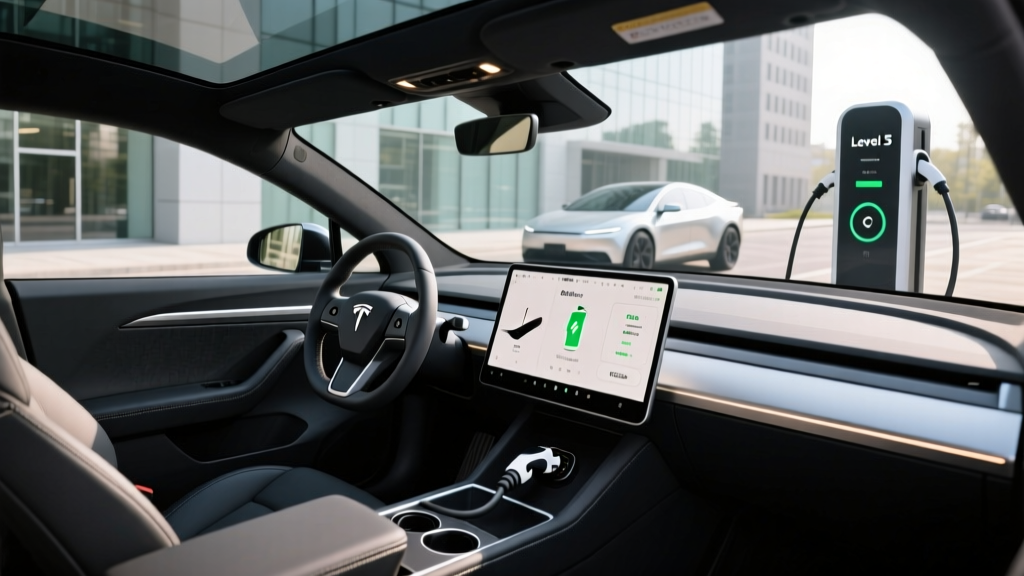
Step through the massive powered tonneau-equipped bed and into the cabin, and the Cybertruck's interior is simultaneously minimalist and massive. Tesla has stripped away nearly every physical button, routing climate, media, and even glovebox release through the 18.5-inch center touchscreen. A secondary 9.4-inch rear touchscreen gives back-seat passengers control over their own climate zone and media — a genuine improvement over earlier Tesla rear-seat experiences.
Material quality has come a long way from early prototypes. The dashboard uses a textured microfiber-like material that resists glare, and the seats in the Foundation Series and higher trims use a premium vegan leather that holds up well after months of use. Fit and finish on 2025-production trucks is noticeably tighter than the earliest 2024 deliveries, though some owners still report panel-gap variation on exterior body panels.
Interior Dimensions at a Glance
| Measurement | Cybertruck (Front) | Cybertruck (Rear) |
|---|---|---|
| Headroom | 40.2 in | 37.8 in |
| Legroom | 41.3 in | 35.2 in |
| Shoulder Room | 62.0 in | 58.4 in |
| Hip Room | 58.0 in | 54.1 in |
The six-foot bed (with the tonneau deployed, effectively an enclosed vault) offers 67 cubic feet of lockable cargo volume. With the rear seats folded, the cabin itself adds roughly 30 cubic feet of flat-load space. The front trunk (frunk) contributes an additional 7.1 cubic feet — enough for a full set of charging cables and a soft-sided cooler.
✅ Interior Pros
- Vast lockable bed vault with powered tonneau
- 18.5-inch front + 9.4-inch rear touchscreens
- Flat-fold rear seats create massive cargo floor
- HEPA bioweapon-defense air filtration standard
❌ Interior Cons
- Zero physical buttons — even wipers are touchscreen
- Sharp interior angles can limit small-item storage
- Rear visibility hampered by narrow rear glass
- No traditional spare tire (uses sealant + compressor)
EPA Range, Battery Chemistry, and Real-World Expectations
The Cybertruck's battery pack is a structural, 4680-cell unit using Tesla's nickel-based chemistry (NMC-type), not the LFP cells found in some Model 3/Y Standard Range variants. Usable capacity sits at approximately 123 kWh — one of the largest packs in any consumer EV sold in the U.S.
| Spec | Dual Motor AWD | Cyberbeast (Tri-Motor) |
|---|---|---|
| EPA Range | 340 miles | 320 miles |
| Battery (Usable) | ~123 kWh (NMC 4680) | ~123 kWh (NMC 4680) |
| MPGe (Combined) | 72 MPGe | 68 MPGe |
| Efficiency | 48 kWh/100 mi | 50 kWh/100 mi |
| Drivetrain | Dual Motor AWD | Tri-Motor AWD |
| Horsepower | 600 hp | 845 hp |
| 0–60 mph | 4.1 sec | 2.6 sec |
| Towing Capacity | 11,000 lbs | 11,000 lbs |
Real-World Range Reality Check
EPA sticker: 340 miles (AWD) / 320 miles (Cyberbeast)
Expect in practice: ~270–290 miles at sustained 75-mph highway speeds in mild weather. In cold weather (below 32°F), plan for 220–250 miles before needing a charge. The Cybertruck's angular, stainless-steel body creates significant aerodynamic drag at highway speed — efficiency drops sharply above 65 mph. Towing a 7,000-lb trailer cuts range roughly in half, to ~150–170 miles.
Tesla offers a Range Extender accessory — an auxiliary battery pack that occupies roughly one-third of the bed and adds an estimated 40–47 miles of range. Availability has been limited, and pricing sits around $16,000. For most owners, it's unnecessary; for frequent long-haul tow-ers, it may justify the bed-space trade-off.
Charging Speed: DC Fast Charge and Home Level 2
The Cybertruck uses a native NACS connector (Tesla's proprietary plug, now the North American Charging Standard), giving it direct access to Tesla's Supercharger network — still the most reliable and extensive DC fast-charging infrastructure in the U.S., per Tesla Supercharger data.
| Charging Level | Power / Rate | Speed / Time |
|---|---|---|
| Level 1 (120V) | ~1.4 kW | ~3 mi/hr |
| Level 2 (240V / 48A) | 11.5 kW | ~22 mi/hr (~13 hrs 10–100%) |
| DC Fast (Peak) | 350 kW (Supercharger V4) | 10–80% in ~20 min |
| DC Fast (Sustained Avg) | ~180–220 kW | 10–80% real-world ~28 min |
Peak 350-kW rates are only achieved on the newest V4 Supercharger stalls equipped with the CCS-compliant Magic Dock or native NACS V4 cables. On older V3 stalls (250 kW peak), expect 10–80% in roughly 25–30 minutes. The charge curve tapers noticeably above 60% state of charge — by 80%, you're typically seeing 80–100 kW, and above 90%, it slows to under 40 kW. This is standard for large NMC packs, but it means the last 20% takes almost as long as the first 70%.
For home charging, Tesla recommends the Wall Connector at 48 amps on a 60-amp dedicated circuit. Expect to add roughly 22 miles of range per hour of Level 2 charging — enough to replenish a daily commute overnight. Installation costs typically range from $800 to $2,500 depending on panel capacity and run length; a 200-amp panel upgrade (if needed) adds $1,500–$3,500.
Performance and Driving Dynamics
The Dual Motor AWD delivers 600 horsepower and a 4.1-second 0–60 mph time — quick for any vehicle, let alone a 6,600-lb stainless-steel truck. The Cyberbeast's tri-motor setup pushes 845 horsepower and a supercar-rivaling 2.6-second sprint. In real driving, the Cyberbeast's acceleration is genuinely startling, though the sheer mass of the vehicle is evident in braking distances and cornering body roll.
The steer-by-wire system (Tesla calls it no mechanical linkage between the steering wheel and the wheels) is the first implementation of its kind in a U.S.-market production truck. The yoke-style steering wheel requires less than one full turn lock-to-lock, making low-speed parking maneuvers effortless but demanding an adjustment period at highway speeds. Most drivers adapt within a week, but it remains a polarizing feature.
Ride quality benefits from the adaptive air suspension, which offers adjustable ride height from 9 to 16 inches of ground clearance. On smooth pavement, the Cybertruck is composed and quiet; on broken pavement, the weight and stiff structure transmit more impact than a Rivian R1T or Ford F-150 Lightning. The 35-inch all-terrain tires help off-road, but this is a heavy vehicle — approach it with respect on loose surfaces.
Pricing, Trims, and Federal Tax Credit Eligibility
| Trim | Base MSRP | Est. Federal Credit (§30D) | Effective Price |
|---|---|---|---|
| Rear-Wheel Drive (Long Range)* | $60,990 | Up to $7,500 | ~$53,490 |
| Dual Motor AWD | $79,990 | Up to $7,500 | ~$72,490 |
| Cyberbeast (Tri-Motor) | $99,990 | Up to $7,500 | ~$92,490 |
*Rear-Wheel Drive (Long Range) expected for 2026 production; specs preliminary until deliveries begin.
Federal tax credit eligibility under IRS §30D depends on several factors that change annually:
- MSRP cap: Trucks/vans/SUVs must be at or below $80,000 MSRP. The Dual Motor AWD qualifies; the Cyberbeast does not.
- Income limits: Modified AGI must not exceed $150,000 (single), $225,000 (head of household), or $300,000 (joint).
- Battery sourcing: Critical minerals and battery components must meet escalating North American/free-trade-partner thresholds. Tesla's domestic 4680 cell production in Austin positions the Cybertruck favorably, but exact compliance percentages shift yearly.
- Point-of-sale transfer: Eligible buyers can apply the credit as an immediate dealer discount rather than waiting for a tax refund.
Because the Cyberbeast exceeds the $80,000 truck MSRP cap, it does not qualify for the federal credit regardless of buyer income. The Dual Motor AWD and the upcoming RWD Long Range model are positioned to qualify — provided battery-sourcing requirements continue to be met. Always verify current-year eligibility on fueleconomy.gov before purchasing.
Technology, Driver Assistance, and Safety
The Cybertruck runs Tesla's latest vehicle software with a 18.5-inch primary display handling navigation, media, climate, and vehicle settings. Wireless Apple CarPlay and Android Auto are still not natively supported — Tesla relies on its own integrated ecosystem, including streaming apps, gaming, and a built-in browser.
⚠️ SAE Automation Level: Level 2
Tesla's Autopilot and Full Self-Driving (Supervised) are SAE Level 2 driver-assistance systems. They require continuous driver supervision — hands on or near the wheel, eyes on the road. They are not autonomous or self-driving. Only SAE Level 4 services (like Waymo in designated zones) operate without a human driver.
Standard Autopilot includes adaptive cruise control and lane-centering. The optional FSD (Supervised) package ($8,000 one-time or $99/month subscription as of early 2026) adds automatic lane changes, traffic-light recognition, and navigation-guided steering on city streets. FSD capability has improved substantially, but it still requires active monitoring and occasional intervention, particularly in construction zones and on poorly marked roads.
The Cybertruck has not yet been rated by the IIHS, and NHTSA ratings are pending full evaluation. Tesla equips the truck with eight cameras, automatic emergency braking, blind-spot monitoring, and a unique side-camera system that replaces traditional mirrors on some configurations (camera-based mirrors are expected for 2026).
FSD Limitations
- Not self-driving — driver must remain fully attentive
- Performance degrades in heavy rain, snow, or construction zones
- Phantom braking events still reported by owners
- $8,000 purchase or $99/mo subscription is non-transferable between vehicles
Warranty and Long-Term Ownership
| Coverage | Term |
|---|---|
| Basic Vehicle | 4 years / 50,000 miles |
| Battery & Drive Units | 8 years / 120,000 miles (min 70% retention) |
| Roadside Assistance | 4 years / 50,000 miles |
Tesla's battery warranty guarantees at least 70% capacity retention over 8 years or 120,000 miles, whichever comes first. Based on data from Tesla's high-mileage Model S and Model 3 fleets, NMC 4680 cells are expected to degrade roughly 10–12% over the first 100,000 miles, with degradation slowing significantly after the initial break-in period. The structural battery pack design makes individual module replacement difficult — a full pack replacement out of warranty could exceed $20,000, though this is unlikely within the warranty period for normal use.
Insurance costs for the Cybertruck run 25–40% higher than comparable full-size trucks, driven by repair complexity (stainless-steel body panels, steer-by-wire components) and high replacement costs. Expect annual premiums of $3,000–$4,500 depending on state and driving record. Tesla Insurance is available in many states and may offer competitive rates for low-mileage drivers.
Who Is the Cybertruck For?
Choose the Cybertruck If:
- You need a lockable, weatherproof bed vault for gear, tools, or adventure equipment
- You tow heavy (up to 11,000 lbs) and want EV torque for trailer launches
- You have home Level 2 charging and rarely exceed 250 miles between charges
- You want cutting-edge tech and don't mind a learning curve (steer-by-wire, yoke, touchscreen-everything)
Consider a Competitor If:
- You need a conventional steering wheel and physical buttons → Ford F-150 Lightning
- You prioritize off-road capability and a more refined interior → Rivian R1T
- You want a traditional truck bed with an open top → Chevrolet Silverado EV
- You need a third row or maximum passenger space → look at SUV platforms instead
Frequently Asked Questions
What is the real-world range of the Cybertruck?
The EPA rates the Dual Motor AWD at 340 miles and the Cyberbeast at 320 miles. In real-world highway driving at 75 mph in moderate temperatures, expect 270–290 miles. Cold weather (below freezing) reduces this to roughly 220–250 miles. Towing a heavy trailer can cut range to 150–170 miles.
How fast does the Cybertruck charge?
At a V4 Supercharger, the Cybertruck peaks at 350 kW and charges from 10–80% in roughly 20 minutes under ideal conditions. Real-world 10–80% sessions average 25–30 minutes on V3 stalls. Home Level 2 charging adds about 22 miles of range per hour (11.5 kW).
How much does the Cybertruck cost after tax credits?
The Dual Motor AWD starts at $79,990 and may qualify for the full $7,500 federal tax credit under IRS §30D (subject to income, MSRP, and battery-sourcing rules), bringing the effective price to ~$72,490. The Cyberbeast at $99,990 exceeds the $80,000 MSRP cap for trucks and does not qualify for the federal credit.
Is the Cybertruck worth buying vs. the F-150 Lightning or Rivian R1T?
The Cybertruck offers the most lockable cargo space (bed vault + frunk) and the highest towing capacity (11,000 lbs). The F-150 Lightning provides a more traditional truck experience with physical controls and a lower starting price. The Rivian R1T excels in off-road capability and interior refinement. Your choice depends on whether you value the Cybertruck's unique bed vault and tech-forward cabin over conventional truck ergonomics.
Does the Cybertruck qualify for the federal EV tax credit?
The Dual Motor AWD ($79,990 MSRP) and the upcoming RWD Long Range ($60,990) are below the $80,000 MSRP cap for trucks and may qualify for up to $7,500 under §30D, provided the buyer meets income limits and battery-sourcing requirements are satisfied. The Cyberbeast ($99,990) does not qualify. Always verify current eligibility on fueleconomy.gov before purchasing.
What are the biggest drawbacks of the Cybertruck?
The touchscreen-only controls (no physical buttons), the yoke steering wheel with steer-by-wire system, high insurance premiums, significant highway-speed range loss due to aerodynamic drag, and the Cyberbeast's ineligibility for the federal tax credit are the most commonly cited limitations.