The Tesla Cybertruck has never been a conventional pickup, and its journey from concept to driveway has been marked by controversy, delays, and engineering surprises. One issue that has drawn outsized attention from owners and forums alike is Cybertruck hitch failure — reports of the trailer hitch receiver detaching, bending, or failing under load. For a vehicle marketed with an 11,000-pound towing capacity, any structural concern around the hitch is a serious matter.
This review examines the hitch failure issue in context, then delivers the full Cybertruck ownership picture: real-world range, charging speed, pricing after tax credits, and how it stacks up against the Ford F-150 Lightning and Rivian R1T. If you're considering a Cybertruck for towing — or just want to know whether the headlines are warranted — here's the data you need.
The Cybertruck Hitch Failure Issue: What We Know
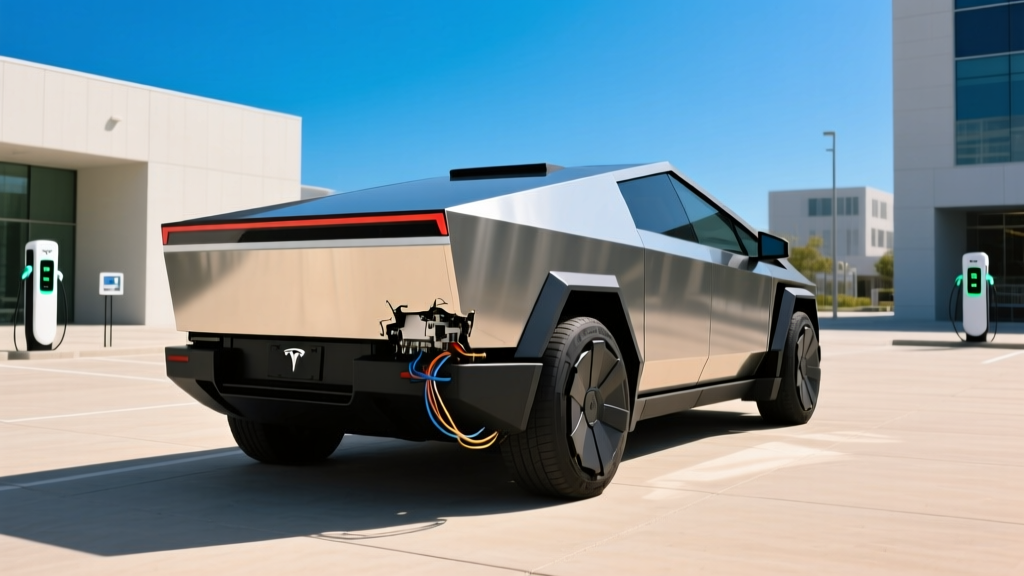
Beginning in late 2024 and continuing into 2025, multiple Cybertruck owners reported hitch-related problems on forums including the Tesla Motors Club and Reddit's r/CyberStuck. The complaints generally fall into three categories:
- Hitch receiver separation: The 2-inch receiver allegedly pulling away from its mounting point under heavy tongue weight or dynamic trailer loads.
- Hitch pin shear: Reports of the locking pin deforming or shearing when towing near the rated capacity.
- Software-related trailer brake calibration: Some owners noted the integrated trailer brake controller behaved inconsistently, though Tesla issued OTA updates to address this.
Tesla has not issued a formal NHTSA recall specifically for hitch receiver detachment as of early 2026, but the company did release a service bulletin reinforcing hitch installation torque specifications and, in some cases, replacing hitch assemblies under warranty. Owners who experienced failures report that Tesla service centers addressed the issue at no charge, though wait times for parts varied.
Real-World Range: EPA Sticker vs. What You'll Actually Get
Real-World Expectation: ~270–300 miles highway (70–75 mph); ~200–230 miles when towing a 5,000-lb trailer; ~240–260 miles in sub-30°F cold weather.
The Cybertruck AWD (dual-motor) carries an EPA rating of 340 miles, while the tri-motor Cyberbeast is rated at 320 miles. These figures assume moderate temperatures, mixed driving, and no payload. In practice, the Cybertruck's brutalist angular shape — striking as it is — creates substantial aerodynamic drag at highway speeds. Independent testing by outlets like Edmunds and Motor Trend has consistently shown highway range falling 12–20% below the EPA sticker.
Towing is where range drops most dramatically. Expect to lose 35–45% of your range when pulling a loaded trailer in the 5,000–8,000 lb range. That 340-mile sticker becomes roughly 200 miles of practical range before you need to plan a charging stop — a critical consideration for anyone buying this truck for trailer work.
Charging Speed: DC Fast Charging and Home Setup
| Charge Level | Power / Rate | Time / Miles Added |
|---|---|---|
| Level 1 (120V) | ~1.4 kW | ~3–4 miles per hour |
| Level 2 (240V / 48A) | 11.5 kW | ~30–34 miles per hour; full charge in ~11 hrs |
| DC Fast Charge (V4 Supercharger) | Peak ~350 kW | 10–80% in ~18–22 minutes (with preconditioning) |
| DC Fast Charge (250 kW V3) | Peak ~250 kW | 10–80% in ~25–30 minutes |
The Cybertruck uses Tesla's NACS (North American Charging Standard) connector natively and charges on the Supercharger network without adapters. On V4 Supercharger cabinets capable of 350 kW, the Cybertruck's 800-volt-class architecture allows impressive peak charge rates. However, as with all EVs, peak kW is not sustained kW. The charge curve tapers significantly above 60% state of charge, and the final 80–100% top-off can add 20+ minutes. For road-trip efficiency, plan stops around the 10–80% window.
At home, the Cybertruck accepts up to 11.5 kW on Level 2 using a Wall Connector at 48 amps. This adds roughly 30–34 miles of range per hour of charging, meaning an overnight session from 20% to full takes about 10–11 hours. Ensure your electrician installs a 60-amp circuit (NEMA 14-50 or hardwired) to support this rate — a 40-amp circuit limits you to roughly 9.6 kW and slower recovery.
Performance, Battery, and Drivetrain Specs
| Specification | AWD (Dual-Motor) | Cyberbeast (Tri-Motor) |
|---|---|---|
| Battery Capacity (usable) | ~123 kWh | ~123 kWh |
| Battery Chemistry | NMC (Nickel Manganese Cobalt) | NMC |
| Horsepower | 600 hp | 845 hp |
| 0–60 mph | 3.9 seconds | 2.6 seconds |
| Drivetrain | Dual-motor AWD | Tri-motor AWD |
| Max Towing Capacity | 11,000 lbs | 11,000 lbs |
| Payload Capacity | 2,500 lbs | 2,500 lbs |
| EPA Range | 340 miles | 320 miles |
| Efficiency (MPGe) | ~67 MPGe combined | ~62 MPGe combined |
| Efficiency (kWh/100 mi) | ~50 kWh/100 mi | ~54 kWh/100 mi |
The Cybertruck's NMC battery pack is among the largest in any production consumer EV. NMC chemistry offers higher energy density than LFP (lithium iron phosphate), which is necessary given the truck's mass and range targets. The trade-off: NMC cells degrade slightly faster over thousands of cycles and are more sensitive to sustained 100% state-of-charge storage. Tesla recommends daily charging to 80–90% and only charging to 100% before long trips.
Performance is genuinely supercar-level in the Cyberbeast, which hits 60 mph in 2.6 seconds — absurd for a 6,800-lb stainless-steel truck. The dual-motor AWD is hardly slow at 3.9 seconds. Both trims feature adaptive air suspension with up to 16 inches of ground clearance in Off-Road mode, and steer-by-wire eliminates the mechanical linkage between the yoke and the front wheels.
Pricing, Trims, and Federal Tax Credit Eligibility
| Trim | Base MSRP (2025/2026) | §30D Tax Credit Eligible? | Est. After Credit |
|---|---|---|---|
| AWD (Dual-Motor) | $79,990 | No (MSRP exceeds $80,000 truck cap) | $79,990 |
| Cyberbeast (Tri-Motor) | $99,990 | No (MSRP exceeds $80,000 truck cap) | $99,990 |
| RWD (announced, 2026+) | $60,990 (est.) | Potentially (if under $80K cap + sourcing rules met) | ~$53,490 (if eligible) |
The Cybertruck's pricing places both current trims above the IRS §30D federal tax credit MSRP cap of $80,000 for trucks. This means neither the AWD nor the Cyberbeast qualifies for the up-to-$7,500 federal credit under current rules. The forthcoming RWD base model, announced but not yet available for delivery as of early 2026, may fall under the cap — but eligibility will also depend on battery component and critical mineral sourcing requirements, buyer income limits ($300,000 joint / $150,000 single AGI), and point-of-sale transfer availability. Always verify current eligibility on IRS.gov before purchasing.
Destination fees, Tesla's order fee, and optional add-ons (Full Self-Driving capability, wraps, all-weather accessories) can push as-tested prices $5,000–$15,000 above base MSRP.
Cargo Space, Interior, and Standout Tech
The Cybertruck's 6-foot bed (with the tonneau closed) offers 67 cubic feet of cargo volume, expandable with the tailgate down. The front trunk (frunk) adds roughly 7 cubic feet — useful for charging cables, groceries, or gear you want secured and weatherproof. The bed features a powered retractable tonneau cover that Tesla claims can support 300 lbs of distributed weight.
Interior space is adequate but not class-leading. Rear-seat legroom measures approximately 38 inches — sufficient for adults on moderate trips but tighter than an F-150 Lightning's rear row. The cabin seats five, though the rear center position is compromised by a stiff seatback and transmission tunnel hump.
Standout tech features:
- Steer-by-wire: No mechanical connection between the yoke and wheels; enables variable steering ratios and extremely tight low-speed turns.
- 48-volt electrical architecture: A first in mass-production vehicles, reducing wiring harness weight and enabling higher-power accessories.
- 18.5-inch front touchscreen + 9.4-inch rear screen: Runs Tesla's latest infotainment with navigation, streaming, and gaming.
- Autopilot (Level 2 ADAS): Includes adaptive cruise, lane centering, and automatic emergency braking. Full Self-Driving (Supervised) is a $8,000 option — but remains a Level 2 system requiring constant driver supervision.
- Bioweapon Defense Mode: HEPA filtration system for cabin air quality.
- Powershare (V2L/V2H): Vehicle-to-load capability can power tools, appliances, or provide backup home power (up to 11.5 kW output).
Notable drawbacks:
- Stainless steel exoskeleton shows fingerprints, smudges, and can be difficult to repair after dents.
- Visibility is compromised by thick A-pillars and the angular rear profile; the camera-based rearview mirror (no traditional mirror) takes adjustment.
- Panel gaps and build-quality inconsistencies have been widely documented in early-production units.
- The yoke steering is polarizing and takes significant adaptation, particularly for three-point turns and parking maneuvers.
Warranty Coverage
Tesla provides the following warranty coverage for the Cybertruck:
- Basic Vehicle Limited Warranty: 4 years / 50,000 miles
- Battery & Drive Unit Warranty: 8 years / 120,000 miles (with minimum 70% battery capacity retention over the warranty period)
- Restraint System: 5 years / 60,000 miles
- Corrosion Perforation: 12 years / unlimited miles
The 8-year/120,000-mile battery warranty is competitive for the truck segment. Tesla's 70% capacity retention threshold is standard — meaning if your 123 kWh pack drops below ~86 kWh usable capacity within the warranty window, Tesla will repair or replace it. Real-world data on Cybertruck-specific degradation is still limited given the vehicle's 2024 launch, but Tesla's NMC packs in the Model S and Model X have historically retained 85–92% capacity at 100,000 miles.
Cybertruck vs. F-150 Lightning vs. Rivian R1T
| Spec | Cybertruck AWD | F-150 Lightning Ext. Range | Rivian R1T Dual-Motor Max |
|---|---|---|---|
| EPA Range | 340 mi | 320 mi | 410 mi |
| Max Towing | 11,000 lbs | 10,000 lbs | 11,000 lbs |
| 0–60 mph | 3.9 sec | 3.8 sec | 3.5 sec |
| Base MSRP | $79,990 | ~$69,995 | ~$89,000 |
| DC Fast Charge Peak | ~350 kW | ~150 kW | ~200 kW |
| §30D Credit Eligible | No (over MSRP cap) | Yes (select trims) | No (over MSRP cap) |
| Bed Length | 6 ft | 5.5 ft | 4.5 ft |
Choose the F-150 Lightning if: You want a proven truck platform, better rear-seat comfort, a more traditional driving experience, and potential §30D tax credit eligibility on lower trims.
Choose the Rivian R1T if: Range is your top priority (410 mi on Max Pack), you value adventure-oriented features like the gear tunnel, and you prefer a more refined interior at a premium price.
Who Should Buy the Cybertruck?
The Cybertruck fits a specific buyer profile: someone who wants maximum towing capacity, appreciates Tesla's Supercharger network advantage for road trips, and values performance and tech over traditional truck comfort. It works well as a daily-driver-plus-weekend-tower — commuting during the week and hauling a boat, horse trailer, or camper on weekends.
It's less ideal for buyers who need maximum rear-seat space for family use, who want a proven work-truck pedigree with dealer service networks in rural areas, or who need the federal tax credit to make the math work. The hitch failure reports, while addressed by Tesla under warranty, are worth monitoring if you plan to tow at or near the 11,000-lb limit regularly.
- Class-leading DC fast charging (~350 kW peak)
- 11,000-lb towing + 2,500-lb payload
- Supercar-level acceleration
- V2L/V2H Powershare capability
- Supercharger network access (NACS native)
- Air suspension with 16" ground clearance
- Hitch failure reports under heavy towing loads
- No federal tax credit on current trims
- Significant range loss when towing (35–45%)
- Build-quality inconsistencies (panel gaps)
- Yoke steering requires adaptation
- Stainless steel body difficult to repair
- Tight rear seat vs. full-size competitors
Frequently Asked Questions
What is the real-world range of the Cybertruck when towing?
Expect approximately 200–230 miles of range when towing a 5,000-lb trailer at highway speeds. Heavier loads (8,000+ lbs) can reduce range to 170–190 miles. Always plan charging stops conservatively when towing — Supercharger stalls with pull-through trailer parking remain limited.
Has Tesla issued a recall for Cybertruck hitch failures?
As of early 2026, no formal NHTSA recall has been issued specifically for hitch receiver detachment. Tesla has addressed individual reports through service bulletins and warranty replacements. Owners experiencing hitch issues should contact Tesla Service for inspection.
Does the Cybertruck qualify for the $7,500 federal EV tax credit?
No. Both currently available trims (AWD at $79,990 and Cyberbeast at $99,990) exceed the IRS §30D MSRP cap of $80,000 for trucks. The planned RWD base model may qualify if its final MSRP stays under the cap and battery sourcing requirements are met. Verify at IRS.gov.
How fast does the Cybertruck charge at home?
On a 240V Level 2 circuit at 48 amps (11.5 kW), the Cybertruck adds roughly 30–34 miles of range per hour. A full charge from near-empty takes about 11 hours. A 60-amp dedicated circuit is recommended for optimal charging.
Is the Cybertruck worth buying over the F-150 Lightning?
It depends on priorities. The Cybertruck charges significantly faster (350 kW vs. 150 kW), tows slightly more (11,000 vs. 10,000 lbs), and offers a more futuristic tech experience. The F-150 Lightning provides a more conventional truck experience, better rear-seat comfort, broader dealer service access, and potential tax credit eligibility. For heavy towing, the Cybertruck's hitch reports warrant caution until more long-term data is available.
What battery chemistry does the Cybertruck use?
The Cybertruck uses NMC (nickel manganese cobalt) lithium-ion cells with approximately 123 kWh of usable capacity. NMC provides the energy density needed for the truck's range and performance targets. Tesla recommends daily charging to 80–90% to maximize long-term battery health.