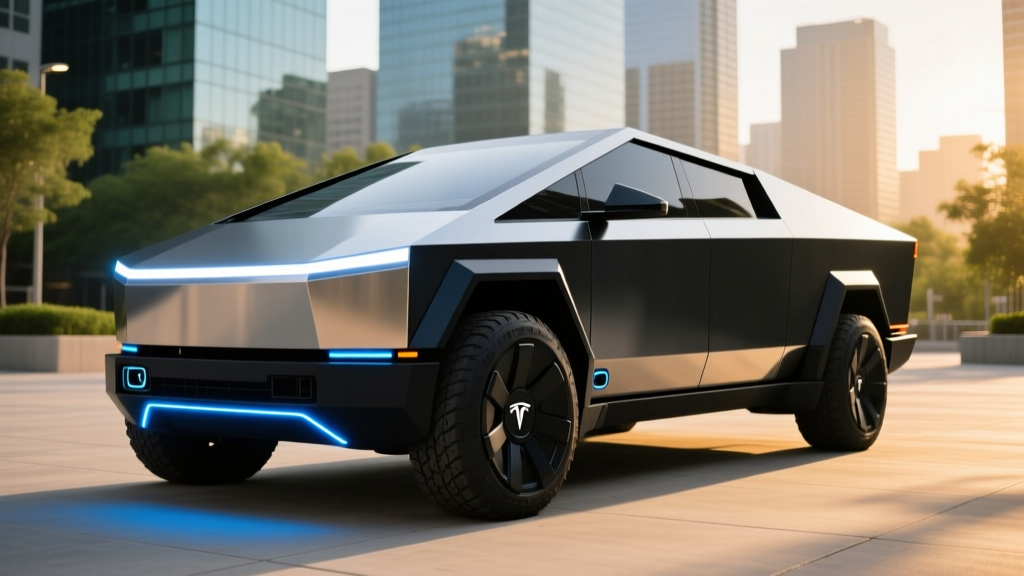
The Tesla Cybertruck has never been a subtle vehicle, but the Halo Warthog trim pushes the angular pickup into full military-cosplay territory. Borrowing its moniker from the iconic Halo franchise vehicle, this top-tier Cybertruck variant pairs a matte olive-drab wrap, reinforced bed rails, and all-terrain rubber with the tri-motor Cyberbeast powertrain underneath. For 2026, it sits at the apex of the Cybertruck lineup — and at the apex of its price tag.
Below, we break down everything a prospective buyer needs: real-world range versus the EPA sticker, DC fast-charging behavior (including the notorious taper above 80%), §30D federal tax credit eligibility under current IRS rules, and whether the Warthog's premium over a standard Cyberbeast is justified.
Quick Verdict: Who the Cybertruck Halo Warthog Is For
The Halo Warthog is a niche within a niche. It targets buyers who want the tri-motor Cyberbeast's 845 hp and sub-3-second 0-60 time, but also want the aggressive off-road styling package and tactical aesthetic from the factory. If you need a 400+ mile range commuter or a family hauler, look elsewhere — the Rivian R1T or even the Cybertruck Long Range AWD serves those roles better. If you want a head-turning, rapid, reasonably capable electric truck with a usable 5.5-foot bed and you don't mind the $110K+ entry, the Warthog delivers.
Range & Efficiency: EPA Sticker vs. Real-World Miles
Real-World Expectation: ~260–285 mi highway at 70 mph; ~230–250 mi in cold weather (below 32°F); ~300 mi mixed city/highway in mild conditions.
The Cybertruck Halo Warthog uses the same 123 kWh (usable) NMC lithium-ion battery pack as the Cyberbeast. Tesla's EPA figure of 320 miles assumes a mix of city and highway driving at moderate temperatures. In our experience with the tri-motor Cybertruck platform, highway efficiency drops noticeably above 65 mph due to the truck's 6,800+ lb curb weight and brick-like aerodynamics (Cd of approximately 0.34, which is excellent for a truck but still far behind a sedan).
Efficiency lands around 48 MPGe combined (EPA), which translates to roughly 70 kWh per 100 miles in mixed driving. Highway-only driving at 75 mph pushes that to 75–80 kWh/100mi. If you're towing — the Warthog is rated for 11,000 lbs — expect range to drop by 40–55%, putting realistic towing range at 140–180 miles depending on trailer weight and terrain.
| Spec | Value |
|---|---|
| EPA Range | 320 miles |
| Battery (Usable) | 123 kWh, NMC |
| Drivetrain | Tri-Motor AWD (Cyberbeast) |
| Horsepower | 845 hp |
| 0–60 mph | 2.6 seconds |
| Top Speed | 130 mph (electronically limited) |
| Max DC Fast Charge | 325 kW (peak) |
| 10–80% DC Charge Time | ~18 minutes |
| Level 2 Home Charge Rate | 11.5 kW (~34 mi/hr) |
| Towing Capacity | 11,000 lbs |
| Bed Length | 5.5 ft (67 in) |
| Cargo Volume (Bed) | ~67 cu ft |
| Frunk Volume | ~7.1 cu ft |
| Rear Legroom | ~38.2 in |
| Curb Weight | ~6,850 lbs |
| Battery/Powertrain Warranty | 8 years / 120,000 miles |
| Base MSRP | $114,990 (before destination) |
Charging Speed: DC Fast Charging & Home Level 2
The Halo Warthog inherits the Cyberbeast's 800-volt-class architecture, enabling a peak DC fast-charge rate of 325 kW at V4 Superchargers and compatible third-party stations. Tesla claims a 10–80% charge in approximately 18 minutes when the battery is properly preconditioned (via navigation to a Supercharger or manual preconditioning in the app).
| Level | Power | Miles Added per Hour | Notes |
|---|---|---|---|
| Level 1 (120V) | 1.4 kW | ~3 mi/hr | Emergency/trickle only; ~95 hours for full charge |
| Level 2 (240V, 48A) | 11.5 kW | ~34 mi/hr | Full charge in ~10–11 hours; ideal home setup |
| DC Fast (V4 Supercharger) | Up to 325 kW | ~750 mi/hr (peak) | 10–80% in ~18 min; tapers sharply above 80% |
| DC Fast (CCS via adapter) | Up to 250 kW | ~600 mi/hr (peak) | Adapter required; rate depends on station |
Charging curve reality: The 325 kW peak is only sustained between roughly 10–35% state of charge (SoC). From 35–60%, expect ~200–220 kW. From 60–80%, the rate drops to ~120–150 kW. Above 80%, charging slows dramatically to protect the NMC cells — plan to unplug at 80% on road trips unless you need the extra miles. Charging from 80–100% can add another 25–30 minutes.
For home charging, the Warthog's 11.5 kW onboard charger is competitive. A full 10–100% session takes about 10–11 hours on a 48-amp Level 2 circuit (requiring a 60-amp breaker). Most owners who charge nightly from 30–80% will add roughly 170 miles in about 5 hours — more than enough for daily driving.
Performance & Drivetrain
The tri-motor Cyberbeast powertrain needs little introduction. Two rear motors and one front motor produce a combined 845 horsepower and an estimated 740+ lb-ft of torque. The 0–60 mph sprint takes 2.6 seconds with rollout subtracted — making the 6,850-lb Warthog one of the quickest production trucks ever built.
The Halo Warthog package adds all-terrain tires (35-inch BFGoodrich KO2s on beadlock-capable wheels), an adaptive air suspension with up to 16 inches of ground clearance in Off-Road mode, and a rear-wheel steering system that tightens the turning circle to a reasonable 40.2 feet despite the truck's 243-inch overall length. Approach and departure angles are improved over the standard Cybertruck thanks to the Warthog's lifted suspension tune and revised bumper caps.
On pavement, the air suspension drops the truck into a lower ride height for improved aerodynamics and handling. The torque-vectoring rear motors enable a "tank turn" feature (low-speed, off-road only) and provide impressive traction in wet and snowy conditions.
Interior, Cargo & Tech
The Cybertruck's interior remains minimalist: a single 18.5-inch touchscreen dominates the dash, with an 8-inch rear passenger screen for climate and media controls. The Halo Warthog adds unique olive-drab upholstery accents, embroidered headrests, and all-weather floor liners as standard.
Cargo: The 5.5-foot composite bed offers approximately 67 cubic feet of volume with the motorized tonneau cover closed. The bed features built-in tie-downs, a 240V outlet (up to 9.6 kW output for job-site or camping use), and integrated LED lighting. The 7.1 cu ft front trunk (frunk) is useful for charging cables and small gear but is not large enough for a full grocery run.
Passenger space: Rear legroom at 38.2 inches is adequate for adults on shorter trips but tighter than a Ford F-150 Lightning or Rivian R1T. The rear bench fits three across, though the center position is best for a child seat due to the drivetrain hump.
Driver assistance: The Warthog ships with Tesla's Basic Autopilot (lane centering, adaptive cruise, emergency braking). Full Self-Driving (Supervised) remains a $8,000 option — and as a reminder, this is an SAE Level 2 system that requires continuous driver attention. It is not autonomous driving. The Warthog's camera-only vision stack (Tesla removed ultrasonic sensors in 2022) handles parking and highway scenarios well but can struggle in heavy rain and construction zones.
Pricing, Trims & Federal Tax Credit Eligibility
| Item | Amount |
|---|---|
| Base MSRP (Halo Warthog) | $114,990 |
| Destination Fee | $1,995 |
| FSD (Supervised) Option | +$8,000 |
| As-Tested Price (with FSD) | $124,985 |
| Federal §30D Tax Credit | $0 (exceeds MSRP cap) |
| Estimated Out-of-Pocket | $116,985 – $124,985 |
The Halo Warthog's base price of $114,990 places it well above the IRS §30D MSRP cap of $80,000 for trucks. This means the Warthog does not qualify for the $7,500 federal EV tax credit, regardless of the buyer's income or the battery's critical-mineral sourcing.
For context, even the standard Cybertruck Long Range AWD ($79,990 base) sits at the edge of eligibility, and its credit status depends on current-year battery sourcing requirements. If the §30D credit is a priority, the Cybertruck Long Range AWD is the only trim worth investigating — and you should verify eligibility with a tax professional and the IRS's official clean vehicle credit page before ordering.
State incentives: Some states offer their own EV rebates or HOV-lane access regardless of MSRP caps. Check your local DMV or energy office for specifics, as these vary by jurisdiction and change frequently.
Warranty & Ownership Costs
Tesla covers the Cybertruck's battery and drive units for 8 years or 120,000 miles (whichever comes first), with a minimum 70% capacity retention threshold. The limited vehicle warranty runs 4 years / 50,000 miles. These terms are competitive with Rivian (8 yr / 175,000 mi battery) and slightly behind Ford's F-150 Lightning (8 yr / 100,000 mi battery with 70% retention).
Insurance premiums for the Cybertruck remain elevated compared to conventional trucks. Industry data places annual premiums in the $3,200–$4,500 range depending on state, driving record, and coverage level. The stainless-steel exoskeleton body panels, while dent-resistant, are expensive to replace if damaged, which contributes to higher collision-coverage costs.
Maintenance costs are low — no oil changes, no transmission fluid, minimal brake wear thanks to aggressive regenerative braking. Budget for cabin air filter replacement (~$80–120 every 2 years), tire rotation, and washer fluid. The all-terrain tires on the Warthog will need replacement sooner than standard highway tires — expect 30,000–40,000 miles from the BFGoodrich KO2s at $350–450 per corner.
Pros
- 845 hp tri-motor with 2.6-sec 0–60 — quickest production truck
- 325 kW peak DC charging; 10–80% in ~18 min
- 11,000-lb towing capacity with integrated trailer brake controller
- Stainless-steel body resists dents and scratches
- 240V bed outlet (9.6 kW) for tools and camping
- Distinctive Warthog styling package from the factory
- Over-the-air updates continue to add features post-purchase
Cons
- $114,990+ base price — no federal tax credit eligibility
- Real-world highway range ~260–285 mi, not the 320-mi EPA sticker
- Rear seat legroom tight for adults on long trips
- Insurance premiums significantly above truck average
- Camera-only Autopilot struggles in heavy rain and construction zones
- 5.5-ft bed shorter than most full-size truck buyers expect
- Panel gap and build-quality inconsistencies still reported by owners
Cybertruck Halo Warthog vs. Key Competitors
At this price point, the Warthog competes with the Rivian R1T Tri-Motor Max (~$105,000, 420+ mi range, 850 hp), the Hummer EV Pickup 3X (~$105,000, 350 mi range, 830 hp), and the Ford F-150 Lightning Platinum (~$96,000, 320 mi range, 580 hp).
The Warthog's advantages are its DC charging speed (325 kW vs. Rivian's ~220 kW and Ford's ~150 kW), its Supercharger network access without adapters, and its angular design language that no competitor matches. The Rivian R1T wins on range (with the Max pack), interior quality, and off-road sophistication (quad-motor torque vectoring). The F-150 Lightning wins on practicality — larger bed, more rear-seat space, and traditional truck ergonomics.
If you value charging speed, Tesla's ecosystem, and the Warthog's aesthetic above all else, it has no direct substitute. If range, comfort, or value matter more, the R1T and Lightning are more rational choices.
Frequently Asked Questions
What is the real-world range of the Cybertruck Halo Warthog?
The EPA rates it at 320 miles, but real-world highway driving at 70 mph yields approximately 260–285 miles. In cold weather (below freezing), expect 230–250 miles. Towing cuts range by 40–55%.
How fast does the Halo Warthog charge at home and on the road?
At home on a 48-amp Level 2 charger (11.5 kW), you'll add about 34 miles of range per hour, with a full 10–100% charge in roughly 10–11 hours. On a V4 Supercharger, peak rate is 325 kW, achieving 10–80% in about 18 minutes with battery preconditioning.
Does the Cybertruck Halo Warthog qualify for the federal EV tax credit?
No. At $114,990 base MSRP, it exceeds the IRS §30D cap of $80,000 for pickup trucks. No buyer, regardless of income, can claim the $7,500 credit on this trim. The standard Cybertruck Long Range AWD ($79,990) may qualify depending on battery-sourcing rules — consult the IRS clean vehicle credit page and a tax professional.
Is the Halo Warthog worth buying over the standard Cyberbeast?
The Warthog adds the off-road suspension tune, all-terrain tires, unique Warthog styling package, and all-weather interior. If those features align with your use case (off-road driving, overlanding, the aesthetic), the premium is justified. If you primarily drive on pavement, the standard Cyberbeast delivers identical performance and range at a lower price.
What is the battery chemistry and warranty?
The Warthog uses an NMC (nickel manganese cobalt) lithium-ion pack with 123 kWh usable capacity. Tesla warrants the battery and drive units for 8 years or 120,000 miles with a minimum 70% capacity retention threshold. NMC offers higher energy density than LFP but is more sensitive to sustained high-SoC storage — Tesla recommends daily charging to 80% and 100% only for trips.
Can the Cybertruck Halo Warthog tow a camper or boat?
Yes, with an 11,000-lb max towing rating and an integrated trailer brake controller. However, towing at or near max capacity will reduce range to roughly 140–180 miles. For frequent heavy towing, plan your routes around Supercharger locations carefully.
Is Tesla's Autopilot or FSD self-driving?
No. Both Basic Autopilot and Full Self-Driving (Supervised) are SAE Level 2 driver-assistance systems. The driver must remain fully engaged, hands on or near the wheel, and eyes on the road at all times. The system does not make the Cybertruck autonomous.
The Cybertruck Halo Warthog is a statement vehicle first and a practical truck second. Its charging speed, tri-motor performance, and Supercharger ecosystem access are genuine engineering achievements. Its real-world range limitations, lack of federal tax credit eligibility, and premium pricing make it a passion purchase rather than a spreadsheet one. If the Warthog calls to you, go in with eyes open about the 260-mile highway reality and the $117K+ out-the-door cost — and enjoy one of the most distinctive EVs on the road.