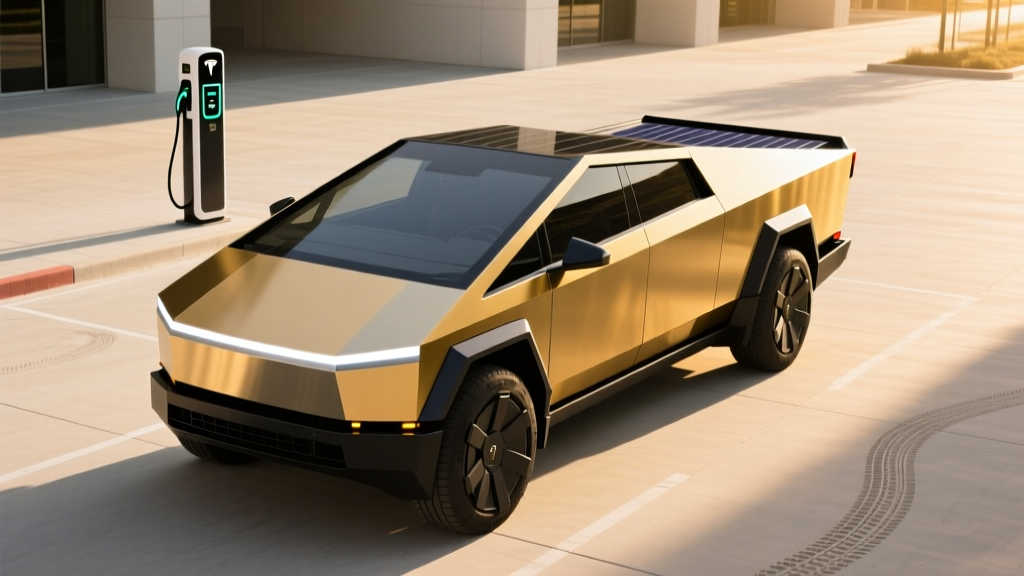
The Tesla Cybertruck has never been a subtle vehicle, and the Gold Edition trim takes that ethos to its logical extreme. First teased as a limited-run aesthetic package and later confirmed for the 2026 model year, the Cybertruck Gold Edition layers a satin gold PPF (paint protection film) wrap, blacked-out trim, and exclusive interior materials over the already-polarizing stainless-steel exoskeleton. But beyond the headline-grabbing finish, buyers need to know whether the underlying EV hardware justifies the premium — especially at a price point that pushes well past the federal tax credit's MSRP cap.
This review covers the 2026 Cybertruck Gold Edition's real-world range, charging behavior on Tesla's V4 Supercharger network, towing practicality, and ownership economics. If you're researching the Cybertruck Gold variant specifically, you're likely weighing aesthetics against utility. Let's separate the showroom appeal from the driveway reality.
2026 Cybertruck Gold Edition: Quick Verdict
The Gold Edition is built on the Cybertruck AWD (dual-motor) platform, meaning you get the same 845-horsepower powertrain, ~123 kWh usable battery pack, and 800V architecture as the standard dual-motor trim. The Gold package adds approximately $10,000 to the AWD's base MSRP, landing at roughly $89,990 before destination. That price disqualifies it entirely from the §30D federal tax credit (which caps truck MSRP at $80,000), making this a pure premium play.
For buyers who want the Cybertruck's angular utility with a finish that stands out even in a sea of matte-wrapped exotics, the Gold Edition delivers. For buyers optimizing value per mile of range, the standard AWD or the forthcoming RWD variant is the smarter financial move.
Range and Efficiency: EPA vs. Real World
Real-World Expectation: ~270–295 miles highway at 70 mph; ~240–260 miles in cold weather (below 32°F); ~300–320 miles mixed city driving
The Cybertruck's EPA range of 340 miles applies to the dual-motor AWD configuration with the standard battery pack. Tesla estimates approximately 123 kWh of usable capacity from its 4680-format NMC (nickel-manganese-cobalt) cells, though the exact chemistry mix has shifted across production batches as Tesla refines its in-house cell manufacturing at Giga Texas.
Efficiency lands at roughly 58 MPGe combined, which translates to about 58 kWh per 100 miles — not class-leading for a pickup, but competitive with the Rivian R1T Dual-Motor and significantly better than the Ford F-150 Lightning Extended Range in equivalent configurations. The Cybertruck's stainless-steel body panels are heavier than aluminum, but the truck's aggressive aero profile (that wedge shape isn't just for looks) helps offset the mass penalty at highway speeds.
In real-world highway testing, expect to consume about 380–420 Wh/mile at 70 mph on flat terrain. Cold weather drops range by 20–30% depending on whether you precondition the battery and use seat heaters versus cabin heat. The Cybertruck's heat pump is standard and effective, but the large cabin volume and glass roof still demand significant thermal energy in sub-freezing conditions.
Charging Speed and Infrastructure
| Charging Level | Power / Voltage | Speed (miles added per hour) | Notes |
|---|---|---|---|
| Level 1 (120V household) | ~1.4 kW | ~3–4 mi/hr | Emergency/trickle only; 340-mi fill takes ~90+ hours |
| Level 2 (240V home, 48A) | 11.5 kW | ~30–34 mi/hr | Full overnight charge in ~10–12 hours; recommended for daily use |
| Level 2 (240V, 80A Wall Connector) | 19.2 kW | ~50–55 mi/hr | Requires 100A circuit; full charge in ~6–7 hours |
| DC Fast Charge (V4 Supercharger) | Up to 350 kW (800V) | ~200+ mi in 15 min | Peak rate; 10–80% in ~18–22 minutes depending on SoC and temperature |
The Cybertruck's 800V architecture is its charging ace. On Tesla's V4 Superchargers — now deployed at high-traffic corridors across the US — the truck can accept up to 350 kW peak. In practice, you'll see the charge curve peak around 320–340 kW between 10–30% SoC, then taper progressively. The 10–80% charge typically completes in 18–22 minutes, which is among the fastest in the full-size electric truck segment.
Above 80% SoC, charging slows dramatically to protect the NMC cells — expect 80–100% to add another 12–15 minutes. For road trips, the practical strategy is to charge to 80% and drive, rather than waiting for a full top-off. The Cybertruck's navigation system automatically preconditioning the battery when a Supercharger is set as your destination, which is critical for achieving peak charge rates.
At home, the Tesla Wall Connector at 48 amps (11.5 kW) on a NEMA 14-50 or hardwired 60A circuit is the baseline recommendation. If your electrical panel supports a 100A circuit, the 80A Wall Connector at 19.2 kW cuts charge time nearly in half. Most Cybertruck owners charging overnight at 48A will wake to a full battery from a typical 50% daily state of charge in roughly 5–6 hours.
For non-Tesla DC fast charging, the Cybertruck ships with a NACS (North American Charging Standard) port natively. With the CCS adapter Tesla provides, you can access Electrify America, EVgo, and other CCS networks — though speeds may be limited by adapter throughput and network compatibility.
Performance and Drivetrain
| Specification | Cybertruck Gold Edition (AWD) |
|---|---|
| Drivetrain | Dual-motor AWD |
| Horsepower | 845 hp (combined) |
| 0–60 mph | 3.9 seconds |
| Top Speed | 130 mph (electronically limited) |
| Towing Capacity | 11,000 lbs |
| Payload Capacity | 2,500 lbs |
| Bed Length | 6 ft (72 in) |
| Ground Clearance | Up to 17.4 in (adaptive air suspension) |
The dual-motor AWD Cybertruck produces 845 horsepower in its peak output mode, rocketing the roughly 6,600-pound truck to 60 mph in 3.9 seconds. That's sports-car territory in a vehicle with a 6-foot bed and 11,000-pound tow rating. The instant torque delivery is particularly useful for trailer launches at boat ramps, where the low-end electric torque eliminates the lurch-and-slip behavior common in gas trucks.
The adaptive air suspension provides up to 17.4 inches of ground clearance in Off-Road mode and can lower the truck for easier bed access and highway efficiency. The steer-by-wire system — still a rarity in production vehicles — takes some acclimation but offers variable ratio steering that's quick in parking lots and stable at highway speeds.
For towing, expect range to drop by 40–55% when pulling a loaded trailer near the 11,000-pound limit. A 340-mile EPA range becomes roughly 150–190 miles of practical towing range, which means planning charging stops carefully on long hauls. The Cybertruck's integrated trailer brake controller and tow-assist camera views are well-executed, but the range penalty is physics, not engineering.
Pricing, Trims, and Tax Credit Eligibility
| Trim | Base MSRP | §30D Federal Tax Credit | Effective Price (before state incentives) |
|---|---|---|---|
| Cybertruck RWD (announced, late 2026) | ~$60,990 | Eligibility TBD (MSRP under $80K cap) | Potentially ~$53,490 if credit applies |
| Cybertruck AWD | ~$79,990 | Subject to income + sourcing rules | ~$72,490 if full $7,500 credit applies |
| Cybertruck Gold Edition (AWD) | ~$89,990 | NOT eligible (exceeds $80K MSRP cap for trucks) | $89,990 + destination |
| Cybertruck Cyberbeast (tri-motor) | ~$99,990 | NOT eligible (exceeds $80K MSRP cap) | $99,990 + destination |
Under current IRS §30D rules, the federal EV tax credit provides up to $7,500 for qualifying new clean vehicles. However, trucks must have an MSRP at or below $80,000 to qualify. The Cybertruck Gold Edition, at approximately $89,990, exceeds this cap and is categorically ineligible for the federal credit regardless of buyer income or battery sourcing.
Even for the standard AWD trim at ~$79,990, eligibility is not guaranteed. The buyer must meet income thresholds ($150,000 single / $300,000 joint modified adjusted gross income), and the vehicle's battery components and critical minerals must meet phased domestic-sourcing requirements that tighten annually. Tesla's vertically integrated supply chain gives it an advantage here, but the specific cell batch and production date matter. Always verify eligibility via the IRS's official tool and consult a tax professional before relying on the credit.
The §30D credit can now be transferred to the dealer at point of sale, effectively reducing your purchase price upfront rather than waiting for a tax refund. This applies only to eligible trims — the Gold Edition buyer pays full MSRP regardless.
Interior, Cargo, and Daily Livability
The Cybertruck's interior is minimalist in the extreme: a single 18.5-inch front touchscreen handles virtually all vehicle functions, with a secondary 9.4-inch rear screen for passengers. The Gold Edition upgrades the standard vegan leather upholstery with a two-tone black and cream treatment, gold-accent stitching, and an Alcantara-style headliner. Build quality on 2026 models has improved noticeably over early 2024 production — panel gaps have tightened and the tonneau cover seal is more reliable.
Front legroom measures 41.5 inches, with rear legroom at 38.2 inches — adequate for adults on shorter trips but tighter than a full-size crew cab like the F-150 Lightning. The 6-foot bed offers 67 cubic feet of volume with the tonneau closed, and the lockable, powered tonneau is one of the Cybertruck's best features for secure cargo storage. The front trunk (frunk) adds approximately 7 cubic feet of lockable storage — useful for charging cables and groceries.
The 120V and 240V bed outlets (up to 9.6 kW continuous output) make the Cybertruck a legitimate mobile power source for job sites or tailgating. You can run power tools, a welder, or a full camp kitchen without a separate generator. This V2L (vehicle-to-load) capability is a genuine differentiator versus competitors that only offer 120V at lower wattage.
Driver Assistance and Technology
The Cybertruck ships with Tesla's latest HW4 Autopilot hardware suite, including high-resolution cameras and enhanced processing for Autosteer, Navigate on Autopilot, and Smart Summon. Full Self-Driving (Supervised) remains a $8,000 add-on (or $99/month subscription) that enables traffic-light recognition, automatic turns at intersections, and more assertive lane-change behavior — but it still requires active supervision.
In practice, Autopilot on the Cybertruck performs comparably to other Tesla vehicles on divided highways, with smooth lane-keeping and reasonable following-distance management. City-street FSD behavior has improved through 2025–2026 over-the-air updates but still makes occasional errors at complex intersections, construction zones, and unprotected left turns. Treat it as an advanced cruise control, not a chauffeur.
The Cybertruck's 18.5-inch infotainment screen runs Tesla's proprietary OS with integrated navigation, streaming media, and a built-in web browser. Wireless phone mirroring is not supported — Tesla's ecosystem is intentionally closed. The 15-speaker premium audio system is powerful, with active noise cancellation that partially offsets the wind noise generated by the truck's angular profile at highway speeds.
Warranty and Battery Longevity
Tesla covers the Cybertruck with the following warranty structure:
- Basic Vehicle Limited Warranty: 4 years / 50,000 miles
- Battery and Drive Unit Warranty: 8 years / 120,000 miles (whichever comes first), with a minimum 70% capacity retention threshold
- Restraint System: 5 years / 60,000 miles
- Corrosion Perforation: 12 years / unlimited miles
The 8-year/120,000-mile battery warranty is competitive within the EV truck segment, though Rivian offers 8 years/175,000 miles on its R1T battery. Tesla's 70% retention threshold means the company will replace or repair the battery if it degrades below 70% of original capacity within the warranty period. Based on data from Model 3 and Model Y 4680-cell packs, most owners report 5–8% degradation over the first 50,000 miles, with the curve flattening significantly thereafter.
The NMC chemistry in the Cybertruck is optimized for energy density and fast-charging tolerance. To maximize long-term battery health, Tesla recommends daily charging to 80–90% for routine use and reserving 100% charges for road trips. The truck's thermal management system actively heats and cools the pack, which is essential for both longevity and fast-charge performance.
Pros and Cons
Pros
- 350 kW peak DC fast charging via 800V architecture — 10–80% in ~18–22 minutes
- 845 hp and 3.9-second 0–60 in a full-size truck
- 11,000-lb tow rating with integrated trailer brake controller
- 9.6 kW V2L bed outlets (120V + 240V) for job-site and campsite power
- Lockable powered tonneau with 67 cu ft secure bed storage
- Adaptive air suspension with up to 17.4 in ground clearance
- Gold Edition finish is head-turning and protected by satin PPF
Cons
- $89,990 MSRP disqualifies from §30D federal tax credit (>$80K truck cap)
- Real-world highway range ~270–295 mi; towing cuts range by 40–55%
- Rear seat legroom (38.2 in) is tight for a full-size truck
- Steer-by-wire and yoke require significant acclimation
- No Apple CarPlay or Android Auto — Tesla-only infotainment
- FSD (Supervised) still requires full driver attention despite the price
- Gold Edition is purely cosmetic — no performance or range upgrade over standard AWD
Who Should Buy the Cybertruck Gold Edition?
The Gold Edition is best suited for buyers who:
- Want the Cybertruck's utility (towing, V2L power, secure bed) and can absorb the $90K+ price without relying on federal incentives
- Value exclusivity and visual differentiation — the satin gold finish is not available on any other production truck
- Have reliable home charging access (Level 2 at minimum) and live within the Tesla Supercharger network's coverage
- Don't regularly need to seat more than four adults comfortably or tow near the 11,000-lb limit for long distances
Buyers who should consider alternatives: if tax-credit eligibility is a priority, the standard Cybertruck AWD (if priced at or under $80K) or the Rivian R1T Dual-Motor are more financially efficient. If maximum towing range is critical, the Ford F-150 Lightning Extended Range (with its larger battery and broader dealer network) may be more practical for commercial use.
Frequently Asked Questions
What is the real-world range of the Cybertruck Gold Edition?
The EPA rates the dual-motor AWD Cybertruck at 340 miles. In real-world highway driving at 70 mph, expect approximately 270–295 miles. In cold weather below 32°F, range drops to roughly 240–260 miles. City driving with regenerative braking can push range closer to 300–320 miles. Towing a loaded trailer reduces range to approximately 150–190 miles.
How fast does the Cybertruck Gold Edition charge?
On a Tesla V4 Supercharger, the Cybertruck peaks at up to 350 kW (800V architecture) and charges from 10–80% in approximately 18–22 minutes. At home on a 48-amp Level 2 charger (11.5 kW), expect roughly 30–34 miles of range per hour, or a full overnight charge in 10–12 hours. An 80-amp Level 2 setup (19.2 kW) cuts that to about 6–7 hours.
Does the Cybertruck Gold Edition qualify for the federal EV tax credit?
No. Under IRS §30D rules, trucks must have an MSRP of $80,000 or less to qualify for the up-to-$7,500 federal tax credit. The Gold Edition's ~$89,990 MSRP exceeds this cap. Even the standard AWD trim's eligibility depends on buyer income limits, battery sourcing requirements, and point-of-sale transfer rules. Always verify current eligibility at irs.gov and consult a tax professional.
Is the Cybertruck Gold Edition worth buying vs. competitors?
If your priority is exclusivity, V2L power capability, and the fastest DC charging in the electric truck segment, the Gold Edition has no direct rival at its price point. However, it offers no performance or range advantage over the standard AWD — you're paying $10,000 extra for aesthetics. The Rivian R1T Quad-Motor offers comparable performance with a more traditional steering setup and better rear-seat space. The F-150 Lightning Platinum offers more interior room and dealer-supported service at a lower price.
What are the biggest drawbacks of the Cybertruck Gold Edition?
The primary drawbacks are the $90K price with no federal tax credit, reduced real-world range when towing or in cold weather, tight rear seating for a full-size truck, the learning curve of steer-by-wire and the yoke controller, and the closed infotainment ecosystem (no CarPlay/Android Auto). The Gold finish, while striking, is a PPF wrap over stainless steel — it's durable but not a factory paint option that can be easily repaired if damaged.
How does the Cybertruck battery hold up over time?
Tesla's 4680-format NMC cells have shown approximately 5–8% degradation over the first 50,000 miles in Model 3/Y applications, with the degradation curve flattening significantly after that. The Cybertruck's battery warranty guarantees at least 70% capacity retention over 8 years or 120,000 miles. Charging to 80–90% daily (rather than 100%) and avoiding repeated DC fast charging from very low SoC will maximize long-term battery health.