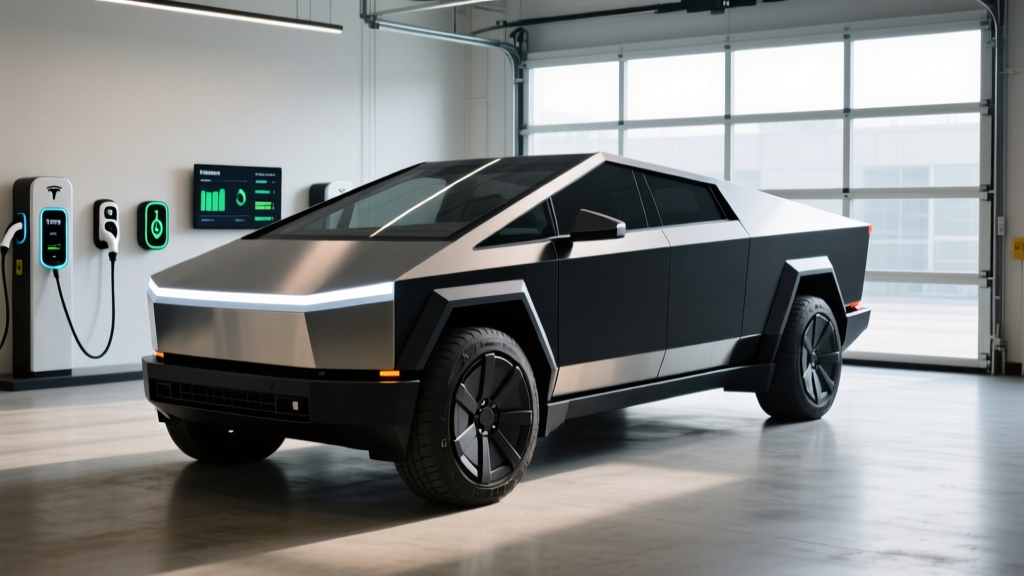
The Tesla Cybertruck is unlike any pickup built before it — and nowhere is that more apparent than in how it's put together. Instead of a traditional body-on-frame design with bolted steel panels, the Cybertruck uses an ultra-hard 30X cold-rolled stainless-steel exoskeleton with panels that are largely glued and bonded rather than welded or bolted. This manufacturing approach, combined with its 48-volt electrical architecture and steer-by-wire steering, makes it one of the most unconventional vehicles on the road. But for buyers researching the Cybertruck in 2026, the big questions go beyond its polarizing looks: What's the real-world range? How fast does it actually charge? And does the glued body construction hold up over time?
This review breaks down the Cybertruck lineup — the Long Range AWD, the Dual Motor AWD, and the tri-motor Cyberbeast — with exact specs, charging data, pricing after the §30D tax credit, and honest ownership insights drawn from EPA data and real-world driving conditions.
Cybertruck at a Glance: Full Spec Sheet
| Specification | Long Range AWD | Dual Motor AWD | Cyberbeast (Tri-Motor) |
|---|---|---|---|
| EPA Range | 340+ miles (est.) | 315 miles | 300 miles (est. w/ range extender) |
| Battery Capacity (usable) | ~123 kWh | ~123 kWh | ~123 kWh |
| Battery Chemistry | NMC (Nickel Manganese Cobalt) | NMC | NMC |
| 0–60 mph | ~4.8 sec | 3.9 sec | 2.6 sec |
| Horsepower | ~600 hp | ~600 hp | 845 hp |
| Drivetrain | Dual-Motor AWD | Dual-Motor AWD | Tri-Motor AWD |
| Max DC Fast Charge | 350 kW (peak) | 350 kW (peak) | 350 kW (peak) |
| 10–80% DC Charge Time | ~15 min (est.) | ~15 min | ~15 min |
| Level 2 Home Charge Rate | 11.5 kW (~34 mi/hr) | 11.5 kW (~34 mi/hr) | 11.5 kW (~34 mi/hr) |
| Towing Capacity | 11,000 lbs | 11,000 lbs | 11,000 lbs |
| Payload Capacity | 2,500 lbs | 2,500 lbs | 2,500 lbs |
| Base MSRP | ~$79,990 | $79,990 | $99,990 |
Note: The Long Range AWD was announced but had limited availability as of early 2026. Pricing and range figures for that trim are preliminary estimates based on Tesla disclosures. Verify current specs at tesla.com/cybertruck.
The Glued Exoskeleton: What It Means for Build Quality
The Cybertruck's defining engineering choice is its stainless-steel exoskeleton. Tesla uses 30X cold-rolled stainless steel — an ultra-hard alloy that resists denting and eliminates the need for conventional paint. Because this steel is too hard to stamp and weld using traditional automotive methods, Tesla relies heavily on structural adhesives (industrial bonding agents) to join body panels and sub-assemblies.
This "glued" construction method isn't unique to Tesla — aerospace and high-performance automotive manufacturers have used structural adhesives for decades. But the Cybertruck applies it at an unprecedented scale for a consumer vehicle. The implications for owners are mixed:
- Pro: Dent and corrosion resistance. The 30X stainless steel is exceptionally hard, and the bonded construction eliminates many weld points that can corrode over time.
- Pro: Structural rigidity. The exoskeleton contributes to a very stiff chassis, which benefits handling precision and towing stability.
- Con: Repair complexity. Damaged panels cannot be easily pulled, hammered, or re-welded at a standard body shop. Panel replacement often requires Tesla-certified collision centers with specific adhesive-bonding equipment and curing procedures.
- Con: Panel alignment variability. Early-production Cybertrucks (2024–2025) drew widespread attention for inconsistent panel gaps. Tesla has publicly stated ongoing improvements to assembly-line precision, and 2026 builds show measurable improvement — but buyers should still inspect panel seams carefully at delivery.
The bottom line: the glued exoskeleton is structurally sound and offers genuine durability advantages, but it makes collision repair more specialized and potentially more expensive than a conventional aluminum or steel-body truck.
Real-World Range: What the EPA Number Doesn't Tell You
EPA Estimated: 315 miles (Dual Motor AWD)
Real-World Highway (70–80 mph): ~240–270 miles
Cold Weather (below 32°F): ~210–250 miles
Towing (5,000+ lb trailer): ~150–180 miles
The Dual Motor AWD's EPA-estimated 315 miles is a useful baseline, but real-world Cybertruck range falls noticeably short in several common scenarios. The truck's angular, flat-panel design creates a high drag coefficient (estimated ~0.50–0.55 Cd) compared to more aerodynamic EVs. At sustained highway speeds of 75–80 mph, energy consumption rises sharply, and you can expect 240–270 miles before needing to charge.
Cold weather compounds this. The stainless-steel body has minimal thermal insulation compared to stamped steel with foam backing, and the large glass surfaces (including the massive windshield) increase heat loss. In sub-freezing conditions, expect a 20–30% range reduction, bringing usable range to roughly 210–250 miles. Tesla's heat pump helps mitigate cabin energy draw, but battery chemistry limitations in cold temperatures are unavoidable physics.
The most punishing scenario is towing. At 5,000+ pounds, the Cybertruck's range drops to approximately 150–180 miles. This is competitive with the Ford F-150 Lightning under similar loads, but it means long-distance towing requires careful Supercharger route planning.
Charging Speed: 350 kW Peak, but Mind the Curve
The Cybertruck supports a peak DC fast-charge rate of 350 kW on Tesla's V4 Superchargers — among the fastest rates available on any production EV. However, as with every EV, peak rate and sustained rate are very different numbers.
| Charging Level | Power (kW) | Speed | Notes |
|---|---|---|---|
| Level 1 (120V household) | ~1.4 kW | ~4 mi/hr | Emergency/trickle only |
| Level 2 (240V, 48A) | 11.5 kW | ~34 mi/hr | Full charge in ~11 hours |
| DC Fast Charge (V4 Supercharger) | Up to 350 kW peak | 10–80% in ~15 min | Peak only below 40% SoC; tapers significantly above 60% |
| DC Fast Charge (250 kW V3 Supercharger) | Up to 250 kW | 10–80% in ~20 min | More widely available |
The charge curve matters. The Cybertruck hits its 350 kW peak only at low state-of-charge (roughly 10–35% SoC) with a preconditioned battery. As the battery fills, the rate tapers — by 60% SoC, you may see 150–180 kW, and above 80%, charging slows dramatically to protect cell longevity. A 10–80% session on a V4 Supercharger takes approximately 15 minutes; a 10–90% session can take 30+ minutes due to the taper.
For home charging, the Cybertruck's 11.5 kW onboard charger adds roughly 34 miles of range per hour on a 240V/48A Level 2 circuit (such as a Tesla Wall Connector). A full overnight charge from 10% takes about 11 hours. Most owners who charge nightly at home will rarely need the full capacity — daily driving of 30–50 miles is easily replenished in 1–2 hours of Level 2 charging.
Home installation tip: A 48A Level 2 charger requires a dedicated 60A circuit. If your electrical panel is near capacity, a panel upgrade ($1,500–$3,000) may be necessary. Always consult a licensed electrician for final specifications.
Performance and Drivetrain: Quick Enough to Embarrass Sports Cars
The Cybertruck's performance figures remain startling for a 6,800-pound stainless-steel pickup:
- Cyberbeast (Tri-Motor AWD): 845 hp, 0–60 mph in 2.6 seconds
- Dual Motor AWD: ~600 hp, 0–60 mph in 3.9 seconds
- Long Range AWD: ~600 hp, 0–60 mph in ~4.8 seconds (estimated)
The Cyberbeast's 2.6-second 0–60 time places it among the fastest production vehicles ever sold, regardless of powertrain. But straight-line speed is only part of the story. The Cybertruck's steer-by-wire system — which eliminates the physical connection between steering wheel and wheels — delivers a variable ratio that requires fewer than one full turn lock-to-lock. It takes adjustment, but once acclimated, the system provides sharp, responsive handling that defies the truck's mass.
All trims feature adaptive air suspension with up to 16 inches of ground clearance (in Extract mode) and a 35-degree approach angle, giving it legitimate off-road capability. The 48-volt electrical architecture — a first for a production vehicle at this scale — powers the steer-by-wire, active damping, and high-load accessories more efficiently than a traditional 12-volt system.
Pricing, Trims, and Federal Tax Credit Eligibility
| Trim | Base MSRP | §30D Credit Eligible? | Effective Price (if eligible) |
|---|---|---|---|
| Long Range AWD | ~$79,990 | No (exceeds $80K truck cap) | $79,990 |
| Dual Motor AWD | $79,990 | No (exceeds $80K truck cap) | $79,990 |
| Cyberbeast | $99,990 | No (exceeds $80K truck cap) | $99,990 |
Here's the hard truth for Cybertruck buyers: no current Cybertruck trim qualifies for the $7,500 federal EV tax credit under IRS §30D. The law caps eligible trucks, vans, and SUVs at an $80,000 MSRP. The Dual Motor AWD at $79,990 sits tantalizingly close, but destination fees and mandatory options push it over the threshold. The Cyberbeast at $99,990 is well above the limit.
Additional §30D requirements that would apply even if pricing qualified include:
- Buyer income caps: Modified AGI ≤ $300,000 (joint), $225,000 (head of household), $150,000 (single)
- Battery sourcing rules: Critical minerals and battery components must meet escalating domestic/free-trade-agreement sourcing percentages — rules that have tightened significantly since 2024
- Point-of-sale transfer: Eligible buyers can transfer the credit to the dealer for an immediate price reduction, but only if the vehicle itself qualifies
For the most current eligibility details, consult the IRS Clean Vehicle Credits page or speak with a tax professional before purchasing.
Interior, Cargo, and Technology
The Cybertruck's interior follows Tesla's minimalist playbook: a single 18.5-inch front touchscreen handles nearly all vehicle functions, with a smaller 9.4-inch rear touchscreen for passengers. There are no physical buttons for climate, mirrors, or glovebox — everything routes through the screen or voice commands.
Cargo and space dimensions:
- Bed length: 6 feet (with tailgate closed); extends to ~8 feet with tailgate down
- Bed volume: ~67 cu ft (bed alone)
- Frunk (front trunk): ~7 cu ft — useful for groceries or charging cables
- Seating: 5 passengers (3-across rear bench); rear legroom ~38 inches
- Sail pillar storage: Lockable vault-style compartment behind rear seats
The motorized tonneau cover is a standout feature — it's strong enough to support 300 pounds (standing weight) and seals the bed from weather. Combined with the bed's 2,500-pound payload and 11,000-pound towing capacity, the Cybertruck is a genuinely functional work truck, not just a performance statement.
Driver assistance: All Cybertrucks ship with Tesla Autopilot (SAE Level 2), which includes adaptive cruise control, lane-centering, and automatic emergency braking. Tesla's Full Self-Driving (Supervised) — also Level 2, despite its name — is available as a paid upgrade. Neither system makes the Cybertruck self-driving; the driver must remain attentive and in control at all times.
Tesla Autopilot and FSD (Supervised) are SAE Level 2 driver-assistance systems. The driver must keep hands on the wheel (or demonstrate attentiveness) and eyes on the road. These systems do not replace an engaged human driver. Level 4 (driverless) capability is limited to geofenced robotaxi services like Waymo — not available in any consumer vehicle.
Efficiency: MPGe and Energy Consumption
For a vehicle this large and heavy, the Cybertruck's efficiency is respectable but not class-leading:
- Dual Motor AWD MPGe: ~68 MPGe combined (EPA est.)
- Energy consumption: ~50–55 kWh/100 mi (combined)
- Cost per mile (at $0.15/kWh home rate): ~$0.075–$0.083/mile
- Comparable gas truck (Ford F-150 3.5L EcoBoost, 20 MPG): ~$0.175/mile at $3.50/gal
The Cybertruck's boxy shape and ~6,800-pound curb weight work against efficiency, especially at highway speeds. Compare this to the Rivian R1T (dual-motor, ~73 MPGe combined) or the Chevrolet Silverado EV (~79 MPGe combined for the 4WT trim). For buyers prioritizing efficiency per mile, the Cybertruck trails its electric truck competitors — but the gap narrows considerably when towing or hauling, where all heavy EVs see steep efficiency drops.
Battery Warranty, Longevity, and the NMC Chemistry Trade-Off
Tesla equips the Cybertruck with an NMC (Nickel Manganese Cobalt) battery pack — chosen for its high energy density, which is necessary to push a 6,800-pound truck past 300 miles of range. The trade-off versus LFP (Lithium Iron Phosphate) chemistry:
- NMC advantage: Higher energy density (more range per pound); better cold-weather performance
- NMC disadvantage: More sensitive to sustained 100% state-of-charge; slightly faster long-term degradation than LFP; contains cobalt (supply-chain and ethical considerations)
Tesla recommends daily charging to 80–90% for NMC packs, reserving 100% charges for road trips. Following this guideline significantly extends long-term battery health.
Warranty coverage:
- Battery and Drive Unit: 8 years / 120,000 miles (whichever comes first), with minimum 70% capacity retention
- Vehicle Limited Warranty: 4 years / 50,000 miles
The 70% retention threshold means Tesla will repair or replace the battery if it degrades below 70% of original capacity within the warranty period. Based on Tesla's fleet data and third-party analysis, most Model S/X/3/Y packs retain 85–90% capacity at 100,000 miles. The Cybertruck's heavier duty cycle (towing, off-road) may accelerate degradation slightly, but the oversized ~123 kWh pack provides a large buffer.
Who Should Buy the Cybertruck — and Who Shouldn't
- Want the fastest, most attention-grabbing electric truck available
- Need 11,000-lb towing capacity with a stainless-steel bed that resists dents and scratches
- Have reliable home Level 2 charging and access to Tesla Superchargers
- Value Tesla's software ecosystem, OTA updates, and Supercharger network
- Can absorb the $80K–$100K price without relying on the federal tax credit
- Prioritize maximum range per dollar — the Rivian R1T or Silverado EV offer better efficiency
- Need the $7,500 federal tax credit to make the math work
- Want conventional body-shop repairability for collision damage
- Prefer physical controls and a traditional truck interior layout
- Live in an area with limited Tesla Service Center access (panel replacement requires certified facilities)
Pros and Cons
- Class-leading 0–60 performance (2.6s Cyberbeast)
- 350 kW peak DC fast charging
- 11,000-lb towing; 2,500-lb payload
- Dent-resistant stainless-steel exoskeleton
- Access to Tesla Supercharger network (17,000+ stalls in North America)
- Steer-by-wire and adaptive air suspension
- Motorized tonneau cover rated for 300 lbs standing weight
- No federal tax credit eligibility (all trims exceed $80K cap)
- Real-world highway range falls 15–20% below EPA estimate
- Glued/bonded body panels require specialized collision repair
- High drag coefficient hurts highway and cold-weather efficiency
- Minimal physical controls — all functions screen-dependent
- Panel gap inconsistency still present on some builds
- No Apple CarPlay or Android Auto
Frequently Asked Questions
What is the real-world range of the Tesla Cybertruck?
The Dual Motor AWD carries an EPA estimate of 315 miles, but expect 240–270 miles at highway speeds (70–80 mph) and 210–250 miles in freezing temperatures. Towing a 5,000+ lb trailer drops range to approximately 150–180 miles.
How fast does the Cybertruck charge at home and on the road?
On a Level 2 home charger (240V, 48A), the Cybertruck adds about 34 miles of range per hour, fully charging in ~11 hours. On a V4 Supercharger, it peaks at 350 kW and charges from 10–80% in approximately 15 minutes — though the rate tapers significantly above 60% state-of-charge.
Does the Cybertruck qualify for the $7,500 federal EV tax credit?
No. Under current IRS §30D rules, trucks must have an MSRP at or below $80,000 to qualify. All 2026 Cybertruck trims — including the $79,990 Dual Motor AWD (which exceeds the cap once destination fees are added) — are ineligible.
Is the Cybertruck's glued body a reliability concern?
Structural adhesives are proven technology in aerospace and performance automotive applications. The bonded construction is structurally sound. The practical concern is repair: collision damage to bonded stainless-steel panels requires Tesla-certified facilities with specific adhesive-curing equipment, which may increase repair time and cost versus a conventional truck body.
How does the Cybertruck compare to the Rivian R1T and Ford F-150 Lightning?
The Cyberbeat beats both on acceleration (2.6s vs. R1T's ~3.0s tri-motor and Lightning's ~3.8s). The F-150 Lightning offers a more conventional truck experience with better rear-seat comfort and a lower starting price (~$55,000). The Rivian R1T provides superior off-road capability and a more refined interior at a similar price point. The Cybertruck's advantages are its Supercharger network access, stainless-steel durability, and steer-by-wire handling — but it lacks the tax credit eligibility of some competitors.
What's the battery warranty on the Cybertruck?
Tesla covers the battery and drive unit for 8 years or 120,000 miles with a minimum 70% capacity retention guarantee. The vehicle limited warranty is 4 years / 50,000 miles.