If you've been searching for details on the Cybertruck front trunk — commonly called a frunk — you've likely noticed Tesla doesn't publish a standalone cubic-footage figure for it the way legacy automakers do with conventional truck beds. That's because the Cybertruck's storage story is more nuanced than a single compartment. This review covers the Cybertruck's complete cargo layout (frunk, bed, and under-bed vault), alongside the full spec sheet you need to evaluate it as a daily driver, tow rig, or road-trip machine in 2026.
The Cybertruck Front Trunk: Dimensions, Access, and Practical Use
The Tesla Cybertruck does include a front trunk (frunk) located beneath the stainless-steel hood. Unlike the Model X or Model S, which offer deep, bin-style frunks, the Cybertruck's frunk is relatively shallow due to the vehicle's steer-by-wire hardware, HVAC components, and the forward-mounted 48-volt electrical architecture housed under the front clamshell.
Estimated frunk volume: Tesla has not published an official cubic-foot measurement for the frunk alone. Based on owner measurements and teardown documentation, the usable space is approximately 6 to 7 cubic feet — enough for a medium soft-sided cooler, a laptop bag and backpack, or a set of charging cables and emergency supplies. The opening is wide but the depth is limited by the structural exoskeleton and front drive unit.
Access is via the front touchpad on the hood or the Tesla app. The clamshell-style hood powers open and closed. Because the Cybertruck uses a stainless-steel monocoque exoskeleton, the frunk area does not have the traditional plastic tub liner found in the Model Y or Rivian R1T — it's a bare, painted-metal cavity with drainage holes.
How the Cybertruck Frunk Compares to Rivals
| Vehicle | Frunk Volume (approx.) | Frunk Type |
|---|---|---|
| Tesla Cybertruck | ~6-7 cu ft | Clamshell hood, shallow bin |
| Rivian R1T (2026) | 11 cu ft | Deep bin with drain plug |
| Ford F-150 Lightning | 14.1 cu ft (400L) | Deep bin, power open/close |
| GMC Sierra EV (Denali) | 10.8 cu ft | Deep bin, power open/close |
| Chevrolet Silverado EV | 10.1 cu ft | Deep bin with drain |
The Cybertruck's frunk is the smallest in the electric pickup segment. If front-trunk storage is a priority — for groceries, tools, or gear you want separate from the bed — the F-150 Lightning and Rivian R1T are meaningfully more practical in this specific area.
Total Cybertruck Cargo Capacity: Bed, Vault, and Gear Tunnel
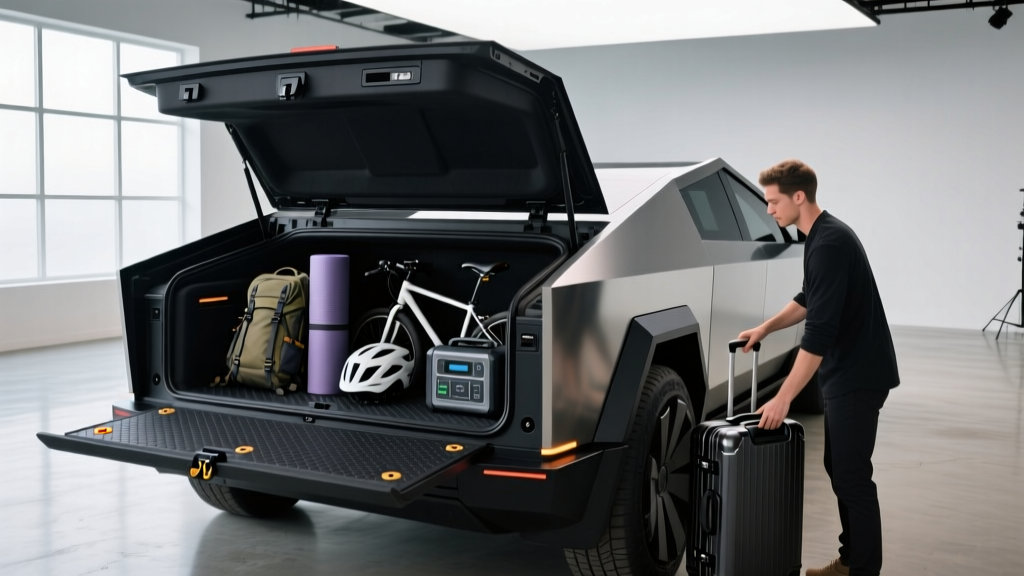
Where the Cybertruck makes up ground is in its total integrated storage system. Tesla designed three distinct cargo zones:
- Bed (6 ft x 4 ft): Approximately 67 cubic feet with the motorized tonneau cover closed. The bed walls are composite-lined stainless steel, and the 48V bed rail system accepts standard T-slot accessories.
- Under-bed vault: A lockable, side-access compartment beneath the bed floor (behind the rear axle). This replaces a traditional spare-tire well and provides roughly 12 cubic feet of enclosed, weather-sealed storage — ideal for tools, recovery gear, or a full-size spare tire.
- Sail pillars and bed rail system: The angular sail pillars behind the cab are structural, not storage, but the integrated bed rails support Tesla's rack and accessory ecosystem.
Combined total enclosed cargo: When you add the frunk (~7 cu ft), the bed with tonneau closed (~67 cu ft), and the under-bed vault (~12 cu ft), the Cybertruck offers approximately 86 cubic feet of lockable, weather-protected storage — competitive with the F-150 Lightning's combined frunk-plus-bed figure.
Cybertruck Range, Battery, and Efficiency Specs
The 2026 Tesla Cybertruck is available in three configurations. All use Tesla's 48-volt electrical architecture and a structural battery pack with NMC (nickel manganese cobalt) chemistry. Tesla has not published an official usable kWh figure; teardown analysis by Munro & Associates and industry estimates place the usable pack capacity at approximately 123 kWh.
| Spec | AWD | Cyberbeast | RWD (announced late 2026) |
|---|---|---|---|
| EPA Range | 340 miles | 320 miles | ~350 miles (est.) |
| Battery (usable, est.) | ~123 kWh (NMC) | ~123 kWh (NMC) | ~123 kWh (NMC) |
| Drivetrain | Dual Motor AWD | Tri-Motor AWD | Rear-Wheel Drive |
| Horsepower | 600 hp | 845 hp | TBA |
| 0-60 mph | 4.1 seconds | 2.6 seconds | TBA |
| Efficiency (EPA) | 2.0 kWh/mi (50 MPGe) | 2.1 kWh/mi (48 MPGe) | TBA |
| Towing Capacity | 11,000 lbs | 11,000 lbs | TBA |
Charging Speed: DC Fast Charge and Home Level 2
The Cybertruck supports the North American Charging Standard (NACS) connector natively — no adapter needed at Tesla Superchargers. For CCS-based public networks (Electrify America, EVgo), a NACS-to-CCS adapter is required.
| Charging Level | Max Power | Speed / Time |
|---|---|---|
| Level 1 (120V household) | ~1.4 kW | ~3-4 miles per hour |
| Level 2 (240V home/public) | 11.5 kW (48A) | ~30-34 miles per hour |
| DC Fast Charge (Supercharger V4) | Peak 250 kW | 10-80% in ~30 minutes |
Charging curve reality: The Cybertruck peaks at 250 kW only at a low state of charge (roughly 5-15% SoC) and optimal battery temperature. Sustained charge rates average closer to 150-175 kW across the 10-80% window, then taper significantly above 80% to protect the NMC cells. Tesla's preconditioning feature — activated automatically when you navigate to a Supercharger — warms the pack to maximize charge speed. Without preconditioning, initial charge rates can be 30-50% slower, especially in cold weather.
At home on a Level 2 Wall Connector (240V/48A), a full overnight charge from 20% to 100% takes approximately 10-11 hours. Most owners charge to 80% daily and set 100% only for road trips, which is the recommended practice for NMC chemistry longevity.
Pricing, Trims, and Federal Tax Credit Eligibility
The 2026 Cybertruck lineup has shifted since its 2023 launch. Here's the current pricing structure:
| Trim | Base MSRP | Est. After §30D Credit | Availability |
|---|---|---|---|
| Cybertruck AWD | $79,990 | See eligibility below | On sale now |
| Cyberbeast (Tri-Motor) | $99,990 | See eligibility below | On sale now |
| Cybertruck RWD | $60,990 (est.) | See eligibility below | Expected late 2026 |
Federal tax credit (§30D) eligibility: The Cybertruck's classification as a pickup truck means the MSRP cap is $80,000 (vs. $55,000 for sedans/SUVs). This puts the AWD trim at $79,990 — just under the cap — while the Cyberbeast at $99,990 exceeds it and does not qualify for the federal credit. The upcoming RWD trim should qualify on MSRP grounds. However, eligibility also depends on:
- Buyer income limits: Modified AGI must not exceed $150,000 (single), $225,000 (head of household), or $300,000 (joint filers).
- Battery component and critical mineral sourcing: The vehicle must meet escalating annual thresholds for North American battery assembly and critical mineral content per IRS §30D rules. Tesla's supply chain has been evolving; verify current-year eligibility on the IRS qualified vehicle list before purchase.
- Point-of-sale transfer: As of 2024, qualifying buyers can transfer the credit to the dealer at purchase, reducing the out-of-pocket price immediately rather than waiting for tax filing.
Technology, Driver Assistance, and Interior
The Cybertruck's interior is minimalist even by Tesla standards — a single 18.5-inch front touchscreen handles all vehicle controls, navigation, media, and climate. Rear passengers get a 9.4-inch touchscreen for climate and media. There are no physical buttons for wipers, turn signals, or drive selection — all are handled via the yoke-style steering wheel (with a round-wheel option available) and touchscreen.
Driver assistance: The Cybertruck ships with Tesla's Basic Autopilot (adaptive cruise, lane centering). Enhanced Autopilot ($6,000) adds auto lane change, auto park, and Summon. Full Self-Driving (Supervised) ($8,000 or $99/month) adds traffic light/stop sign recognition and city-street navigation. Per NHTSA SAE classifications, all Tesla driver-assist features are SAE Level 2 — the driver must remain fully engaged and attentive at all times. This is not autonomous driving.
Notable tech features:
- Steer-by-wire with variable ratio — fewer turns lock-to-lock than any production truck
- 48-volt electrical architecture (industry first for a production vehicle)
- Bioweapon Defense Mode (HEPA cabin filtration)
- Powered frunk and bed, integrated air compressor (bed rail), and 240V bed outlet (up to 9.6 kW output for tools/camping)
- Armor glass with laminate — improved over the 2019 demo, but still susceptible to stone chips
Who Should Buy the Cybertruck — and Who Shouldn't
Buy the Cybertruck If:
- You want the most distinctive design on the road and don't mind attention
- You need 11,000 lbs of towing and a stainless-steel bed that won't dent
- You value Tesla's Supercharger network for road-trip charging infrastructure
- Steer-by-wire and 48V architecture appeal to your tech sensibilities
Skip the Cybertruck If:
- Frunk storage is a priority (F-150 Lightning offers 2x the volume)
- You need a proven IIHS/NHTSA safety rating before purchasing
- You prefer physical buttons, conventional steering, or a traditional truck feel
- You want a sub-$60,000 EV truck now (wait for the RWD trim or consider competitors)
Frequently Asked Questions
Does the Cybertruck have a front trunk (frunk)?
Yes. The Cybertruck has a front trunk under the clamshell-style hood with approximately 6-7 cubic feet of usable space. It's smaller than the frunks in the F-150 Lightning (14.1 cu ft) and Rivian R1T (11 cu ft) but sufficient for a charging cable kit, small cooler, or a couple of bags.
What is the real-world range of the Cybertruck?
The EPA rates the AWD at 340 miles and Cyberbeast at 320 miles. In real-world highway driving at 70+ mph, expect 260-290 miles. Cold weather and towing reduce this further — plan conservatively for road trips and use Tesla's built-in trip planner for charge-stop routing.
How fast does the Cybertruck charge?
On a V4 Supercharger, it peaks at 250 kW and charges from 10-80% in approximately 30 minutes. At home on a 240V Level 2 Wall Connector (11.5 kW), expect about 30-34 miles of range per hour of charging, or roughly 10-11 hours for a full charge.
Does the Cybertruck qualify for the $7,500 federal EV tax credit?
The AWD trim ($79,990 MSRP) falls just under the $80,000 truck MSRP cap and may qualify, pending buyer income limits and battery-sourcing compliance. The Cyberbeast ($99,990) exceeds the cap and is ineligible. The upcoming RWD trim is expected to qualify. Always check the IRS qualified vehicle list for the latest status.
Is the Cybertruck worth buying over the F-150 Lightning or Rivian R1T?
It depends on priorities. The Cybertruck wins on towing capacity (11,000 lbs vs. 10,000 for the Lightning), acceleration (2.6s 0-60 for Cyberbeast), and Supercharger access. The F-150 Lightning wins on frunk space, conventional truck ergonomics, and lower starting price. The Rivian R1T wins on off-road capability, build quality, and quad-motor precision. Test-drive all three before deciding.