The Cybertruck Floating Claim: Marketing Stunt or Real Capability?
When Tesla CEO Elon Musk suggested the Cybertruck could "float for a bit," the internet exploded with renders of stainless-steel amphibious pickups. But what does Cybertruck floating actually mean in practice? The short answer: the truck can wade through deep water and may briefly stay buoyant in calm conditions, but it is emphatically not a boat. Understanding the distinction between water fording, temporary buoyancy, and true amphibious operation is critical for any buyer considering the Cybertruck for off-road or flood-prone environments.
This review covers the Cybertruck's water capabilities alongside a complete 2026 spec breakdown — range, charging, battery chemistry, pricing, and tax credit eligibility — so you can evaluate the truck on its full merits, not just viral moments.
| Spec | AWD (Dual-Motor) | Cyberbeast (Tri-Motor) |
|---|---|---|
| EPA Range | 340 miles | 325 miles |
| Battery Capacity (usable) | ~122 kWh (NMC) | ~122 kWh (NMC) |
| Max DC Fast Charge | 250 kW (peak) | 250 kW (peak) |
| 10–80% Charge Time | ~28 minutes | ~28 minutes |
| Level 2 Home Charging | 11.5 kW (~37 mi/hr) | 11.5 kW (~37 mi/hr) |
| 0–60 mph | 4.1 seconds | 2.6 seconds |
| Horsepower | 600 hp | 845 hp |
| Drivetrain | Dual-Motor AWD | Tri-Motor AWD |
| MPGe (combined) | 79 MPGe | 76 MPGe |
| Efficiency | 43 kWh/100mi | 45 kWh/100mi |
| Max Water Fording | ~32 inches (est.) | ~32 inches (est.) |
| Towing Capacity | 11,000 lbs | 11,000 lbs |
| Cargo Bed Volume | 67 cu ft | 67 cu ft |
| Frunk Volume | 7.1 cu ft | 7.1 cu ft |
| Base MSRP | $79,990 | $99,990 |
| Battery/Drive Unit Warranty | 8 yr / 120,000 mi | 8 yr / 120,000 mi |
Water Fording vs. Floating: What the Cybertruck Can Actually Do
Tesla has never published an official water fording depth for the Cybertruck in its owner's manual, which is itself a red flag for buyers who need rated capability. For comparison, the Rivian R1T is rated at 43.1 inches of water fording, and the Ford F-150 Lightning manages 24 inches conservatively. Based on the Cybertruck's ground clearance (up to 17.4 inches in Extract mode via adaptive air suspension) and sealed battery pack placement, independent testers and owners have demonstrated wading through approximately 30–32 inches of standing water without immediate failure.
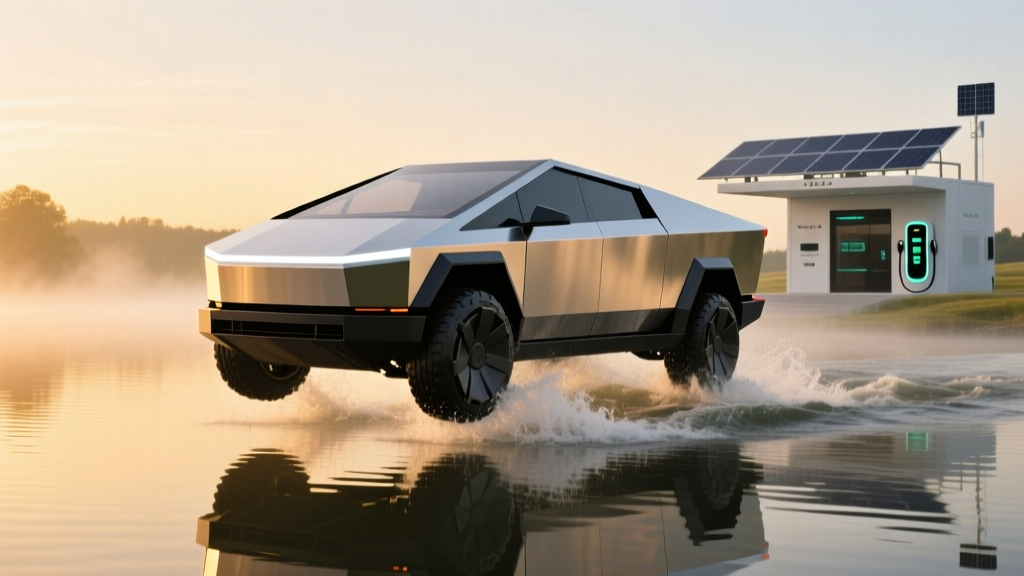
The "floating" claim stems from basic physics: the Cybertruck's stainless-steel exoskeleton and sealed underbody create a hull-like shape. With a curb weight around 6,600–6,800 lbs and a total enclosed volume that displaces more water than the truck weighs, the Cybertruck can achieve temporary buoyancy in still water. Tesla demonstrated this in a controlled setting. However, several critical caveats apply:
- Buoyancy is temporary. Water will eventually infiltrate through door seals, the bed, and unsealed body gaps. The truck is not watertight.
- Moving water is dangerous. Even 12 inches of flowing water can sweep a vehicle. The Cybertruck's high center of gravity and flat underbody make it susceptible to rolling in currents.
- Electronics are at risk. While the battery pack is sealed to IP67-level standards, 12V systems, wiring harnesses, and interior electronics are not designed for submersion.
- Warranty does not cover water damage. Tesla's warranty explicitly excludes damage from flooding, submersion, or water intrusion beyond rated fording limits.
The EPA rates the Cybertruck AWD at 340 miles and the Cyberbeast at 325 miles. In real-world highway driving at 70–75 mph, expect 260–290 miles from the AWD and 250–275 miles from the Cyberbeast. The angular stainless-steel body creates significant aerodynamic drag (estimated Cd of ~0.39), which hammers efficiency at speed. In cold weather (below 32°F), reduce those figures by an additional 15–25%, yielding as low as 200–220 miles on winter road trips. The 122 kWh battery is large, but the Cybertruck's weight and aero work against it.
Battery, Charging, and Energy: The 122 kWh Reality
The Cybertruck uses an estimated 122 kWh usable battery pack built with NMC (nickel manganese cobalt) cells in Tesla's 4680 structural format. Unlike the LFP chemistry found in some Model 3/Y Standard Range vehicles, NMC offers higher energy density — necessary to push a 6,800-lb truck past 300 miles of range — but it carries different long-term care considerations. NMC packs degrade slightly faster when regularly charged to 100%, so Tesla recommends daily charging to 80–90% for longevity, reserving full charges for road trips.
| Charge Level | Power (kW) | Speed (mi/hr added) | Notes |
|---|---|---|---|
| Level 1 (120V household) | ~1.4 kW | ~3–4 mi/hr | Emergency/trickle only; full charge takes days |
| Level 2 (240V, 48A) | 11.5 kW | ~37 mi/hr | Full overnight charge in ~11 hours; recommended home setup |
| DC Fast Charge (peak) | 250 kW | ~500+ mi/hr (at peak) | 10–80% in ~28 min; tapers significantly above 80% |
| DC Fast Charge (V4 Supercharger) | Up to 250 kW | Variable | NACS native; no adapter needed at Tesla stations |
The 250 kW peak DC charge rate is competitive but not class-leading — the Rivian R1T and Hyundai Ioniq 5 both accept higher peak rates on compatible infrastructure. More importantly, the Cybertruck's large 122 kWh pack means that even at 250 kW, the 10–80% charge takes roughly 28 minutes. The charging curve tapers sharply above 60% state of charge, so the final 20% (80–100%) can add another 25–35 minutes. On road trips, plan stops around the 20–80% sweet spot for efficiency.
Home charging on a Level 2 Wall Connector at 11.5 kW replenishes about 37 miles of range per hour. A full 0–100% charge takes approximately 11 hours — feasible overnight for most owners. Installation of a 60-amp circuit (to deliver the full 48A continuous) typically costs $800–$2,500 depending on panel proximity, with a 200-amp panel upgrade adding $1,500–$3,500 if your home's electrical service is insufficient.
Performance: Cyberbeast's 2.6-Second Thrill and Real-World Driving
The tri-motor Cyberbeast produces 845 horsepower and rockets to 60 mph in 2.6 seconds — making it one of the quickest production pickups ever built. The dual-motor AWD trim delivers 600 hp and a 4.1-second 0–60 time, which is still comfortably quick for a vehicle this heavy.
But straight-line speed is only part of the story. The Cybertruck's steer-by-wire system (Tesla calls it no mechanical linkage between the steering wheel and wheels) takes genuine adaptation. At low speeds, it feels unnervingly light and twitchy; at highway speeds, it firms up but lacks the feedback of a traditional rack. The rear-wheel steering helps the 223.5-inch-long truck maneuver in tight spaces, giving it a surprisingly tight turning circle.
Ride quality is firm — the adaptive air suspension offers multiple height settings, but the exoskeleton's stiffness and the truck's mass translate road imperfections directly into the cabin. This is not a luxury-truck ride; it's a performance-oriented setup that prioritizes body control over plushness.
Pricing, Trims, and Federal Tax Credit Eligibility
The Cybertruck lineup has simplified for 2026:
| Trim | Base MSRP | As-Tested (typical options) | §30D Federal Credit Eligibility |
|---|---|---|---|
| AWD (Dual-Motor) | $79,990 | $83,000–$87,000 | Not eligible (MSRP exceeds $80,000 pickup cap) |
| Cyberbeast (Tri-Motor) | $99,990 | $103,000–$110,000 | Not eligible (MSRP exceeds $80,000 pickup cap) |
This is a critical point many buyers miss: under IRS §30D rules, the federal clean vehicle credit for trucks, vans, and SUVs is capped at vehicles with an MSRP of $80,000 or less. The Cybertruck AWD starts at $79,990 — technically $10 under the cap — but Tesla's destination fee and mandatory options often push the actual transaction price above the threshold. Additionally, the credit requires the buyer to meet income limits ($150,000 single / $300,000 joint modified AGI), and the vehicle must satisfy critical-mineral and battery-component sourcing requirements that have tightened significantly since 2024.
In practice, most Cybertruck buyers will not qualify for the full $7,500 federal credit. Tesla's own configurator and the fueleconomy.gov tax credit lookup should be checked at time of purchase, as eligibility can shift with sourcing-rule updates. Some buyers may qualify for a partial credit or can explore the point-of-sale transfer option if the vehicle meets all criteria at delivery.
Interior, Cargo, and Daily Usability
The Cybertruck's cabin is aggressively minimal. A single 18.5-inch touchscreen dominates the dash, handling everything from climate to media to vehicle settings. There are no physical buttons, no traditional instrument cluster, and no Apple CarPlay or Android Auto — Tesla's proprietary infotainment handles everything, including navigation, streaming, and a built-in dashcam.
Passenger space is adequate but not generous for a full-size pickup:
- Front legroom: 41.0 inches
- Rear legroom: 36.0 inches (tight for tall adults on long trips)
- Seating capacity: 5 passengers (bench front seat with a small center fold-down)
The 67-cu-ft bed (with the tonneau cover-style vault closed) is competitive, and the powered retractable bed cover is a standout feature. The 7.1-cu-ft frunk adds secure, weather-sealed storage. However, the bed's trapezoidal shape and the high load floor (due to the structural battery pack beneath) make loading heavy items more challenging than in a conventional pickup.
Autopilot, FSD, and Driver Assistance
Tesla's Autopilot and Full Self-Driving (Supervised) are SAE Level 2 systems. The driver must remain fully engaged, hands on the steering wheel (or providing torque input), and eyes on the road at all times. The Cybertruck is not a self-driving vehicle. Only Level 4 services like Waymo operate without a human driver in defined geographic zones.
The Cybertruck ships with Tesla's basic Autopilot (traffic-aware cruise control and lane centering). The $8,000 FSD (Supervised) upgrade adds automatic lane changes, intersection handling, and parking assistance. Real-world FSD performance in 2026 has improved substantially in urban environments, but it still struggles with construction zones, unprotected left turns, and adverse weather. The steer-by-wire system integrates with FSD smoothly, but driver monitoring via cabin camera remains strict — look away for more than a few seconds and the system escalates warnings rapidly.
Standard safety features include automatic emergency braking, blind-spot monitoring, lane departure warning, and 360-degree cameras. NHTSA crash-test ratings for the Cybertruck were still pending as of early 2026; the truck's stainless-steel exoskeleton is extremely rigid, but repair costs after a collision are expected to be substantial due to the proprietary body panels.
Pros, Cons, and Who Should Buy the Cybertruck
- Class-leading acceleration (Cyberbeast: 2.6s 0–60)
- 11,000-lb towing capacity
- Stainless-steel exoskeleton resists dents and corrosion
- Access to Tesla's Supercharger network (17,000+ stalls in North America)
- OTA software updates continuously add features
- Distinctive design that stands out in any parking lot
- Real-world highway range drops to ~260 mi (aero drag)
- Steer-by-wire requires significant driver adaptation
- Firm ride quality; not a luxury-truck experience
- Likely ineligible for $7,500 federal tax credit (MSRP cap)
- No Apple CarPlay / Android Auto
- High insurance premiums (specialty body panels, repair complexity)
- Water fording depth not officially rated by Tesla
The Cybertruck is best for: Tech-forward buyers who want a high-performance electric pickup for light towing, daily driving, and occasional off-pavement use — and who are comfortable with Tesla's ecosystem and unconventional driving dynamics. It suits early adopters who value novelty and acceleration over traditional truck refinement.
The Cybertruck is not ideal for: Fleet buyers, commercial work-truck users who need proven durability data, buyers in flood-prone areas who need rated water fording, or families who prioritize rear-seat comfort and ride quality. For those needs, the Rivian R1T, Ford F-150 Lightning, or Chevrolet Silverado EV are more pragmatic choices.
Frequently Asked Questions
Can the Tesla Cybertruck actually float?
Temporarily, in calm, still water, the Cybertruck can achieve buoyancy due to its sealed underbody and displacement volume. However, it is not waterproof — water will enter through door seals, the bed, and body gaps within minutes. Tesla does not rate the Cybertruck for amphibious use, and water damage is excluded from the warranty. Think of it as a party trick, not a capability you should rely on.
What is the Cybertruck's real-world range on a road trip?
Expect 260–290 miles at highway speeds (70–75 mph) in mild weather for the AWD trim, and 250–275 miles for the Cyberbeast. In cold weather (below freezing), range can drop to 200–220 miles. The large 122 kWh battery helps, but the truck's aerodynamic drag and 6,800-lb weight work against efficiency. Plan Supercharger stops every 200–230 miles for comfort.
How fast does the Cybertruck charge at home and on the road?
On a Level 2 home charger (11.5 kW / 48 amps), the Cybertruck adds about 37 miles of range per hour, taking roughly 11 hours for a full charge. On a Tesla V3 or V4 Supercharger, it peaks at 250 kW and charges from 10–80% in approximately 28 minutes, though the rate tapers significantly above 60% state of charge.
Does the Cybertruck qualify for the $7,500 federal EV tax credit?
Almost certainly not. The IRS §30D credit caps eligibility for pickups at $80,000 MSRP. While the AWD trim starts at $79,990, destination charges and options typically push the transaction above the cap. Even if the MSRP qualifies, buyers must meet income limits and the vehicle must satisfy critical-mineral and battery-component sourcing rules. Always verify current eligibility on irs.gov before purchase.
How deep can the Cybertruck drive through water?
Tesla has not published an official water fording rating. Based on ground clearance (up to 17.4 inches in Extract mode) and owner testing, the Cybertruck can likely wade through approximately 30–32 inches of still water. This is less than the Rivian R1T's rated 43.1 inches. Driving through moving water of any significant depth is dangerous and not recommended.
Is the Cybertruck worth buying over the Rivian R1T or F-150 Lightning?
It depends on priorities. The Cybertruck wins on acceleration, design uniqueness, and Supercharger network access. The Rivian R1T offers superior off-road capability, rated water fording, a more refined interior, and better rear-seat space. The F-150 Lightning provides the most traditional truck experience, the lowest starting price, and broader commercial acceptance. Test-drive all three before deciding.
What is the Cybertruck's battery warranty?
Tesla covers the Cybertruck's battery pack and drive units for 8 years or 120,000 miles (whichever comes first), with a minimum 70% capacity retention guarantee over that period. This is competitive with other EV pickups, though real-world long-term degradation data for the 4680 cells is still limited as of 2026.