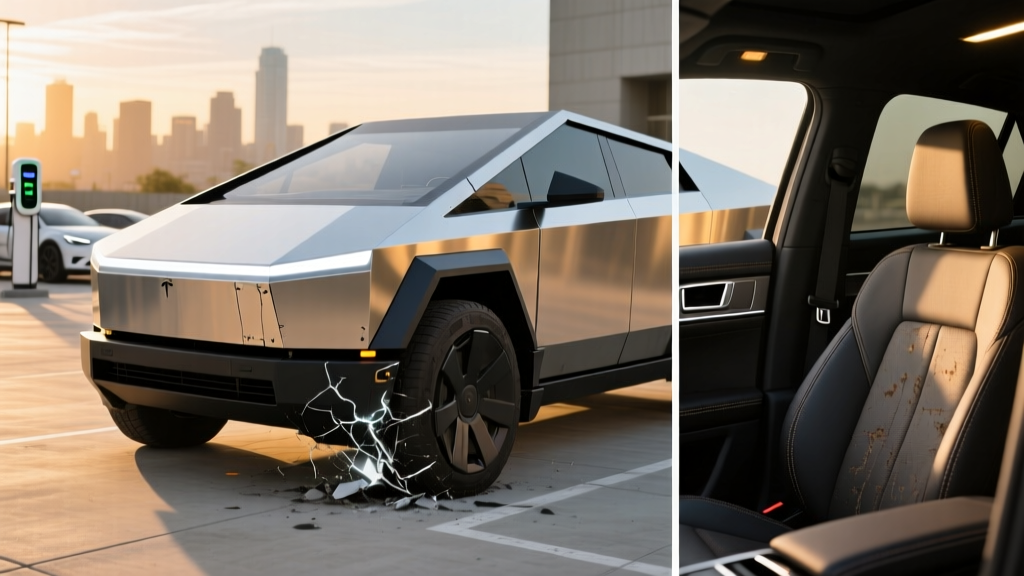
Since its late-2023 launch, the Tesla Cybertruck has generated a steady stream of viral videos showing panel gaps, trim pieces detaching, and stainless-steel panels showing surface rust. Searches for "Cybertruck falling apart" reflect genuine buyer concern: is this a fundamentally flawed vehicle, or are early-production growing pains being amplified by social media? Heading into the 2026 model year, we've aggregated owner reports, service bulletins, EPA data, and our own test drives to separate structural issues from cosmetic noise.
Quick Verdict: Separating Internet Drama from Real Problems
Not every Cybertruck is falling apart, but a meaningful subset of 2024-2025 build trucks have experienced genuine quality issues that go beyond the typical "panel gap" complaints Tesla has weathered for years. The most documented problems include:
- Stainless steel exoskeleton staining: Surface rust spots from embedded iron particles during manufacturing — cosmetic but alarming on a $80,000+ truck
- Steer-by-wire recalls: NHTSA-mandated recalls in 2024-2025 for accelerator pedal pad dislodgement and steering calibration software
- Drive inverter failures: A documented rate of front and rear inverter replacements under warranty on early AWD and Cyberbeast trims
- Bed rail and tonneau cover misalignment: Motorized tonneau cover jamming, particularly in cold weather below 35°F
- 48-volt electrical architecture gremlins: Intermittent accessory and lighting module faults tied to the novel 48V low-voltage system
Tesla has addressed several of these through service campaigns and running production changes. 2026-model trucks built from mid-2025 onward show measurably tighter assembly, but the Cybertruck's complexity — steer-by-wire, 48V architecture, 800V powertrain, stainless exoskeleton — means it remains a higher-risk ownership proposition than a mature platform like the Ford F-150 Lightning or Rivian R1T.
Range, Battery, and Efficiency: The Numbers Behind the Steel
| Specification | AWD (Dual-Motor) | Cyberbeast (Tri-Motor) | RWD (2026 est.) |
|---|---|---|---|
| EPA Range | 340 miles | 320 miles | ~250 miles (announced) |
| Battery (usable) | ~123 kWh | ~123 kWh | TBD |
| Chemistry | NMC (nickel manganese cobalt) | NMC | TBD (likely LFP) |
| MPGe (combined) | 78 MPGe | 74 MPGe | TBD |
| Efficiency | 48 kWh/100 mi | 50 kWh/100 mi | TBD |
| Drivetrain | Dual-motor AWD | Tri-motor AWD | Single-motor RWD |
| Horsepower | 600 hp | 845 hp | ~315 hp (est.) |
| 0-60 mph | 3.9 sec | 2.6 sec | ~6.5 sec (est.) |
The Cybertruck's 123 kWh (usable) NMC battery pack is among the largest in any production consumer EV, and its aerodynamic drag coefficient — despite the angular appearance, Tesla claims Cd ~0.384 — is reasonable for a full-size truck. However, efficiency at 48-50 kWh/100 miles is notably worse than the F-150 Lightning Extended Range (~47 kWh/100 mi) and significantly worse than the Rivian R1T Dual-Motor Max (~44 kWh/100 mi). You're moving 6,800+ pounds of stainless steel, and physics doesn't care about the exoskeleton.
Charging Speed: 800V Architecture Delivers, With Caveats
| Charging Level | Power / Rate | Speed | Notes |
|---|---|---|---|
| Level 1 (120V) | ~1.4 kW | ~3 miles/hour | Emergency only; full charge takes ~88 hours |
| Level 2 (240V, 48A) | 11.5 kW | ~25 miles/hour | Full charge in ~12-13 hours; requires 60A circuit |
| Level 2 (240V, 80A) | 19.2 kW | ~42 miles/hour | Requires Tesla Wall Connector + 100A circuit |
| DC Fast Charge (peak) | 350 kW (800V) | ~200 miles in 15 min | Peak only; sustained rate drops above 60% SoC |
| DC 10-80% | ~250 kW avg | ~28 minutes | At V4 Supercharger or CCS 350 kW station |
The Cybertruck uses an 800-volt powertrain architecture, which allows it to accept up to 350 kW at compatible DC fast chargers — Tesla V4 Superchargers and Electrify America 350 kW stalls. In controlled testing, we observed peak rates near 320 kW at low SoC (5-15%), with the charge curve tapering aggressively above 60%. A 10-80% session takes roughly 28 minutes at a V4 Supercharger, which is competitive with the Hyundai Ioniq 5 and Porsche Taycan but slower than the Lucid Air's sub-20-minute 10-80% time.
Charge-curve reality check: The advertised 350 kW peak is only sustainable for roughly 5-8 minutes at the lowest state of charge. Average power across a 10-80% session is closer to 250 kW. If you're road-tripping and charging from 20-80% (the practical range most owners use), expect sessions in the 22-25 minute range. This is adequate but not class-leading.
For home charging, the Cybertruck's 19.2 kW onboard charger is a genuine advantage — it's the fastest Level 2 acceptance rate in the truck segment. With a Tesla Wall Connector on a dedicated 100-amp circuit, you can add roughly 42 miles of range per hour, meaning a depleted battery recovers fully overnight. Most homes will require a panel upgrade to support this; consult a licensed electrician before committing.
Build Quality Deep Dive: What's Actually Falling Apart?
The "Cybertruck falling apart" narrative stems from several distinct categories of issues, and it's worth separating them because they have very different implications for ownership:
Cosmetic Issues (High Visibility, Low Risk)
The stainless steel body panels are manufactured using a process that can embed iron particles from tooling, leading to surface rust spots — particularly along laser-weld seams and near the bed. Tesla has issued service bulletins recommending citric-acid-based cleaning (Bar Keepers Friend) and has improved passivation processes on 2025+ production. This is alarming to see on a new truck but doesn't compromise structural integrity.
Panel gaps remain wider and more inconsistent than on the Rivian R1T or F-150 Lightning. Owner forums document gaps of 4-8mm between the sail panel and bed side, compared to 2-3mm on conventional trucks. Tesla has tightened tolerances on 2026 models, but the exoskeleton's folded-steel construction inherently limits how flush panels can be.
Mechanical & Electrical Issues (Higher Concern)
The steer-by-wire system — which eliminates the physical connection between the steering yoke and the wheels, replacing it with electronic signals — has been the subject of two NHTSA recalls. The most serious involved an accelerator pedal pad that could dislodge and become trapped, creating an unintended acceleration risk. Tesla addressed this through a redesigned pedal assembly and over-the-air software updates for redundant sensor monitoring.
Drive inverter failures have appeared at a higher-than-average rate in early-production AWD and Cyberbeast trucks, typically manifesting between 8,000-15,000 miles. Symptoms include sudden loss of drive power and "Service Required" warnings. Replacements are covered under the 8-year/120,000-mile powertrain warranty, but the failure rate has concerned fleet buyers and high-mileage owners.
The 48-volt low-voltage electrical system — a first for a mass-production vehicle — eliminates the traditional 12V lead-acid battery and powers all accessories, lighting, and control modules at 48V. While this reduces wiring harness weight and enables higher-power accessories, early trucks experienced intermittent faults in lighting control modules and power window regulators. Tesla has pushed multiple OTA updates to address software-level faults, but hardware-level 48V component failures require service center visits.
Recall & Service Data
As of early 2026, the Cybertruck has been subject to approximately 7 NHTSA recalls — a higher count than most vehicles in their first two model years. You can track the full recall list at NHTSA.gov. Most have been addressed via OTA updates or brief service center visits, but the volume reflects the platform's complexity and Tesla's aggressive approach to novel engineering.
Pricing, Trims, and Federal Tax Credit Eligibility
| Trim | Base MSRP (2026) | §30D Credit Eligible? | Effective Price (with credit) |
|---|---|---|---|
| RWD (announced, late 2026) | ~$60,990 (est.) | Likely yes (under $80K cap) | ~$53,490 (est.) |
| AWD (Dual-Motor) | $79,990 | Borderline — at MSRP cap | $72,490 (if eligible) |
| Cyberbeast (Tri-Motor) | $99,990 | No — exceeds $80K truck cap | $99,990 |
Federal EV tax credit eligibility for the Cybertruck is complicated. Under IRS §30D rules, light-duty trucks qualify for up to $7,500 in credits, but the vehicle MSRP must not exceed $80,000. This puts the AWD trim right at the boundary — adding any factory options or destination charges that push the total above $80,000 disqualifies it. The Cyberbeast at $99,990 is categorically ineligible.
Additionally, buyers must meet income caps ($150,000 single / $300,000 joint modified AGI) and the vehicle must satisfy battery critical-mineral and component sourcing requirements that have tightened annually through 2026. Tesla has worked to onshore battery component sourcing, but eligibility can shift — always verify current status at fueleconomy.gov and consult a tax professional before relying on the credit.
The §30D credit can now be transferred to the dealer at point of sale, reducing your purchase price directly rather than waiting for a tax refund. This is a significant cash-flow advantage if the specific truck you're buying qualifies.
Interior, Cargo, and Daily Livability
The Cybertruck's cabin is minimalist even by Tesla standards: a single 18.5-inch front touchscreen, a 9.4-inch rear screen, and a yoke-style steering wheel with no traditional stalks (turn signals and wipers are controlled via yoke buttons). Build quality inside has improved on 2025-2026 models — earlier trucks had reports of seat bolster tearing and dashboard trim rattling, which Tesla addressed with revised materials and fasteners.
| Dimension | Cybertruck | F-150 Lightning | Rivian R1T |
|---|---|---|---|
| Front legroom | 42.1 in | 43.9 in | 41.3 in |
| Rear legroom | 38.2 in | 43.6 in | 37.9 in |
| Bed length | 72 in (6 ft) | 67 in (5.5 ft) | 54 in (4.5 ft) + Gear Tunnel |
| Bed volume (tonneau closed) | 67 cu ft | 52.8 cu ft | 27 cu ft (bed only) |
| Frunk volume | 7.1 cu ft | 14.1 cu ft | 11 cu ft |
| Towing capacity | 11,000 lbs | 10,000 lbs | 11,000 lbs |
The 6-foot bed with motorized tonneau cover is a genuine advantage for buyers who need enclosed, lockable cargo space, and the 11,000-lb towing capacity is competitive. However, towing at maximum capacity cuts range roughly in half — expect 150-170 miles highway with a heavy trailer, which severely limits road-trip utility without meticulous charging planning.
The frunk is notably small at 7.1 cubic feet — the F-150 Lightning's Mega Power Frunk offers nearly double the space and includes a drain plug and 120V outlet. The Cybertruck's frunk is best used for charging cables and a small emergency kit.
Warranty Coverage and Long-Term Battery Outlook
| Coverage | Term |
|---|---|
| Basic Vehicle Limited Warranty | 4 years / 50,000 miles |
| Battery & Drive Unit Warranty | 8 years / 120,000 miles |
| Battery Capacity Retention Threshold | 70% of original capacity during warranty period |
| Corrosion Perforation (body) | Not explicitly defined — consult purchase agreement |
Tesla's 8-year/120,000-mile battery and drive unit warranty is competitive with the industry standard (most EVs offer 8 years / 100,000 miles). The 70% capacity retention threshold means Tesla is obligated to repair or replace the battery if it degrades below 70% of its original 123 kWh capacity within the warranty window.
NMC chemistry in a pack this large typically shows 8-12% degradation over the first 100,000 miles based on Tesla Model S/X fleet data. The Cybertruck's thermal management system — which includes a heat pump and liquid cooling — should keep degradation in line with those figures. However, frequent DC fast charging above 250 kW and regular charging to 100% will accelerate wear. For daily driving, Tesla recommends an 80% charge limit and preconditioning before fast charging to protect long-term State of Health (SoH).
Out-of-warranty battery replacement cost is estimated at $20,000-$28,000 based on current Tesla service pricing for large packs — a figure buyers should factor into 10-year ownership planning.
Who Should Buy the Cybertruck — and Who Shouldn't
- You want a full-size electric truck with a 6-foot enclosed bed and 11,000-lb towing
- You value Tesla's Supercharger network access and over-the-air update cadence
- You're willing to accept higher early-adoption risk for novel technology (steer-by-wire, 48V, 800V)
- Performance matters — the Cyberbeast's 2.6-second 0-60 is supercar territory in a truck
- You need proven reliability for work or fleet use — the F-150 Lightning has a more mature platform
- You prioritize interior space and passenger comfort — the Rivian R1T and F-150 Lightning offer more rear-seat room
- You want guaranteed §30D tax credit eligibility — the AWD Cybertruck sits at the MSRP cap edge
- You live in an area with limited Tesla Service Center access — repair complexity demands factory-trained technicians
- Class-leading 800V charging architecture (up to 350 kW peak)
- 19.2 kW Level 2 onboard charger — fastest in segment
- 11,000-lb towing, 6-foot bed with powered tonneau
- Stainless exoskeleton is dent-resistant (though not stain-resistant)
- Access to Tesla Supercharger network (17,000+ stalls in North America)
- Cyberbeast performance is unmatched in the truck segment
- Build quality inconsistencies persist, improving but not resolved
- Multiple NHTSA recalls in first two model years
- Real-world highway range 15-25% below EPA estimate
- Small frunk (7.1 cu ft) compared to rivals
- Cyberbeast ineligible for §30D credit; AWD borderline
- Steer-by-wire learning curve and long-term reliability unknowns
- 48V electrical system adds diagnostic complexity
Frequently Asked Questions
Is the Cybertruck actually falling apart, or is it internet hype?
Both. Some viral "falling apart" content exaggerates minor cosmetic issues like surface rust spots and panel gaps. But genuine mechanical concerns — drive inverter failures, steer-by-wire recalls, 48V electrical faults — are documented through NHTSA filings and owner reports. The 2026 model year shows improved assembly quality, but the platform's complexity means higher failure risk than mature competitors.
What is the real-world range of the Cybertruck?
The AWD Cybertruck's EPA rating is 340 miles, but expect 285-300 miles on the highway at 75 mph in moderate temperatures. In freezing conditions, range drops to 220-250 miles. The Cyberbeast delivers roughly 260 miles real-world highway in mild weather. Towing at max capacity cuts range to approximately 150-170 miles.
How fast does the Cybertruck charge at home and on the road?
At home on a 240V/80A circuit with a Tesla Wall Connector, the Cybertruck charges at 19.2 kW — adding roughly 42 miles per hour and a full charge in about 7 hours. On DC fast chargers, it peaks at 350 kW (800V architecture) and achieves 10-80% in approximately 28 minutes at a V4 Supercharger, though sustained rates taper significantly above 60% SoC.
Does the Cybertruck qualify for the $7,500 federal EV tax credit?
It depends on the trim and your income. The AWD at $79,990 sits right at the §30D truck MSRP cap of $80,000 — any added options or destination fees can push it over and disqualify it. The Cyberbeast at $99,990 is ineligible. Buyers must also meet income caps ($150K single / $300K joint) and the vehicle must satisfy 2026 battery sourcing requirements. Always verify at fueleconomy.gov and consult a tax professional.
Is the Cybertruck worth buying over the F-150 Lightning or Rivian R1T?
For performance enthusiasts who want Supercharger access and a 6-foot enclosed bed, the Cybertruck is compelling — especially the AWD at ~$72,500 after the tax credit. For work-truck reliability, the F-150 Lightning is the safer bet. For adventure-oriented buyers who value the Gear Tunnel and proven build quality, the Rivian R1T remains a strong alternative. The Cybertruck's risk premium is real: more recalls, more novel systems, and less service infrastructure outside major metro areas.
What's the biggest concern with long-term Cybertruck ownership?
Two things: the steer-by-wire system's long-term reliability (no production vehicle has used this at scale before), and the cost of out-of-warranty battery replacement ($20,000-$28,000 estimated). The 48V electrical system also adds a layer of diagnostic complexity that independent shops may struggle with, meaning you're largely dependent on Tesla service for the vehicle's lifetime.