Two Electric Trucks, Two Very Different Philosophies
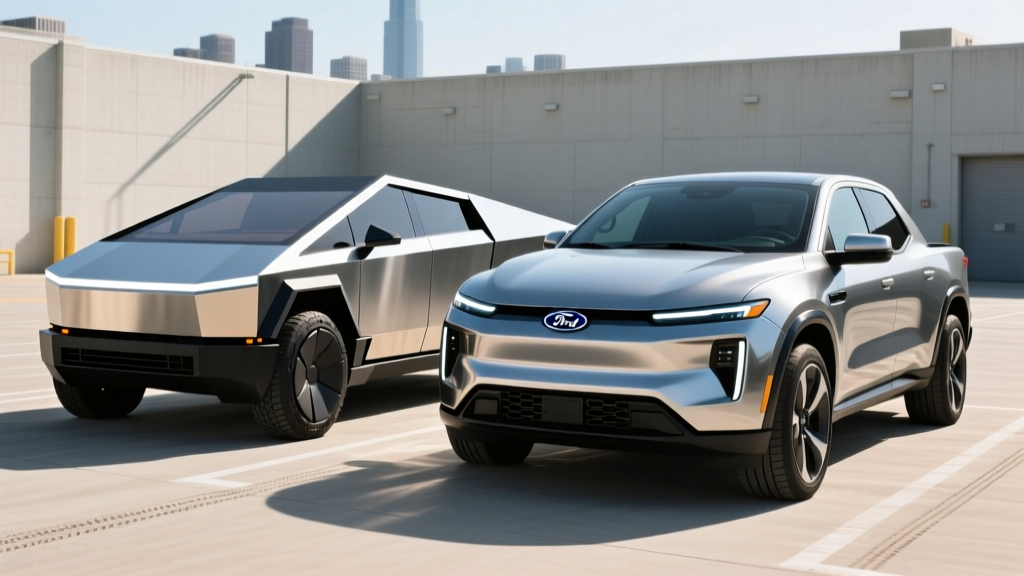
The electric pickup segment in 2026 is no longer a novelty — it's a battleground. The Tesla Cybertruck and Ford F-150 Lightning represent the two dominant approaches to electrifying America's best-selling vehicle format. One is a stainless-steel angular statement with a steer-by-wire system and an 800-volt architecture; the other is a more conventional-looking workhorse that slots seamlessly into Ford's existing truck ecosystem. This Cybertruck vs F-150 Lightning wrap breaks down every spec that matters to buyers: real-world range, charging speed, towing, cargo, pricing after tax credits, and long-term ownership costs.
Both trucks are available now, both offer dual-motor AWD, and both target buyers who need utility alongside zero tailpipe emissions. But the numbers tell a nuanced story.
Spec-by-Spec: Cybertruck vs F-150 Lightning at a Glance
| Specification | 2026 Tesla Cybertruck (AWD) | 2026 Ford F-150 Lightning (Extended Range) |
|---|---|---|
| EPA Range | 340 mi | 320 mi |
| Battery Capacity (usable) | ~123 kWh (NMC, 800V) | ~131 kWh (NMC) |
| Max DC Fast Charge | 250 kW (peak) | 150 kW (peak) |
| 10-80% DCFC Time | ~28 min | ~41 min |
| Level 2 Home Charge Rate | 11.5 kW (~37 mi/hr) | 19.2 kW (~52 mi/hr) w/ 80A charger |
| 0-60 mph | 4.1 sec (AWD) | 3.8 sec (Extended Range) |
| Horsepower | 600 hp | 580 hp |
| Towing Capacity | 11,000 lb | 10,000 lb |
| Payload | 2,500 lb | 2,235 lb |
| Bed Length | 6 ft (vault) | 5.5 ft |
| MPGe (combined) | 68 MPGe | 66 MPGe |
| Base MSRP | $79,990 (AWD) | $69,995 (XLT Extended Range) |
| Battery/Powertrain Warranty | 8 yr / 120,000 mi | 8 yr / 100,000 mi |
Sources: fueleconomy.gov, Tesla Cybertruck specs, Ford F-150 Lightning
Real-World Range: What the EPA Sticker Doesn't Tell You
Cybertruck AWD: EPA 340 mi — expect ~280-300 mi highway at 70 mph; ~230-250 mi in sub-freezing weather.
F-150 Lightning Ext Range: EPA 320 mi — expect ~260-280 mi highway; ~210-230 mi in cold conditions.
The Cybertruck's aerodynamic advantage (its angular, wedge-shaped body yields a lower drag coefficient than the Lightning's more traditional truck profile) gives it a modest real-world efficiency edge at highway speeds. Both trucks suffer the typical 15-25% range reduction in cold weather due to battery thermal management demands and cabin heating loads. The Lightning's larger 131 kWh pack partially offsets its less efficient highway profile, but the Cybertruck's 800-volt architecture runs its thermal system more efficiently.
If you regularly tow, plan on a 40-50% range reduction with a loaded trailer on either truck. Neither is a road-trip towing champion — this remains the core limitation of electric pickups in 2026.
Charging Speed: Where the Cybertruck Pulls Ahead
| Charging Level | Cybertruck | F-150 Lightning |
|---|---|---|
| Level 1 (120V / 12A) | ~3 mi/hr | ~2 mi/hr |
| Level 2 (240V home) | 11.5 kW / ~37 mi/hr | 19.2 kW / ~52 mi/hr (80A) |
| DC Fast Charge (peak) | 250 kW | 150 kW |
| 10-80% DCFC Time | ~28 min | ~41 min |
| Connector | NACS (native) | NACS (2025+ models) |
The Cybertruck's 800-volt architecture enables higher peak DC charge rates, shaving roughly 13 minutes off a 10-80% session compared to the Lightning. On a road trip, that difference compounds — three charging stops means nearly 40 fewer minutes plugged in.
However, the Lightning fights back at home. Ford's available 80A Charge Station Pro delivers up to 19.2 kW on Level 2, adding roughly 52 miles of range per hour. The Cybertruck's onboard charger caps at 11.5 kW (~37 mi/hr), meaning a full overnight replenishment takes longer. For owners who charge exclusively at home and rarely road-trip, the Lightning's Level 2 advantage is meaningful.
Charge curve note: Both trucks taper significantly above 80% SoC. The Cybertruck's peak 250 kW is sustained only between roughly 10-35% SoC before stepping down. Plan your DC fast-charging stops around the 10-80% window for maximum efficiency.
Performance, Towing, and Daily Drivability
Both trucks deliver sports-car acceleration that still surprises first-time EV truck drivers. The Lightning Extended Range hits 60 mph in 3.8 seconds; the Cybertruck AWD does it in 4.1 seconds. The difference is negligible in practice — both are explosively quick off the line.
The Cybertruck's steer-by-wire system and four-wheel steering give it a turning circle of just 34.5 feet, remarkably tight for a full-size truck. The Lightning uses a conventional steering rack and turns in 41.5 feet — more typical of the segment. In urban driving and tight job sites, the Cybertruck's maneuverability is a genuine advantage.
Towing favors the Cybertruck at 11,000 lb rated capacity versus the Lightning's 10,000 lb. However, real-world towing range tells the more important story: expect roughly 150-170 miles from the Cybertruck and 140-160 miles from the Lightning with a 7,000 lb trailer on flat terrain at 65 mph. Neither truck solves the towing-range problem that plagues all electric pickups.
The Lightning's Pro Power Onboard system (up to 9.6 kW of AC output) turns the truck into a mobile generator — a feature that's proven invaluable on job sites and during power outages. The Cybertruck offers a similar vehicle-to-load capability but at a lower output (approximately 4.8 kW from the bed outlets).
Cargo, Interior Space, and Practicality
The Cybertruck's 6-foot bed (Tesla calls it a "vault") is slightly longer than the Lightning's 5.5-foot bed, and its power-retractable tonneau cover is standard. The Lightning uses a traditional bed with an available powered tailgate and the massive front trunk ("Mega Power Frunk") offering 14.1 cu ft of lockable, weather-sealed storage — a significant practical advantage the Cybertruck's small frunk (approximately 7 cu ft) can't match.
Interior dimensions:
- Cybertruck rear legroom: 41.2 inches — adequate for adults but tighter than the F-150
- Lightning rear legroom: 43.6 inches — genuine full-size crew-cab comfort
- Cybertruck front storage: Minimalist 18.5-inch touchscreen dominates the dash; no physical buttons
- Lightning front storage: 15.5-inch portrait screen (SYNC 4A) with physical climate and volume controls
The Lightning feels like a truck inside. The Cybertruck feels like a concept car that made it to production — which is either its greatest appeal or its greatest drawback, depending on the buyer.
Pricing, Trims, and Federal Tax Credit Eligibility
| Trim / Config | MSRP | Federal Credit (§30D) | Effective Price |
|---|---|---|---|
| Cybertruck AWD | $79,990 | $0 (exceeds $80K truck cap) | $79,990 |
| Cybertruck Cyberbeast | $99,990 | $0 | $99,990 |
| Lightning XLT Ext Range | $69,995 | Up to $7,500* | ~$62,495* |
| Lightning Lariat Ext Range | $79,995 | Up to $7,500* | ~$72,495* |
| Lightning Platinum | $96,874 | $0 (exceeds $80K cap) | $96,874 |
*§30D credit eligibility requires: buyer AGI under $150K single / $300K joint; vehicle MSRP under $80,000 for trucks; battery critical-mineral and component sourcing thresholds met. Credit can be transferred to the dealer at point of sale as a purchase-price reduction. Verify current-year rules at IRS.gov. Consult a tax professional for personal eligibility.
This pricing breakdown is the Lightning's most significant advantage in the Cybertruck vs F-150 Lightning wrap. The XLT Extended Range, after the full $7,500 credit, lands near $62,500 — nearly $17,500 below the base Cybertruck AWD, which exceeds the §30D MSRP cap for trucks and qualifies for no federal credit. For budget-conscious buyers, the value proposition strongly favors Ford's mid-trim Lightning.
Driver Assistance and Technology
Tesla Autopilot / FSD (Supervised) and Ford BlueCruise are SAE Level 2 driver-assistance systems. The driver must remain attentive and keep hands on (or near) the wheel at all times. Neither system is "self-driving."
Cybertruck: Ships with Tesla Autopilot standard. Full Self-Driving (Supervised) is available as a $8,000 add-on or subscription. FSD offers city-street navigation and traffic-light recognition but requires constant driver supervision. The Cybertruck also features a unique steer-by-wire system with variable ratio — fewer turns lock-to-lock at low speeds, more stability at highway speeds.
F-150 Lightning: Ford BlueCruise is available on Lariat and Platinum trims (standard on Platinum, part of an option package on Lariat). It enables hands-free driving on over 130,000 miles of pre-mapped divided highways, with a driver-facing camera ensuring attention. BlueCruise is more geofenced than FSD but has earned strong marks for smoothness and predictability in IIHS evaluations of Ford's driver-monitoring implementation.
Who Should Buy Which Truck?
- You prioritize DC fast-charging speed for road trips
- You want maximum towing capacity (11,000 lb)
- Tight turning radius matters for urban or job-site use
- You value the stainless-steel exterior and unconventional design
- Tesla's Supercharger network access is important to you
- You want the lowest effective price after the $7,500 tax credit
- Maximum rear-seat passenger comfort is a priority
- You need the Mega Power Frunk for secure front storage
- Pro Power Onboard (9.6 kW) is critical for work or backup power
- You prefer a conventional truck experience with physical controls
Biggest Pros and Cons
- 250 kW peak DCFC — fastest-charging electric truck
- 11,000 lb towing capacity
- 34.5 ft turning circle (four-wheel steering)
- Standard stainless-steel exoskeleton — no paint to chip
- 8 yr / 120,000 mi battery warranty
- No federal tax credit (MSRP exceeds $80K cap)
- Limited rear-seat legroom vs. traditional crew cabs
- No physical controls — steep learning curve
- Smaller frunk than Lightning
- Build-quality inconsistencies reported by early owners
- Up to $7,500 federal tax credit on sub-$80K trims
- 14.1 cu ft Mega Power Frunk
- Pro Power Onboard up to 9.6 kW
- 19.2 kW Level 2 home charging available
- Familiar F-150 ergonomics and dealer network
- Slower DC fast charging (150 kW peak, ~41 min 10-80%)
- Lower towing capacity (10,000 lb)
- Shorter 5.5 ft bed
- Larger turning radius (41.5 ft)
- BlueCruise limited to pre-mapped highways
Frequently Asked Questions
What is the real-world range of the Cybertruck and F-150 Lightning?
The Cybertruck AWD delivers approximately 280-300 miles in mixed highway driving and 230-250 miles in cold weather, against its 340-mile EPA rating. The F-150 Lightning Extended Range yields roughly 260-280 miles highway and 210-230 miles in cold conditions versus its 320-mile EPA estimate. Towing cuts range by 40-50% on both trucks.
How fast does each truck charge at home and on the road?
On DC fast chargers, the Cybertruck peaks at 250 kW (10-80% in ~28 minutes) while the Lightning peaks at 150 kW (~41 minutes). At home on Level 2, the Lightning has the edge: up to 19.2 kW with an 80-amp charger (~52 mi/hr) versus the Cybertruck's 11.5 kW (~37 mi/hr).
Does the Cybertruck qualify for the federal EV tax credit?
No. The Cybertruck's starting MSRP of $79,990 for the AWD trim exceeds the §30D truck cap of $80,000 when destination fees are included, and higher trims exceed it further. The F-150 Lightning XLT and Lariat Extended Range trims fall under the cap and can qualify for up to $7,500, subject to buyer income limits and battery-sourcing requirements. Always verify at IRS.gov.
Is the Cybertruck worth the premium over the F-150 Lightning?
It depends on your priorities. If fast DC charging, maximum towing, and a tight turning radius justify a $17,000+ premium (and forgoing the tax credit), the Cybertruck delivers. If value, passenger space, the frunk, and onboard power matter more, the Lightning is the more practical and affordable choice.
Which truck is better for daily commuting?
The Lightning wins for most commuters. Its more conventional ride quality, superior rear-seat comfort, physical controls, and lower effective price make it the easier daily driver. The Cybertruck's steer-by-wire and minimalist interior demand an adjustment period that not every commuter will enjoy.
Can either truck handle off-road use?
Both offer AWD with adaptive air suspension (standard on Cybertruck, available on Lightning Platinum). The Cybertruck's approach/departure angles and ground clearance are competitive, but neither truck is purpose-built for serious off-roading like a Rivian R1T with its quad-motor tank turns. Light trail use and snowy conditions are well within both trucks' capabilities.