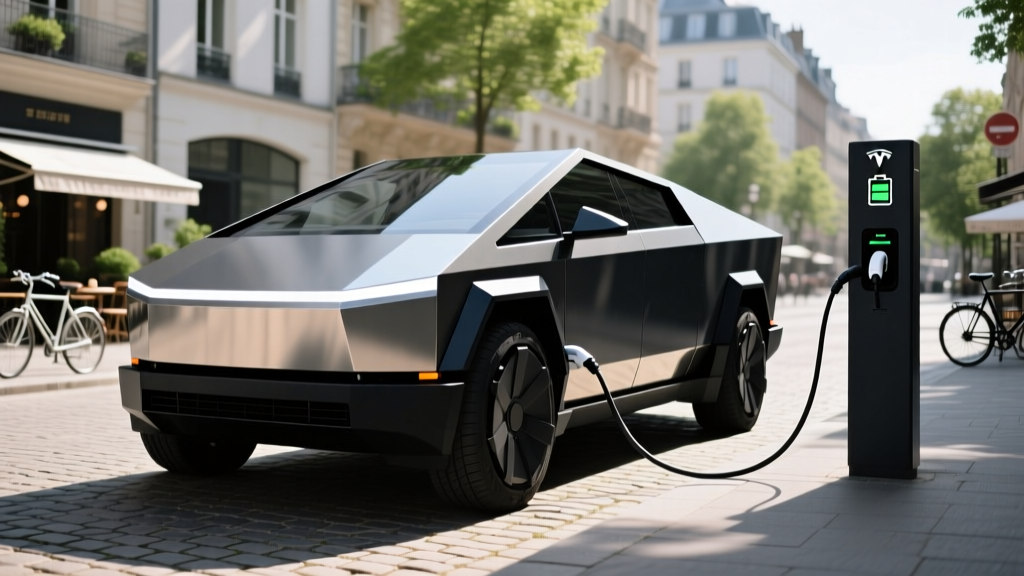
The Tesla Cybertruck is one of the most talked-about electric vehicles on the road — but if you've been searching for Cybertruck Europe availability, the answer is complicated. As of 2026, Tesla has not homologated the Cybertruck for sale in the European Union, the United Kingdom, or most European markets. The angular stainless-steel pickup remains a North American phenomenon, and the regulatory, safety, and practical barriers blocking its European arrival are substantial.
This profile breaks down exactly why the Cybertruck can't legally be sold across most of Europe, provides the full US-spec data for buyers and enthusiasts tracking the vehicle, and explores whether Tesla could ever overcome these hurdles.
Why the Cybertruck Isn't Available in Europe
European vehicle regulations differ fundamentally from US FMVSS standards, and the Cybertruck's design runs afoul of several key requirements:
- Pedestrian safety regulations: EU Regulation (EC) No 78/2009 mandates strict headform and legform impact standards for vehicle front ends. The Cybertruck's flat, rigid stainless-steel exoskeleton and sharp leading edges perform poorly in pedestrian impact testing compared to deformable bumper designs.
- Exterior projection rules: European type-approval limits sharp edges and protrusions on a vehicle's exterior. The Cybertruck's angular geometry and exposed panel seams raise compliance concerns.
- Vehicle dimensions and mass: At 223.7 inches long, 80 inches wide (including mirrors), and up to 6,800+ lbs curb weight, the Cybertruck exceeds typical European road and parking infrastructure design parameters. EU driving license category B restricts vehicles to 3,500 kg (7,716 lbs) maximum authorized mass — the Cybertruck's Cyberbeast with payload approaches or exceeds this.
- Pickup truck market realities: European consumers overwhelmingly prefer smaller vehicles. The full-size pickup segment is tiny in Europe, dominated by the Ford Ranger and Toyota Hilux, both significantly smaller than the Cybertruck.
Tesla CEO Elon Musk acknowledged these challenges publicly, noting the Cybertruck was designed primarily for the North American market. As of early 2026, no European type-approval application has been filed.
Cybertruck US Specs: Range, Battery, and Efficiency
For those evaluating the Cybertruck against European EVs or tracking it as a potential import, here are the complete US-market specifications for the 2025/2026 model year lineup:
| Spec | Long Range AWD | Dual Motor AWD | Cyberbeast (Tri-Motor) |
|---|---|---|---|
| EPA Range | 340 miles | 340 miles (est.) | 320 miles |
| Battery Capacity | ~123 kWh (usable) | ~123 kWh (usable) | ~123 kWh (usable) |
| Battery Chemistry | NMC (2170 cells, structural pack) | NMC (2170 cells, structural pack) | NMC (2170 cells, structural pack) |
| Horsepower | 600 hp | 600 hp | 845 hp |
| 0–60 mph | 4.1 seconds | 4.1 seconds | 2.6 seconds |
| Drivetrain | Dual-Motor AWD | Dual-Motor AWD | Tri-Motor AWD |
| MPGe (Combined) | ~67 MPGe | ~67 MPGe | ~63 MPGe |
| Efficiency | ~50 kWh/100 mi | ~50 kWh/100 mi | ~53 kWh/100 mi |
| Max Tow Capacity | 11,000 lbs | 11,000 lbs | 11,000 lbs |
| Payload | 2,500 lbs | 2,500 lbs | 2,500 lbs |
| Base MSRP | $79,990 | $99,990 | $119,990 |
The Cybertruck uses a 4680-cell structural battery pack with NMC (nickel manganese cobalt) chemistry. NMC offers higher energy density than LFP (lithium iron phosphate), which Tesla needs to hit 340 miles in a heavy truck, but it requires more careful state-of-charge management for longevity. Tesla recommends daily charging to 80–90% for NMC packs, with 100% reserved for trips. Source: Tesla Cybertruck Design Page.
Charging Speeds: DC Fast, Level 2, and Home Setup
The Cybertruck supports the NACS (North American Charging Standard) connector natively — Tesla's proprietary plug that has now been adopted by nearly every major automaker for the North American market. This is one more barrier to European sales, where CCS2 is the mandated standard.
| Charging Level | Power | Speed / Time | Notes |
|---|---|---|---|
| DC Fast Charge (Supercharger V4) | Up to 350 kW (peak) | 10–80% in ~15–20 minutes | Sustained rate tapers above 60%; expect ~180 kW average in real-world sessions |
| DC Fast Charge (Non-Tesla 250 kW CCS w/ adapter) | Up to 250 kW | 10–80% in ~22–28 minutes | Adapter required; NACS-to-CCS availability improving in 2026 |
| Level 2 (Tesla Wall Connector, 48A) | 11.5 kW | ~37 miles of range per hour | Full charge in ~11 hours from 10% |
| Level 2 (Standard 240V / 32A outlet) | 7.7 kW | ~25 miles of range per hour | Common for NEMA 14-50 installations |
| Level 1 (120V household) | 1.4 kW | ~4–5 miles of range per hour | Emergency/trickle only; 3+ days for a full charge |
kW vs. kWh refresher: kW (kilowatts) measures the rate of charging — like water pressure from a hose. kWh (kilowatt-hours) measures the total energy stored in the battery — like the size of the tank. The Cybertruck's ~123 kWh battery charged at 11.5 kW (Level 2) takes roughly 11 hours; at 250 kW DC, it charges much faster but only at peak rates for a portion of the session.
The Cybertruck's charge curve is aggressive in the early session. On a V4 Supercharger, it can pull 300+ kW below 40% state of charge, but the rate tapers significantly above 60% to protect the battery. Plan charging stops around 80% for optimal time efficiency — pushing to 100% on DC adds 20+ minutes for the last 20% of charge.
Preconditioning matters: navigating to a Supercharger in the Tesla app or navigation system warms the battery to optimal temperature before arrival, which can shave 3–5 minutes off a fast-charge session in cold weather.
Pricing, Tax Credits, and Ownership Costs
The Cybertruck's pricing has been volatile since launch, with Tesla adjusting trim availability and MSRP multiple times. Here is the current 2026 lineup:
| Trim | Base MSRP | Federal Tax Credit (§30D) | Effective Price |
|---|---|---|---|
| Long Range AWD | $79,990 | Up to $7,500 (if eligible) | ~$72,490 |
| Dual Motor AWD | $99,990 | $0 — exceeds MSRP cap | $99,990 |
| Cyberbeast (Tri-Motor) | $119,990 | $0 — exceeds MSRP cap | $119,990 |
Critical tax credit caveat: Under current IRS §30D rules, the federal EV tax credit for new clean vehicles has an MSRP cap of $80,000 for pickup trucks, SUVs, and vans. Only the Long Range AWD trim at $79,990 qualifies on price alone. Additionally, buyers must meet income caps ($150,000 single / $300,000 joint filers), and the vehicle must satisfy battery component and critical minerals sourcing requirements that tighten annually. The Dual Motor and Cyberbeast trims exceed the MSRP cap and are categorically ineligible for the federal credit. Always verify current-year rules with a tax professional before purchasing.
The credit can be applied as a point-of-sale transfer to the dealer, reducing your out-of-pocket cost at purchase — you don't need to wait until tax filing. But you must attest to income eligibility, and if your actual income exceeds the cap at filing time, you'll repay the credit.
Performance, Cargo, and Daily Practicality
The Cyberbeast's 2.6-second 0–60 mph time makes it one of the quickest production vehicles ever sold, regardless of powertrain. Even the Long Range AWD at 4.1 seconds outpaces most sports cars. The tri-motor setup provides exceptional traction, and the steer-by-wire system (no mechanical connection between the steering wheel and rack) delivers quick, adjustable-ratio responses — though it takes some getting used to for drivers accustomed to traditional steering feel.
Cargo and Passenger Dimensions
- Bed length: 6 feet (72 inches), with a motorized retractable tonneau cover
- Bed width: ~47 inches between wheel wells
- Built-in ramp: Fold-out tailgate ramp for loading ATVs, motorcycles, or cargo
- Front trunk (frunk): ~7.1 cu ft lockable storage
- Rear seat legroom: ~38 inches — adequate for adults on shorter trips, tight for long drives
- Seating: 5 passengers (3-across bench rear seat)
- Curb weight: ~6,600–6,800 lbs depending on trim
The vault (bed) is well-sealed with the tonneau closed, and the 120V/240V onboard power outlets (up to 9.6 kW output) enable job-site tool use or campsite power — a genuine differentiator. However, the bed is shorter than a traditional F-150 or Rivian R1T, and the sloped roofline limits stacking tall cargo.
Technology and Driver Assistance
The Cybertruck features an 18.5-inch center touchscreen running Tesla's latest UI, a rear-seat 9.4-inch display, and a yoke-style steering wheel (a conventional round wheel is available by request at no extra charge). The infotainment system supports streaming, gaming, and Tesla's navigation with real-time Supercharger routing.
On the driver-assist front, the Cybertruck ships with Autopilot (adaptive cruise + lane centering) standard. Full Self-Driving (Supervised) is available as a $8,000 add-on or $99/month subscription.
Warranty Coverage and Battery Longevity
Tesla provides the following warranty coverage for the Cybertruck:
- Basic vehicle warranty: 4 years / 50,000 miles
- Battery and drive unit warranty: 8 years / 120,000 miles (whichever comes first), with a minimum 70% battery capacity retention guaranteed
- Corrosion warranty: 12 years with no mileage limit (relevant for the stainless-steel body)
The 8-year/120,000-mile battery warranty is competitive with the Rivian R1T (8 yr / 175,000 mi) and Ford F-150 Lightning (8 yr / 100,000 mi). Tesla's structural battery pack is designed for longevity, but replacement costs for a ~123 kWh NMC pack are estimated at $15,000–$25,000 out of warranty based on current Tesla service pricing for comparable packs. Real-world degradation data for the Cybertruck's specific 4680 pack is still accumulating, but Tesla's historical NMC packs typically show 8–12% degradation over 100,000 miles.
Cybertruck vs. European-Accessible Competitors
Since the Cybertruck isn't available in Europe, buyers there looking for an electric pickup or a similarly capable EV have different options:
- Rivian R1T: Also not sold in Europe (US-only as of 2026), but a closer analog in size and capability
- Ford F-150 Lightning: Limited European availability through specialty importers; not officially sold by Ford Europe
- Ford Ranger PHEV (Europe): The closest mainstream European-market electrified pickup, though it's a plug-in hybrid, not a BEV
- Maxus T90 EV: A Chinese-made electric pickup sold in select European markets, but significantly smaller and less powerful
- Ineos Grenadier (ICE): Not electric, but comparable in rugged utility positioning
The reality is that the European full-size electric pickup market is essentially nonexistent in 2026. Buyers wanting Cybertruck-level performance and utility must either wait for potential future homologation, pursue a costly grey-market import (with no guarantee of passing type-approval), or look to non-electric alternatives.
Pros, Cons, and Final Verdict
✅ Pros
- Class-leading acceleration (2.6s Cyberbeast)
- 340-mile EPA range is competitive for a heavy pickup
- 350 kW peak DC charging is among the fastest in any EV
- Onboard 240V power (9.6 kW) for tools and camping
- Stainless-steel body is dent- and corrosion-resistant
- 11,000-lb towing capacity
- Access to Tesla Supercharger network (20,000+ stalls in North America)
❌ Cons
- Not available in Europe — no homologation, no timeline
- Only the base Long Range trim qualifies for the $7,500 federal credit
- Real-world highway range 20%+ below EPA sticker
- Steer-by-wire and yoke require adaptation
- Short 6-foot bed vs. traditional pickups
- Rear seat legroom is tight for taller adults
- Visibility challenges due to thick A-pillars and sloping rear glass
- High insurance premiums reported by early owners
Who the Cybertruck suits best (US market): Tech-forward buyers who want a daily-drivable electric truck with sports-car acceleration, job-site power capability, and access to the best DC fast-charging network in North America. It's ideal for suburban homeowners with Level 2 home charging who occasionally tow or haul. It's less suited for buyers who need a full 8-foot bed, frequent rear-seat passengers, or anyone outside North America.
Frequently Asked Questions
Can I legally import a Cybertruck to Europe?
Technically, you can import one through a grey-market process, but it would need to pass individual vehicle type-approval (IVA in the UK, Einzelabnahme in Germany), which requires meeting pedestrian safety standards the Cybertruck likely cannot satisfy. Even if approved, you'd face restricted registration, potential insurance difficulties, and no Tesla service support in-region. It is not a practical path for most buyers.
Will Tesla ever sell the Cybertruck in Europe?
Tesla has not announced any European launch timeline. Redesigning the front structure for pedestrian safety compliance would require significant engineering changes. Given the small European pickup market, the business case is weak. A smaller, Europe-specific Tesla truck (sometimes rumored) would be more plausible, but nothing has been announced as of 2026.
Does the Cybertruck qualify for the US federal EV tax credit?
Only the Long Range AWD trim at $79,990 MSRP qualifies, and only if the buyer meets income caps ($150,000 single / $300,000 joint) and the vehicle meets battery-sourcing requirements. The Dual Motor ($99,990) and Cyberbeast ($119,990) exceed the $80,000 MSRP cap for trucks and are ineligible. Verify current rules at IRS.gov.
What is the real-world range of the Cybertruck?
EPA rates it at 320–340 miles depending on trim. Real-world highway driving yields approximately 260–310 miles. In cold weather (below freezing), expect a further 15–25% reduction, potentially bringing the Cyberbeast down to ~220 miles on a full charge.
How fast does the Cybertruck charge at home?
On a Tesla Wall Connector at 11.5 kW (48A, 240V), it adds roughly 37 miles of range per hour, with a full 10–100% charge taking about 11 hours. On a standard NEMA 14-50 outlet at 7.7 kW (32A), expect ~25 miles per hour. Level 1 (120V) is impractical for daily use at ~4–5 miles per hour.
Is the Cybertruck safe?
As of early 2026, the Cybertruck has not been crash-tested by NHTSA or IIHS. Its stainless-steel exoskeleton is extremely rigid, which may benefit occupant protection but raises pedestrian safety concerns (the primary European barrier). Tesla's active safety features (automatic emergency braking, lane-keeping) are standard.
What's the towing range impact?
Towing at or near the 11,000-lb maximum can reduce range by 40–60%. Expect roughly 130–190 miles when towing a heavy trailer — plan Supercharger stops accordingly. The Cybertruck's navigation system adjusts range estimates when a trailer profile is configured.