The Tesla Cybertruck remains one of the most polarizing vehicles on the road, and nowhere is that more apparent than at the Cybertruck door handle. Tesla ditched conventional pull-handles for flush, electronic push-buttons integrated into the B and C pillars. They look clean, reduce drag, and fit the monolithic stainless-steel aesthetic — but they also raise real questions about usability, safety, and long-term ownership. This review evaluates the Cybertruck's entry system alongside the data that actually matters: range, charging speed, pricing, and whether it still qualifies for federal tax credits in 2026.
Cybertruck Door System: How It Works
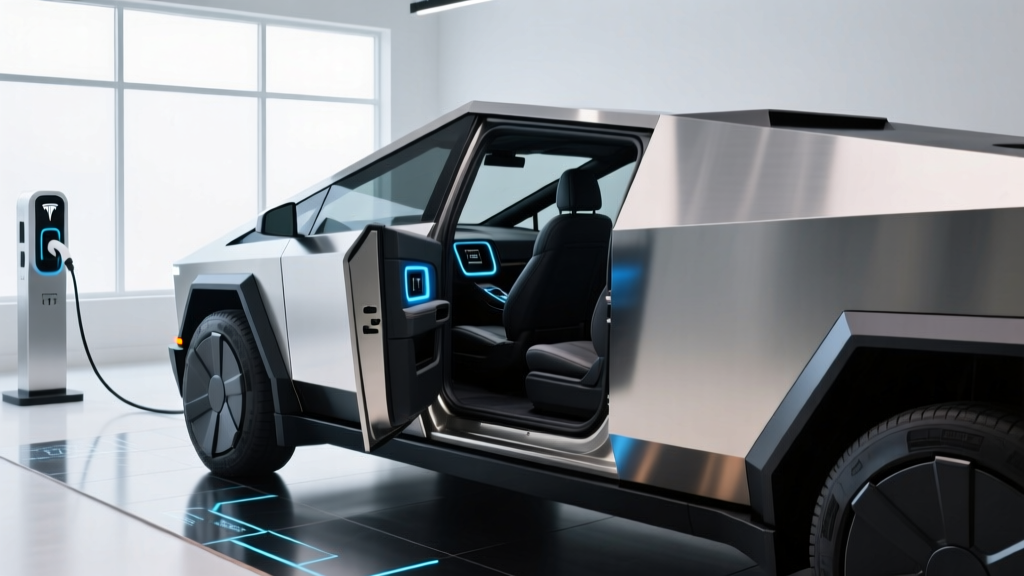
Each Cybertruck door uses an electronic push-button latch recessed into the window trim. Press the button, and the door pops out roughly an inch — you then pull the edge to swing it open. There is no traditional grab handle on the exterior panel. Inside, a slim electronic release pad on the door card triggers the same mechanism.
The system is powered by the 12V auxiliary architecture (which Tesla now uses a lithium-ion 12V battery for, replacing the old lead-acid unit). In the event of a 12V failure, Tesla includes a manual cable release behind the front door speaker grille, documented in the owner's manual. It is not intuitive under stress, and this has drawn scrutiny from safety advocates.
For families, the rear doors are notably heavy due to the thick stainless-steel skin and frameless glass. Children will struggle to open them without assistance. The electronic latch also introduces a slight delay (~0.3 seconds) between press and pop — not a dealbreaker, but noticeable when you are used to mechanical handles.
Range, Battery, and Efficiency
Real-World Expectation: ~270-290 miles at sustained 70-75 mph highway speeds; ~230-250 miles in cold weather (below 30°F) with cabin heat active.
The Cybertruck Dual-Motor AWD carries a structural battery pack with approximately 123 kWh of usable capacity (roughly 135 kWh gross). Tesla uses an NMC (nickel-manganese-cobalt) chemistry for energy density — not LFP, which is reserved for lower-cost, shorter-range models like the Model 3 RWD. The stainless-steel exoskeleton and angular shape create a higher drag coefficient than a rounded competitor like the Rivian R1T, which partially explains the range discrepancy between EPA and highway driving.
| Attribute | AWD Dual-Motor | Cyberbeast (Tri-Motor) |
|---|---|---|
| EPA Range | 340 miles | 320 miles |
| Battery (Usable) | ~123 kWh (NMC) | ~123 kWh (NMC) |
| Efficiency | 64 MPGe / 52 kWh/100mi | 60 MPGe / 56 kWh/100mi |
| 0-60 mph | 3.9 seconds | 2.6 seconds |
| Horsepower | 600 hp | 845 hp |
| Drivetrain | Dual-Motor AWD | Tri-Motor AWD |
| Towing Capacity | 11,000 lbs | 11,000 lbs |
| Cargo (Bed) | 67 cu ft (6-ft bed) | 67 cu ft (6-ft bed) |
| Frunk | 7 cu ft | 7 cu ft |
| Rear Legroom | 38.4 inches | 38.4 inches |
The Cybertruck's efficiency of 52 kWh/100mi (AWD) is poor by EV standards — for comparison, a Model Y Long Rear-Wheel-Drive achieves roughly 26 kWh/100mi. The penalty is weight (6,800+ lbs curb) and aerodynamics. On a road trip, expect to stop more often than in a Rivian R1T Dual-Motor (which achieves roughly 350 miles EPA with its Max Pack).
Charging: DC Fast Charge and Home Level 2
The Cybertruck uses a native NACS connector and supports Tesla's Supercharger network directly — no adapter needed. It runs on an 800V architecture, which enables higher peak charge rates with lower current (reducing heat and cable weight).
| Charging Level | Power / Rate | Time / Miles Added |
|---|---|---|
| DC Fast Charge (Peak) | 250 kW (V3 Supercharger) | 10-80% in ~28 minutes |
| DC Fast Charge (Sustained Avg) | ~170 kW (10-80%) | ~140 miles in 15 min |
| Level 2 (Tesla Wall Connector) | 11.5 kW / 48A | ~37 miles per hour of charging |
| Level 2 (Standard 240V/32A) | 7.7 kW | ~25 miles per hour of charging |
| Level 1 (120V household) | 1.4 kW | ~4 miles per hour of charging |
The 800V architecture is impressive on paper, but Tesla's current V3 Superchargers cap at 250 kW (V4 cabinets can deliver more, but rollout is limited). The Cybertruck's charge curve tapers significantly above 60% SoC — expect the last 20% (60-80%) to take nearly as long as the first 30%. For road-trip efficiency, plan stops around 10-70% SoC rather than pushing to 80%.
At home, a Tesla Wall Connector on a 60A circuit (48A continuous) adds roughly 37 miles per hour. Given the Cybertruck's ~123 kWh usable pack, a full 10-100% charge takes approximately 11-12 hours — meaning overnight charging is practical if you drive under 250 miles daily.
Pricing, Trims, and Federal Tax Credit Eligibility
| Trim | Base MSRP | §30D Credit Eligibility | Effective Price (if eligible) |
|---|---|---|---|
| AWD Dual-Motor | $79,990 | Partial — up to $3,750* | ~$76,240 |
| Cyberbeast (Tri-Motor) | $99,990 | Partial — up to $3,750* | ~$96,240 |
| RWD (announced, 2026+) | $60,990 (est.) | Likely up to $7,500* | ~$53,490 |
*Source: IRS §30D eligible vehicles list. Credit eligibility depends on battery component and critical mineral sourcing requirements, buyer AGI caps ($150K single / $300K joint), and MSRP caps ($80,000 for trucks). The Cybertruck AWD and Cyberbeast exceed the $80,000 MSRP cap — meaning they do NOT qualify for the full $7,500 credit. The upcoming RWD model, if priced under $80K, may qualify fully. Tesla lists the point-of-sale transfer option at checkout. Always verify with a tax professional.
The Cybertruck's pricing has stabilized after initial Foundation Series markups (which added $20,000). The AWD Dual-Motor at $79,990 is the volume trim, but its position just under the $80,000 MSRP cap for trucks is critical — any dealer-installed accessories or destination fees that push the transaction price above $80K could affect credit eligibility. Confirm the final MSRP on the window sticker, not the out-the-door price.
Performance, Tech, and Driver Assistance
The Dual-Motor AWD hits 0-60 mph in 3.9 seconds with 600 horsepower — brisk for a 6,800-lb truck. The Cyberbeast's 2.6-second run is supercar territory, though the weight is felt in corners and braking distances. Steering is quick but heavily assisted, and the rear-wheel steering system (up to 10 degrees) makes the 223-inch-long truck maneuver like a midsize SUV in parking lots.
The infotainment runs on a 18.5-inch front touchscreen with no physical buttons — climate, mirrors, and glovebox are all screen-controlled. A rear 9.4-inch screen handles rear-seat climate and entertainment. Autopilot is standard; Full Self-Driving (Supervised) is a $8,000 add-on. To be clear: FSD is SAE Level 2, meaning the driver must remain fully engaged, hands on the wheel (or torque applied), and eyes on the road. It is not autonomous driving.
Who the Cybertruck Suits Best
The Cybertruck works for: buyers who want a statement vehicle with genuine utility (11,000-lb towing, 67 cu ft bed), access to the Supercharger network, and daily driving under 250 miles. It is less suited for: budget-conscious buyers (even with partial credits, it exceeds $76K), families with small children (heavy rear doors, electronic latch complexity), or those prioritizing efficiency (52 kWh/100mi is costly at public DC fast chargers, where rates of $0.40-$0.50/kWh mean ~$25-$30 for 140 miles).
Key Competitors: Rivian R1T and Ford F-150 Lightning
The Rivian R1T Dual-Motor Max Pack (~350 miles EPA, ~$89,000) offers better real-world range, a more conventional door handle, and a quad-motor option. The Ford F-150 Lightning Extended Range (~320 miles EPA, ~$75,000) is more traditional in layout, qualifies more easily for the full $7,500 credit, and has a larger dealer network. The Cybertruck wins on raw acceleration, Supercharger access (though Rivian now has NACS adapter access too), and the stainless-steel bed durability. It loses on efficiency, interior material quality, and service-center wait times.
Pros
- Supercharger network access (native NACS)
- 800V architecture enables strong DC fast-charge rates
- Stainless-steel exoskeleton resists dents and scratches
- Rear-wheel steering improves low-speed maneuverability
- 11,000-lb towing with integrated trailer brake controller
Cons
- Electronic door latches raise safety and usability concerns
- Poor efficiency (52 kWh/100mi) increases charging costs
- MSRP exceeds $80K MSRP cap on AWD/Cyberbeast — limits §30D credit
- Heavy rear doors difficult for children
- Service center backlog; body repair requires specialized stainless work
Frequently Asked Questions
What is the real-world range of the Cybertruck?
EPA rates the AWD at 340 miles, but sustained highway driving at 70-75 mph yields roughly 270-290 miles. Cold weather (below 30°F) drops that to 230-250 miles. Towing at max capacity cuts range by roughly 50%.
How fast does the Cybertruck charge?
Peak DC fast charge is 250 kW on a V3 Supercharger, with 10-80% taking approximately 28 minutes. Sustained average is ~170 kW. Home Level 2 at 11.5 kW adds about 37 miles per hour.
Does the Cybertruck qualify for the $7,500 federal tax credit?
Partially. The AWD ($79,990) and Cyberbeast ($99,990) trims are subject to the §30D MSRP cap of $80,000 for trucks — the Cyberbeast exceeds it entirely. Critical mineral and battery component sourcing rules also apply. The upcoming RWD trim, if under $80K, may qualify fully. Verify on the IRS eligible vehicle list.
Are the Cybertruck's electronic door latches safe?
They include manual cable releases for 12V failure or crash scenarios, but these are not intuitively located. All occupants should be briefed on their position. Aftermarket mechanical-release kits are available.
Is the Cybertruck worth buying over the Rivian R1T or F-150 Lightning?
Choose the Cybertruck if you prioritize Supercharger-native access, stainless-steel durability, and acceleration. Choose the R1T for better range and conventional usability. Choose the Lightning for dealer support, easier tax-credit qualification, and a more traditional truck experience.
What is the battery warranty?
Tesla covers the Cybertruck battery and drive units for 8 years or 150,000 miles (whichever comes first), with a minimum 70% capacity retention threshold. The vehicle limited warranty is 4 years / 50,000 miles.