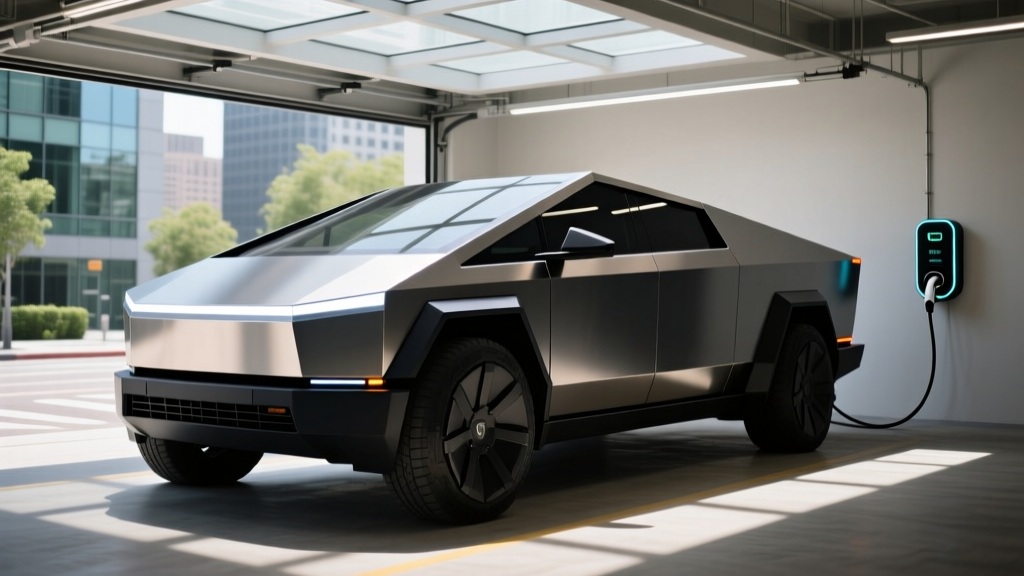
The Tesla Cybertruck defies conventional pickup proportions, and that starts with its polarizing stainless-steel exoskeleton. But beyond the angular styling, buyers need hard numbers: will it fit in your garage, how far can it actually drive on a charge, and what does the total cost look like after incentives? This guide breaks down every critical Cybertruck dimension alongside the range, charging, and ownership data that matter for a real purchase decision in 2026.
Exterior Dimensions and Garage Fitment
At 223.7 inches long, 79.9 inches wide (with mirrors folded), and 70.5 inches tall, the Cybertruck occupies a unique space between midsize and full-size pickups. It's shorter than a Ford F-150 Lightning (232.2 in) but wider than a Rivian R1T (81.8 in with mirrors). The 141.6-inch wheelbase keeps it maneuverable, yielding a 39.4-foot turning circle — tighter than most body-on-frame trucks.
| Dimension | Cybertruck AWD | Ford F-150 Lightning | Rivian R1T |
|---|---|---|---|
| Length | 223.7 in | 232.2 in | 217.1 in |
| Width (mirrors folded) | 79.9 in | 79.9 in | 81.8 in |
| Height | 70.5 in | 79.2 in | 73.0 in |
| Wheelbase | 141.6 in | 145.5 in | 135.9 in |
| Curb Weight | 6,603 lbs | 6,015 lbs | 7,148 lbs |
| Ground Clearance (max) | 17.4 in | 8.9 in | 14.9 in |
The Cybertruck's 70.5-inch roof height is a standout advantage. Most residential garage doors are 84 inches (7 feet) tall, and the Cybertruck clears them easily — even with the adaptive air suspension raised. The F-150 Lightning, by contrast, often requires an 8-foot garage door depending on trim and rack accessories. If you're measuring your garage, budget at least 230 inches of depth and 96 inches of width for comfortable door clearance.
Bed, Cargo, and Passenger Dimensions
The Cybertruck's 6-foot composite bed (72.0 in long, 43.0 in wide between wheel wells) trades length for a powered tonneau cover that Tesla claims supports 300 lbs of distributed weight. Total bed volume is 34.2 cubic feet with the tailgate down and the cover deployed as a ramp. The lockable frunk adds 6.8 cu ft, and there's a sealed under-bed "sail pillar" storage area accessible from inside the bed.
| Measurement | Specification |
|---|---|
| Bed Length | 72.0 in |
| Bed Width (between wells) | 43.0 in |
| Bed Volume | 34.2 cu ft |
| Frunk Volume | 6.8 cu ft |
| Front Headroom | 41.0 in |
| Front Legroom | 41.8 in |
| Rear Headroom | 37.8 in |
| Rear Legroom | 38.2 in |
| Seating Capacity | 5 (bench front seat) |
| Max Payload | 2,500 lbs |
| Max Towing | 11,000 lbs |
Rear-seat comfort is adequate for adults on shorter trips, though the 37.8-inch headroom feels tight for passengers over 6 feet — the sloping roofline is the trade-off for that low-profile garage fit. The front bench seat fits three across, giving the Cybertruck a 5-passenger rating. For comparison, the F-150 Lightning seats 5–6 depending on console configuration, and the R1T seats 5.
Battery, Range, and Real-World Efficiency
EPA Estimated: 340 miles (AWD) / 320 miles (Cyberbeast)
Real-World Highway (70 mph, 75°F): ~270–290 miles
Cold Weather (32°F, highway): ~220–250 miles (30–35% reduction)
With Range Extender (announced): ~470+ miles EPA (pending final certification)
The Cybertruck uses a ~123 kWh (usable) battery pack with NMC (nickel manganese cobalt) chemistry — necessary to meet the energy density and power delivery demands of a 6,600-lb truck capable of 11,000-lb towing. Tesla has not offered an LFP variant, and given the pack's performance requirements, one is unlikely.
Efficiency on the EPA cycle is rated at 56 MPGe combined (2.0 kWh/mile) for the AWD and 51 MPGe (2.2 kWh/mile) for the tri-motor Cyberbeast. In real-world highway driving at 75 mph, expect consumption closer to 2.4–2.6 kWh/mile. The Cybertruck's blunt frontal area and stainless-steel skin don't help aerodynamic efficiency — its drag coefficient is estimated at ~0.38 Cd, higher than the F-150 Lightning's ~0.36. If you regularly drive above 70 mph in cold weather, plan charging stops around the 220-mile mark for comfort.
| Spec | AWD | Cyberbeast |
|---|---|---|
| Battery Capacity (usable) | ~123 kWh (NMC) | ~123 kWh (NMC) |
| EPA Range | 340 mi | 320 mi |
| EPA Efficiency | 56 MPGe / 2.0 kWh/mi | 51 MPGe / 2.2 kWh/mi |
| Drivetrain | Dual-Motor AWD | Tri-Motor AWD |
| Horsepower | 600 hp | 845 hp |
| 0–60 mph | 4.1 sec | 2.6 sec |
Charging Speed: DC Fast, Level 2, and the 800V Advantage
The Cybertruck runs on an 800-volt architecture, enabling DC fast-charge peaks of up to 250 kW at V3/V4 Superchargers. Tesla quotes a 10–80% charge in approximately 28 minutes, adding up to 154 miles of range in 15 minutes under ideal conditions. However, the 123 kWh pack's size means the charge curve tapers noticeably above 80% — expect a full 10–100% session to take closer to 50 minutes. This is typical physics: larger packs take longer to fill the final 20%.
| Charging Method | Max Power | Speed / Time |
|---|---|---|
| DC Fast Charge (V3/V4 Supercharger) | 250 kW peak | 10–80% in ~28 min |
| Level 2 (Tesla Wall Connector, 48A) | 11.5 kW | ~18 mi/hr; full charge ~11 hr |
| Level 2 (Mobile Connector, 32A) | 7.7 kW | ~12 mi/hr; full charge ~16 hr |
| Level 1 (120V outlet) | 1.4 kW | ~2 mi/hr (emergency only) |
At home on a 48-amp Level 2 Tesla Wall Connector (requiring a 60-amp circuit), the Cybertruck recovers roughly 18 miles of range per hour. For a daily commute of 40–60 miles, overnight charging easily replenishes what you use. But if you're regularly depleting the pack below 30% — say, after a towing day — plan for an 11-hour Level 2 session to fully recharge. The 800V architecture does not accelerate Level 2 charging; that speed is limited by the onboard charger's 11.5 kW acceptance rate.
The Cybertruck ships with a NACS (North American Charging Standard) port natively. No adapter is needed for Tesla Superchargers. For non-Tesla DC networks (Electrify America, EVgo), the built-in NACS port now works at participating stations that have adopted the standard — a rapidly growing list as of 2026.
Pricing, Trims, and Federal Tax Credit Eligibility
As of early 2026, Tesla offers the Cybertruck in three configurations. The long-promised RWD variant has been delayed and remains listed as "available 2026" with preliminary specs. Pricing reflects Tesla's current MSRP before any incentives:
| Trim | Base MSRP | Federal §30D Credit | Effective Price |
|---|---|---|---|
| AWD (Dual-Motor) | $79,990 | Up to $7,500* | ~$72,490* |
| Cyberbeast (Tri-Motor) | $99,990 | Up to $7,500* | ~$92,490* |
| RWD (Single-Motor) | ~$60,990 (est.) | Up to $7,500* | ~$53,490* (est.) |
*Federal tax credit eligibility under IRS §30D depends on multiple factors. The Cybertruck qualifies as a light truck, so the MSRP cap is $80,000 — meaning the AWD trim at $79,990 clears the threshold, while the Cyberbeast at $99,990 does not qualify. Buyer income limits apply ($300,000 joint / $150,000 single for new vehicles). Battery component and critical mineral sourcing requirements must also be met; Tesla's US-built pack partially qualifies, but exact credit amounts vary by delivery date and supply chain compliance. The credit can now be transferred to the dealer at point of sale, reducing your purchase price directly. Consult a tax professional for your specific situation.
Destination charges, optional paint colors (the raw stainless steel is the default — "paint" options like Stealth Grey add ~$0–$3,000 depending on Tesla's current offerings), and the $12,000 FSD (Supervised) package can push an AWD model's as-tested price well above $90,000.
Technology, Driver Assistance, and Standout Features
The Cybertruck's cabin centers on an 18.5-inch touchscreen running Tesla's latest UI, with a 9.4-inch rear-seat display. There are no physical buttons — climate, mirrors, glovebox, and wiper speed all route through the screen or steering-wheel scroll wheels. This is polarizing; some owners adapt quickly, others find it distracting.
Standard driver assistance includes Tesla Autopilot (adaptive cruise + lane centering), which is an SAE Level 2 system — meaning the driver must remain fully engaged with hands on the wheel and eyes on the road at all times. The optional Full Self-Driving (Supervised) package adds automatic lane changes, traffic-light recognition, and city-street navigation, but it remains Level 2. Tesla's naming is aspirational; no consumer Tesla is a self-driving vehicle. Only Level 4 services like Waymo operate without a human driver in defined zones.
Tesla Autopilot and FSD (Supervised) are SAE Level 2 driver-assist systems. They do NOT make the Cybertruck autonomous. You are legally and physically responsible for steering, braking, and monitoring traffic at all times. FSD (Supervised) may make unexpected lane changes, miss construction zones, or misread temporary signage. Treat it as an advanced cruise system, not a chauffeur.
Unique Cybertruck tech includes steer-by-wire (no mechanical connection between the yoke and the wheels), four-wheel steering for a tight turning radius, adaptive air suspension with 17.4 inches of max ground clearance, and a 48-volt electrical architecture — a first for a production vehicle. The 48V system reduces wiring harness weight and enables features like the powered tonneau and high-output bed lighting. The stainless-steel exoskeleton is dent-resistant but shows fingerprints aggressively; Tesla sells a "passivation" treatment to reduce smudging.
Warranty, Ownership Costs, and Who Should Buy
Tesla covers the Cybertruck with a 4-year/50,000-mile limited vehicle warranty and an 8-year/120,000-mile battery and drive unit warranty (whichever comes first). The battery warranty guarantees retention above 70% of original capacity during the coverage period. Given the NMC chemistry and the Cybertruck's heavy-duty use case (towing, payload), monitoring State of Health (SoH) via Tesla's in-app diagnostics is wise — especially if you frequently DC fast-charge above 150 kW or regularly tow near the 11,000-lb limit, both of which accelerate degradation.
Insurance costs run high. The Cybertruck's repair complexity (stainless-steel body panels, steer-by-wire, 48V system) pushes premiums 20–40% above comparable electric trucks. Get a quote before ordering — several owners report annual premiums of $3,500–$5,000 depending on state and driving record.
Buy it if: You want a garageable electric truck with class-leading ground clearance, you value the 11,000-lb tow rating and lockable bed, you're in the Tesla Supercharger ecosystem, and the angular design appeals to you.
Skip it if: You need a full-size 8-foot bed for construction work, you prefer traditional switchgear and physical controls, you want a proven long-term reliability track record, or you're uncomfortable with steer-by-wire and touchscreen-only operation.
Consider the F-150 Lightning if: You want a more conventional truck experience, Pro Power Onboard for job-site power, and a larger rear seat. Consider the Rivian R1T if: You prioritize build quality, adventure-oriented features (gear tunnel, camp kitchen), and a smaller overall footprint.
Pros, Cons, and Final Verdict
- Garageable height (70.5 in) unlike most full-size EV trucks
- 11,000-lb towing, 2,500-lb payload, 17.4-in ground clearance
- 800V architecture with 250 kW DC fast-charge capability
- 48V electrical system and steer-by-wire are genuinely novel
- Lockable bed with powered tonneau; frunk + sail-pillar storage
- Access to Tesla Supercharger network (native NACS)
- Real-world highway range drops to ~270 mi; worse in cold/towing
- 6-ft bed is short for traditional truck buyers; 43-in width between wells
- Touchscreen-only controls and yoke steering are divisive
- High insurance premiums due to repair complexity
- Cyberbeast exceeds $80K MSRP cap — no federal tax credit
- Stainless-steel body shows fingerprints; limited panel-repair options
The Cybertruck is a compelling but niche electric truck. Its dimensions make it uniquely practical for suburban owners who want truck capability without full-size bulk, and its 800V charging architecture keeps road-trip downtime reasonable. But the real-world range, short bed, and steep learning curve on the controls mean it's not a universal replacement for a conventional pickup. If the dimensions fit your garage and your life, it's one of the most capable EVs on the road. If you need a workhorse with an 8-foot bed and physical knobs, look elsewhere.
Frequently Asked Questions
Will the Cybertruck fit in a standard residential garage?
Yes, in most cases. At 70.5 inches tall, it clears a standard 7-foot (84-inch) garage door. You'll need at least 230 inches of depth and roughly 96 inches of width for comfortable clearance. The F-150 Lightning often requires an 8-foot garage door.
What is the real-world highway range of the Cybertruck?
Expect approximately 270–290 miles at 70 mph in moderate temperatures. The EPA rates the AWD at 340 miles, but the truck's weight (6,603 lbs) and aerodynamic drag reduce efficiency at sustained highway speeds. In cold weather (below 40°F), plan for 220–250 miles.
Does the Cybertruck qualify for the $7,500 federal EV tax credit?
The AWD trim at $79,990 MSRP qualifies under the §30D truck MSRP cap of $80,000, assuming you meet income limits ($300K joint / $150K single) and battery-sourcing requirements are satisfied at the time of delivery. The Cyberbeast at $99,990 does not qualify. Rules change — always verify current eligibility on IRS.gov or with your tax professional.
How fast does the Cybertruck charge at home?
On a 48-amp Level 2 Tesla Wall Connector (11.5 kW), the Cybertruck gains about 18 miles of range per hour, taking roughly 11 hours for a full charge. A standard 32-amp Mobile Connector adds about 12 miles per hour. Level 1 (120V) is impractical at ~2 miles per hour.
Is the Cybertruck good for towing?
It has an 11,000-lb max tow rating — best in the EV truck segment. However, towing near max capacity cuts range roughly in half. On a 300-mile trip towing 8,000+ lbs, expect to stop for a 25–30 minute DC fast charge every 150–170 miles. Preconditioning the battery before arriving at a Supercharger is critical for maintaining charge speed.
What's the difference between Cybertruck AWD and Cyberbeast?
The AWD uses a dual-motor setup (600 hp, 0–60 in 4.1 sec, 340 mi EPA range) and starts at $79,990. The Cyberbeast adds a third motor (845 hp, 0–60 in 2.6 sec, 320 mi EPA range) at $99,990. The Cyberbeast sacrifices range and tax-credit eligibility for supercar-level acceleration in a 6,600-lb truck.