Tesla Cybertruck Design: Engineering Meets Controversy
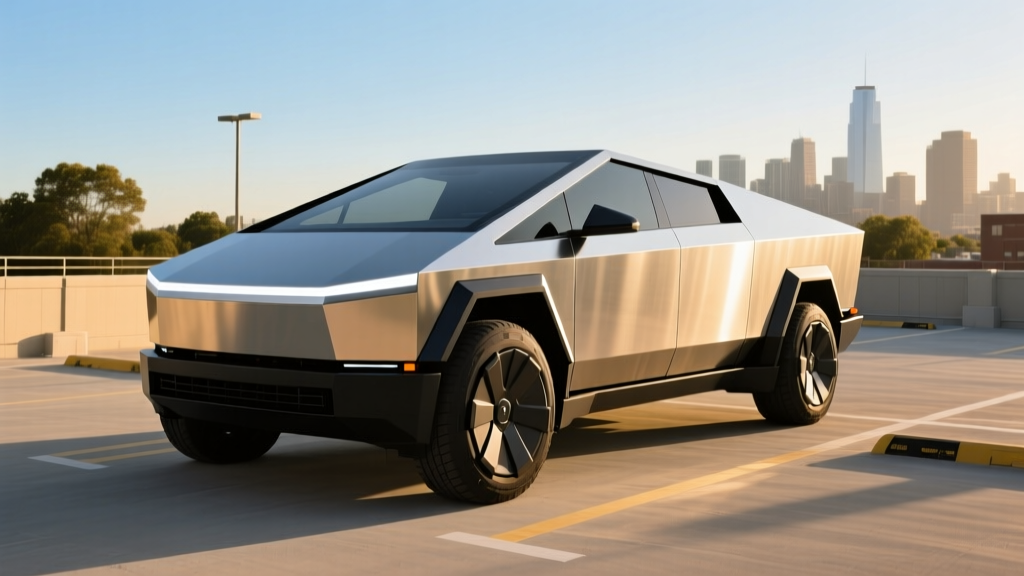
The Tesla Cybertruck design remains the most polarizing silhouette on American roads in 2026. Its cold-rolled stainless steel exoskeleton, angular geometry, and steer-by-wire architecture challenge every convention of the full-size pickup segment. But beyond the polarizing aesthetics, buyers need hard data: How far does it actually go on a charge? How fast does it recover range? Does the §30D federal tax credit apply? This review dissects the Cybertruck's engineering, ownership economics, and daily-driver practicality with the precision that spec-driven buyers demand.
Range, Efficiency, and Real-World Expectations
EPA range figures for the Cybertruck vary significantly by trim. The Dual Motor AWD achieves an EPA-estimated 340 miles, while the tri-motor Cyberbeast drops to 320 miles due to its higher output and weight. However, the stainless steel exoskeleton creates substantial aerodynamic drag, and real-world highway efficiency tells a different story than the sticker.
Real-World Range Reality Check
EPA Sticker: 340 mi (Dual Motor) / 320 mi (Cyberbeast)
Highway (70 mph, 75°F): Expect 270–290 mi — the slab-sided design and ~6,800 lb curb weight hammer efficiency at speed.
Cold Weather (30°F, highway): Plan for 210–240 mi. Tesla's heat pump helps, but LFP chemistry isn't used here — this is an NMC pack, which loses range in cold but charges faster when preconditioned.
Towing (5,000 lb trailer): Range drops to approximately 150–180 mi. Plan charging stops accordingly.
Efficiency on the Dual Motor AWD is rated at 56 MPGe combined, translating to roughly 56–60 kWh per 100 miles driven. For context, the Rivian R1T Dual Large is rated at 73 MPGe combined, and the Ford F-150 Lightning Extended Range hits 70 MPGe. The Cybertruck's design prioritizes durability and structural rigidity over aerodynamic efficiency, and the energy consumption reflects that trade-off.
Battery, Charging Speed, and Infrastructure
The Cybertruck uses an estimated 123 kWh usable battery pack with NMC (nickel manganese cobalt) chemistry. Tesla has not published exact cell-level specs, but teardown analysis and EPA application data confirm the NMC chemistry — chosen for its higher energy density, which is necessary given the truck's weight and drag profile.
The Cybertruck's 800-volt architecture is its charging ace. On a compatible DC fast charger (V4 Supercharger or 350 kW CCS station with NACS adapter), the truck peaks at approximately 350 kW. However, as with all EVs, peak rate is not sustained rate. The charge curve tapers significantly above 60% state of charge.
| Charge Level | Power / Rate | 10–80% Time | Miles Added per Hour |
|---|---|---|---|
| Level 1 (120V, 12A) | ~1.4 kW | N/A (days) | ~3 mi/hr |
| Level 2 (240V, 48A) | 11.5 kW | ~10.5 hours | ~25 mi/hr |
| Level 2 (240V, 80A) | 19.2 kW | ~6.5 hours | ~42 mi/hr |
| DC Fast (V4 Supercharger) | Peak 350 kW | ~15 minutes | N/A |
| DC Fast (150 kW station) | Peak 150 kW | ~32 minutes | N/A |
Charging curve insight: The Cybertruck sustains above 300 kW only between roughly 10–40% SoC. From 40–60%, it drops to ~200 kW, and from 60–80%, it tapers to ~100–120 kW. The published 15-minute 10–80% figure assumes a V4 Supercharger with active battery preconditioning. On a 150 kW Electrify America or EVgo station, expect closer to 32–35 minutes for the same window.
Home charging on a Tesla Wall Connector (48A circuit) delivers about 25 miles of range per hour of charging — sufficient for most daily commutes if you plug in overnight. An 80A circuit (requiring a 100A breaker and likely a panel upgrade) cuts full-charge time nearly in half but adds $500–$1,500 in electrical work depending on your home's service capacity.
Performance, Drivetrain, and Capability
The Cybertruck's performance numbers are supercar-adjacent, which is remarkable for a vehicle with an 11,000 lb towing rating. The tri-motor Cyberbeast produces 845 horsepower and rockets from 0–60 mph in 2.6 seconds (with rollout subtracted). The Dual Motor AWD delivers 600 horsepower and a 3.9-second 0–60 time.
| Specification | Dual Motor AWD | Cyberbeast (Tri-Motor) |
|---|---|---|
| Drivetrain | AWD (Dual Motor) | AWD (Tri-Motor) |
| Horsepower | 600 hp | 845 hp |
| 0–60 mph | 3.9 sec | 2.6 sec |
| EPA Range | 340 mi | 320 mi |
| Battery (usable) | ~123 kWh (NMC) | ~123 kWh (NMC) |
| Max DC Charge Rate | 350 kW peak | 350 kW peak |
| Towing Capacity | 11,000 lbs | 11,000 lbs |
| Payload Capacity | 2,500 lbs | 2,500 lbs |
| Bed Length | 6 ft (72 in) | 6 ft (72 in) |
| Cargo Volume (bed) | 67 cu ft | 67 cu ft |
The steer-by-wire system eliminates the mechanical connection between the steering wheel and the front wheels, enabling a variable ratio that requires less than one full lock for most maneuvers. Rear-wheel steering (up to 10 degrees) gives the Cybertruck a turning circle tighter than a Model S — a genuine engineering win for a truck this size.
Pricing, Tax Credits, and Total Cost
As of early 2026, the Cybertruck lineup has been streamlined after the discontinuation of the base RWD variant (originally announced at $60,990 but never produced in meaningful volume). The current lineup starts at $81,695 for the Dual Motor AWD, with the Cyberbeast at $101,690 — both figures including the $1,995 destination charge.
Cybertruck Pricing and Federal Tax Credit Eligibility
| Trim | Base MSRP | §30D Credit Eligible? | Effective Price (if eligible) |
|---|---|---|---|
| Dual Motor AWD | $81,695 | No (exceeds $80,000 truck MSRP cap) | $81,695 |
| Cyberbeast | $101,690 | No (exceeds $80,000 truck MSRP cap) | $101,690 |
Source: IRS §30D qualified vehicles list. The §30D credit caps truck MSRP at $80,000. Cybertruck trims exceed this threshold. Additionally, buyer income caps ($150K single / $300K joint AGI) and critical-mineral/battery-sourcing rules apply to eligible vehicles. Consult a tax professional for your specific situation.
Without the federal credit, the Cybertruck competes on spec rather than incentive-adjusted price. A fully optioned Rivian R1T Tri Motor Max (420 mi range, ~$100,000) and the Ford F-150 Lightning Platinum ($96,874, 320 mi range) are the direct competitors. The Lightning qualifies for the §30D credit at lower trims, narrowing the effective price gap substantially.
Interior, Technology, and Daily Practicality
The Cybertruck's cabin follows Tesla's minimalist ethos: an 18.5-inch center touchscreen handles nearly all vehicle functions, with a secondary 9.4-inch rear touchscreen for passengers. There are no physical buttons for climate, media, or glovebox release — everything routes through the UI. This will delight tech-forward buyers and frustrate those who prefer tactile controls.
Passenger space: Front legroom measures 41.2 inches; rear legroom is 38.4 inches — competitive with the F-150 Lightning but less generous than the Rivian R1T's rear seat. The 6-foot bed with a powered tonneau cover offers 67 cubic feet of cargo volume. A front trunk (frunk) adds lockable storage, though its volume is modest compared to the Lightning's massive front compartment.
Driver assistance: The Cybertruck ships with Tesla's Basic Autopilot (adaptive cruise, lane centering). Full Self-Driving (Supervised) is available as a $8,000 add-on or $99/month subscription. This is a SAE Level 2 system — the driver must remain attentive, hands on or near the wheel, and is legally responsible for all driving decisions. It is not autonomous driving.
Driver Assistance Clarification
Tesla's Autopilot and FSD (Supervised) are SAE Level 2 driver-assistance systems. They require continuous driver supervision. The vehicle does not drive itself. Only Level 4 services like Waymo operate without a human driver — and those are geofenced robotaxis, not consumer vehicles.
Standout features: The stainless steel body requires no paint (reducing repair costs for minor scratches but complicating dent repair). The 120V/240V bed outlets support up to 11.5 kW of vehicle-to-load (V2L) power — enough to run power tools at a job site or appliances during an outage. The armored glass, while improved from the infamous 2019 demo, still shows a tendency for star cracks from road debris.
Warranty, Reliability, and Ownership Considerations
Tesla covers the Cybertruck with a 4-year/50,000-mile basic warranty and an 8-year/120,000-mile battery and drive unit warranty. The battery warranty guarantees at least 70% capacity retention over the warranty period. For a truck likely to see heavy use, the 120,000-mile powertrain coverage is competitive with Rivian (8-yr/175,000-mi) but falls short of Ford's 8-year/100,000-mile battery warranty on the Lightning.
Insurance: Cybertruck insurance premiums run 25–40% higher than comparable F-150 Lightning policies, driven by the stainless steel body's repair complexity, high replacement part costs, and the vehicle's performance profile. Expect $2,800–$4,200 annually depending on your state, driving record, and coverage level.
Known issues (as of early 2026): Early-production Cybertrucks (2024–2025 build dates) saw recalls for accelerator pedal trim dislodgement, windshield wiper motor failures, and inverter faults. Tesla has issued over-the-air and service-center fixes, but buyers of used early-build units should verify recall completion via NHTSA's VIN lookup tool at nhtsa.gov/recalls.
Pros, Cons, and the Verdict
Pros
- 350 kW peak DC charging — among the fastest in the truck segment
- 845 hp Cyberbeast delivers supercar acceleration in a pickup
- Stainless steel exoskeleton eliminates paint costs and resists minor scratches
- 11.5 kW V2L capability for job-site and emergency power
- Rear-wheel steering gives a remarkably tight turning radius
- Access to Tesla's Supercharger network (17,000+ stations in North America)
Cons
- No §30D federal tax credit — all trims exceed the $80,000 truck MSRP cap
- Real-world highway range drops to 270–290 mi; towing cuts range nearly in half
- Insurance premiums 25–40% higher than comparable electric trucks
- Touchscreen-only controls frustrate users who prefer physical buttons
- Armored glass prone to star cracks from road debris
- 6-foot bed is shorter than competing full-size trucks (F-150 Lightning: 5.5 ft box but more usable width)
Who Should Buy the Cybertruck?
The Cybertruck design serves a specific buyer: someone who values performance, tech-forward engineering, and visual distinctiveness over tax-credit optimization and traditional truck ergonomics. If you need a daily-driver truck with job-site V2L capability, rapid DC charging for road trips, and acceleration that embarrasses sports cars, no other pickup matches this combination.
If your priorities are maximum real-world range, federal tax credit eligibility, or conventional truck controls, the Ford F-150 Lightning (Extended Range, §30D-eligible at lower trims) or Rivian R1T (superior rear-seat space, longer available range with Max pack) may serve you better.
Choose the Cybertruck If:
- You prioritize charging speed (350 kW peak) over absolute range
- You want tri-motor performance and steer-by-wire technology
- V2L power (11.5 kW) is essential for work or emergency use
- You accept higher insurance costs and no federal tax credit
Look Elsewhere If:
- Federal §30D credit eligibility is a dealbreaker for your budget
- You tow frequently and need 300+ miles of real-world range while loaded
- You prefer physical climate/media controls over touchscreen-only operation
Frequently Asked Questions
What is the real-world range of the Cybertruck?
The EPA rates the Dual Motor AWD at 340 miles and the Cyberbeast at 320 miles. In real-world highway driving at 70 mph, expect 270–290 miles. Cold weather (below freezing) reduces this to 210–240 miles. Towing a 5,000 lb trailer cuts range to roughly 150–180 miles.
How fast does the Cybertruck charge?
On a V4 Supercharger or equivalent 350 kW DC station, the Cybertruck charges from 10–80% in approximately 15 minutes, peaking at 350 kW. On a 150 kW public charger, plan for 32–35 minutes. Home Level 2 charging at 48A adds about 25 miles of range per hour.
Does the Cybertruck qualify for the federal EV tax credit?
No. Under IRS §30D rules, trucks must have an MSRP at or below $80,000 to qualify. The cheapest Cybertruck (Dual Motor AWD) starts at $81,695, exceeding the cap. Even if pricing were adjusted, buyer income limits ($300K joint / $150K single AGI) and battery critical-mineral sourcing requirements would apply. Always verify current eligibility on the IRS qualified vehicles page.
Is the Cybertruck worth buying vs. the Rivian R1T or F-150 Lightning?
It depends on your priorities. The Cybertruck wins on DC charging speed (350 kW vs. Rivian's ~220 kW and Lightning's ~150 kW peak), performance (Cyberbeast's 2.6-second 0–60), and V2L output (11.5 kW). The F-150 Lightning wins on §30D credit eligibility, lower insurance costs, and conventional truck ergonomics. The Rivian R1T wins on rear-seat comfort, available 420-mile Max pack range, and build-quality reputation. Cross-shop all three before committing.
What is the Cybertruck's battery warranty?
Tesla provides an 8-year/120,000-mile battery and drive unit warranty, guaranteeing at least 70% capacity retention during the coverage period. This is competitive but trails Rivian's 8-year/175,000-mile powertrain warranty.
Does the Cybertruck have a frunk?
Yes, the Cybertruck includes a front trunk (frunk) with lockable storage, though its volume is smaller than the F-150 Lightning's 14.1 cu ft frunk. The Cybertruck's frunk is best suited for charging cables and small bags rather than large cargo.
Is Tesla's FSD self-driving?
No. Tesla's Full Self-Driving (Supervised) is an SAE Level 2 driver-assistance system. It requires the driver to remain fully attentive and in control at all times. The system can navigate highways, change lanes, and handle some city streets, but it is not autonomous. Only Level 4 services like Waymo operate without a human driver.
Sources: EPA range and efficiency data via fueleconomy.gov; IRS §30D eligibility rules via irs.gov; NHTSA recall data via nhtsa.gov/recalls.