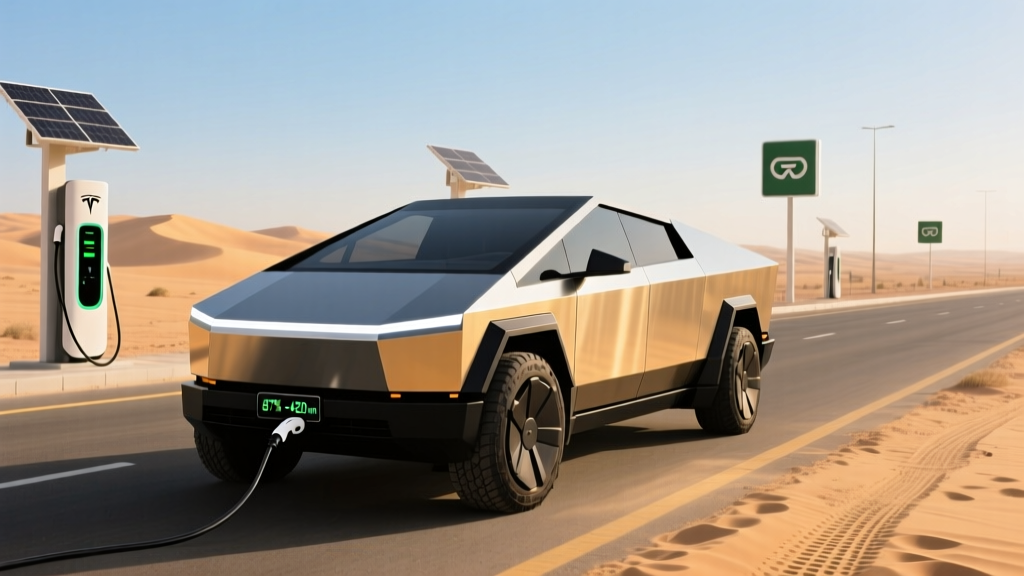
Searches for Cybertruck deliveries UAE have surged as Tesla expands exports of its stainless-steel pickup beyond North America. For buyers in the Emirates — and US shoppers cross-researching global availability — understanding the real-world specs, charging behavior, and ownership economics is essential before signing a purchase order or navigating a grey-market import.
This profile covers the current 2026 Tesla Cybertruck lineup (AWD and Cyberbeast trims), with precise EPA data, charging-curve realities, battery chemistry, and federal tax credit eligibility under IRS §30D. We also address the specific considerations for UAE deliveries, where climate, charging infrastructure, and import logistics reshape the ownership equation.
2026 Cybertruck Core Specs at a Glance
| Specification | AWD (Dual-Motor) | Cyberbeast (Tri-Motor) |
|---|---|---|
| EPA Range | 340 miles | 320 miles |
| Battery (usable, est.) | ~123 kWh, NMC | ~123 kWh, NMC |
| Peak DC Fast Charge | 250 kW (Supercharger V3) | 250 kW (Supercharger V3) |
| 10–80% DC Time | ~30 minutes | ~30 minutes |
| Level 2 Home Charge | 11.5 kW (~34 mi/hr) | 11.5 kW (~34 mi/hr) |
| 0–60 mph | 4.1 seconds | 2.6 seconds |
| Horsepower | 600 hp | 845 hp |
| Drivetrain | Dual-Motor AWD | Tri-Motor AWD |
| MPGe (combined) | 67 MPGe | 63 MPGe |
| Efficiency | 50 kWh/100 mi | 53 kWh/100 mi |
| Towing Capacity | 11,000 lbs | 11,000 lbs |
| Cargo Bed | 6.5 ft (68.4 cu ft) | 6.5 ft (68.4 cu ft) |
| Frunk Volume | 7.0 cu ft | 7.0 cu ft |
| Base MSRP | $81,895 | $101,895 |
| Battery/Drive Warranty | 8 yr / 120,000 mi | 8 yr / 120,000 mi |
Sources: EPA fueleconomy.gov, Tesla Cybertruck Design Page. Specs reflect 2026 model year. Efficiency figures based on EPA combined cycle.
Range Reality: EPA Sticker vs. Real-World Expectations
Real-World Highway (75 mph): Expect ~260–290 miles
Extreme Heat (110°F+, UAE summer): Expect ~240–270 miles with aggressive cabin cooling
Heavy Towing (8,000+ lbs): Expect ~140–170 miles
The Cybertruck's angular stainless-steel exoskeleton creates a high drag coefficient (~0.34 Cd) that penalizes highway efficiency more than smoother pickups like the Rivian R1T. At sustained 75 mph speeds, energy consumption climbs to roughly 55–60 kWh/100 mi, reducing effective range by 15–20% versus the EPA combined figure.
In UAE conditions — where ambient temperatures regularly exceed 115°F (46°C) — battery thermal management systems work continuously to keep the NMC pack within optimal temperature windows. This parasitic load, combined with aggressive air conditioning demands, can reduce range by an additional 8–12%. Cybertruck owners in Dubai and Abu Dhabi should plan for ~250 miles of practical range during summer months.
The EPA's fueleconomy.gov database lists the AWD trim at 67 MPGe combined (50 kWh/100 mi). For comparison, the Ford F-150 Lightning Extended Range achieves 70 MPGe combined with a slightly smaller battery — a reminder that the Cybertruck's mass (nearly 6,800 lbs curb weight) and aerodynamics work against efficiency.
Charging Speed: DC Fast Charge Curve and Home Level 2
| Charging Method | Power (kW) | Miles Added per Hour | Notes |
|---|---|---|---|
| Level 1 (120V / 12A) | 1.4 kW | ~3 mi/hr | Emergency/trickle only |
| Level 2 (240V / 48A) | 11.5 kW | ~34 mi/hr | Full charge in ~11 hours |
| DC Fast (Tesla V3 Supercharger) | Peak 250 kW | ~200 mi in 15 min | 10–80% in ~30 min |
| DC Fast (CCS adapter, 350 kW station) | Peak ~200 kW | ~170 mi in 15 min | Adapter required; speed limited by vehicle |
The Cybertruck's ~123 kWh battery (usable capacity; Tesla does not publish official kWh figures) accepts a peak 250 kW on Tesla's V3 Supercharger network. However, as with all large NMC packs, the charge curve tapers significantly above 50% state of charge. You will see 250 kW only briefly between roughly 10–30% SoC, after which the rate drops to ~175 kW through 50%, then progressively declines to ~80 kW by 80%.
This means the advertised 10–80% time of ~30 minutes is achievable under ideal conditions (battery preconditioned via navigation routing to a Supercharger, moderate ambient temperature). In extreme UAE heat, preconditioning works harder, and peak rates may be held for shorter durations to protect cell longevity. Plan for 35–40 minutes at a Supercharger during summer.
For home charging, the Cybertruck supports up to 11.5 kW on a 240V / 48-amp circuit (hardwired Tesla Wall Connector). This adds roughly 34 miles of range per hour, meaning a full 0–100% charge takes approximately 11 hours. Most owners charging overnight from 20% to 80% will replenish the battery in about 7 hours.
Important kW vs. kWh distinction: The battery stores ~123 kWh of energy (kilowatt-hours, like gallons in a tank). The charger delivers up to 250 kW of power (kilowatts, like gallons-per-minute flow rate). A 250 kW charger does not deliver 250 kWh in one hour — the battery's charge curve and physical capacity govern actual energy transferred.
UAE Delivery Logistics: What Buyers Need to Know
Tesla began limited Cybertruck exports to the Middle East in late 2025, with the UAE among the first markets outside North America to receive allocations. However, "Cybertruck deliveries UAE" does not mean the same seamless experience as ordering in the United States.
Key considerations for UAE buyers:
- Import pathway: Most UAE deliveries are handled through authorized grey-market importers or Tesla's direct export program. Delivery timelines of 4–8 months from order are common, compared to 2–4 months for US customers.
- Pricing premium: Expect to pay $15,000–$30,000 above US MSRP once shipping, import duties, dealer markups, and UAE VAT (5%) are factored in. A Cyberbeast that stickers at $101,895 in the US can land in Dubai at $125,000–$135,000+.
- Charging connector: UAE-spec Cybertrucks are expected to ship with the CCS2/NACS combination inlet compatible with Tesla's global Supercharger network and regional CCS infrastructure. Confirm the exact connector with your delivery partner before purchase.
- Service infrastructure: Tesla operates service centers in Dubai and Abu Dhabi, but Cybertruck-specific parts availability (stainless panels, steer-by-wire components, 48V architecture) may involve longer wait times than Model 3/Y service.
- Warranty coverage: Tesla's 8-year/120,000-mile battery and drive unit warranty generally transfers internationally, but confirm that UAE deliveries through non-direct channels do not void coverage. Always verify with Tesla's regional support.
- Climate preparation: The Cybertruck's heat pump and battery thermal management system are capable, but UAE owners should install Level 2 home charging in a shaded or climate-controlled garage to prevent extreme heat soak during charging, which accelerates NMC degradation over time.
Performance and Drivetrain: Tri-Motor Cyberbeast vs. Dual-Motor AWD
The Cybertruck uses Tesla's 48-volt electrical architecture — a first for a production vehicle — which reduces wiring harness weight and enables the steer-by-wire system and four-wheel steer (rear wheels turn up to 10 degrees for a remarkably tight 34.5-foot turning circle despite the truck's 223.7-inch length).
AWD (Dual-Motor): 600 horsepower, 0–60 mph in 4.1 seconds. This is the volume trim and offers the best range (340 miles EPA). It is more than adequate for daily driving, highway merging, and moderate towing.
Cyberbeast (Tri-Motor): 845 horsepower, 0–60 mph in 2.6 seconds — supercar acceleration in a 6,800-pound pickup. The tri-motor setup adds a rear-axle dual-motor assembly that enables torque vectoring and the "crab walk" diagonal-drive feature. Range drops to 320 miles EPA due to the additional motor mass and higher energy draw.
Both trims include adaptive air suspension with up to 16 inches of ground clearance (in Extract mode) and a 11,000-pound towing rating. Payload capacity is 2,500 pounds. The powered tonneau cover on the 6.5-foot bed is rated to support 300 pounds of distributed weight.
Interior, Tech, and Driver Assistance
The Cybertruck cabin is minimalist by design — an 18.5-inch center touchscreen handles virtually all vehicle functions, climate, and media. A rear 9.4-inch touchscreen serves second-row passengers. There is no traditional instrument cluster; speed and drive info are projected on the main display's left quadrant.
Notable tech features:
- Steer-by-Wire: No mechanical connection between yoke and wheels. Variable ratio means ~340 degrees lock-to-lock at low speed (no hand-over-hand) and ~180 degrees at highway speed. Takes adaptation but works precisely.
- Rear-Wheel Steering: Up to 10 degrees of counter-steer at low speed dramatically improves maneuverability.
- Powershare: V2L (vehicle-to-load) capability — 120V and 240V outlets in the bed and cabin can deliver up to 11.5 kW of continuous power, enough to run power tools, a campsite, or essential home circuits during an outage.
- Autopilot / FSD (Supervised): Standard Autopilot includes adaptive cruise and lane-keep. Full Self-Driving (Supervised) is a $8,000 option (or $99/month) adding automated lane changes, intersection handling, and parking.
Tesla Autopilot and FSD (Supervised) are driver-assistance systems, not autonomous driving. The driver must remain fully engaged, hands on the yoke (or torque-verified via steering input), and eyes on the road at all times. This is SAE Level 2 — comparable to Ford BlueCruise or GM Super Cruise in capability tier, though implementation differs. Only Level 4 systems (like Waymo's robotaxi) operate without a human driver.
Drawbacks to note:
- Visibility is compromised by the angular design — the rear view is obstructed by the bed walls, and the camera-based digital rearview mirror is mandatory for any practical rearward sight.
- The yoke steering is polarizing; some drivers find it impractical for low-speed parking maneuvers despite the steer-by-wire variable ratio.
- Cabin materials are durable but austere — hard plastics and vegan leather throughout, with limited storage cubbies compared to competitors like the Rivian R1T or F-150 Lightning.
- The stainless-steel body is fingerprint-prone and difficult to repair. Minor dents require panel replacement rather than traditional bodywork.
Pricing, Trims, and Federal Tax Credit Eligibility
| Trim | Base MSRP | As-Tested (with FSD, typical) | §30D Credit Eligible? |
|---|---|---|---|
| AWD (Dual-Motor) | $81,895 | ~$89,895 | No — exceeds $80,000 MSRP cap for trucks |
| Cyberbeast (Tri-Motor) | $101,895 | ~$109,895 | No — exceeds $80,000 MSRP cap for trucks |
Critical tax credit note: Under IRS §30D rules current for 2026, new electric pickup trucks must have an MSRP at or below $80,000 to qualify for the up-to-$7,500 federal tax credit. The Cybertruck AWD starts at $81,895 — above the cap. Neither trim qualifies for the new-vehicle credit, regardless of buyer income or battery sourcing.
Additional §30D restrictions that would apply even if the price cap were met:
- Buyer income caps: Modified AGI must not exceed $150,000 (single), $225,000 (head of household), or $300,000 (joint filing).
- Battery sourcing: Critical minerals and battery components must meet escalating domestic-content thresholds. As of 2026, a significant percentage must be sourced from the US or free-trade-agreement partners, with zero content from "foreign entities of concern" (primarily Chinese supply chain).
- Point-of-sale transfer: Eligible buyers can transfer the credit to the dealer at purchase for an immediate price reduction — but only if the vehicle itself qualifies.
For UAE buyers, the US federal tax credit is irrelevant — no §30D credit applies to vehicles delivered outside the United States. UAE pricing is determined by the importer, shipping costs, duties, and local market demand.
Who Should Buy the Cybertruck (and Who Shouldn't)
- You need a full-size electric pickup with 340 miles of range and 11,000-lb towing
- You value the stainless-steel design and 48V architecture as a long-term ownership proposition
- You have reliable home Level 2 charging and access to Tesla Superchargers for road trips
- You are in the US and can absorb the $81,895+ price without relying on the §30D credit
- Performance is a priority — 2.6-second 0–60 in a pickup is unmatched
- You want torque vectoring and crab-walk capability for off-road or tight-site maneuvering
- Budget is not a primary constraint ($101,895+)
- You need the federal tax credit — the Rivian R1T Dual-Motor (starting ~$75,000) or Ford F-150 Lightning Pro (~$55,000) may qualify depending on trim and sourcing
- You prioritize proven long-term reliability data — the Cybertruck's 48V architecture, steer-by-wire, and stainless body are new and unproven at scale
- You live in a region with limited Tesla service infrastructure (parts delays are a real concern)
Biggest Pros and Cons
- 340-mile EPA range (AWD) — among the longest of any electric pickup
- 250 kW DC fast charging with extensive Tesla Supercharger network
- 11,000-lb towing + 2,500-lb payload with air suspension leveling
- Steer-by-wire + rear steering = remarkably tight turning circle
- 11.5 kW Powershare V2L for job-site or emergency home power
- Stainless-steel body is dent- and corrosion-resistant (in theory)
- 8-year / 120,000-mile battery and drive unit warranty
- Does NOT qualify for $7,500 federal tax credit (above $80K MSRP cap)
- Real-world highway range drops to ~260–290 mi; less when towing
- Stainless body is difficult and expensive to repair after collision damage
- Yoke steering and lack of physical controls polarize drivers
- Rear visibility is poor; fully dependent on camera-based digital mirror
- UAE deliveries carry $15K–$30K price premium and longer wait times
- Insurance premiums are high — early data suggests $250–$400/month for many owners
Competitive Comparison: Cybertruck vs. R1T vs. F-150 Lightning
| Attribute | Tesla Cybertruck AWD | Rivian R1T Dual-Motor (Max Pack) | Ford F-150 Lightning Ext. Range |
|---|---|---|---|
| EPA Range | 340 mi | ~410 mi | ~320 mi |
| Base MSRP | $81,895 | ~$87,000 | ~$65,000 |
| §30D Credit Eligible | No (over cap) | Possible (trim-dependent) | Yes (select trims) |
| Peak DC Charge | 250 kW | ~220 kW | ~150 kW |
| 0–60 mph | 4.1 sec | ~4.5 sec | ~4.5 sec |
| Towing | 11,000 lbs | 11,000 lbs | 10,000 lbs |
| Bed Length | 6.5 ft | 4.5 ft (+ Gear Tunnel) | 5.5 ft |
The Rivian R1T Max Pack offers the most range but at a higher price. The F-150 Lightning is the value leader and qualifies for the tax credit on eligible trims, but charges slower and offers less range. The Cybertruck occupies a middle ground: strong charging speed and range, but no tax credit and higher repair-cost risk.
Frequently Asked Questions
What is the real-world range of the Cybertruck?
The EPA estimates 340 miles for the AWD and 320 miles for the Cyberbeast. In real-world highway driving at 75 mph, expect 260–290 miles. In extreme UAE heat (110°F+), plan for 240–270 miles due to battery thermal management and AC loads. When towing above 8,000 lbs, range drops to approximately 140–170 miles.
How fast does the Cybertruck charge?
On a Tesla V3 Supercharger, the Cybertruck peaks at 250 kW and charges from 10–80% in approximately 30 minutes under ideal conditions. In extreme heat, expect 35–40 minutes. At home on a 240V / 48-amp Level 2 charger (11.5 kW), it adds about 34 miles of range per hour, with a full charge taking roughly 11 hours.
How much does the Cybertruck cost after tax credits?
The Cybertruck does NOT qualify for the §30D federal tax credit because both trims exceed the $80,000 MSRP cap for pickup trucks. You will pay full MSRP: $81,895 for the AWD and $101,895 for the Cyberbeast, plus destination fees, any FSD option, and state/local taxes. UAE buyers face an additional $15,000–$30,000 in import costs and markups.
Does the Cybertruck qualify for the federal EV tax credit?
No. Under current IRS §30D rules, the Cybertruck's MSRP ($81,895–$101,895) exceeds the $80,000 cap for trucks, vans, and SUVs. Even if priced below the cap, buyers would still need to meet income limits and battery-sourcing requirements. Consult a tax professional for your specific situation.
Is the Cybertruck worth buying vs. the Rivian R1T or F-150 Lightning?
It depends on priorities. If you want the best combination of charging speed (250 kW), range (340 mi), and unique technology (steer-by-wire, V2L Powershare), the Cybertruck AWD is compelling. If tax credit eligibility matters, the F-150 Lightning on qualifying trims (~$57,500 after credit) offers dramatically lower net cost. If maximum range is your goal, the Rivian R1T Max Pack (~410 mi EPA) leads the segment.
What is the Cybertruck's battery chemistry?
Tesla uses NMC (nickel-manganese-cobalt) chemistry in the Cybertruck's ~123 kWh pack. NMC offers higher energy density than LFP (lithium iron phosphate), which is necessary for a large, heavy pickup. However, NMC is more sensitive to sustained high-temperature operation and benefits from avoiding prolonged 100% state-of-charge holds. For daily use, charge to 80–90% and only charge to 100% before long trips.
How long will the Cybertruck battery last?
Tesla warranties the battery and drive unit for 8 years or 120,000 miles, whichever comes first, with a minimum 70% capacity retention threshold. Based on Tesla's historical NMC pack data from Model S/X, most owners see 10–15% degradation in the first 100,000 miles. With proper care (avoiding frequent 100% charges, minimizing DC fast charging in extreme heat), the pack should retain usable capacity well beyond 200,000 miles. A full battery replacement, if ever needed, is estimated at $20,000–$30,000+ out of warranty.
Can I charge the Cybertruck at home in the UAE?
Yes, provided you install a 240V Level 2 charger (Tesla Wall Connector or compatible unit) on a dedicated 60-amp circuit. UAE residential electrical systems typically support this, but a licensed electrician should verify your panel capacity. Expect installation costs of AED 3,000–7,000 (~$800–$1,900) depending on wiring run length and panel upgrades. Always charge in a shaded or ventilated garage to minimize heat-related degradation.
Verdict: The Cybertruck in 2026
The Tesla Cybertruck remains one of the most technically ambitious electric vehicles on the road. Its 48V architecture, steer-by-wire system, stainless-steel exoskeleton, and 250 kW charging capability represent genuine engineering differentiation. For UAE buyers specifically, the growing Supercharger network in the Emirates and the truck's robust thermal management system make it a viable — if expensive — proposition.
But the math is unforgiving: no federal tax credit, real-world range well below the EPA sticker under highway and hot-climate conditions, high insurance costs, and unproven long-term repair economics for the stainless body and steer-by-wire components. Buyers who can absorb these trade-offs and prioritize the Cybertruck's unique capabilities will find it rewarding. Everyone else should test-drive the R1T and F-150 Lightning before committing.
Always verify current pricing, tax credit eligibility, and delivery timelines directly with Tesla's official Cybertruck page and, for US tax questions, the IRS §30D guidance. Rules and specs are subject to change.