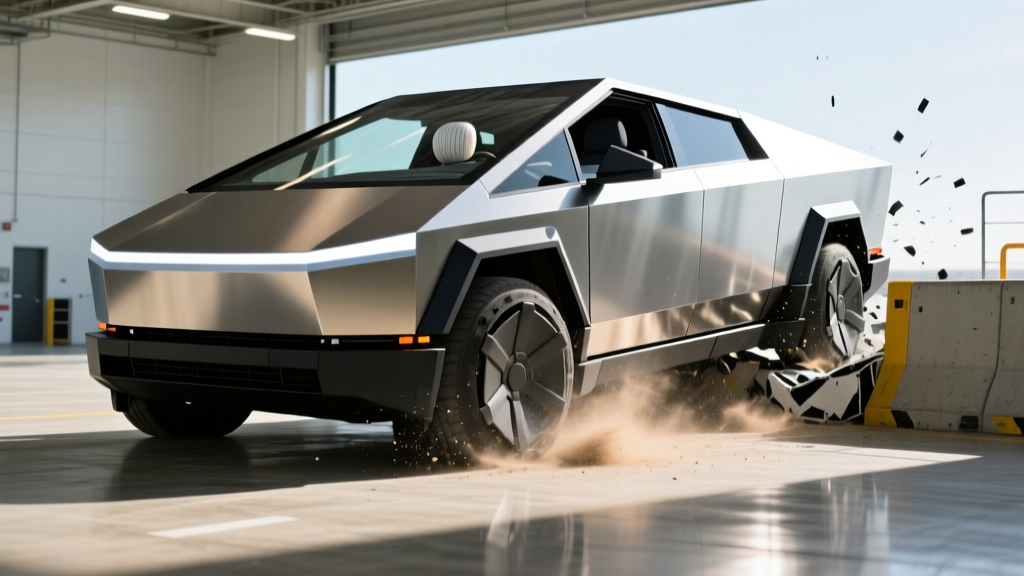
The Tesla Cybertruck's angular stainless-steel exoskeleton looks like it was built to survive an apocalypse. But angular design and thick steel don't automatically translate to top crash-test scores — and for a vehicle this heavy (nearly 7,000 lbs curb weight), crash dynamics are uniquely complex. If you've been searching for Cybertruck crash test data before committing to a purchase, you've likely noticed a frustrating gap: as of early 2026, neither the National Highway Traffic Safety Administration (NHTSA) nor the Insurance Institute for Highway Safety (IIHS) has published a full crash-test battery for the Cybertruck.
That absence of official ratings doesn't mean the truck is unsafe — but it does mean buyers are relying on Tesla's internal testing claims, structural engineering logic, and the physics of a 6,800+ lb electric pickup. This review covers everything we know about Cybertruck safety, alongside the complete ownership picture: real-world range, charging speed, pricing after tax credits, and how it stacks up against the Ford F-150 Lightning and Rivian R1T.
Crash Test Status: What NHTSA and IIHS Have (and Haven't) Tested
As of the 2025–2026 model year, the Cybertruck has not received an official NHTSA star rating or an IIHS Top Safety Pick evaluation. NHTSA has not published frontal, side, or rollover crash results for the Cybertruck on its public database. IIHS similarly has no test results listed.
Why the delay? Several factors are at play:
- Low production volume: Cybertruck deliveries only began in late 2023, and production ramped slowly through 2024–2025. Testing agencies prioritize high-volume vehicles.
- Unique structure: The ultra-hard 30X cold-rolled stainless-steel exoskeleton and unconventional geometry don't fit neatly into legacy crash-test fixtures designed around conventional body-on-frame or unibody pickups.
- Weight class considerations: At a GVWR that pushes the upper boundary of light-duty, some test protocols require special accommodation for vehicles this heavy.
Structural Safety Engineering: What the Exoskeleton Actually Does
The Cybertruck's safety proposition rests on three pillars that differ from conventional pickups:
1. Ultra-hard stainless-steel skin. The 30X cold-rolled stainless-steel panels are up to 3mm thick — far thicker than the 0.7–1.0mm mild steel used in most vehicle body panels. In low-speed impacts, this resists denting and deformation. In high-speed crashes, however, crumple zones (not rigid panels) are what protect occupants by absorbing kinetic energy. Tesla has engineered dedicated front and rear crumple zones behind the exoskeleton to manage this.
2. Structural battery pack. Like the Model Y, the Cybertruck uses a structural battery pack where the cells themselves form part of the vehicle's floor rigidity. This lowers the center of gravity dramatically (reducing rollover risk) and creates an extremely stiff passenger cell floor — a proven advantage in side-impact and offset-frontal crashes for Tesla's other vehicles.
3. Mass advantage (and disadvantage). At roughly 6,800–7,000 lbs depending on trim, the Cybertruck carries a significant momentum advantage in multi-vehicle collisions — physics favors the heavier vehicle. However, that same mass increases stopping distances, puts more stress on tires and brakes, and raises the risk to other vehicles and pedestrians in a collision. The IIHS has increasingly flagged the safety risks that very heavy EVs pose to others on the road.
Active Safety and Driver-Assist Systems
The Cybertruck ships with Tesla's latest Hardware 4 (HW4) sensor suite, including higher-resolution cameras and improved neural-net processing. Standard features include:
- Automatic Emergency Braking (AEB) with pedestrian detection
- Forward Collision Warning
- Lane Departure Warning and Lane Keeping Assist
- Blind Spot Monitoring (camera-based, displayed on the central screen)
- Rear Cross-Traffic Alert
- Adaptive Cruise Control
Autopilot and Full Self-Driving (Supervised) are available as upgrades. To be clear: these are SAE Level 2 driver-assist systems. The driver must remain fully engaged, with hands on the steering wheel and eyes on the road at all times. FSD (Supervised) can navigate intersections, change lanes, and follow navigation routes, but it does not make the Cybertruck self-driving. Only Level 4 services like Waymo operate without a human driver — and those are robotaxis, not consumer vehicles.
Full Specifications: Range, Battery, Charging, and Performance
| Spec | AWD (Dual Motor) | Cyberbeast (Tri-Motor) |
|---|---|---|
| EPA Range | 340 miles | 320 miles |
| Real-World Range (highway, 70 mph) | ~270–290 miles | ~255–275 miles |
| Real-World Range (cold weather, 20°F) | ~220–250 miles | ~210–240 miles |
| Battery Capacity (usable) | ~123 kWh | ~123 kWh |
| Battery Chemistry | NMC (Nickel Manganese Cobalt) | NMC |
| Max DC Fast Charge | 250 kW | 250 kW |
| 10–80% DC Fast Charge Time | ~30 minutes | ~30 minutes |
| Level 2 Home Charging | 11.5 kW (~37 mi/hr) | 11.5 kW (~37 mi/hr) |
| Charge Port / Connector | NACS (native Tesla) | NACS (native Tesla) |
| 0–60 mph | 3.9 seconds | 2.6 seconds |
| Horsepower | 600 hp | 845 hp |
| Drivetrain | Dual Motor AWD | Tri-Motor AWD |
| Efficiency (MPGe) | ~67 MPGe combined | ~62 MPGe combined |
| Efficiency (kWh/100 mi) | ~50 kWh/100 mi | ~54 kWh/100 mi |
| Towing Capacity | 11,000 lbs | 11,000 lbs |
| Payload | 2,500 lbs | 2,500 lbs |
| Battery Warranty | 8 years / 120,000 miles | 8 years / 120,000 miles |
| Vehicle Warranty | 4 years / 50,000 miles | 4 years / 50,000 miles |
Charging Speed: DC Fast Charging and Home Setup
The Cybertruck supports the native NACS (North American Charging Standard) connector — the same plug used across Tesla's Supercharger network. This gives it access to the most reliable and expansive DC fast-charging network in the US without adapters.
| Charging Level | Power | Miles Added per Hour | Notes |
|---|---|---|---|
| Level 1 (120V outlet) | ~1.4 kW | ~3–4 mi/hr | Emergency/trickle only; a full charge takes days |
| Level 2 (240V, 48A) | 11.5 kW | ~37 mi/hr | Full charge in ~11 hours; ideal overnight setup |
| DC Fast (V3 Supercharger) | 250 kW peak | ~200+ mi in 15 min | 10–80% in ~30 min; tapers significantly above 80% |
| DC Fast (V4 Supercharger) | 250 kW (current truck limit) | Same as V3 | Cybertruck doesn't yet support V4's higher rates |
Charging curve reality: The 250 kW peak only holds from roughly 10–30% State of Charge. After 50%, the rate drops to ~150 kW, and above 80% it falls sharply to under 50 kW. This is normal lithium-ion behavior — charging speed is not linear. If you're road-tripping, plan stops around the 15–80% window for the fastest sessions.
Home charging note: A full Level 2 install (Tesla Wall Connector, 60A circuit, 240V) typically costs $800–$2,000 including equipment and electrician labor, depending on your panel capacity and run distance. The Cybertruck's 123 kWh battery means you'll want the full 48A/11.5 kW rate — a 32A charger would add only ~25 mi/hr and take 16+ hours for a full charge.
Pricing, Trims, and Federal Tax Credit Eligibility
| Trim | Base MSRP | Est. After §30D Credit | Credit Eligible? |
|---|---|---|---|
| Rear-Wheel Drive (RWD) | ~$60,990 | ~$53,490 | Yes — if MSRP cap, income, and sourcing rules are met (expected 2026 availability) |
| AWD (Dual Motor) | $79,990 | $72,490 | Yes — under $80,000 truck MSRP cap |
| Cyberbeast (Tri-Motor) | $99,990 | $99,990 | No — exceeds $80,000 MSRP cap for trucks under IRS §30D |
Federal tax credit rules (§30D) for 2025–2026: The Cybertruck AWD qualifies in principle because its MSRP is under the $80,000 cap for pickup trucks. However, eligibility depends on three additional hurdles per IRS guidelines:
- Buyer income cap: Modified AGI must not exceed $150,000 (single), $225,000 (head of household), or $300,000 (joint).
- Battery component sourcing: A percentage of battery components must be manufactured or assembled in North America, and critical minerals must meet sourcing thresholds. These thresholds increase each year, and eligibility can shift mid-year.
- Point-of-sale transfer: As of 2024+, you can transfer the credit to the dealer at purchase, reducing your out-of-pocket cost immediately — rather than waiting to claim it on your tax return.
The Cyberbeast at $99,990 is categorically ineligible for the federal credit due to the MSRP cap. The upcoming RWD trim, expected in 2026 at ~$60,990, would qualify if sourcing requirements are met at the time of purchase. Always verify current eligibility on the IRS website or with a tax professional before relying on the credit in your budget.
Cargo, Passenger Space, and Practicality
The Cybertruck is a full-size pickup, but its unconventional shape creates some surprises in the cargo and cabin dimensions:
- Bed length: 6 feet (72 inches) — shorter than the F-150 Lightning's 5.5-foot box but compensated by the vault design
- Bed volume: ~67 cu ft with the tonneau cover closed
- Frunk (front trunk): ~7.1 cu ft — useful for charging cables and groceries
- Seating: 5 passengers (2+3 bench rear); rear legroom is ~38 inches — adequate but tighter than the F-150 Lightning
- Tonneau cover: Power-retractable, lockable, and rated to support 300 lbs of distributed weight — a genuine differentiator for security
The angular roofline cuts into rear headroom for taller passengers, and the rear seat cushion is relatively flat, reducing under-thigh support on long trips. For families with kids in car seats, the width works; for three adults across the rear bench, it's snug.
Who Should Buy the Cybertruck (and Who Shouldn't)
✅ Choose the Cybertruck if:
- You want a distinctive, conversation-starting EV pickup with genuine utility (11,000-lb towing, 2,500-lb payload)
- You rely on the Tesla Supercharger network for road trips and want native NACS without adapters
- You prioritize acceleration and performance (2.6-second 0–60 on Cyberbeast is supercar territory)
- You value the lockable, power-retractable tonneau and integrated bed power (V2L capability for tools and camping)
❌ Skip the Cybertruck if:
- Crash-test ratings are a dealbreaker — you'll be buying without NHTSA/IIHS validation
- You need maximum rear-seat comfort for adults (F-150 Lightning is roomier)
- You want a proven, high-volume platform with established service infrastructure
- You're budget-sensitive — even the AWD trim is ~$80K before options, and insurance premiums run 20–40% higher than comparable pickups
Cybertruck vs. Ford F-150 Lightning vs. Rivian R1T
| Spec | Tesla Cybertruck AWD | Ford F-150 Lightning (Ext. Range) | Rivian R1T (Dual-Motor Max) |
|---|---|---|---|
| EPA Range | 340 mi | 320 mi | 352 mi |
| 0–60 mph | 3.9 sec | 3.8 sec | 3.5 sec |
| Max DC Charge | 250 kW | 150 kW | 200+ kW |
| 10–80% Charge | ~30 min | ~41 min | ~35 min |
| Towing | 11,000 lbs | 10,000 lbs | 11,000 lbs |
| Starting MSRP | $79,990 | ~$69,995 | ~$79,900 |
| NHTSA Crash Rating | Not yet rated | 5-Star Overall | IIHS Top Safety Pick+ |
| §30D Credit Eligible | Yes (AWD) | Varies by trim/battery | Yes (most trims) |
✅ Pros
- Fastest DC charging in the electric pickup segment (250 kW)
- Native NACS/Supercharger access — best road-trip charging network
- Structural battery pack + steel exoskeleton = potentially excellent crash performance
- Lockable power tonneau and V2L bed power
- Cyberbeast performance is absurd (2.6s 0–60)
❌ Cons
- No official NHTSA or IIHS crash-test rating yet
- Efficiency is poor (~50 kWh/100 mi) due to weight and aero
- Rear seat comfort lags behind F-150 Lightning
- Cyberbeast ineligible for federal tax credit (MSRP cap)
- Insurance costs significantly higher than competitors
- Camera-only ADAS lacks radar/lidar redundancy
Frequently Asked Questions
Has the Cybertruck been crash tested by NHTSA or IIHS?
Not yet, as of early 2026. Neither NHTSA nor IIHS has published official crash-test results for the Cybertruck. Tesla claims it was engineered to exceed 5-star criteria, but independent validation is still pending. We recommend checking NHTSA's database periodically for updates.
What is the real-world range of the Cybertruck?
The EPA rates the AWD at 340 miles and the Cyberbeast at 320 miles. In real-world highway driving at 70 mph, expect ~270–290 miles (AWD). In cold weather (20°F), plan for 220–250 miles. Towing at max capacity drops range to roughly 150 miles or less.
How fast does the Cybertruck charge?
At a V3 Supercharger, the Cybertruck peaks at 250 kW and charges from 10–80% in approximately 30 minutes. At home on a Level 2 (11.5 kW / 48A) charger, it adds about 37 miles per hour, taking roughly 11 hours for a full charge from empty.
Does the Cybertruck qualify for the $7,500 federal EV tax credit?
The AWD trim ($79,990 MSRP) qualifies in principle — it's under the $80,000 truck cap. But you must also meet IRS income limits ($150K single / $300K joint), and the battery must meet evolving critical-mineral and component-sourcing thresholds. The Cyberbeast ($99,990) is categorically ineligible due to the MSRP cap. Always verify on irs.gov before purchasing.
Is the Cybertruck worth buying over the F-150 Lightning or Rivian R1T?
If crash-test ratings are your top priority, the F-150 Lightning (5-star NHTSA) and Rivian R1T (IIHS Top Safety Pick+) have verified safety data that the Cybertruck lacks today. If you prioritize charging speed, Supercharger network access, and distinctive design — and you're comfortable buying without third-party crash validation — the Cybertruck's 250 kW charging and 340-mile range make a compelling case. Test-drive all three before deciding.
Is the Cybertruck safe for pedestrians?
This is an area of legitimate concern. The Cybertruck's blunt, angular front-end design and high leading edge present a larger impact surface to pedestrians compared to sloped hoods on conventional vehicles. The IIHS has increasingly weighed pedestrian safety in its ratings, and the Cybertruck's geometry may score poorly in this category when tested. NHTSA does not currently include pedestrian safety in its star ratings.
What is the Cybertruck's battery warranty?
Tesla covers the Cybertruck's battery and drive unit for 8 years or 120,000 miles (whichever comes first), with a minimum 70% capacity retention guarantee. The limited vehicle warranty is 4 years / 50,000 miles.
Sources: NHTSA Ratings Database, IIHS, IRS §30D Clean Vehicle Credits, Tesla Cybertruck Specifications, fueleconomy.gov.